Concept of Crypto Exchange
Driven by the wave of digitalization, the cryptocurrency market has been experiencing rapid growth. Since the birth of Bitcoin in 2009, the number of cryptocurrencies has steadily increased, and the market has continued to expand. According to relevant data, as of early 2025, the total global cryptocurrency market capitalization has surpassed $3 trillion, with the number of participants in crypto trading rising year by year. In this emerging financial sector, cryptocurrency exchanges serve as a crucial bridge connecting investors to the world of digital assets. They not only provide an essential platform for cryptocurrency transactions but also significantly contribute to the prosperity and development of the entire crypto ecosystem.

Image Source:https://www.coingecko.com/
A cryptocurrency exchange is essentially an online platform that allows users to buy and sell various cryptocurrencies, such as the well-known Bitcoin and Ethereum. It functions similarly to a traditional stock exchange, except that instead of trading stocks or bonds, users trade digital cryptocurrencies. The core function of a crypto exchange is to provide a marketplace where buyers and sellers can exchange digital assets. Additionally, the exchange plays a vital role in matching buy and sell orders to facilitate transactions.
For example, if an investor wants to purchase Bitcoin, they can check the current market price on the exchange and place a buy order. The exchange, using its matching algorithm, identifies a suitable seller from the available listings and executes the trade. Throughout this process, the exchange serves as an aggregator of market information, a price discovery mechanism, and a trade-matching facilitator.
A common type of order is the limit order, where an investor sets a specific price at which they wish to buy Bitcoin. When a seller’s asking price matches the buyer’s specified price, the trade is executed.
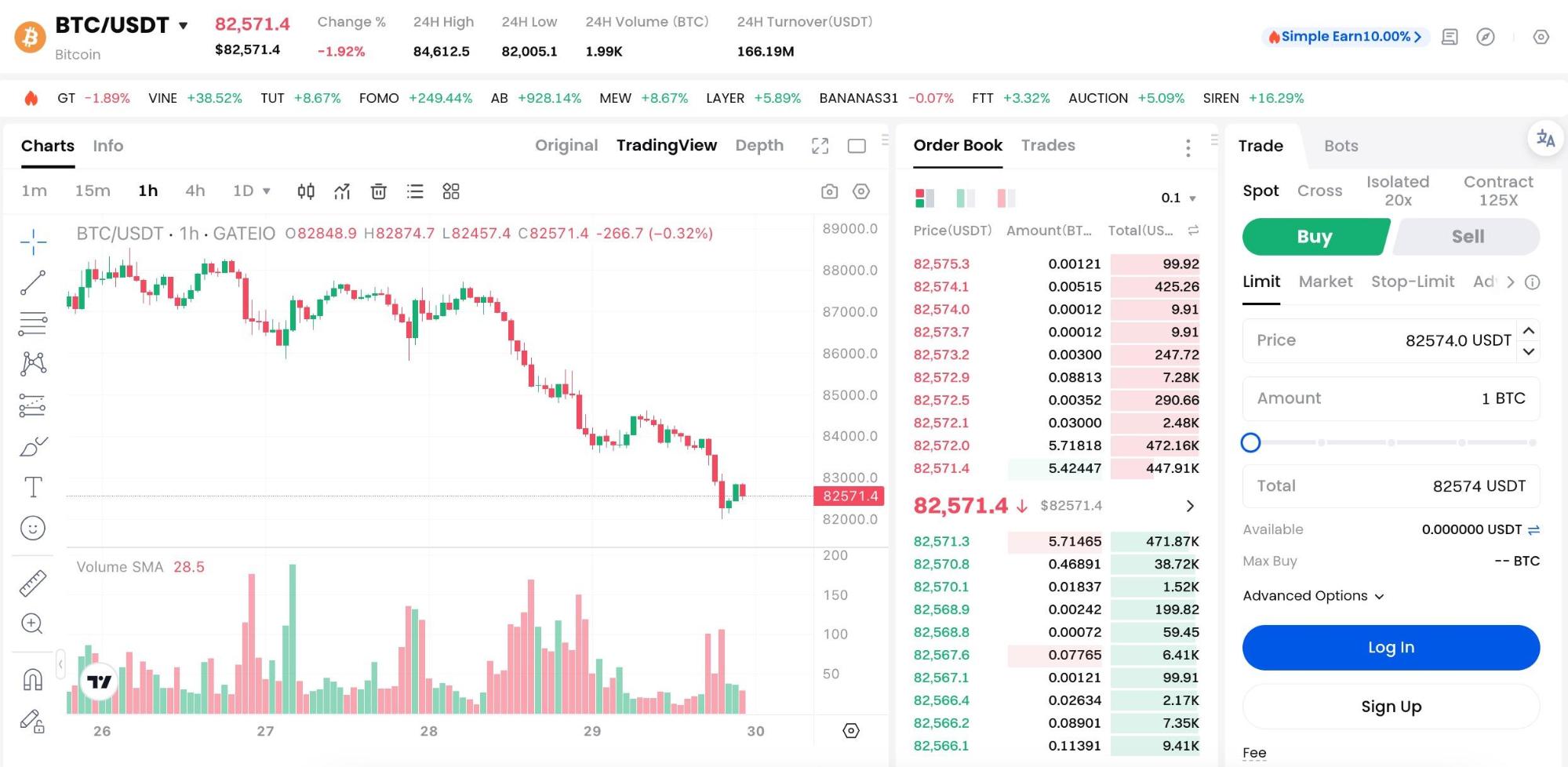
Image Source:https://www.Gate.com/trade/BTC_USDT
Classification of Crypto Exchanges
From a trading model perspective, cryptocurrency exchanges can be categorized into two main types: centralized exchanges (CEX) and decentralized exchanges (DEX).
(1) Centralized Exchange (CDX)
Centralized exchanges are currently the most common type in the market. These exchanges, like traditional financial institutions, have a central management entity. They will rigorously verify the identity of users, usually requiring users to provide identification, bank card information, etc., to ensure the compliance of transactions through the KYC (Know Your Customer) process. During the trading process, users need to deposit their crypto assets into the exchange’s account, and the trading is matched through the exchange’s servers.

Image source:https://www.coingecko.com/en/exchanges
Like the globally renowned exchange Binance, it is a typical centralized exchange. Binance was established in 2017 and has developed rapidly. As of 2024, Binance provides trading services for more than 500 types of crypto assets, covering options, spot trading, coin-margined contracts, and other various trading products. Its trading system has outstanding performance, capable of processing approximately 1.4 million orders per second, with a very large trading volume. When trading on Binance, users can enjoy a convenient trading experience. The platform provides a wide range of trading pairs, allowing users to quickly exchange one crypto asset for another, or purchase crypto assets with fiat currency. For example, users can easily exchange US dollars for Bitcoin, or exchange Ethereum for Litecoin.
The well-known Gate.com is also a typical centralized exchange. Gate.com was established in 2013 and is one of the oldest crypto asset trading platforms globally. It provides users with trading services for over 1000 types of crypto assets, covering various types of trading such as spot trading, margin trading, perpetual contracts, etc. Its trading system is stable and efficient, capable of handling high-frequency trading requests to ensure smooth transactions. Trading on Gate.com, users can experience a wide range of trading options, easily exchange different crypto assets, and also support purchasing popular crypto assets using fiat currency.

Image Source:https://www.Gate.com/
Centralized exchanges also have certain risks, as all users’ assets are centrally stored on the exchange. Once the exchange suffers a hacker attack or internal management issues, the security of users’ assets will be threatened. For example, in 2018, the Japanese cryptocurrency exchange Coincheck was hacked, and virtual currencies worth about $530 million were stolen, causing huge losses to numerous users. This incident exposed the security risks of centralized exchange asset storage.
(2) Decentralized Exchange (DEX)
Decentralized exchanges are a relatively new model based on blockchain technology, without a central management authority. The biggest feature of decentralized exchanges is privacy protection. Users usually do not need to provide personal information when trading, and the trading process is anonymous, greatly protecting user privacy. Moreover, transactions and operations are executed through public smart contracts, which anyone can view and verify transaction records, providing high transparency and auditability.

Image Source:https://www.coingecko.com/en/exchanges/decentralized
In decentralized exchanges, users have control over their assets, which are always kept by themselves and do not need to be deposited in the exchange, reducing the risk of assets being hacked or frozen. For example, in some decentralized exchanges, users sign transactions with their wallet private keys for authorization, without the need to entrust assets to third parties. However, decentralized exchanges also have limitations. Currently, their transaction speed is relatively slow, constrained by the processing capacity of the blockchain network, resulting in longer transaction confirmation times. Additionally, the user-friendliness of the trading interface needs to be improved. For novice users, the operation is relatively difficult, which to a certain extent limits its large-scale popularity.
How to choose Crypto Exchange
When choosing a cryptocurrency exchange, investors need to consider multiple factors. First and foremost is security, which is of paramount importance. Investors need to examine whether the exchange has robust security measures, such as whether it employs multiple encryption technologies to encrypt user data and assets, whether it uses cold storage wallets to protect user assets by storing the majority of assets in offline cold wallets, thereby reducing the risk of being hacked.
Next is the transaction fee, the charging standards of different exchanges vary greatly. Some charge a certain percentage of the transaction amount, such as 0.1% - 0.5%, while others charge a fixed fee for each transaction. Investors need to choose an exchange with lower fees based on their trading frequency and amount. For example, high-frequency traders are suitable for exchanges with lower proportional fees, while low-frequency large-volume traders need to consider both fixed and proportional fees.
Furthermore, the richness of the trading pairs is also important. If investors wish to invest in a variety of different crypto assets, they need to choose an exchange that offers a wide range of trading pairs. For example, some large exchanges offer trading pairs for hundreds of crypto assets, meeting the diverse investment needs of investors.
In addition, the quality of customer service should not be overlooked. It is crucial for investors to receive timely and effective assistance when encountering issues during the trading process. This includes whether the exchange provides 24-hour customer service support, the responsiveness of customer service, and the ability to resolve issues.
Risk Warnings and Future Outlook
As the cryptocurrency market continues to evolve, exchanges are expected to become more secure, efficient, and user-friendly. Advancements in encryption technology, multi-signature mechanisms, and improved blockchain scalability will enhance trading security and speed. Additionally, exchanges may introduce personalized services, such as AI-driven investment advisors, further optimizing the user experience.
However, regulatory uncertainty remains a key challenge. Different countries have varying stances on cryptocurrency regulation, and sudden policy shifts can impact exchange operations. Market risks, such as extreme price volatility and manipulation, are also concerns for investors.
To navigate these risks, investors should stay informed, exercise caution, and make well-researched investment decisions when engaging in cryptocurrency trading.







