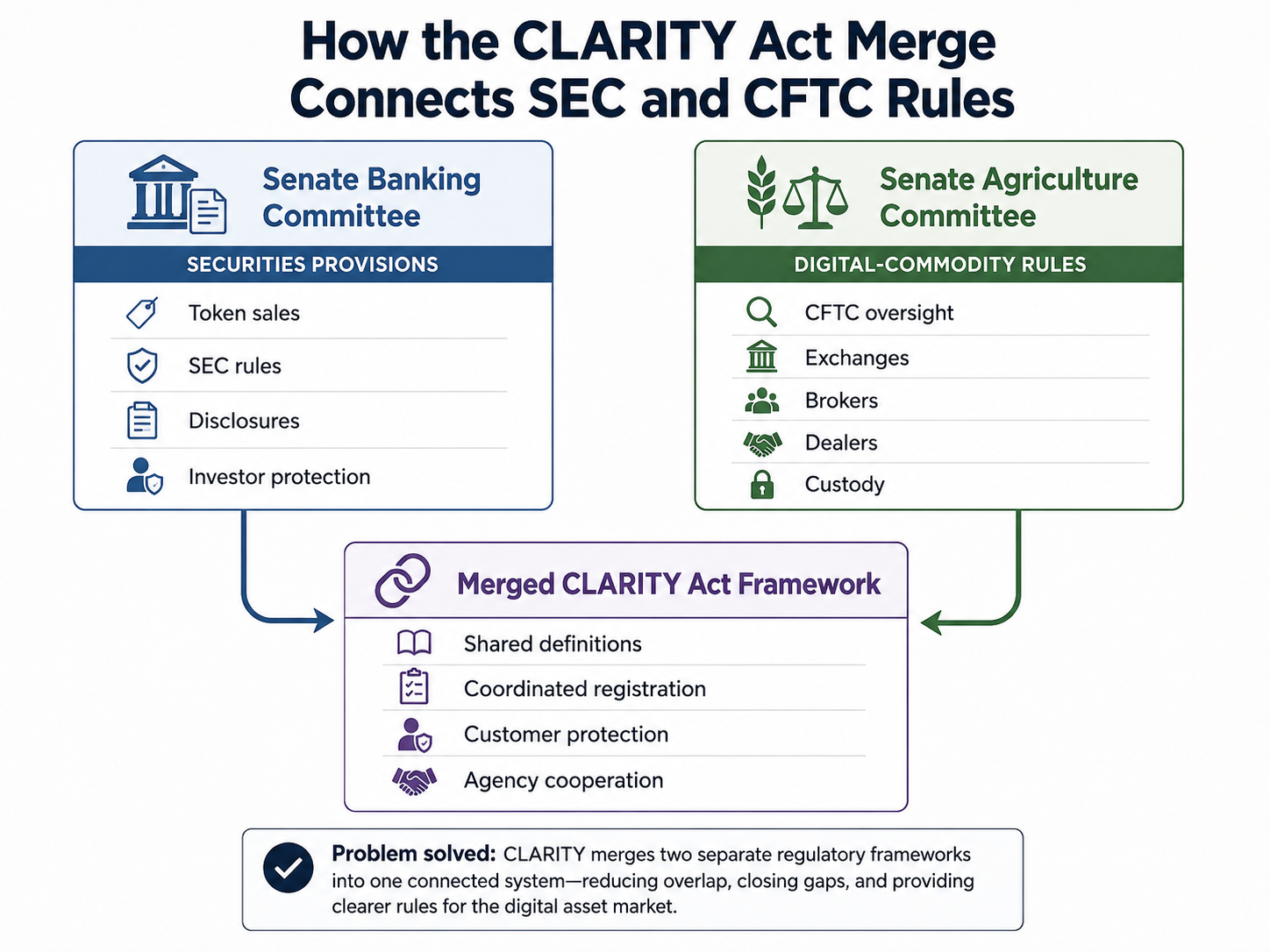
The CLARITY Act is proposed U.S. federal legislation meant to create a clearer rulebook for digital assets, crypto companies, and trading activity by coordinating how the SEC and CFTC oversee the market. The updated Senate text combines previously separate securities and commodities proposals so the framework works as one connected system rather than two competing rulebooks.
For crypto traders, investors, exchanges, custodians, DeFi participants, legal teams, and regulators trying to understand U.S. digital asset rules, that distinction matters: regulatory uncertainty has slowed compliance planning, product design, and broader crypto innovation in the U.S. This introduction focuses on what the CLARITY Act is, how the merged Senate approach is structured, where the SEC-CFTC boundary is drawn, and what the bill could change for exchanges, custody, customer protections, and the bill’s current status.
In practical terms, the CLARITY Act is an attempt to reduce uncertainty over whether a digital asset or related activity falls under securities or commodities regulation, and to make that split more workable for firms and more predictable for market participants. The revised Senate draft brings together earlier legislative efforts that were developed in isolation, aligning market supervision, asset classification, and enforcement responsibilities into a single legislative design.
TL;DR
The CLARITY Act aims to clarify when U.S. securities rules apply to digital assets and when the CFTC would oversee digital-commodity markets.
Two Senate committees developed different parts of the framework because the SEC and CFTC fall under different areas of congressional oversight.
Senator Cynthia Lummis released merged text on July 22, 2026, combining work from the Senate Banking and Agriculture Committees.
The merger connects definitions, registration rules, custody requirements, customer protections and agency responsibilities.
The CLARITY Act remains proposed legislation as of July 30, 2026 and could change before becoming law.
What Is the CLARITY Act for Digital Assets?
The CLARITY Act, formally called the Digital Asset Market Clarity Act, is proposed federal market structure legislation intended to establish a clearer U.S. crypto market structure. Its scope covers how key digital-asset activities are regulated across the crypto industry and the broader industry.
Its central purpose is to reduce uncertainty over which rules apply when a digital asset is created, sold, traded or held for customers. It would preserve the SEC’s authority over securities while dividing oversight between the Commodity Futures Trading Commission and the Securities and Exchange Commission for qualifying digital commodities and the businesses that trade them. That clearer path is meant to support firms and users as rules advance.
The bill also addresses exchanges, brokers, dealers, custodians, decentralized finance, customer disclosures and regulatory coordination. The updated Senate merge focuses on connecting these areas within one legislative structure, and the Senate version builds on bipartisan support from Republicans and Democrats.
What Market Structure Legislation Problem Was the CLARITY Act Merge Designed to Solve?
The merger was designed to prevent the securities and commodities parts of crypto regulation from operating as disconnected systems, and the CLARITY Act is proposed market structure legislation for the U.S. crypto industry.
The Senate Banking Committee handles matters involving securities markets, banking and the SEC. The Senate Agriculture Committee oversees commodity markets and the CFTC. Crypto activity can cross both areas, so the combined approach is meant to support one bill whose scope runs across asset creation, sales, trading and custody.
For example, a project may raise money by selling tokens, while a separate exchange later offers trading in those tokens. The fundraising transaction may raise securities-law questions, while later spot trading may fall within a digital-commodity framework.
Separate committee drafts could therefore use different definitions or impose requirements that do not connect cleanly. The merger creates one structure in which the treatment of an asset, transaction and intermediary can be considered together.
In simple terms, the combined bill tries to answer three connected questions:
What is being regulated? The asset, token sale, trading activity or financial service.
Who is being regulated? The issuer, exchange, broker, dealer, custodian or software operator.
Which regulator is responsible? The SEC, CFTC or both under coordinated requirements.
Without common definitions and cross-references, the answers to those questions could conflict. Readers should watch the legislative process ahead, because the bill can still advance and change before enactment.
Why Were There Two Senate Proposals?
There were two Senate work products because no single committee controls every part of digital-asset market regulation, and each committee supported a different part of the broader regulatory framework.
The Senate Agriculture Committee developed the Digital Commodity Intermediaries Act, focused on CFTC oversight of digital commodities and market intermediaries as part of broader market structure legislation. Chairman John Boozman released updated text on January 21, 2026, and the committee advanced the proposal on January 29, 2026. The committee said the framework included registration, customer-asset segregation, disclosure and market-conduct requirements.
The Senate Banking Committee developed the SEC-facing and broader financial-regulation portion of the CLARITY Act. The committee considered H.R. 3633 and advanced its version on May 14, 2026, reflecting bipartisan support that included some Democrats and showing how agencies and lawmakers were trying to move the legislative process forward for the digital-asset industry.
Neither work product could create a complete market-structure system by itself. The Banking provisions needed to connect with CFTC-regulated spot markets, while the Agriculture provisions needed clear boundaries around securities transactions and SEC authority.
How Was the CLARITY Act Text Merged?
The CLARITY Act text was merged through a substitute amendment that reorganized the proposals under one legislative vehicle as part of broader market structure legislation.
A substitute amendment replaces substantial parts of an existing bill while keeping the original bill number. In this case, the Senate continued working through H.R. 3633, even though its language could differ considerably from the House-passed version.
The Senate Banking draft was itself presented as an amendment in the nature of a substitute. Its structure included ancillary assets, illicit finance, customer protection, DeFi and other digital-asset provisions, while also helping define the scope of how those provisions fit within the larger regulatory framework.
The merger required legislative drafters to:
align important definitions;
place SEC and CFTC provisions in a shared structure;
remove or resolve duplicated requirements;
update section numbers and legal cross-references;
connect registration categories;
preserve agency-specific responsibilities; and
include provisions developed during later negotiations and advanced through the legislative process with bipartisan support, including from some Democrats.
These changes may appear technical, but they can produce practical consequences. A revised definition could change whether a business must register, whether a transaction qualifies for an exemption or which regulator has authority.
Is the Canadian Clarity Act Related to U.S. Crypto?
No. Canada’s Clarity Act is an unrelated constitutional law concerning possible provincial secession.
Canada enacted the law in 2000 following the legal and political questions associated with the 1995 Quebec referendum and the Supreme Court of Canada’s Quebec Secession Reference.
The Canadian law provides that:
the House of Commons assesses whether a referendum question clearly expresses a desire for secession;
a clear majority is required before the federal government enters negotiations;
the statute does not set one fixed numerical threshold for a clear majority;
lawful secession would require negotiations and a constitutional amendment;
negotiations must address the division of assets and liabilities;
minority rights must be protected; and
the rights, interests and territorial claims of Canada’s Aboriginal peoples must be considered.
Canada’s Clarity Act does not permit unilateral secession. It establishes conditions under which the federal government may enter negotiations after a clear question and clear majority, while recognizing that constitutional change would still be required.
This Canadian law should never be used as evidence for claims about SEC jurisdiction, digital commodities, stablecoins or U.S. crypto regulation.
CLARITY Act Timeline
The timeline below separates verified historical events from the bill’s current status.
Date
Verified development
Why it matters
May 29, 2025
H.R. 3633 was introduced in the House as the Digital Asset Market Clarity Act of 2025.
Established the main legislative vehicle for the market-structure proposal and showed early bipartisan support, including from some Democrats.
July 17, 2025
The House passed H.R. 3633 by 294 votes to 134.
Sent the House version to the Senate for consideration.
January 21, 2026
Senate Agriculture Committee Chairman John Boozman released updated digital-commodity legislation.
Developed the CFTC-focused part of the Senate framework as regulators continued to advance their oversight approach.
January 29, 2026
The Senate Agriculture Committee advanced the Digital Commodity Intermediaries Act.
Moved intermediary and digital-commodity market rules forward.
May 14, 2026
The Senate Banking Committee advanced its version of the CLARITY Act.
Moved the SEC-facing and broader financial-regulation text forward.
July 22, 2026
Senator Cynthia Lummis released updated merged text.
Combined the Banking and Agriculture Committee work products; the substitute amendment also affected the scope of definitions and cross-references across the bill.
July 30, 2026
The merged text remained proposed legislation, alongside related debates around the GENIUS Act.
Senate approval, House-Senate agreement and enactment were still required as the legislative process continued.
These dates remain useful as historical milestones even if the bill advances. Looking ahead, readers should track whether later Senate action adds further support or changes the final framework. Only the current-status row requires frequent updating.
Before the Merge, After the Merge and Why It Matters
The clearest way to understand the updated text is to examine what the merger changed for common regulatory questions.
Reader question
Before the merge
After the merge
Why it matters
Who would oversee digital-commodity exchanges?
CFTC-facing exchange rules were mainly contained in the Agriculture proposal.
Exchange rules sit within the broader CLARITY Act structure.
Businesses can evaluate CFTC obligations together with related SEC rules as markets continue the shift toward 24/7 trading.
How would token sales connect to later trading?
Securities and commodity treatment appeared in separate committee work products.
Definitions and transaction rules are linked across the merged bill.
The initial sale and later trading of the same asset can receive different legal treatment.
How would customer assets be protected?
Custody and customer-protection rules appeared in different sections and proposals.
Segregation, custody and conduct rules form part of one framework.
Customers and institutions can see how protections connect across intermediaries and market infrastructure.
What happens when one company performs several activities?
Registration requirements could be read through separate regulatory systems.
The merged structure coordinates exchange, broker, dealer and custody categories.
A business may be able to identify each registration obligation more clearly.
How would DeFi developers be treated?
Developer protections and intermediary questions were spread across separate provisions.
DeFi and software-development rules are coordinated in the same bill.
Publishing software can be distinguished from controlling customer assets or operating shared platforms.
How would the SEC and CFTC cooperate?
Their roles were divided but not always presented as one operating process.
Shared definitions and coordination provisions link their responsibilities.
Fewer gaps or duplicated obligations may result if the bill is enacted and implemented effectively.
A related timeline point is that the GENIUS Act established a regulatory framework for stablecoins in 2025, which helps place CLARITY in the broader sequence of crypto legislation. In the Senate, the July 22, 2026 version also builds on bipartisan support.
The main information gain is not that the merged bill chooses one regulator over another. It tries to create a process for deciding which regulator applies to each asset, transaction and business activity.
How Would SEC and Commodity Futures Trading Commission (CFTC) Authority Work?
The CLARITY Act would generally keep securities and securities transactions under SEC authority while giving the CFTC clearer jurisdiction over qualifying digital commodities and registered spot-market intermediaries.
It would not automatically classify every cryptocurrency as a commodity.
Regulatory treatment could depend on:
how the asset was offered or sold;
whether purchasers funded a business or network;
what rights the asset provides;
the role of an issuer or related party;
whether the network meets statutory conditions under particular circumstances;
how the asset is traded;
what class of asset or market activity is involved; and
which activity a company performs.
This creates an important beginner distinction: an asset and the transaction involving that asset are not always regulated in the same way.
A token may initially be sold through a transaction subject to securities requirements. Later secondary-market transactions involving the asset could receive different treatment if statutory conditions are satisfied, reflecting the proposed jurisdictional boundaries between the SEC and CFTC, with bitcoin often cited as a clearer commodity example on regulated derivatives venues and the broader merger reflecting a regulatory shift toward treating digital-asset markets as shared financial infrastructure rather than isolated platforms.
What Would Change for Exchanges and Custodians?
The CLARITY Act could create clearer federal categories for exchanges, brokers, dealers and custodians operating in digital-commodity markets.
The Agriculture Committee framework included CFTC registration and requirements involving customer-asset segregation, conflicts of interest, disclosure and market conduct. The merged text places those elements inside a wider system that also addresses securities-market activity and aims to protect customers without treating every platform the same way.
A covered business could need to:
register under the appropriate category;
separate customer assets from company assets;
maintain records and compliance systems;
disclose conflicts and material risks;
follow rules against fraud and manipulation;
meet custody or financial-resource requirements; and
cooperate with regulatory examinations.
Clearer categories would not necessarily mean lighter regulation. The intended benefit is greater predictability about which obligations apply, and it would not automatically classify every cryptocurrency as a commodity because the Act defines many cryptocurrencies as digital commodities only if they meet decentralization criteria. Bitcoin is already widely treated as a commodity, and nine cryptocurrencies currently have futures contracts on CFTC exchange, which shows how asset class and trading context can matter.
What Does the Merge Mean for the Crypto Industry, DeFi and Developers?
The merged CLARITY Act attempts to distinguish software development from operating a regulated financial intermediary.
That distinction depends on activity rather than labels.
A person publishing open-source code may not hold customer assets, choose transactions or control access to a protocol, which supports users' ability to interact with decentralized infrastructure through publicly auditable platforms and autonomous agents rather than a single operator. A company operating a custodial interface may perform several of those functions. Centralized exchanges would still need to register with regulators and comply with anti-money laundering standards.
The House framework already contained an exclusion for certain decentralized-finance activities while preserving anti-fraud and anti-manipulation authority. The Senate merge coordinates developer protections, intermediary definitions and the proposed regulatory boundaries for decentralized finance.
The practical question is therefore not simply whether a project calls itself decentralized. Regulators may consider:
who controls the service;
who holds customer assets;
who can change the protocol;
who collects fees;
whether users depend on an identifiable operator; and
whether the activity resembles brokerage, exchange or custody.
The Act can also preserve an individual's right to hold digital assets in cold storage instead of using a covered intermediary.
How Could the CLARITY Act Affect Customers?
The bill could give customers clearer protections when using covered intermediaries, but it could not remove market or technology risk.
Potential protections include customer-asset segregation, risk disclosure, conflict controls, custody standards, recordkeeping and stronger authority against fraud or manipulation.
These protections address operational conduct. They cannot guarantee that:
a token will retain its value;
an exchange will never fail;
a smart contract is secure;
customer losses will always be recoverable; or
every regulated product is suitable for every user.
The CLARITY Act should therefore be understood as a proposed market-rule framework, not a government statement that digital assets are safe investments.
Could the CLARITY Act Support U.S. Crypto Innovation?
The CLARITY Act could attract startup activity back to the U.S. by giving crypto companies clearer rules for token issuance, registration, custody and SEC-CFTC oversight. Greater certainty may reduce legal costs, support domestic product development and make it easier for firms to raise capital and build compliant infrastructure.
The GENIUS Act also created a federal framework for permitted payment stablecoins in 2025. Supporters link that framework to stronger stablecoin adoption, although claims of “unprecedented growth” should be supported by dated supply, transaction-volume or user data.
Neither law guarantees innovation. The outcome depends on final rules, compliance costs and whether startups and established companies can use the available regulatory pathways.
Is the CLARITY Act Law?
No. As of writing this article, the merged CLARITY Act was not federal law.
The House passed its version on July 17, 2025, while Senate committees later developed and merged their own provisions.
For the proposal to become law, the House and Senate must approve identical legislative text. If their versions differ, lawmakers must resolve the differences. The final measure must then complete the constitutional enactment process.
Agency rulemaking would also be required to turn many statutory requirements into detailed operating rules. Passage would begin implementation rather than instantly create a complete regulatory system.
How to Compare Future CLARITY Act Versions
Readers can use this five-question checklist whenever a new draft appears:
What is the document date? Do not compare provisions without identifying the exact version.
Which chamber or committee produced it? House, Banking Committee and Agriculture Committee texts may have different scopes.
Did the definition change? Changes to terms such as digital commodity, intermediary, control or custody can affect several sections.
Was the provision removed or merely moved? A different section number does not necessarily mean the policy disappeared.
Did the legal effect change? Words such as “may,” “shall,” “exempt,” “exclusive” and “subject to” can alter regulatory obligations.
This checklist is more reliable than comparing headlines or page counts. Legislative meaning comes from operative language, definitions, exceptions and cross-references.
Conclusion
The CLARITY Act merge addresses a straightforward problem: U.S. crypto regulation cannot function effectively if securities and commodities rules are written as separate systems.
The updated text combines the Senate Banking Committee’s SEC-facing work with the Agriculture Committee’s CFTC market framework. It connects token transactions, trading intermediaries, custody, customer protection, DeFi and agency coordination.
Its most important contribution is not assigning every cryptocurrency permanently to one regulator. The proposal creates a method for examining the asset, transaction and activity before determining which rules apply.
The merged text remains subject to change and is not yet law. Its lasting educational value comes from showing how Congress is trying to connect securities regulation, commodity-market oversight and digital-asset business rules within one federal structure.
FAQ
What is the CLARITY Act in simple terms?
The CLARITY Act is a proposed U.S. law for deciding how digital assets and crypto businesses should be regulated. It would clarify the roles of the SEC and CFTC and create rules for covered market intermediaries.
When was the merged CLARITY Act text released?
Senator Cynthia Lummis released the merged Senate text on July 22, 2026. Her office described it as the combined work product of the Senate Banking and Agriculture Committees.
Why did the CLARITY Act need to be merged?
The bill needed to be merged because securities and commodity-market rules were developed by different Senate committees. The combined text connects those rules so definitions, registration requirements and regulatory responsibilities can operate together.
Does the CLARITY Act make all crypto assets commodities?
No. The proposed treatment depends on the asset, transaction and activity involved. Securities transactions would remain under SEC authority, while qualifying digital-commodity activities could fall under the CFTC framework.
Did the CLARITY Act pass Congress?
The House passed H.R. 3633 on July 17, 2025, but the merged Senate text had not completed the full congressional process as of July 30, 2026.
What is the most important change in the merged text?
The most important change is that SEC-facing and CFTC-facing provisions now sit within one legislative structure. This helps connect asset classification, token transactions, intermediary registration and customer protection.
Author: Jared
Disclaimer
* The information is not intended to be and does not constitute financial advice or any other recommendation of any sort offered or endorsed by Gate.
* This article may not be reproduced, transmitted or copied without referencing Gate. Contravention is an infringement of Copyright Act and may be subject to legal action.
PAXG (Pax Gold) is a tokenized asset backed by physical gold, issued by the fintech company Paxos and traded on the Ethereum blockchain as an ERC-20 token. The core concept is to tokenize physical gold on-chain, with each PAXG token representing ownership of a certain amount of gold. This structure enables investors to hold and trade gold in the form of a digital asset.
PAXG (Pax Gold) is a tokenized asset backed by physical gold reserves, launched by fintech firm Paxos and issued as an ERC-20 token on the Ethereum blockchain. The core concept is to digitally represent real-world gold assets, allowing investors to hold and trade gold via the blockchain network. Because each PAXG token corresponds to a specific quantity of physical gold, its price is theoretically expected to closely track the global gold market.
Espresso Network serves as a blockchain infrastructure purpose-built for multi-chain ecosystems. Utilizing fast finality, the HotShot consensus mechanism, and decentralized sequencing services, it empowers various blockchains to realize real-time cross-chain interactions. This article summarizes the core architecture, technical highlights, application scenarios, and ESP Token utilities of Espresso Network, offering a concise introduction to its role in the Web3 multi-chain landscape.
This report provides a comprehensive analysis of the past year's market performance and future development trends from four key perspectives: market overview, popular ecosystems, trending sectors, and future trend predictions. In 2024, the total cryptocurrency market capitalization reached an all-time high, with Bitcoin surpassing $100,000 for the first time. On-chain Real World Assets (RWA) and the artificial intelligence sector experienced rapid growth, becoming major drivers of market expansion. Additionally, the global regulatory landscape has gradually become clearer, laying a solid foundation for market development in 2025.
The Ethereum EIP-3074/EIP-7702 incident reveals the complexity of its governance structure: in addition to the formal governance processes, the informal roadmaps proposed by researchers also have significant influence.
PCE, Nonfarm Payrolls (NFP), and FOMC events are among the most closely watched U.S. macroeconomic releases. They focus on different parts of the economy—inflation, employment, and monetary policy—but markets often interpret them through the same core question: