Over the past few years, the blockchain industry has moved from single-chain competition toward a multichain environment. Networks such as Ethereum, BNB Chain, Avalanche, Arbitrum, and Optimism have gradually formed their own independent ecosystems. At the same time, assets and applications have become fragmented across different chains, making interoperability a key challenge for the industry.
To enable true cross-chain interoperability, the market has developed a variety of technical solutions. Celer Network and Axelar are two of the most representative projects in this space. Both aim to solve the problem of information silos between blockchains, but they take different paths in network architecture, security design, and product positioning.
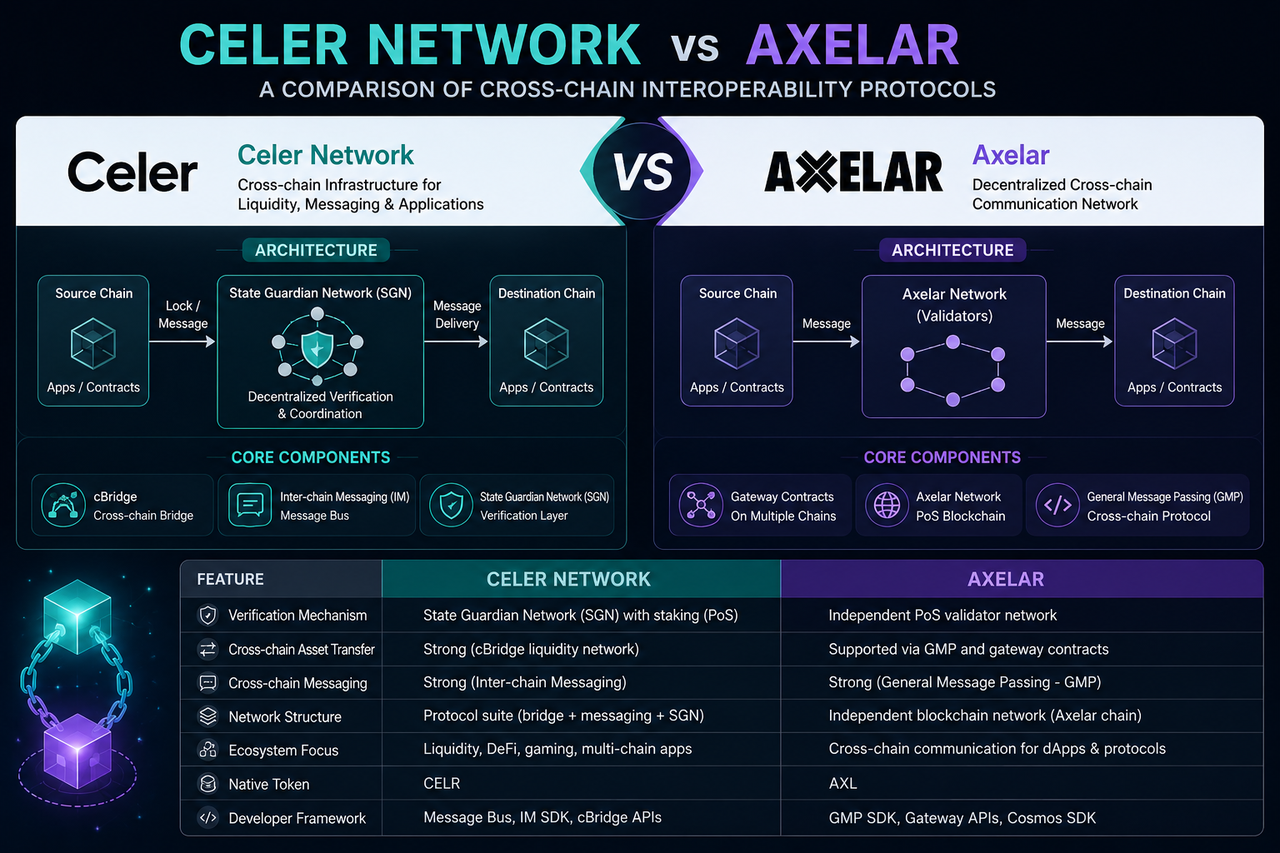
What Is Celer Network?
Celer Network originally started as a Layer2 scaling solution, then gradually evolved into a cross-chain protocol and launched core products such as cBridge, Inter-chain Messaging, IM, and State Guardian Network, SGN.
Celer’s goal is to establish a unified cross-chain communication layer that enables asset transfers, message passing, and smart contract coordination across different blockchains.
Today, its ecosystem is mainly focused on cross-chain bridges, cross-chain messaging protocols, and multichain application infrastructure.
What Is Axelar?
Axelar is a decentralized network built specifically for cross-chain communication. Unlike many cross-chain bridges, Axelar itself is an independently operated PoS blockchain maintained by a validator network.
Axelar connects multiple blockchains through Gateway contracts and cross-chain communication protocols, allowing developers to send messages across chains, call smart contracts, and transfer assets.
Its core vision is to build a cross-chain infrastructure network similar to the routing layer of the internet.
How Do Their Core Positions Differ?
Although both are cross-chain interoperability protocols, their areas of focus are clearly different.
Celer places greater emphasis on cross-chain liquidity and application-layer interoperability, with an ecosystem built around cBridge and IM.
Axelar focuses more on becoming a universal communication network between blockchains, connecting different chains through a unified verification layer.
As a result, Celer can be seen as a combination of cross-chain bridge and messaging protocol, while Axelar is closer to a cross-chain communication middleware layer.
How Are Their Network Architectures Different?
Celer’s core architecture includes:
-
cBridge, a cross-chain bridge
-
Inter-chain Messaging, a cross-chain messaging protocol
-
State Guardian Network, SGN
SGN is responsible for state verification and cross-chain coordination.
Axelar’s architecture includes:
All cross-chain requests on Axelar are processed through its independent validator network.
From an architectural perspective, Axelar is closer to an independent cross-chain blockchain, while Celer is more like a collection of cross-chain infrastructure protocols.
How Does SGN Differ from the Axelar Validator Network?
This is one of the most important differences between the two.
Celer’s SGN is a verification layer specifically designed for cross-chain verification and message coordination.
Validators participate in state verification and message confirmation by staking CELR.
Axelar, by contrast, has a complete validator network and an independent PoS chain.
Validators are responsible for monitoring external blockchain events, verifying cross-chain requests, and reaching consensus.
Put simply, SGN is a verification network that serves the Celer protocol, while the Axelar validator network itself forms an independent blockchain.
How Do They Enable Cross-Chain Messaging?
Celer uses Inter-chain Messaging, IM, to enable messages to move across chains.
Messages are initiated through Message Bus, verified by SGN, and then synchronized to the destination chain for execution.
Axelar uses the General Message Passing, GMP, mechanism.
Developers send messages through Gateway contracts, and after confirmation by the validator network, those messages are delivered to the destination chain.
Both support arbitrary cross-chain messaging, but their underlying execution paths are different.
How Do Their Security Models Differ?
Security is one of the most important metrics for any cross-chain protocol.
Celer’s security is mainly built on SGN’s PoS staking mechanism.
Validators need to stake CELR, while economic incentives and penalty mechanisms help maintain network security.
Axelar’s security depends on its independent validator network and Cosmos SDK PoS consensus mechanism.
Validators jointly maintain the Axelar chain and are responsible for cross-chain state verification.
Therefore, both protocols use a PoS model, but their security boundaries and consensus-layer designs are not the same.
How Do Their Cross-Chain Asset Transfer Capabilities Compare?
Celer’s cBridge is one of its most mature products.
Through a liquidity network model, users can quickly move assets across multiple chains.
Cross-chain liquidity management has long been one of Celer’s core strengths.
Axelar also supports cross-chain asset transfers, but its design focuses more on the cross-chain communication layer.
As a result, Celer is more commonly viewed in the market as a cross-chain bridge solution, while Axelar is more often seen as a cross-chain communication network.
How Is the Developer Experience Different?
Celer provides developers with:
Developers can quickly build cross-chain applications and cross-chain liquidity features.
Axelar provides:
Developers can use a unified interface to enable multichain communication.
Both aim to reduce the complexity of cross-chain development, but their technical stacks differ.
What Are Their Main Use Cases?
Celer’s typical use cases include:
-
Cross-chain bridges
-
Multichain DeFi
-
Cross-chain governance
-
Liquidity networks
-
Cross-chain games
Axelar’s main use cases include:
From an application perspective, both support cross-chain application development, but their ecosystem priorities are different.
Core Comparison Between Celer and Axelar
| Comparison Dimension |
Celer Network |
Axelar |
| Core Positioning |
Cross-chain bridge and interoperability protocol |
Cross-chain communication network |
| Verification Mechanism |
SGN verification network |
Axelar Validator Network |
| Consensus Model |
SGN PoS |
Cosmos PoS |
| Cross-Chain Bridge Capability |
Strong |
Moderate |
| Cross-Chain Messaging Capability |
Strong |
Strong |
| Liquidity Network |
cBridge |
Supported but not core |
| Developer Framework |
Message Bus |
GMP |
| Native Token |
CELR |
AXL |
Conclusion
Celer Network and Axelar are both important infrastructure protocols in the cross-chain interoperability sector, but they follow different technical paths.
Celer builds a cross-chain liquidity and communication system through cBridge, Inter-chain Messaging, and SGN. Axelar, on the other hand, enables unified connectivity between blockchains through an independent PoS network and the GMP protocol.
FAQs
What Is the Biggest Difference Between Celer and Axelar?
The biggest difference lies in network architecture. Celer uses SGN as its verification layer, while Axelar itself is an independently operated PoS blockchain.
How Is SGN Different from Axelar Validator Network?
SGN is Celer’s cross-chain verification network, while Axelar Validator Network not only verifies cross-chain requests but also maintains the operation of the Axelar chain itself.
Which Protocol Is Better Suited to Cross-Chain Bridge Use Cases?
Celer’s cBridge is more representative in cross-chain liquidity and asset transfers, so it is generally considered to have a stronger advantage in the cross-chain bridge sector.
What Is Axelar’s GMP?
GMP, General Message Passing, is Axelar’s cross-chain messaging protocol. It allows developers to pass arbitrary messages between different blockchains and call smart contracts.