Unlike many tokens designed purely for trading and circulation, BTG is engineered as the core economic unit of the entire Layer 0 infrastructure. As cross-chain assets, digital identities, NFTs, securitized assets, and various on-chain value instruments continue to integrate into Openverse, BTG's role has evolved from a simple payment medium into the foundational settlement asset of the Value Internet.
Understanding BTG's functionality not only clarifies how the Openverse network operates but also helps users grasp the economic model design logic within a Layer 0 network.
BTG Token Mechanism
According to the Openverse design philosophy, BTG is far more than a crypto asset—it is the fundamental value unit of the entire Value Internet ecosystem. The project posits that all assets, rights, credentials, and identities in the future digital world can be digitally expressed through tokenization, with BTG serving as the value bridge connecting these digital assets.
The Openverse whitepaper argues that currencies, securities, bonds, loyalty points, identity credentials, and even real-world assets are essentially different forms of value tokens. As more assets undergo tokenization, a basic value medium enabling free circulation and exchange becomes essential, and BTG is the core medium within the Openverse economic system.
Thus, BTG is not merely a payment token; it is a critical economic infrastructure underpinning the entire cross-chain value network.
BTG's Role in the Network
Within Openverse, BTG functions as the network's value hub.
If Openverse is understood as a Layer 0 network connecting different blockchains and digital assets, then BTG acts as the basic fuel and value bridge. Whether for cross-chain messaging, digital asset transfers, NFT exchanges, or identity data verification, value coordination is achieved through BTG.
This design mirrors the TCP/IP protocol of the internet. While the internet solves information transmission, Openverse addresses value transmission. BTG becomes the unified unit of value across this entire value transmission network.
As more applications and assets enter the Openverse network, BTG will continue to handle value measurement, transaction settlement, and network incentives, forming a value cycle that spans the entire ecosystem.
BTG for Gas Payments
The Gas mechanism is a fundamental element for blockchain network operation, and BTG fulfills the network's Gas payment function within Openverse.
When users execute transfers, deploy smart contracts, perform cross-chain operations, or submit on-chain data, network resources are consumed. To prevent network abuse and incentivize validators to provide continuous service, Openverse uses BTG as the asset for paying network fees.
This model is analogous to Ethereum using ETH and Solana using SOL. Each on-chain operation consumes resources, and BTG becomes the unified unit for measuring and paying for these resource costs.
As the Openverse network scales and on-chain transaction volume rises, the actual demand for BTG will grow in tandem, creating a sustained consumption scenario.
| Network Action |
BTG Consumed? |
| Standard Transfer |
Yes |
| Cross-Chain Transaction |
Yes |
| NFT Transfer |
Yes |
| Smart Contract Call |
Yes |
| Identity Verification |
Yes |
Gas payment is one of BTG's most fundamental and core use cases.
BTG Participation in Staking
Beyond its payment function, BTG is also a vital component of the Openverse network security mechanism.
Openverse employs a DPoS (Delegated Proof of Stake) mechanism combined with a PoH (Proof of History) design to maintain network consensus. Under this architecture, validator nodes must stake BTG to participate in block production and network validation.
Staking raises the cost of attacking the network. If a malicious node attempts to compromise security, its staked assets face slashing risk. Thus, BTG staking functions as an economic bonding mechanism.
For ordinary users, even without running a validator node directly, they can participate in network security through delegated staking and earn incentive rewards. This model enhances community engagement while boosting overall network security.
As the ecosystem grows, more nodes and users will stake, further increasing BTG's importance in the security framework.
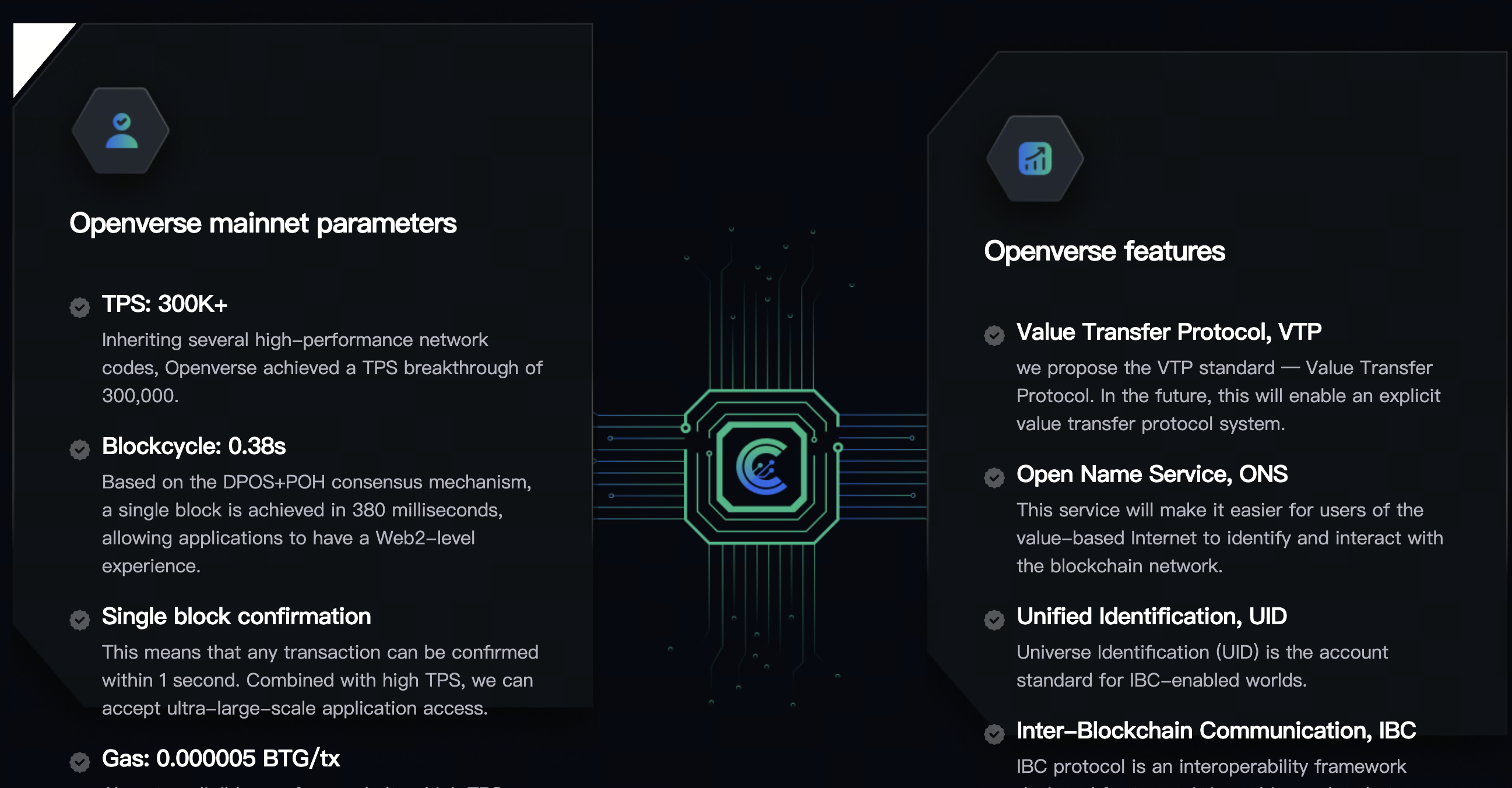
Source: openverse.network
BTG Participation in Governance
Openverse aims to build an open Value Internet, making governance a crucial part of the network.
BTG holders can participate in network governance, voting on protocol upgrades, parameter adjustments, ecosystem fund allocation, and major development directions.
As the Layer 0 network expands, the number of participants will increase. Through governance, community members collectively decide the network's future direction, rather than relying solely on a single entity.
This aligns with the decentralized governance trend in blockchain. In this process, BTG represents both economic rights and governance rights, enabling token holders to help shape network rules.
In the long term, the governance function enhances ecosystem synergy and drives Openverse toward a more open and autonomous future.
BTG's Value Capture Logic
BTG's value stems from its actual usage demand within the network's economic system.
As digital assets, cross-chain transactions, NFT applications, identity systems, and various Tokenized Assets on Openverse continue to grow, network activity increases. Since these activities require consuming BTG as fees or settlement media, genuine token demand emerges.
From an economic model perspective, BTG's value capture comes from the following sources:
| Value Source |
BTG Role |
| Network Transactions |
Gas Payment |
| Cross-Chain Activities |
Settlement Medium |
| Validator Nodes |
Staking Asset |
| Community Governance |
Voting Credential |
| Ecosystem Applications |
Incentives & Settlement |
This design means BTG demand is directly correlated with network activity. As the Value Internet ecosystem expands, BTG's use cases will grow accordingly.
Therefore, BTG's value logic is not based on speculative demand but on the actual operation and value flow of the network.
BTG in Ecosystem Expansion
Openverse's long-term goal is to build a global Value Internet, and BTG is a key connector in this expansion.
The project proposes that in the future, not only digital currencies but also securities, loyalty points, property rights, identity credentials, and real-world assets can enter the on-chain world through tokenization. When these assets begin to circulate and trade across chains, a unified value coordination mechanism is needed.
BTG plays exactly this role. It supports asset issuance and cross-chain transfer while providing a unified settlement standard for ecosystem participants.
As asset systems like Bitcurrency, Privcurrency, Bitsecurity, and Tokenized Assets continue to diversify, BTG is poised to become a key value circulation medium within the Openverse ecosystem.
From a long-term perspective, BTG's role extends beyond network operation to serve the entire Value Internet infrastructure.
Summary
BTG is the native token of the Openverse Network and a critical economic infrastructure of the Value Internet. It performs multiple core functions: Gas payment, node staking, governance voting, ecosystem incentives, and value settlement.
As Openverse continues to advance its Layer 0 cross-chain network and drive tokenization of various digital assets, BTG's role will further expand—from payment fuel to governance credential to unified settlement asset—forming a vital core of the Openverse economic model.
FAQ
What is BTG?
BTG is the native token of the Openverse Network, used for paying network fees, staking, governance voting, and ecosystem settlement.
Can BTG be used to pay Gas fees?
Yes. When users conduct transfers, cross-chain operations, NFT actions, or smart contract calls on the Openverse network, BTG is required to pay Gas fees.
Can BTG be staked?
Yes. BTG can be staked directly by validator nodes or through delegated staking to participate in network security and earn rewards.
Does BTG have governance functions?
Yes. BTG holders can participate in Openverse network governance, voting on protocol upgrades and ecosystem development proposals.
What is the source of BTG's value?
BTG's value primarily comes from network usage demand—transaction fees, cross-chain settlement, staking requirements, governance participation, and sustained demand from ecosystem application growth.







