For many blockchain projects, tokens are typically used for gas fees, governance, or liquidity incentives. However, Bana Protocol takes a different approach—the team aims to link its token to real-world commercial revenue, so its value is derived from both on-chain activity and real asset operations.
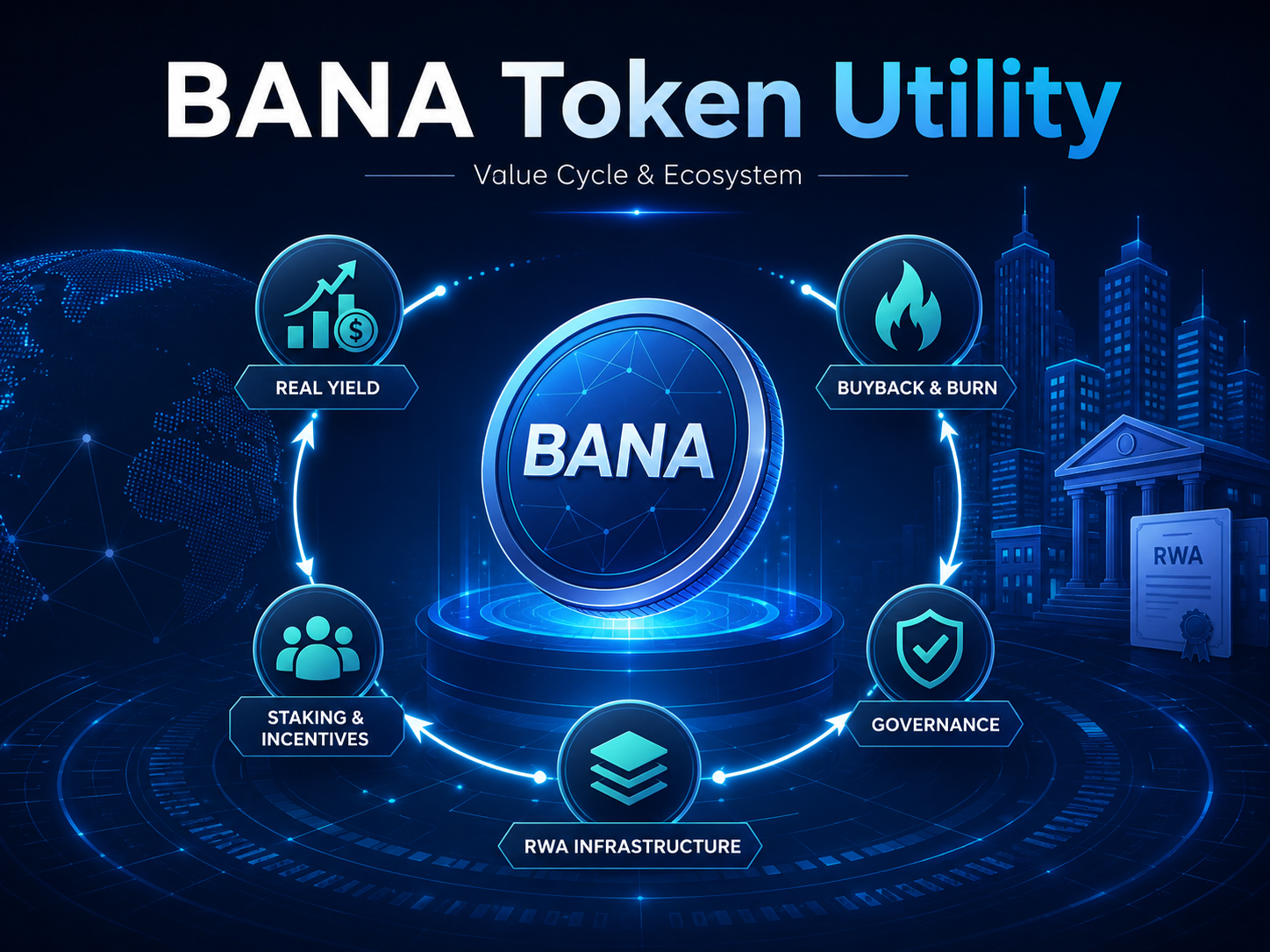
To truly understand the role of the BANA token, you need to look beyond the token itself and consider core mechanisms like Real Yield, Buyback & Burn, and medical RWA. Only then can you fully grasp Bana Protocol’s value cycle.
The Role of BANA Token in Bana Protocol
The BANA token is a fundamental value carrier in the Bana Protocol ecosystem, serving as a critical bridge between real-world assets and on-chain economies. Official documentation makes clear that BANA is not merely a trading medium—it’s integral to payments, value transfer, value cycling, and future governance.
Multiple core protocol modules interact with the BANA token. For example, when the underlying medical industry generates genuine commercial revenue, a portion of that yield is allocated to Buyback & Burn according to protocol rules, and the entire value loop ultimately feeds back to the BANA token. The token is not an isolated asset but a central node in the protocol’s economic model.
As the ecosystem expands, the team plans to empower BANA with additional use cases, including the BANA Pay payment system and DAO governance. Currently, public information indicates that the token is primarily positioned for payments, value transfer, and ecosystem functionality, with governance capabilities to be developed in future roadmaps.
The core functions of the BANA token as disclosed include:
| Function |
Role |
| Payment |
Enables payments and value exchange within the ecosystem |
| Value Transfer |
Connects real commercial yield to the on-chain economy |
| Value Cycle |
Establishes a long-term mechanism with Buyback & Burn |
| Ecosystem Utility |
Supports protocol operations and future ecosystem expansion |
| DAO Governance (planned) |
Community governance functionality to be implemented |
These functions are interconnected, collectively serving Bana Protocol’s economic system. As more real-world assets are onboarded, BANA’s role in the ecosystem will continue to grow.
Why Bana Protocol Needs the BANA Token
Bana Protocol introduced the BANA token not simply to create an on-chain payment asset, but to forge a value connection between real-world commerce and blockchain economics. The team believes that only by integrating the token into real yield cycles can the protocol move beyond reliance on token incentives alone.
Without a unified value carrier, commercial revenue generated off-chain cannot be sustainably cycled on-chain. The BANA token acts as a bridge, allowing medical industry and future RWA asset yields to flow into on-chain value transfer and support mechanisms like Buyback & Burn.
Furthermore, BANA is foundational to future ecosystem expansion. As BANA Pay, DAO governance, and more industry assets are integrated, the token will take on additional ecosystem collaboration functions beyond payments and value transfer. This design gives Bana Protocol a scalable economic model and preserves a unified value base for future growth.
BANA’s Role in Payments and Ecosystem Circulation
Payments and value transfer are currently the most important uses for the BANA token. Official sources position BANA as the ecosystem’s core functional token, connecting real-world asset yields to on-chain economic activity and enabling value to flow continuously among participants.
With medical RWA and other real industries joining the protocol, BANA will serve as the medium for value exchange within the ecosystem. Medical institutions, business partners, and ecosystem participants can route part of their value into the on-chain system according to protocol rules, completing payments, value transfers, and subsequent ecosystem applications via BANA. This design creates a unified value channel between real-world commerce and blockchain, not just a simple token payment.
The roadmap includes BANA Pay, aiming to further expand payment scenarios. While this feature is still under development, the team plans for BANA to support both internal protocol payments and broader real-world commercial transactions and collaborations, enhancing the token’s practical utility.
Currently, BANA’s main circulation scenarios include:
- Acting as the value transfer medium connecting real-world commerce and the on-chain ecosystem
- Facilitating the value cycle with Real Yield and Buyback & Burn
- Supporting future payment applications such as BANA Pay
- Providing a unified value foundation for DAO governance and additional ecosystem functions
Unlike tokens that depend solely on trading demand, BANA is designed for sustained circulation within the protocol’s economic model. The team aims to continually add real-world use cases so token demand grows with the ecosystem, not just market activity.
Buyback & Burn’s Impact on BANA’s Value Cycle
Buyback & Burn is a cornerstone of Bana Protocol’s tokenomics and the core of its value cycle. The protocol uses commercial revenue generated from real-world operations to buy back BANA tokens on the market and burn them according to established rules, creating a long-term value model driven by actual income.
This mechanism is tightly integrated with Real Yield. Real-world assets generate revenue, and the protocol channels part of that yield on-chain to execute Buyback & Burn. Buyback funds come from real business activity—not new token issuance or protocol subsidies—making this a Real Yield Driven Value Cycle.
The value cycle can be summarized as:
| Stage |
Main Content |
Impact on BANA |
| Real Business Operation |
Medical and other RWA assets generate revenue |
Source of value |
| Real Yield |
Commercial yield enters the protocol |
Foundation for on-chain yield |
| Buyback |
Protocol buys back BANA tokens |
Increases token demand |
| Burn |
Burn tokens per protocol rules |
Reduces circulating supply |
| Ecosystem Cycle |
Tokens continue to participate in ecosystem operations |
Strengthens long-term value support |
This approach differs sharply from traditional DeFi, which often relies on high inflation incentives. Many protocols must continually issue new tokens to maintain rewards, while Bana Protocol seeks to anchor its value cycle in real business cash flow, ensuring long-term viability.
Of course, Buyback & Burn’s effectiveness depends on the performance of underlying assets. Only if the medical industry and future RWA assets generate sustained revenue can the value cycle remain stable. Real Yield, Buyback, and the BANA token are integrated mechanisms forming Bana Protocol’s complete economic model.
BANA Token Issuance and Allocation
The BANA token issuance mechanism balances ecosystem development, market liquidity, and long-term growth. Official tokenomics set total supply at 1 billion, deployed on BNB Chain under the BEP-20 standard. No inflation model has been disclosed, so BANA does not rely on ongoing issuance for ecosystem maintenance, but instead builds long-term value through Real Yield and Buyback & Burn.
Most tokens are allocated to ecosystem development, supporting protocol construction, partnerships, and future applications. The team, marketing, and liquidity receive designated allocations, with the structure favoring long-term ecosystem growth over short-term market release.
| Allocation Category |
Proportion |
Main Usage |
| Ecosystem |
45% |
Protocol development, ecosystem growth, and future applications |
| Team |
20% |
Long-term team incentives |
| Token Sale |
15% |
Market issuance |
| Marketing |
15% |
Promotion and community building |
| Liquidity |
5% |
Market liquidity provision |
The team’s token allocation follows a 36-month lock-up, then 24-month linear release, mitigating early market flooding risk. The team also aims to keep initial circulation low, aligning token release with ecosystem progress.
Overall, BANA’s economic model does not depend on token issuance as a primary value source. Instead, it serves as a tool for ecosystem development, with long-term value anchored in real RWA-generated commercial revenue and the resulting value cycle.
BANA Token’s Long-Term Role and Ecosystem Positioning
BANA’s long-term positioning goes far beyond being a payment tool—it’s a central value carrier for the entire Bana Protocol ecosystem. As more real-world assets join the protocol, BANA will continually connect business operations, yield distribution, and on-chain applications, enabling ecosystem participants to collaborate within a unified value framework.
The roadmap outlines plans for BANA Pay, DAO governance, and more cross-industry use cases. BANA’s functionality will expand from payments and value transfer to community governance, ecosystem collaboration, and real-world payments, enriching the protocol’s capabilities.
The 16 Sector Portfolio plan will broaden BANA’s application scope. As industries like hospitality, real estate, education, AI, and FinTech join Bana Protocol, BANA will become the unified value medium for a multi-industry RWA network, not just medical. This cross-sector approach enhances ecosystem scalability and reduces single-industry volatility.
The long-term ecosystem vision for BANA focuses on:
- Continuously linking Real Yield and Buyback & Burn value cycles
- Supporting real-world payment scenarios via BANA Pay
- Enabling DAO community governance and ecosystem functions
- Facilitating value transfer across a multi-industry RWA network
- Driving sustained ecosystem expansion and collaborative growth
BANA’s value is rooted not only in its design, but in the ongoing development of Bana Protocol’s commercial ecosystem. As more real assets and industries join, the token’s role in the value network will strengthen—this is the core of the protocol’s long-term strategy.
Summary
The BANA token is a key component of Bana Protocol’s value cycle. It delivers payment and value transfer functionality and connects real commercial revenue to on-chain economic activity through Real Yield and Buyback & Burn. Unlike traditional DeFi models that rely on high inflation incentives, Bana Protocol prioritizes real asset-driven revenue, providing sustainable value support for the token.
As medical and other real-world assets are integrated, BANA’s use cases will expand to payments, ecosystem collaboration, and community governance. Planned features like BANA Pay, DAO, and a multi-industry RWA network will further enrich the token’s long-term role within the protocol.
FAQ
What is the main function of the BANA token?
BANA is Bana Protocol’s core functional token, responsible for payments, value transfer, and future governance. It participates in the protocol’s value cycle via Real Yield and Buyback & Burn.
Does BANA have governance functionality?
According to the roadmap, DAO governance is a future feature. Currently, BANA focuses on payments, value transfer, and supporting protocol operations, with governance to be developed further.
How does BANA participate in Buyback & Burn?
Bana Protocol allocates part of real commercial yield to buy back BANA tokens and burn them per protocol rules. This mechanism aims to reduce circulating supply and establish a long-term value cycle driven by real-world revenue.
What is BANA’s total supply?
Official tokenomics set BANA’s total supply at 1 billion, deployed on BNB Chain under the BEP-20 standard.
Where does BANA’s value primarily come from?
BANA’s long-term value is derived from commercial revenue generated by medical RWA and other real-world assets, as well as the value cycle formed through Real Yield and Buyback & Burn, not just market trading or token incentives.
How does BANA differ from traditional DeFi tokens?
Unlike DeFi tokens that rely on high inflation rewards or liquidity mining, BANA emphasizes real commercial revenue as the foundation for its ecosystem, aiming for a sustainable long-term economic model through real asset operations, Real Yield, and Buyback & Burn.