Anthropic’s IPO prospects depend partly on whether the company can secure enough cloud capacity, AI chips, data-center space and electricity without allowing infrastructure costs to outgrow Claude revenue. Anthropic has diversified across several compute ecosystems, but large supply commitments could still create concentration, utilization and margin risks for future public investors.
TL;DR
-
Anthropic relies on external cloud, chip and data-center partners to train and operate Claude at scale.
-
AWS is Anthropic’s primary cloud and training partner, while Google Cloud provides additional TPU-based infrastructure.
-
Multiple chip architectures can improve resilience, but they also increase software, integration and capacity-planning complexity.
-
Long-term infrastructure commitments are beneficial when Claude demand is strong, but underused capacity could pressure cash flow and margins.
-
An Anthropic IPO filing should be evaluated through compute obligations, supplier concentration, utilization, inference costs and infrastructure financing, not infrastructure spending alone.
Why Infrastructure Matters to the Anthropic IPO
Infrastructure matters because Claude cannot grow without continuous access to specialized and expensive computing capacity. The cost, availability and efficiency of that capacity could influence Anthropic’s growth rate, gross margin, cash requirements and ability to meet customer demand.
Anthropic confidentially submitted a draft Form S-1 registration statement to the US Securities and Exchange Commission on June 1, 2026. The submission begins a regulatory-review process but does not guarantee that an IPO will occur or establish a listing date, valuation, ticker or offer price.
A traditional software company can often add standardized cloud resources as demand grows. Frontier AI developers face a more constrained supply chain. Training and operating models such as Claude require specialized accelerators, high-bandwidth memory, high-speed networking, cooling systems, electricity and large data-center campuses.
For Anthropic, infrastructure affects five potential IPO considerations:
| Infrastructure factor |
Potential IPO significance |
| Available compute capacity |
Limits how quickly Anthropic can train models and serve Claude users |
| Training expenditure |
Influences research spending and future financing needs |
| Inference efficiency |
Affects the cost of processing subscriptions and API requests |
| Supplier concentration |
Creates operational and negotiating-power dependencies |
| Contracted capacity |
Secures supply but may create fixed or minimum-spending obligations |
The infrastructure question is narrower than Anthropic’s overall valuation or business model. It asks whether Anthropic can convert expensive compute inputs into scalable and increasingly efficient Claude revenue. That relationship also affects the assumptions behind Anthropic’s business model, IPO expectations and valuation logic.
How Anthropic’s AI Infrastructure Supply Chain Works
Anthropic’s supply chain extends from chip production and power generation to cloud platforms and Claude distribution. Anthropic does not need to manufacture every chip or own every facility, but the company remains exposed to bottlenecks throughout the chain.
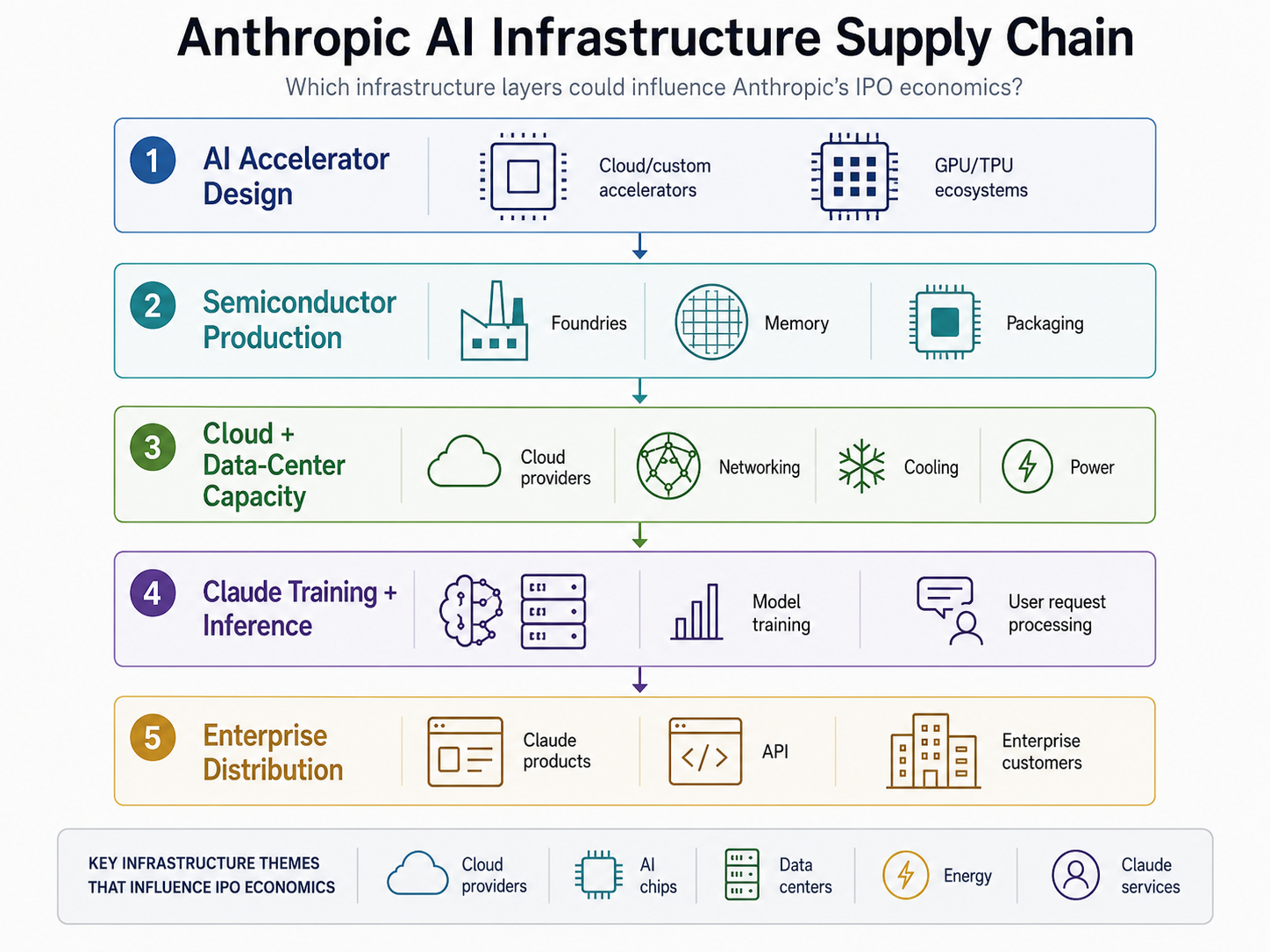
A simplified Claude compute infrastructure chain contains five layers:
-
AI accelerator design: AWS, Google, Nvidia and other suppliers design processors for machine-learning workloads.
-
Semiconductor manufacturing: Foundries, memory producers and packaging companies manufacture the components.
-
Data-center deployment: Cloud and infrastructure providers install chips, networking systems, cooling and power equipment.
-
Claude training and inference: Anthropic uses the capacity to develop models and process user requests.
-
Commercial distribution: Claude is delivered through Anthropic products, APIs and third-party cloud platforms.
The chain is only as effective as its most constrained layer. A supply of processors is insufficient when high-bandwidth memory, networking equipment, power connections or completed data halls are unavailable.
This is why announced chip quantities and spending plans should not automatically be interpreted as usable capacity. Investors would need to distinguish between capacity that is announced, contracted, installed, operational and productively utilized.
How Dependent Is Anthropic on AWS?
AWS remains Anthropic’s most important publicly identified infrastructure relationship. Anthropic announced in November 2024 that AWS had become its primary cloud and training partner as part of an expanded collaboration with Amazon.
The relationship includes work on AWS Trainium, Amazon’s custom AI accelerator. Anthropic has described collaboration with AWS Annapurna Labs on software components needed to run Claude workloads efficiently on Trainium infrastructure.
Amazon later launched Project Rainier, an AI computing system designed to support Anthropic. Reuters reported that the project initially incorporated nearly 500,000 Trainium2 chips, with Anthropic expected to use more than one million Trainium2 chips through AWS by the end of 2025.
The relationship provides several potential benefits:
-
Large-scale reserved compute capacity
-
Access to a chip architecture outside the Nvidia ecosystem
-
Joint optimization of Claude workloads
-
Distribution through Amazon Bedrock
-
Integration with enterprises already using AWS
However, the relationship also concentrates several roles in one counterparty. Amazon is an investor in Anthropic, a major infrastructure supplier and a distributor of Claude. An IPO prospectus would ideally disclose how much Anthropic spends with AWS, the duration of material commitments, minimum-purchase requirements and the ability to transfer workloads.
The overlap between strategic investment, infrastructure supply and product distribution can also shape Anthropic IPO governance and public-investor oversight, particularly where contractual dependence may influence negotiation power or board-level decisions.
Does Google Cloud Reduce Anthropic’s Cloud Dependency?
Google Cloud reduces Anthropic’s reliance on a single cloud and chip architecture, but it does not eliminate hyperscaler dependency.
Google Cloud has stated that Anthropic uses its infrastructure for model training and inference. Google also distributes Claude through Vertex AI, giving Anthropic another route to enterprise customers.
Google Cloud TPUs provide an alternative to AWS Trainium and Nvidia GPUs. Google describes TPUs as custom processors designed to accelerate machine-learning workloads, while Anthropic has become a significant user of TPU-based infrastructure.
This multi-provider approach can improve resilience, but diversification creates trade-offs:
| Benefit |
Associated limitation |
| Access to more compute sources |
More complex workload allocation |
| Less dependence on one chip family |
Additional software optimization |
| Stronger negotiating position |
Multiple contractual commitments |
| Wider cloud distribution |
Operational consistency becomes harder |
| Greater capacity flexibility |
Moving workloads may remain costly |
Anthropic’s dependence on external cloud partners contrasts with Google DeepMind’s position inside Alphabet, where model development, cloud infrastructure, custom chips and distribution sit within the same corporate ecosystem. This infrastructure gap is one of several meaningful differences in Anthropic vs OpenAI vs Google DeepMind.
Why AI Chip Supply Is an Anthropic IPO Risk
AI chip supply is a risk because model development depends on more than obtaining a large number of processors. Anthropic needs accelerators with sufficient memory, networking, software support and dependable access at the time new models and products are ready.
Using AWS Trainium, Google TPUs and Nvidia-based systems may reduce exposure to a single hardware ecosystem. It may also require Anthropic to maintain different software stacks, engineering teams and performance-optimization processes.
Three risks are particularly relevant:
Capacity-delivery risk
Chips may be ordered or reserved before the surrounding data-center capacity, electrical connections and networking infrastructure are ready. Delayed deployment could postpone model training or reduce the capacity available for Claude users.
Architecture risk
A model optimized for one accelerator may not transfer efficiently to another. Hardware diversity improves optionality only when Anthropic can move or divide workloads without excessive performance loss or engineering cost.
Obsolescence risk
Long contracts may extend beyond a hardware generation’s economic life. New accelerators could deliver better performance per unit of power, leaving older capacity relatively expensive even when it remains operational.
Reliable access to multiple hardware ecosystems can support Anthropic’s competitive advantage, but infrastructure access alone does not create a defensible moat. Claude model quality, enterprise adoption, research capability, safety positioning and distribution remain equally important.
Can Data-Center Capacity Become an Advantage?
Data-center capacity becomes an advantage only when Anthropic can use it efficiently and convert it into paying demand. A large capacity announcement may indicate supply security, but it does not establish profitable utilization.
Reuters reported in November 2025 that Anthropic announced a $50 billion plan for custom US data centers developed with Fluidstack, including projects in Texas and New York. The facilities were expected to begin coming online in 2026.
This plan could strengthen Anthropic by giving the company greater access to dedicated infrastructure. It also creates execution questions involving construction, financing, power availability, completion schedules and utilization.
Investors should separate four stages:
-
Announced capacity: Publicly proposed infrastructure
-
Contracted capacity: Supply covered by binding agreements
-
Operational capacity: Systems installed and ready for workloads
-
Utilized capacity: Infrastructure actively generating productive output
Only the final stage directly supports revenue. Data-center spending that grows faster than Claude demand may increase cash burn rather than strengthen the business.
How Compute Costs Could Affect Anthropic’s Margins
Compute costs could pressure Anthropic’s margins when the cost of training and serving Claude grows faster than subscriptions, API usage and enterprise revenue.
Anthropic generates revenue from API consumption, Claude subscriptions and enterprise agreements. These income streams form the foundation of how Anthropic makes money through Claude APIs and enterprise services.
From an infrastructure perspective, the key relationship is:
Infrastructure contribution margin = customer revenue minus inference, cloud and directly attributable compute costs
Inference economics may vary by workload. Long-context processing, software agents, coding tasks and complex reasoning can consume more resources than short requests. Model efficiency, customer pricing and hardware utilization therefore affect whether rising Claude usage improves or weakens margins.
Long-term capacity reservations create an additional issue. They can protect Anthropic from shortages when demand is high, but may become costly when actual usage falls below committed levels.
Anthropic Infrastructure Risk Matrix
The most material risks are supplier concentration, capacity underutilization, delayed deployment and rising unit costs.
| Risk |
Potential effect |
IPO disclosure to examine |
| Cloud concentration |
Reduced bargaining power or service disruption |
Spending by major provider |
| Minimum-spend commitments |
Payments for unused capacity |
Contractual obligations by year |
| Deployment delays |
Slower Claude expansion |
Data-center completion milestones |
| Low utilization |
Infrastructure cost outpaces revenue |
Capacity and gross-margin trends |
| Hardware obsolescence |
Older capacity becomes less economical |
Contract duration and upgrade rights |
| Multi-cloud complexity |
Higher engineering and operating costs |
Migration and optimization expenses |
| Energy constraints |
Capacity cannot operate as planned |
Power availability and energy costs |
Cloud and chip dependencies sit alongside valuation pressure, regulation, commercialization and competition within the wider set of Anthropic IPO risks. The infrastructure dimension is distinct because it directly affects whether the company can physically deliver its AI services at an economically sustainable cost.
What Investors Should Look for in an Anthropic IPO Filing
The most useful disclosures would show whether infrastructure commitments are producing scalable revenue rather than simply expanding headline capacity.
Investors should examine:
-
Cloud and compute expenditure
-
Purchase and lease commitments by year
-
Dependence on AWS, Google Cloud and other providers
-
Related-party infrastructure arrangements
-
Claude gross-margin trends
-
Data-center financing obligations
-
Capacity utilization
-
Hardware migration and upgrade terms
-
Power and construction dependencies
-
Expected timing of future capacity
These disclosures would help investors assess whether Anthropic’s infrastructure supports or weakens its broader business model and valuation. A company that secures large amounts of capacity but cannot generate enough revenue from that capacity may face continued cash requirements, even when Claude adoption is growing.
Anthropic’s confidential S-1 also does not create an immediately available public investment. Until shares are formally offered on a public exchange, access remains limited to the private-market routes, eligibility requirements and liquidity constraints associated with investing in Anthropic before an IPO.
Conclusion
Anthropic’s cloud, chip and data-center supply chain could materially affect an Anthropic IPO because infrastructure determines how quickly Claude can grow and how expensive that growth becomes. AWS provides Anthropic’s primary training and cloud relationship, while Google Cloud and multiple accelerator ecosystems provide additional capacity and diversification.
The central investor question is not whether Anthropic can announce large infrastructure commitments. It is whether Anthropic can deploy and utilize that capacity efficiently enough for Claude revenue and margins to outgrow the associated costs.
This content is provided for educational purposes only and does not constitute investment, financial or legal advice. Anthropic remains subject to IPO execution, valuation, liquidity and business risks.
FAQs
Has Anthropic filed for an IPO?
Anthropic confidentially submitted a draft S-1 registration statement to the SEC on June 1, 2026. The submission does not guarantee that an IPO will be completed or establish its final timing, valuation, exchange or ticker.
Which cloud provider does Anthropic primarily use?
AWS is Anthropic’s primary cloud and training partner. Anthropic also uses Google Cloud infrastructure, including TPUs, for model training and inference.
Does Anthropic use its own AI chips?
Anthropic does not publicly manufacture its own AI accelerators. Claude workloads use infrastructure based on externally designed hardware, including AWS Trainium, Google TPUs and Nvidia-based systems.
Why could unused compute capacity hurt Anthropic?
Unused capacity could hurt Anthropic when contractual payments continue without enough Claude usage to generate corresponding revenue. The effect would depend on contract terms, utilization and Anthropic’s ability to reallocate workloads.
Is infrastructure Anthropic’s main IPO risk?
Infrastructure is one important IPO risk, but not the only one. Anthropic also faces valuation, competition, governance, regulatory and commercialization risks.