Anthropic’s corporate structure could give future public investors economic exposure to the Claude developer without giving them conventional control over its board or strategy. An Anthropic IPO would need to preserve the company’s Public Benefit Corporation obligations and Long-Term Benefit Trust, creating a governance model that balances shareholder returns with Anthropic’s stated AI-safety mission.
Educational notice: This article explains corporate governance concepts for general educational purposes. It is not legal, financial or investment advice. Anthropic’s final shareholder rights can only be evaluated after the company publishes its complete IPO registration statement and governing documents.
TL;DR
-
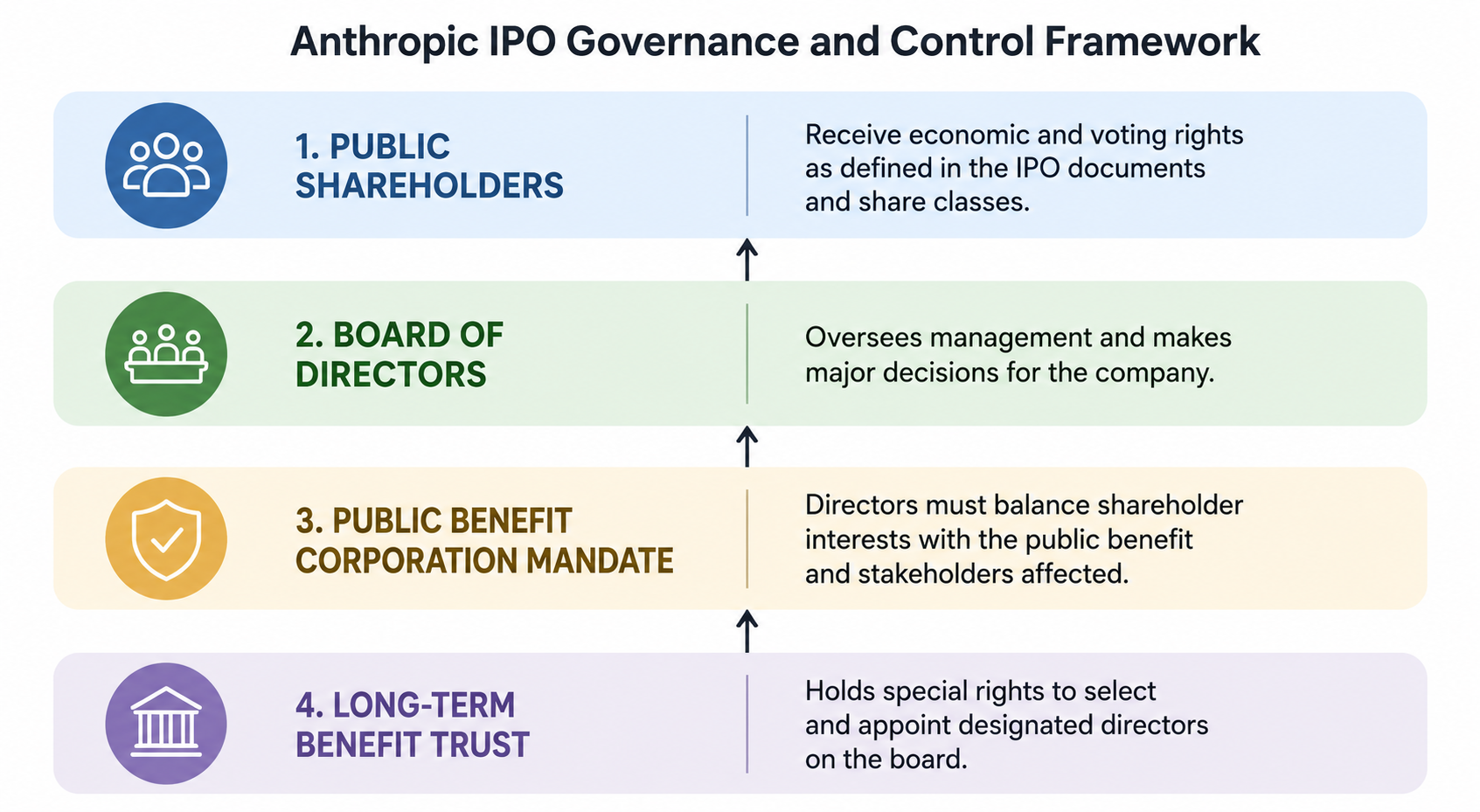
Anthropic is a Delaware Public Benefit Corporation, so its board must balance shareholder interests with its stated public benefit and the interests of people affected by its decisions.
-
The Long-Term Benefit Trust holds special powers connected to selecting members of Anthropic’s corporate board.
-
Public investors could own Anthropic shares without receiving voting influence proportional to their economic ownership.
-
Anthropic’s final share classes, voting ratios and investor protections must be confirmed through its public IPO filing.
-
The main investor trade-off is stronger protection from short-term commercial pressure in exchange for reduced shareholder control.
Why Is Anthropic IPO Governance Different?
Anthropic IPO governance differs from standard public-company governance because Anthropic combines a for-profit corporation with two mission-protection mechanisms: Public Benefit Corporation status and the Long-Term Benefit Trust.
Anthropic is still a commercial company. Claude subscriptions, API usage and enterprise agreements form part of how Anthropic makes money, while investors would expect the company to expand revenue and manage costs. However, Anthropic’s directors are not expected to consider shareholder returns in isolation.
Under Delaware law, directors of a Public Benefit Corporation must balance:
-
Shareholders’ financial interests.
-
The interests of people materially affected by the corporation’s conduct.
-
The specific public benefit stated in the corporation’s charter.
Anthropic identifies its purpose as the responsible development and maintenance of advanced artificial intelligence for the long-term benefit of humanity. The structure therefore gives directors a legal basis for considering safety, social effects and long-term consequences when approving major decisions.
This balancing duty does not make Anthropic a charity, nor does it mean profit is unimportant. Anthropic remains a for-profit business whose commercial prospects depend on Claude adoption, enterprise demand, infrastructure spending and its position within the broader Anthropic, OpenAI and Google DeepMind competition.
What Is Anthropic’s Long-Term Benefit Trust?
The Long-Term Benefit Trust is an independent governance body designed to help preserve Anthropic’s public-benefit mission as the company raises capital and faces stronger commercial pressure.
Anthropic created the Trust with a special class of stock carrying rights related to the selection of directors. The original framework was designed to expand the Trust’s board-selection power over time, eventually enabling it to elect a majority of Anthropic’s board.
The Trust does not develop Claude, negotiate customer contracts or run Anthropic’s daily operations. Its importance comes from its ability to influence who oversees management.
Anthropic has continued adding members with experience in economics, law, public policy and national security. Former US Federal Reserve Chair Ben Bernanke joined the Trust in July 2026, while Mariano-Florentino Cuéllar joined in January 2026. Anthropic describes the Trust as a mechanism for holding the company to its public mission.
How Could Anthropic’s Structure Affect Shareholder Rights?
Anthropic’s structure could separate economic ownership from effective corporate control.
A public investor might benefit when Anthropic’s revenue or valuation grows, but the same investor may have limited ability to elect directors, remove management or redirect corporate strategy. The exact result will depend on the share classes and governance rights disclosed in Anthropic’s public offering documents.
| Governance issue |
Possible effect on public investors |
| Director elections |
The Trust may select designated directors independently of public shareholders |
| Management accountability |
Investors may have less influence over replacing leadership |
| Strategic priorities |
Safety or public-benefit objectives may outweigh near-term revenue opportunities |
| Activist campaigns |
Activist shareholders may struggle to gain board control |
| Acquisitions |
The board may assess mission consequences as well as the proposed price |
| Governance changes |
Special approval thresholds may protect Trust powers from ordinary shareholder votes |
The key question is not simply how many Anthropic shares an investor owns. Investors must calculate how much voting power those shares carry and which decisions remain outside ordinary shareholder control.
That distinction also separates this governance analysis from the broader question of what Anthropic is, how Claude works and how an IPO could be valued. Valuation measures the price assigned to the business. Governance determines who can influence how that business is managed.
Could Anthropic’s Governance Benefit Investors?
Anthropic’s governance could benefit long-term investors if it prevents short-term market pressure from weakening model testing, security controls or responsible deployment standards.
Advanced AI companies may face incentives to release models quickly, enter sensitive markets or reduce expensive safety work. Anthropic’s board could conclude that delaying a launch or limiting a high-risk deployment supports the corporation’s long-term public benefit, even when the decision lowers immediate revenue.
Such restraint could protect enterprise trust, regulatory relationships and long-term business durability. Anthropic’s emphasis on model reliability, safety research and enterprise adoption is also part of its wider competitive advantage in the AI market.
The same protections can create an accountability problem. A mission-protection mechanism may shield responsible decision-making, but it could also shield poor execution. Shareholders may find it difficult to challenge management when products underperform, costs rise or strategic decisions fail to produce measurable benefits.
Anthropic’s structure therefore creates an exchange rather than an automatic advantage:
| Potential protection |
Corresponding investor trade-off |
| Resistance to short-term pressure |
Less direct shareholder influence |
| Greater freedom to fund safety work |
Lower near-term financial flexibility |
| Protection against hostile control |
Greater management-entrenchment risk |
| Mission continuity |
Uncertainty over how the mission is interpreted |
What Governance Risks Should Investors Examine?
Anthropic governance introduces risks that are related to, but distinct from, the valuation, competition, regulation and infrastructure issues covered by broader Anthropic IPO risk analysis.
Control Risk
Public shareholders may provide substantial capital while electing only a limited proportion of the board. Investors should compare voting power with economic ownership rather than assuming one share provides one equal vote.
Mission-Interpretation Risk
The “long-term benefit of humanity” is broad enough to support different interpretations. Directors and Trust members may disagree about model releases, government work, safety thresholds or commercial partnerships.
Entrenchment Risk
Special director-selection rights may make it harder to replace ineffective leadership. Mission protection is valuable only when it operates alongside credible accountability mechanisms.
Amendment Risk
The governance structure may be stronger or weaker than it first appears depending on who can amend the Trust agreement, charter and special share rights. Investors need to know whether protections are permanent, conditional or subject to a sunset clause.
What Should Investors Check in Anthropic’s IPO Filing?
Anthropic’s eventual public registration statement should be treated as the controlling source for shareholder rights.
Anthropic confidentially submitted draft IPO documents in June 2026, but a confidential filing does not complete an IPO or reveal the final offering terms.
When the documents become public, investors should examine:
-
Share classes: Identify every class and the number of votes attached to each share.
-
Board-selection rights: Determine which directors are elected by shareholders, founders and the Trust.
-
Director removal: Check whether public investors can remove Trust-appointed or founder-appointed directors.
-
Trust amendments: Identify who can change the Long-Term Benefit Trust’s powers.
-
Sunset provisions: Determine whether special rights expire after a date, ownership threshold or leadership change.
-
Change-of-control rules: Review how the structure affects mergers, acquisitions and activist campaigns.
-
Public-benefit reporting: Check how Anthropic measures and discloses progress against its stated purpose.
-
Related-party arrangements: Examine agreements involving founders, directors and strategic investors.
These disclosures will also determine whether future exchange-listed shares differ materially from the limited private-market pathways associated with investing in Anthropic before an IPO.
Conclusion
Anthropic IPO governance could give public investors participation in the company’s economic growth without providing conventional control over its board and strategy. Anthropic’s Public Benefit Corporation status expands the interests directors must consider, while the Long-Term Benefit Trust can influence board composition.
The structure may protect long-term AI-safety commitments from quarterly market pressure, but it may also limit shareholder accountability and make management more difficult to challenge. Investors cannot reach a final judgment until Anthropic publicly discloses its share classes, voting ratios, Trust rights, director-removal procedures and governance-amendment rules.
FAQs
Is Anthropic a Public Benefit Corporation?
Yes. Anthropic is organized as a Delaware Public Benefit Corporation. Its directors must balance shareholder financial interests, Anthropic’s stated public benefit and the interests of people materially affected by its conduct.
What is Anthropic’s Long-Term Benefit Trust?
The Long-Term Benefit Trust is an independent governance body with special rights connected to selecting Anthropic board members. The Trust is intended to help Anthropic preserve its mission as investor and commercial pressures grow.
Can Anthropic shareholders control the board?
The level of shareholder control cannot be confirmed until Anthropic publishes its final IPO documents. The Long-Term Benefit Trust’s director-selection rights could prevent ordinary shareholders from controlling a majority of board seats.
Would Anthropic IPO shares have voting rights?
Anthropic has not publicly disclosed the final voting terms of its IPO shares. Investors must review the registration statement for share classes, votes per share and director-election rights.
Has Anthropic completed its IPO?
No. A confidential filing is an early regulatory step and does not mean Anthropic has completed an IPO. The offering date, ticker, exchange, valuation and final terms remain subject to disclosure and regulatory review.
Is Anthropic’s governance structure good for investors?
Anthropic’s structure may protect long-term safety investments and institutional trust, but it may also reduce shareholder influence. Its value depends on whether the board and Trust remain transparent, accountable and commercially disciplined.