Founded in 2021 by former OpenAI researchers, Anthropic developed Claude as a family of large language models designed for reasoning, coding, analysis, and professional workflows. The company competes in a rapidly changing AI market where technical improvements spread quickly, making business strategy and ecosystem development increasingly important.
As AI competition expands between Anthropic, OpenAI, Google DeepMind, and other technology companies, the strongest advantage is no longer only creating powerful models. AI companies must also build reliable products, attract developers, support enterprise users, and create sustainable revenue models.
TL;DR
-
Anthropic’s competitive advantage comes from Claude AI models, Constitutional AI research, enterprise adoption, and API-based AI services.
-
Anthropic differentiates itself through AI alignment research and a focus on reliable AI deployment.
-
Claude supports professional workflows including coding, research, document analysis, and business automation.
-
Anthropic’s business model depends on enterprise customers, Claude API usage, and strategic partnerships.
-
Anthropic faces challenges from competition, infrastructure costs, regulation, and uncertainty around future AI market dynamics.
What Creates Anthropic’s Competitive Advantage?
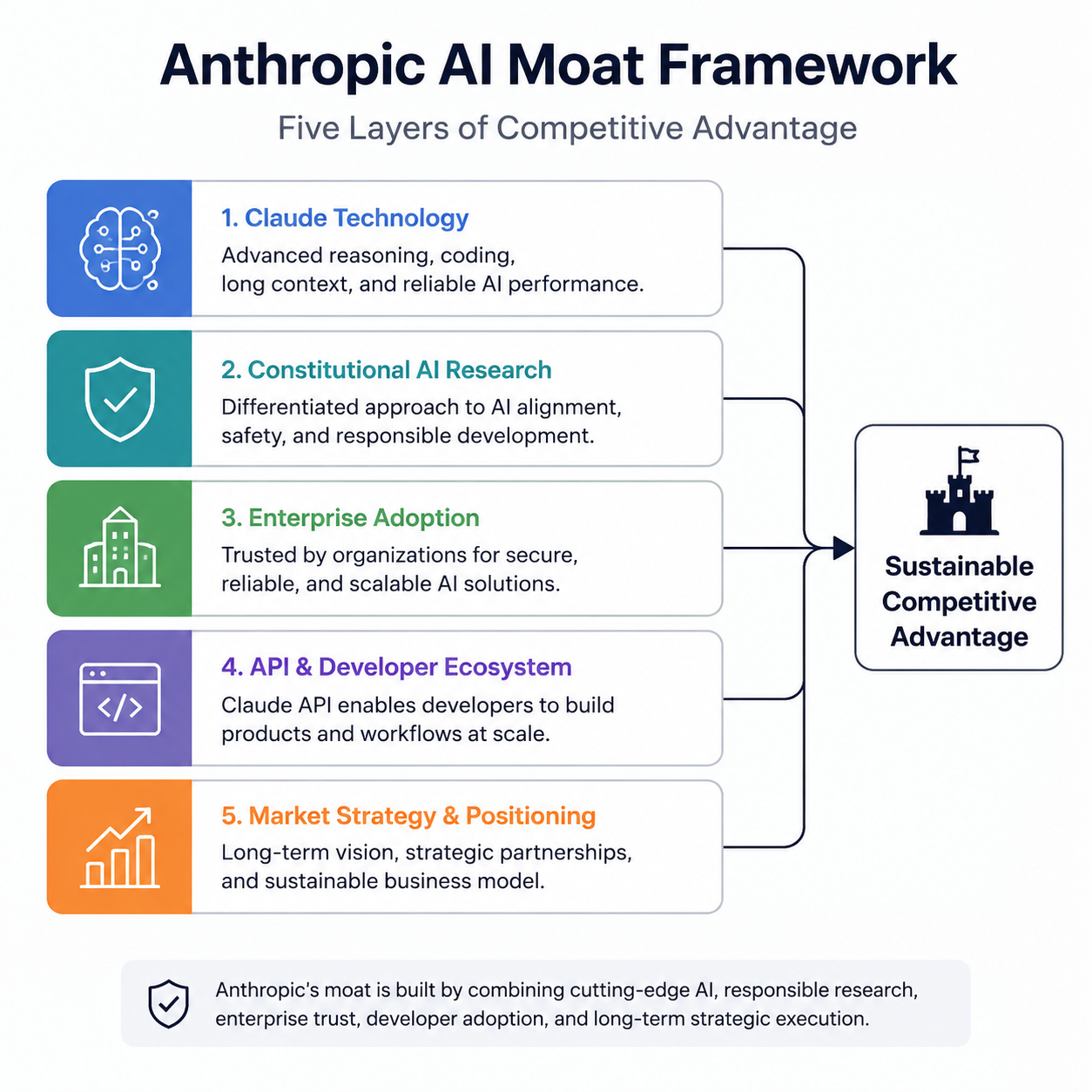
Anthropic’s competitive advantage comes from five connected areas: AI technology, research expertise, enterprise adoption, monetization strategy, and ecosystem development.
| Competitive Advantage |
Role in Anthropic’s Strategy |
| Claude AI models |
Provides advanced reasoning, coding, and analysis capabilities |
| Constitutional AI |
Creates differentiation in AI alignment research |
| Enterprise adoption |
Supports real-world AI deployment |
| Claude API ecosystem |
Enables developers and businesses to integrate AI |
| Research expertise |
Helps Anthropic compete in frontier AI development |
A sustainable AI moat requires more than achieving strong benchmark results. Model capabilities continue improving across the industry, meaning individual technical advantages can become temporary.
Anthropic’s broader advantage comes from combining technical capability with adoption, trust, and commercial infrastructure.
How Does Claude Technology Strengthen Anthropic’s AI Moat?
Claude strengthens Anthropic’s competitive position by supporting complex knowledge work, including software development, research, document analysis, and enterprise automation.
Key Claude capabilities include:
| Capability |
Business Importance |
Strategic Focus |
| Reasoning |
Helps solve complex analytical problems |
Reliable enterprise AI deployment |
| Long-context processing |
Supports large document and information workflows |
Consumer and developer AI applications |
| Coding assistance |
Enables software engineering applications |
Frontier AI integrated with Google ecosystem |
| Language understanding |
Supports research and communication tasks |
Supports research and communication tasks |
| API availability |
Allows developers to build AI-powered products |
Allows developers to build AI-powered products |
Enterprise customers typically evaluate AI systems based on more than intelligence alone. Businesses also consider reliability, security requirements, integration options, and operational consistency.
This creates an advantage for Anthropic because enterprise AI adoption requires confidence that AI systems can support important workflows.
Claude’s commercial importance is closely connected to Anthropic’s revenue model. The company’s approach combines enterprise usage, Claude API adoption, and partnerships that allow organizations to integrate AI capabilities into applications. Anthropic’s approach to monetization and Claude’s commercial strategy is discussed through its Claude AI business model and IPO valuation.
Why Is Constitutional AI Important to Anthropic’s Strategy?
Constitutional AI is important because it represents Anthropic’s approach to improving AI behavior through principle-based training methods.
While many AI companies focus primarily on increasing model capability, Anthropic also emphasizes alignment research. The goal is to create systems that remain useful while following defined behavioral principles.
Constitutional AI contributes to Anthropic’s positioning in three ways:
Research Differentiation
Anthropic has built a recognizable identity around AI safety and alignment research.
Enterprise Trust
Organizations deploying AI often consider governance, reliability, and responsible development practices.
Long-Term Positioning
As AI regulation and enterprise standards develop, responsible AI practices may become increasingly important.
However, Constitutional AI does not eliminate all AI limitations. Models can still produce incorrect information, misunderstand requests, or generate unexpected outputs.
Anthropic Business Model: How Does Commercial Strategy Support Its AI Moat?
Anthropic’s business model strengthens its competitive position by connecting AI research with commercial adoption.
The company’s revenue opportunities are connected to:
-
Claude subscriptions;
-
enterprise agreements;
-
API access;
-
developer integrations;
-
strategic partnerships.
API access is particularly important because developers can build applications using Claude models instead of creating AI infrastructure independently. This creates ecosystem effects because businesses may integrate Claude into existing workflows.
Anthropic’s Claude API strategy demonstrates how AI companies increasingly compete through platforms rather than only through models. The company’s monetization approach, enterprise relationships, and API-driven growth are important parts of how Anthropic makes money through Claude API and its business model.
A successful AI company needs both technical capability and commercial execution. Strong models attract users, but sustainable growth depends on turning those capabilities into reliable products and recurring business relationships.
Anthropic vs OpenAI vs Google DeepMind: Competitive Position
Anthropic competes with some of the largest AI organizations globally.
| Company |
Core Advantage |
Strategic Focus |
| Anthropic |
Claude models and AI alignment research |
Reliable enterprise AI deployment |
| OpenAI |
ChatGPT ecosystem and broad adoption |
Consumer and developer AI applications |
| Google DeepMind |
Research strength and infrastructure |
Frontier AI integrated with Google ecosystem |
Each company has different strengths.
Anthropic’s differentiation comes from combining advanced AI research with enterprise-focused deployment. OpenAI benefits from consumer recognition and broad product adoption. Google DeepMind benefits from Google’s infrastructure and research resources.
AI leadership depends on multiple factors including research capability, computing resources, distribution, partnerships, and commercial execution.
What Are the Five Layers of Anthropic’s AI Moat?
Anthropic’s AI moat can be understood through five layers.
-
Research Moat
Frontier AI development requires specialized knowledge and experienced researchers. Anthropic’s research background supports continued development of advanced AI systems.
-
Technology Moat
Claude models provide capabilities across reasoning, coding, and complex information processing.
Technology advantages remain difficult to maintain because competitors continue improving their own models.
-
Trust Moat
Enterprise users often require predictable AI behavior, security considerations, and responsible deployment approaches.
Anthropic’s focus on AI alignment contributes to its trust-based positioning.
-
Distribution Moat
Developer adoption and enterprise integrations can create long-term ecosystem advantages.
When organizations build workflows around AI systems, changing providers may require additional technical effort.
-
Market Positioning Moat
Anthropic has developed a distinct identity around reliable AI systems and enterprise-focused deployment.
This positioning influences how businesses evaluate AI providers.
What Challenges Could Limit Anthropic’s Competitive Advantage?
Anthropic faces several challenges despite its strong market position.
| Challenge |
Potential Impact |
| Infrastructure costs |
Frontier AI requires significant computing investment |
| Competition |
OpenAI, Google DeepMind, Meta, and others continue advancing |
| AI commoditization |
Model differences may become smaller |
| Regulation |
AI rules may affect deployment and compliance |
| Commercial scaling |
Technical success must translate into sustainable growth |
Anthropic’s future depends on maintaining innovation while managing the financial and operational demands of frontier AI development.
Anthropic IPO Risks and Future Market Position
Anthropic remains a private company, meaning discussions about future public-market possibilities involve uncertainty.
Potential considerations around a future IPO include:
-
maintaining AI technology leadership;
-
managing infrastructure expenses;
-
demonstrating sustainable revenue growth;
-
responding to regulatory changes;
-
competing against larger technology companies.
The relationship between private-company growth, valuation expectations, and potential public-market considerations requires careful analysis because AI companies operate in a rapidly changing environment. These factors are discussed in the context of Anthropic IPO risks and possible challenges.
Private-company ownership and access to potential investment opportunities also depend on eligibility, availability, and applicable regulations. Discussions around private-market participation require understanding company structure and risk factors rather than assuming future outcomes. The broader topic of private-company access is explored through how Anthropic investment opportunities are discussed before an IPO.
Summary
Anthropic’s competitive advantage comes from combining Claude AI technology, Constitutional AI research, enterprise adoption, API-based monetization, and ecosystem development.
Anthropic’s AI moat is built through multiple reinforcing advantages. Research creates differentiation, technology creates capability, and commercial adoption creates long-term value.
However, Anthropic operates in one of the most competitive technology markets. Maintaining its position will depend on continued innovation, efficient infrastructure management, enterprise adoption, and responsible AI development.
FAQs
What is Anthropic’s biggest competitive advantage?
Anthropic’s biggest competitive advantage is the combination of Claude AI capabilities, AI alignment research, enterprise adoption, and developer ecosystem growth.
Why is Claude different from ChatGPT?
Claude and ChatGPT are developed by different companies with different strategies. Anthropic focuses strongly on reliable AI deployment and alignment research, while OpenAI focuses on broad consumer and developer adoption.
Does Anthropic have an AI moat?
Anthropic has several potential moat factors, including research expertise, Claude technology, enterprise relationships, and API adoption. However, AI competition remains intense.
How does Anthropic make money?
Anthropic generates revenue through Claude subscriptions, API usage, enterprise customers, and partnerships that integrate AI capabilities into business workflows.
What are the risks of an Anthropic IPO?
Potential IPO considerations include valuation uncertainty, competition, infrastructure costs, regulation, and the challenge of maintaining growth in a rapidly changing AI market.