Introduction
Crypto tools are not limited to wallets, trading terminals, or data analytics platforms. They also include the foundational components used within protocols to process assets, pricing, risk, and governance. One important characteristic of DeFi is that it breaks down some functions of the traditional financial system into composable on-chain modules and connects them through smart contracts. Tokens can serve different roles, such as mediums of exchange, collateral, units of account, or governance tools. How these roles are designed directly affects a protocol's use cases and risk structure.
Ampleforth is a case study for examining this type of design. AMPL uses an elastic supply mechanism that adjusts the token quantity based on its deviation from the target price. FORTH previously served as a governance token, providing a voting mechanism for protocol parameters and DAO decisions. The two correspond to an asset tool and a governance tool, respectively, demonstrating how DeFi protocols can design monetary and management functions as separate layers.
However, innovation in mechanism design does not automatically translate into successful applications. AMPL's elastic supply design requires market participants to understand how rebase affects wallet balances and asset value. Related lending, collateral, and derivatives applications must also address the accounting and risk management issues caused by supply changes. Meanwhile, the Forth DAO underlying FORTH entered an exit phase in 2026, resulting in changes to its original governance structure. These developments show that analyzing crypto tools requires more than studying how smart contracts operate. It also requires observing whether the tools continue to address real needs and whether the governance systems supporting them can operate over the long term.
Key Points
-
AMPL is an elastic supply tool: The protocol adjusts the token quantity based on the deviation from the target price, changing how volatility is expressed compared with traditional fixed-supply assets
-
Rebase changes the token quantity and does not automatically guarantee investment returns: Changes in wallet balances must be analyzed together with the price per token and the total value of the holdings
-
Wrapping mechanisms such as WAMPL help assets work with different DeFi applications: However, wrapped tokens do not eliminate the supply changes or price risk of the underlying AMPL
-
FORTH previously served as a governance tool: Its function differs from AMPL's asset function, and changes to the governance system also change the context of its original role
-
The sustainability of a protocol tool depends on real-world applications: Technical composability, market demand, liquidity, risk management, and governance arrangements must all work together
AMPL's Elastic Supply Mechanism: From Price Volatility to Quantity Adjustments
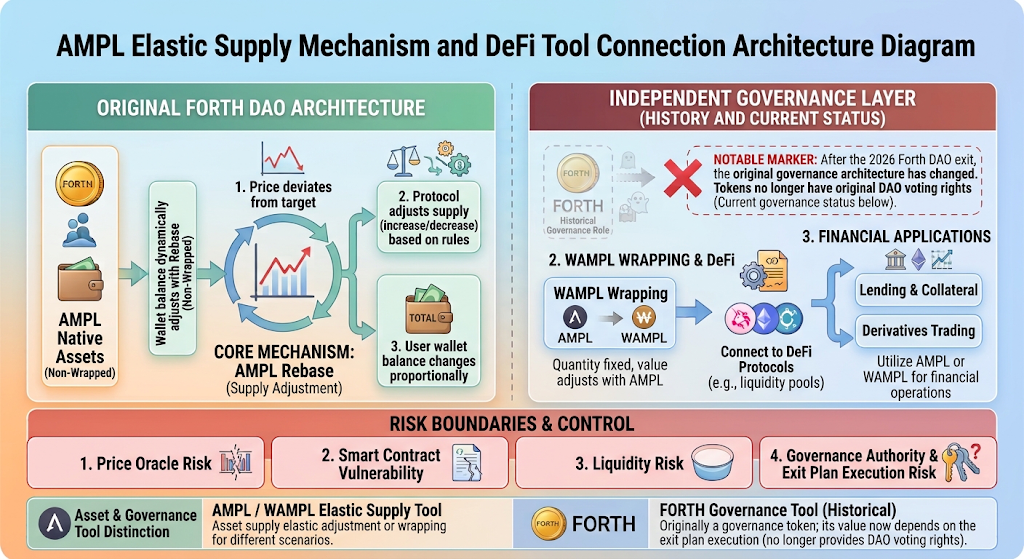
Traditional crypto assets generally use relatively fixed or predetermined supply rules. When market demand increases, the price may rise. When demand falls, the price may decline. AMPL uses a different design approach: The protocol uses the purchasing power of 2019 US dollars adjusted by CPI as its target reference. When the market price deviates from the target range, the protocol adjusts the token supply through a rebase mechanism.
When the AMPL price rises above the target level and reaches the adjustment conditions set by the protocol, the system proportionally increases the amount of AMPL in holders' wallets. When the price falls below the target level and reaches the corresponding conditions, the system proportionally reduces wallet balances. Supply adjustments are not completed through individual transfers initiated by users. Instead, the protocol uniformly updates the quantities corresponding to account balances.
This mechanism changes how the asset absorbs changes in market demand. Fixed-supply assets primarily reflect supply and demand through price changes, while AMPL attempts to shift part of demand volatility to the token quantity. Its goal is not to keep the token price fixed at every moment, but to use supply adjustments to make the price operate around the purchasing power target over a longer time horizon.
Understanding this mechanism requires distinguishing between the price per token, the token quantity, and the total value of the holdings. Suppose a user holds 100 AMPL and their balance increases after a positive rebase. The number of tokens they hold increases, but this does not mean they automatically receive a proportional increase in wealth, because the market price may also be affected by supply changes and market trading activity. A negative rebase likewise reduces the number of tokens in the wallet, but the reduction in quantity alone cannot be used to conclude that the user has incurred exactly the same loss as they would from a decline in the price of an ordinary token.
Therefore, AMPL should not be analyzed solely by observing the price per token or changes in wallet balances. A more appropriate approach is to examine the token quantity, market price, total value of the holdings, and asset use case both before and after the rebase. Users who use AMPL for lending, collateral, or contract pricing must also understand how the protocol handles supply changes and whether the related applications properly support the rebase mechanism.
How Does Rebase Affect Wallets, Trading, and Asset Management?
The most direct impact of a rebase is a change in wallet balances. Users may not need to actively execute a transaction for the protocol to adjust the displayed amount of AMPL in their accounts according to its rules. This differs from the fixed-balance experience of ordinary ERC-20 tokens and means that wallets, trading terminals, asset management tools, and DeFi protocols must correctly read and process balance changes.
For ordinary holders, asset records must distinguish between changes in quantity and changes in value. Suppose the amount of AMPL held by a user increases due to a positive rebase, but the market price declines during the same period. The total value of the holdings may still change. Conversely, a reduction in quantity after a negative rebase cannot be evaluated separately from price changes. Focusing only on the token quantity can lead to an overestimate or underestimate of the actual risk.
For trading platforms and data tools, the rebase mechanism creates additional data processing requirements. Market pages need to accurately display the price, circulating supply, and trading volume. Asset accounting systems need to distinguish between balance changes and actual buying or selling activity. Historical data analysis must also avoid misclassifying automatic protocol adjustments as user trading activity. If a data tool does not process rebase correctly, discrepancies may arise between supply statistics, changes in holdings, and return calculations.
The issue is more complex for DeFi applications. Lending protocols need to clearly define how collateral quantities change with a rebase, which price and balance should be used to calculate liquidation thresholds, and whether the borrower's debt is affected by the same mechanism. Different protocols may use different compatibility methods, so it cannot be assumed that all lending markets support AMPL in the same way.
This also shows that the value of a crypto tool depends not only on the design of the token itself but also on whether the surrounding infrastructure can correctly process its special mechanisms. Wallets, oracles, data indexes, lending protocols, and trading platforms need to establish consistent asset processing logic. Otherwise, a seemingly simple supply adjustment mechanism may create complex risk transmission across different applications.
AMPL, WAMPL, and DeFi Composability
In the DeFi ecosystem, whether an asset can be recognized and used by different protocols is an important factor in determining its range of applications. Although AMPL's elastic supply characteristics provide a unique pricing mechanism, they may also make it more difficult for certain smart contracts and financial applications to support the asset. To improve compatibility with other ERC-20 applications, the Ampleforth ecosystem provides WAMPL, or Wrapped AMPL.
Wrapping mechanisms generally lock or deposit the native asset in a corresponding contract and then issue a wrapped token representing its value or rights. In the case of WAMPL, the wrapped token format helps connect AMPL's elastic supply characteristics with the token interaction methods required by certain DeFi applications. This allows the AMPL ecosystem to explore a wider range of application combinations without requiring every external protocol to process the native rebase mechanism directly.
However, wrapping does not mean that the underlying economic risks disappear. Users still need to understand the conversion relationship between WAMPL and AMPL, the wrapping and unwrapping rules, smart contract risks, and market liquidity. If the price of the underlying asset changes, the market value of the wrapped asset may also be affected. If the wrapping contract encounters a technical problem, users may face additional smart contract risks.
From a tool design perspective, wrapped assets reflect the modular approach of DeFi: A standardized interface allows assets with special mechanisms to enter a broader application environment. However, composability does not mean unconditional compatibility. Protocols still need to verify the asset price source, collateral parameters, redemption mechanism, and risk boundaries. For elastic supply assets such as AMPL, external applications must also understand their supply adjustment characteristics and avoid mistaking quantity changes for ordinary transfers or newly issued tokens.
How Does AMPL Enter Lending and On-Chain Financial Applications?
Ampleforth's official materials position AMPL as a decentralized unit of account and describe its potential applications in lending, borrowing, derivatives, and collateral. Unlike crypto assets whose primary characteristic is market price volatility, AMPL's design attempts to combine a long-term pricing target with changes in the token quantity held in wallets. This structure provides a design approach for on-chain contracts and financial products that differs from that of fixed-supply assets.
In lending scenarios, lending contracts can use AMPL as a pricing or debt unit. Because AMPL's price target is linked to a purchasing power benchmark, protocol designers can explore expressing debt and repayment obligations in this unit. However, the actual risk still depends on the lending protocol's parameters, collateral type, interest rate design, and liquidation rules. A target price mechanism cannot eliminate risks such as borrower default, insufficient collateral, or a lack of market liquidity.
In collateral scenarios, AMPL or its wrapped form may be used to support other on-chain assets or financial products. Protocols need to clearly define how collateral value is calculated, how a rebase affects account balances, and how risk management measures are triggered when the price deviates from the target. If an application calculates collateral ratios solely based on the token quantity without considering the price and supply mechanisms, it may produce unreasonable risk assessments.
In derivatives scenarios, elastic supply assets may also provide new underlying variables for contract design. Traditional derivatives generally build their return structures around price changes, while AMPL's quantity adjustment mechanism allows designers to study different relationships between price, quantity, and purchasing power. However, derivatives do not automatically reduce risk. Instead, they may add complex factors such as contract leverage, liquidity, and model assumptions.
Therefore, the value of AMPL as a financial tool should be evaluated based on actual applications rather than conceptual innovation. It is necessary to observe whether related products continue to operate, whether they have sufficient liquidity, whether users actually adopt them, and whether external protocols can correctly process the elastic supply mechanism. Technical design provides possibilities, but a tool can develop long-term utility only when supported by stable application demand and reliable risk management.
FORTH: How Can a Protocol Governance Tool Affect an Asset Tool?
If AMPL primarily addresses asset supply and pricing, FORTH previously served a function at the level of protocol governance. It allowed holders to participate in decisions concerning protocol rules, ecosystem direction, and DAO fund allocation, enabling the parameters and development path of the asset tool to be adjusted through community governance.
This design reflects a common functional separation in DeFi: The underlying asset provides a specific financial function, while the governance token provides a mechanism for participating in protocol decisions. Governance tools can influence protocol upgrades, parameter settings, ecosystem resource allocation, and application development. They may therefore indirectly affect the environment in which the underlying asset is used. However, a governance token is not the same as the underlying asset and does not automatically represent protocol revenue or ownership of assets.
The FORTH case also shows that the effectiveness of a governance tool depends on whether its institutional arrangements continue to exist. According to information published by the Ampleforth official governance forum in October 2026, FORTH holders approved a proposal to end the Forth DAO. Protocol management authority was subsequently transferred to a Kennel Club multisig and Timelock structure. The official materials also proposed the disposal of DAO treasury assets, liquidity adjustments, and certain subsequent arrangements for the ecosystem.
This means that FORTH can no longer be described as a governance tool that continues to manage the AMPL ecosystem under its original model. The continued existence of the token and the continued operation of the original DAO governance mechanism are two separate issues. For the architecture of protocol tools, the withdrawal of governance may transfer the management of parameters, funds, and system maintenance from the DAO to other managing entities. The relevant boundaries of authority, transparency, and responsibility also need to be reassessed.
More broadly, governance tools are not necessarily a permanently stable and unchanging layer of a DeFi system. A protocol may adjust its governance structure based on product-market fit, community participation, and capital efficiency, or even end a DAO. For users of the underlying asset, these changes may affect future upgrades, ecosystem support, and application maintenance. Governance status should therefore be included in the risk assessment of asset tools.
SPOT and Ecosystem Adjustments: Why Does Technical Design Need Product-Market Fit?
The development of the Ampleforth ecosystem has involved more than AMPL and FORTH. It also previously explored new financial applications around products such as SPOT. SPOT's design attempted to build a different value storage and risk structure on the foundation of an elastic supply asset, reflecting the project's efforts to extend its underlying monetary mechanism into more complex DeFi products.
However, an innovative technical structure does not mean that the market will necessarily adopt it. For an on-chain financial product to achieve sustained use, it must address multiple factors, including user needs, risk comprehension, liquidity, trading convenience, and competing products. If the product structure is complex and users have difficulty understanding the source of returns and the risks they assume, it may struggle to generate sufficient market demand even if it operates technically.
In the DAO exit plan announced by the official Ampleforth forum in October 2026, the project proposed ending related systems, including SPOT, stAMPL, and Bill Broker, and recommended that users pay attention to asset withdrawal and redemption matters according to the applicable deadlines. The plan shows that whether ecosystem products should continue to develop must be assessed based on actual adoption and operational resources rather than technical design alone. The specific status of the exit process and asset handling should be determined based on subsequent official announcements and on-chain records.
This provides an important lesson for crypto tool design. Protocol innovation must simultaneously meet the requirements of technical feasibility, user understanding, market demand, and risk management. If a tool cannot create sufficient value in real-world applications, the governance system may ultimately choose to reduce the product scope, reallocate resources, or end the related system. For users, understanding the product mechanism is not enough. They must also continue to monitor whether the protocol is still maintained, whether assets can be redeemed normally, and whether the related contracts and front-end services remain available.
Key Dimensions for Evaluating Elastic Supply Crypto Tools
When studying elastic supply tools such as AMPL, the first step is to understand their supply adjustment rules. Users need to confirm the price target, trigger conditions, adjustment frequency, and method used to calculate supply changes. They should also understand whether these rules can be adjusted through governance or administrative authority. Looking only at the token name or price target does not provide a complete understanding of the asset mechanism.
Second, it is necessary to analyze the relationship between changes in asset quantity and changes in value. A rebase affects wallet balances but does not guarantee that the total value of holdings will increase or decrease by the same proportion. Users should observe the token quantity, market price, circulating supply, and actual trading value together, and understand whether different data platforms process rebase correctly.
Third, application compatibility must be assessed. If an asset is used in lending, collateral, liquidity pools, or derivatives, factors such as whether the related protocol supports elastic supply mechanisms, whether it uses a wrapped asset, and how its price oracle operates will all affect risk. The fact that an asset can be transferred on-chain does not mean that it can be used safely in every DeFi scenario.
Fourth, users need to pay attention to liquidity and market depth. An elastic supply mechanism does not guarantee liquidity. Even if a token has a clearly defined price target, it may trade at a deviation from that target or experience wider bid-ask spreads on different trading platforms. Liquidity may also differ between wrapped and native assets, so users need to check them separately.
Fifth, governance and maintenance arrangements must be reviewed. Whether the protocol still has active governance, who manages the key contracts, how upgrade permissions are allocated, how treasury assets are used, and whether the product is still maintained will all affect the tool's long-term usability. Ampleforth's governance changes show that governance and ecosystem support may change even when a technical mechanism can continue to operate.
Gate and Ampleforth: Understanding DeFi Tools Through Elastic Supply Mechanisms
Ampleforth's design provides a case study for understanding special asset mechanisms in DeFi. AMPL's rebase mechanism shows that on-chain assets do not necessarily use a fixed supply and a single price volatility model. WAMPL demonstrates how a wrapped asset can help connect a special token mechanism with a broader range of DeFi tools. FORTH's governance changes further show that the long-term usability of a protocol tool also depends on its governance and management structure.
Gate's educational content has introduced elastic supply tokens and AMPL's operating mechanism, providing users with foundational knowledge about rebase, supply adjustments, and changes in asset quantity. Users who want to study Ampleforth further can combine Gate's educational materials with the project's official documentation to learn about AMPL's technical design, FORTH's governance history, and the current status of related ecosystem products.
For market observations, users can also use Gate's market information and research content to learn about crypto asset prices, trading volume, and industry developments. However, for assets with special supply mechanisms, simply comparing price increases and decreases is not enough. Users must also confirm whether the data accounts for rebase, whether the asset has sufficient liquidity, and whether the related DeFi applications are still operating normally.
It should be made clear that this article's analysis of AMPL, FORTH, and related ecosystem tools constitutes mechanism and industry research. It does not represent Gate's endorsement of the related protocols or tokens, a guarantee of returns, or an investment recommendation. Specific asset trading services, product support, and trading rules are subject to the real-time pages and official announcements on the Gate platform. Redemption or exit arrangements involving products such as SPOT are subject to Ampleforth's official announcements and on-chain execution records.
From the broader perspective of DeFi development, truly valuable crypto tools require more than innovative mechanisms. They also need an understandable risk structure, reliable infrastructure, and sustained real-world demand. The development of AMPL and FORTH shows that asset mechanisms, application compatibility, and governance systems must evolve together to support sustainable, long-term use cases for a protocol.
FAQ
What Is AMPL? What Does Rebase Mean?
AMPL is the elastic supply token of the Ampleforth protocol. The protocol adjusts the token supply based on the deviation of the market price from the target level, which may cause wallet balances to change proportionally. Rebase is the mechanism through which the protocol adjusts the token supply according to its rules. For AMPL, a positive rebase increases wallet balances, while a negative rebase reduces them. However, changes in balances do not mean that the total value of holdings changes by the same proportion.
What Is the Difference Between AMPL and WAMPL?
AMPL is the native elastic supply token, while WAMPL is its wrapped form, designed to help AMPL work with certain DeFi applications. The wrapping mechanism does not automatically eliminate the market risk and smart contract risk of the underlying asset.
What Function Does FORTH Serve in the Ampleforth Ecosystem?
FORTH is the governance token of the Ampleforth ecosystem. Historically, it was used to participate in decisions concerning the protocol and the Forth DAO. After the Forth DAO entered an exit phase in 2026, its original governance mechanism and management authority were adjusted.
Can AMPL Be Used for Lending and Collateral?
Ampleforth's official materials describe AMPL's intended use in on-chain financial scenarios such as lending, borrowing, and collateral. Whether it is supported by a specific application depends on the relevant protocol's asset compatibility, collateral parameters, and risk rules.
Can the Elastic Supply Mechanism Guarantee a Stable AMPL Price?
It should not be understood as a guarantee that the price will remain fixed at all times. AMPL uses supply adjustments to respond to changes in demand, but the market price may still deviate from the target. The process of returning to the target is also affected by market activity and the protocol's mechanisms.