Web3 applications rely on a multilayer technology stack to operate. Blockchains can record state, execute smart contracts, and manage digital assets, but large-scale data processing, model execution, and content delivery still require support from other infrastructure. AIOZ Network seeks to integrate AI computing, storage, content pinning, and media delivery through distributed nodes, providing developers with a range of infrastructure services. Starting from application architecture, this article examines how these services can work together, the practical value of decentralized resource networks, and their limitations in performance, security, developer experience, and commercial adoption.
Key Takeaways
-
Web3 applications typically need to combine on-chain rules with off-chain computing, storage, and content delivery
-
AIOZ Network seeks to bring AI computing, storage, and media services into a unified distributed infrastructure framework
-
Integrating multiple services may reduce some development and coordination costs, but does not automatically ensure better performance or lower prices
-
Developer adoption depends on service reliability, interface compatibility, data security, costs, and migration capabilities
-
The long-term value of Web3 infrastructure must be validated through real-world applications, sustained use, and sustainable operations
Why Web3 Applications Need Infrastructure Beyond Blockchains
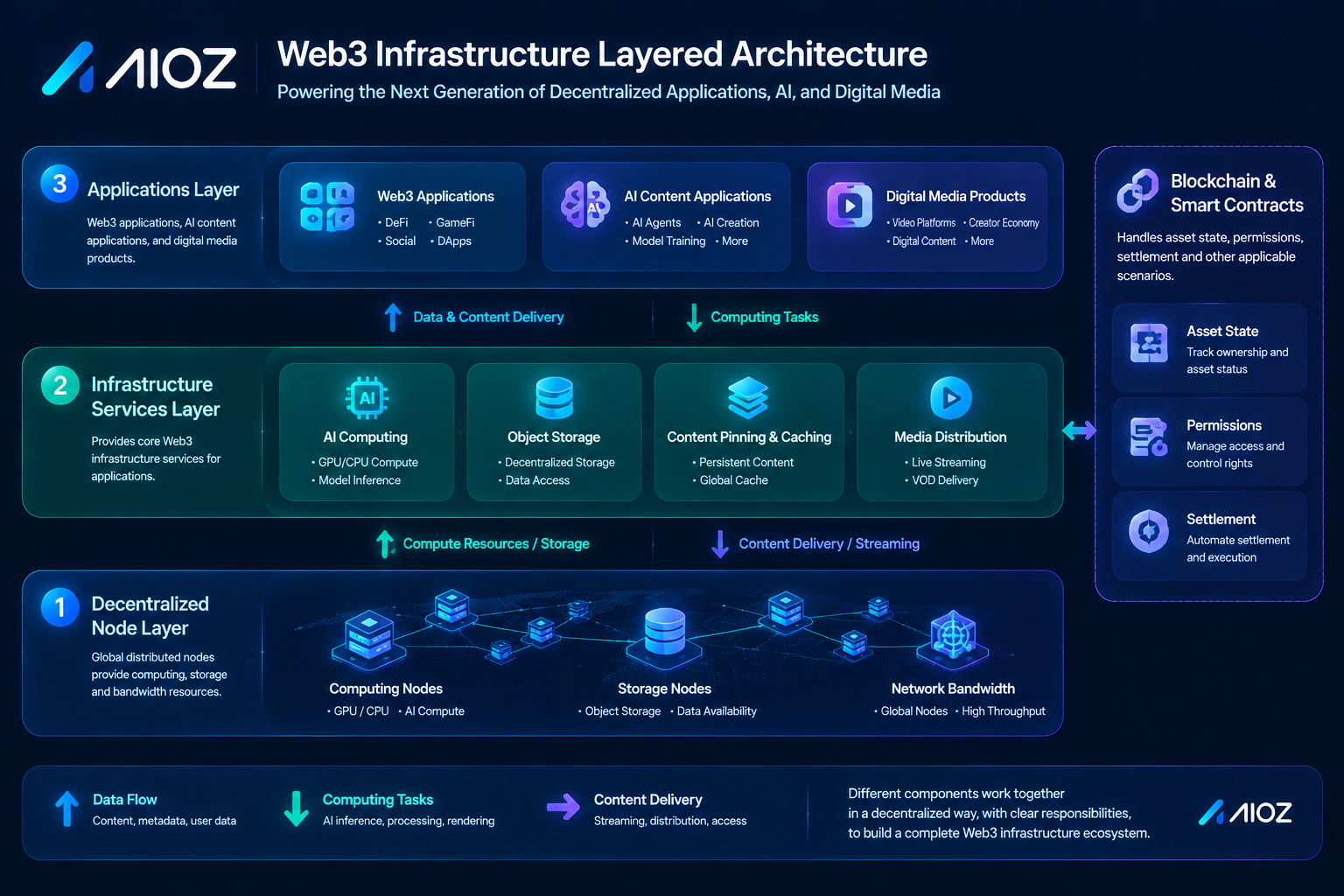
Blockchains are an important component of Web3 applications, but they are not a complete application runtime environment. Smart contracts can execute operations according to predefined rules, record asset states, and process transactions, but they are not suitable for every type of data storage or intensive computing task. Large images, videos, user files, AI models, and datasets typically involve substantial data volumes or computing requirements. Processing all of this content directly on-chain can create limitations in cost, throughput, and efficiency. Real-world applications therefore need to combine blockchains with other infrastructure based on the characteristics of each task.
In a typical architecture, smart contracts handle rules and states suited to on-chain execution, storage systems retain files, computing services execute tasks, and content distribution mechanisms deliver data to users. Each component needs clearly defined responsibilities. For example, a blockchain can record a file's hash or asset ownership, but the on-chain record itself cannot ensure that the corresponding file remains accessible. Similarly, a smart contract can record payments for AI services or the results of service calls, but cannot independently prove that model outputs are correct, data sources are reliable, or computation proceeds as expected. Other technical mechanisms must address these issues.
Web2 infrastructure provides developers with mature cloud computing, object storage, database, and content delivery services, typically supported by professional operations and unified management interfaces. Web3 does not mean that every application must abandon these services. Instead, it allows developers to choose an appropriate architecture based on their requirements for decentralization, cost, performance, and data control. Some applications may prioritize the reliability and support capabilities of traditional cloud services, while others may seek to reduce dependence on a single provider or make resource contributions and financial settlement more open.
AIOZ Network explores the use of distributed nodes and network coordination mechanisms to provide computing, storage, and content delivery capabilities. Its connection to Web3 infrastructure lies in its attempt to organize these services into a resource network that applications can use, rather than simply offering an on-chain asset or a single tool. However, the practical advantages of a decentralized architecture need validation through specific applications. Infrastructure design translates into practical application value only when the services meet performance, security, and cost requirements and developers are willing to keep using them.
AIOZ's Multiservice Architecture: How AI, Storage, and Content Delivery Work Together
AIOZ's official materials describe several infrastructure offerings, including AIOZ AI, AIOZ Storage, AIOZ Pin, and AIOZ Stream. They address needs such as AI computing, object storage, content pinning and caching, and media delivery, respectively. This combination of services offers some potential for coordination because modern applications often need to handle data storage, task execution, and result delivery together, rather than relying on a single type of infrastructure.
For example, an AI content application may need to store materials uploaded by users and model files, call on computing resources to execute tasks, and then store and deliver the generated results to users. If the application also involves digital assets, paid access, or content licensing, smart contracts can record states and enforce relevant rules at appropriate stages. In this architecture, computing, storage, and content delivery have different responsibilities, each addressing part of the application workflow. If these services can work together through stable interfaces, developers may be able to reduce coordination costs across different systems.
However, combining services does not mean they already work together seamlessly. AI computing depends on hardware performance, task scheduling, runtime environments, and result verification. Storage services must handle data access, durability, permissions, and recovery. Content delivery must address network latency, bandwidth fluctuations, regional coverage, and peak traffic. Different services have different quality standards and resource costs. Even when they belong to the same network, their capabilities and limitations need independent assessment to determine whether they suit a particular application.
For developers, valuable integration means more than a broader service catalog. It means being able to handle data flows, access control, failures, and costs through clear interfaces. If developers still need to write extensive custom code for each service or cannot reliably handle service interruptions, the practical benefits of integration may be limited. The competitiveness of AIOZ's infrastructure offering therefore needs to be assessed through coordination between products, developer integration costs, and real-world application performance.
Decentralized AI: New Challenges When Computing Resources Become More Open
The growth of AI applications has made computing resources an important part of infrastructure competition. Model inference, content generation, and other AI workloads have different requirements for computing power, memory, runtime environments, and task scheduling. Traditional cloud computing typically meets these needs by centrally managing hardware, optimizing scheduling, and providing standardized interfaces. Decentralized AI seeks to organize computing resources supplied by multiple participants, exploring a more open approach to resource provision.
AIOZ AI's official materials position it as decentralized AI computing infrastructure and describe distributed task execution, AI service interfaces, and model-related ecosystem development. This design can give developers an alternative to the resource organization of traditional centralized platforms, but its practical suitability still depends on the task type. Some tasks can be split and assigned to different nodes, while others require specific hardware, stable runtime environments, or strict execution deadlines. Devices may also differ in performance and availability. The network therefore needs to match tasks with resources effectively and verify execution results appropriately.
Data security and privacy present another important challenge for decentralized AI. AI workloads may involve user files, business data, or other sensitive inputs. When assigning tasks to distributed nodes, the system needs to clarify which data nodes can access, how tasks execute, how results return, and what protections apply to the data during transmission and processing. Distributed computing does not automatically ensure data privacy, and a larger number of nodes does not necessarily improve security. Actual security depends on access control, encryption methods, execution environments, and the specific protocol design.
AI services also need to address quality assessment and economic incentives. Users care not only about whether a task is completed, but also whether output quality, execution time, and costs meet expectations. Networks need sound mechanisms for task verification, failure handling, and service evaluation to prevent participants from prioritizing task quantity over result quality. If developers cannot reliably predict execution results or handle failures, a service may be unsuitable for critical operations even when resource costs are attractive. The long-term development of decentralized AI therefore depends on balancing open resource access, execution quality, security, and developer experience.
Distributed Storage and Content Delivery: Balancing Data Availability and User Experience
Storage and content delivery address different but related problems. Storage systems retain data and provide corresponding access and management capabilities, while content delivery systems focus on getting that data to users efficiently. For Web3 applications, files may relate to NFT metadata, application frontends, media content, or user-uploaded resources. Even after data has been written to a storage system, users may still encounter inaccessible content or slow loading if reliable access paths, durability safeguards, or appropriate delivery capabilities are missing.
AIOZ Storage's official materials describe application-focused object storage services and S3 compatibility. AIOZ Pin focuses on IPFS content pinning and access services, while AIOZ Stream addresses media delivery and streaming use cases. This combination reflects a practical need: applications must not only store data, but also ensure that it can be retrieved and delivered when needed. However, distributed storage does not automatically mean permanent availability. Data replicas, node reliability, recovery strategies, access permissions, and actual operating conditions all affect the outcome.
Content delivery has a particularly visible impact on user experience. Video, interactive media, and AI-generated content typically require fast access and relatively stable transmission performance. Distributed nodes may provide more routes for resource delivery, but their effectiveness depends on node locations, bandwidth, caching strategies, and the distribution of user requests. If users are concentrated in one region while resource nodes are mainly located elsewhere, the network may still face latency and transmission cost issues. Changes in content access patterns can also affect cache efficiency and resource utilization.
Developers also need to consider data control and migration capabilities. If an application stores critical files with a particular storage service, developers should understand how to export the data, manage access permissions, and recover from service interruptions. Applications involving personal data or confidential business information also need clear requirements for encryption, authorization, and data deletion. Web3's openness does not mean that all data should be public or that stored data no longer needs management. Reliable infrastructure must address accessibility, control, and security together.
Developer Adoption: Infrastructure Must Reduce Real Engineering Costs
For infrastructure projects, developer adoption is an important step in turning technical capabilities into long-term demand. Developers typically consider integration difficulty, documentation completeness, interface stability, tool compatibility, cost transparency, and troubleshooting capabilities. Even if a service is innovative, application teams may still choose mature alternatives when it requires extensive custom development or makes operating costs difficult to predict. Infrastructure products therefore need to encapsulate complex resource scheduling and service management in clear, testable, and maintainable development interfaces.
AIOZ's multiservice architecture offers potential integration opportunities for applications, but each product needs clear functional boundaries and technical documentation. Developers need to understand which workloads a service supports, what access restrictions apply, how it handles identity and permissions, and what recovery measures are available when the service fails. If AI, storage, and media services connect through relatively consistent interfaces and management methods, they may reduce application integration complexity. However, actual development experience and operational results must validate these benefits; they cannot be assumed simply because the products belong to the same project.
Developer adoption also depends on migration costs. During long-term operation, applications may need to change infrastructure providers, migrate data, or modify their computing architecture. If service interfaces and data formats are too proprietary, migration may require substantial development work and create new dependencies. For Web3 applications that emphasize openness, infrastructure portability, interface transparency, and data control are especially important. Developers need to understand service limitations and retain alternatives when necessary, rather than turning a decentralized architecture into a new single point of dependence.
Adoption should not be measured solely by the number of registered developers, test projects, or ecosystem partners. More meaningful signals include whether applications continue operating, users return, developers are willing to deploy critical functions on the services, and the services remain stable under sustained workloads. Short-term testing can help projects identify problems, but developers are more likely to keep investing in maintenance and integration only when infrastructure addresses real engineering needs. For AIOZ, this kind of real adoption provides stronger evidence of a foundation for ecosystem development than simply expanding its service range.
Security, Reliability, and Governance: Decentralization Does Not Eliminate Risk
Decentralized infrastructure typically draws resources from multiple independent participants. This structure may reduce dependence on a single operator, but it also introduces new coordination challenges. Nodes may go offline, hardware capabilities may differ, and service quality may vary. Networks must also handle malicious behavior, task failures, and data access issues. Systems therefore need clear requirements for resource participation, task verification rules, failure-handling procedures, and participant responsibilities. Without these mechanisms, open resource access may come at the cost of uncertain service quality.
Data security needs assessment at the individual service level. Storage services should explain how they encrypt data, who can access it, and how they manage permissions and recover data. AI services need to address the security of task inputs, model execution environments, and outputs. Media delivery services must consider content access control, data transmission, and procedures for service interruptions. Blockchains can help record some operations and states, but cannot automatically resolve off-chain data protection, device security, or all legal liability issues. Security requires specific technical designs and verifiable operational mechanisms.
Reliability also involves more than node uptime. What matters to users is whether a service can meet performance requirements under real requests, recover from failures, and allow applications to predict service quality reasonably. Distributed networks can improve resilience through redundancy, task retries, and resource scheduling, but these mechanisms need to work in practice and may add costs. Developers should choose fault-tolerance strategies based on the importance of their operations, rather than assuming distributed architectures are inherently more reliable.
Governance and clearly defined responsibilities also affect enterprise and developer willingness to adopt services. Traditional providers can typically clarify some responsibilities through contracts, service-level agreements, and support procedures. Distributed networks need to explain the duties of different participants, how service failures are handled, and how disputes are resolved. For critical operations, technical feasibility is only the foundation; operational support and predictable accountability are equally important. AIOZ and other decentralized infrastructure projects need to continually demonstrate that they can support open participation while providing service assurances that users can understand and rely on.
How Web3 Infrastructure Can Build a Sustainable Ecosystem
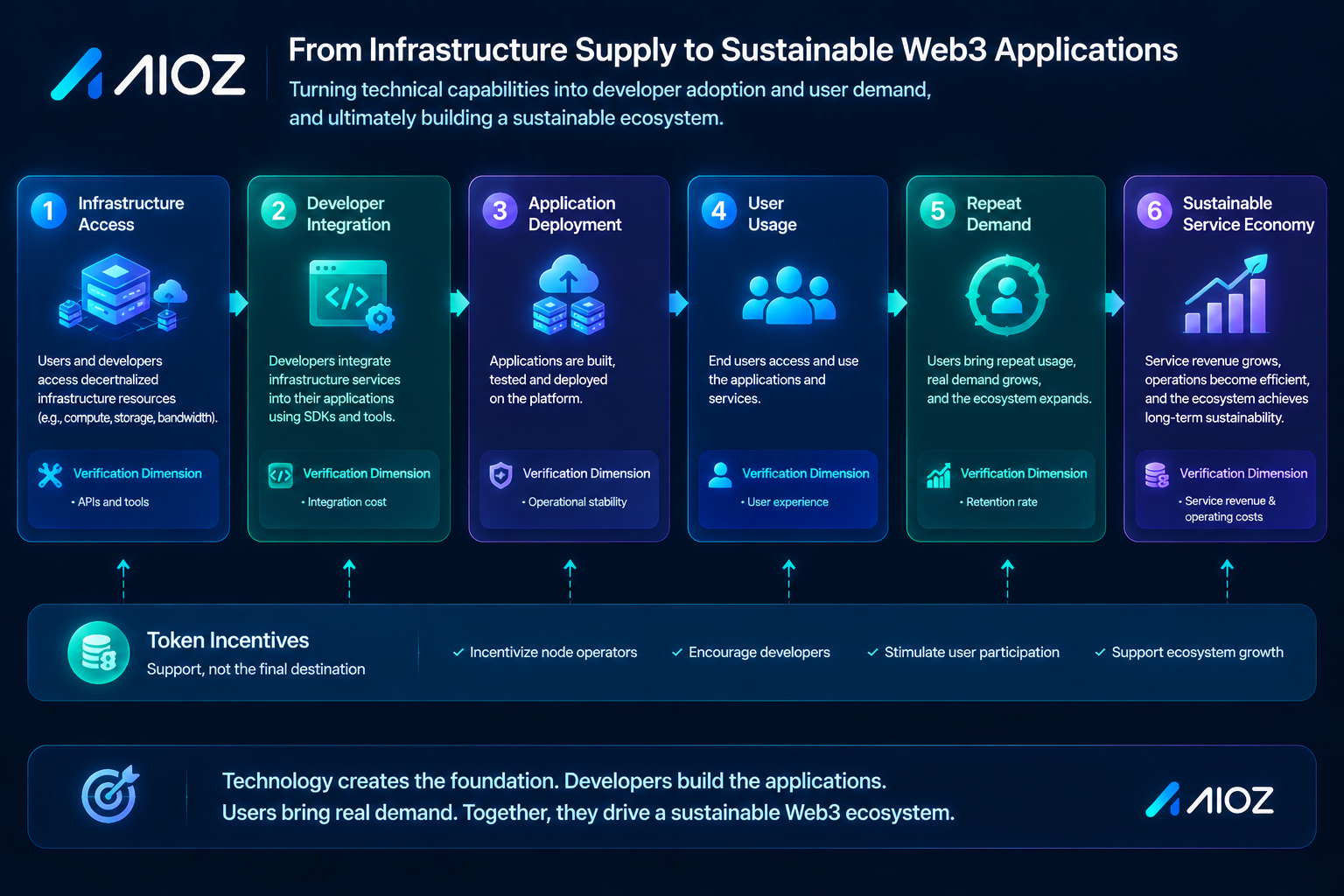
The long-term value of an infrastructure ecosystem depends on whether technology supply and application demand reinforce each other. Resource networks can expand supply through open participation, developers can use infrastructure to build applications, and user demand may generate more service calls and operating revenue. If services are competitive, greater application usage may improve resource utilization and provide more stable compensation for node operators. However, this process does not happen automatically: applications must meet user needs, infrastructure must deliver acceptable performance and costs, and economic mechanisms must support ongoing operations.
AIOZ's multiservice offering creates potential opportunities for applications that use multiple services, but ecosystem coordination still needs validation through specific applications. Key questions include whether developers can deploy more easily, services can work together reliably, users can enjoy a better experience, and overall costs are competitive. If services develop independently without meaningful cross-service usage, ecosystem breadth may not translate into synergies. Conversely, if multiple services genuinely work together to solve critical application problems, they may give developers clearer reasons to adopt them.
Sustainability also involves the relationship between incentives and real demand. Early rewards can attract nodes, developers, and users, but a long-term ecosystem cannot rely indefinitely on subsidies to sustain activity. Services need to gradually establish real usage and sustainable sources of funding, allowing resource providers to earn reasonable compensation while keeping costs acceptable to users. For decentralized infrastructure, reward design should support reliable services rather than merely increase participation numbers.
AIOZ's value as Web3 infrastructure should therefore be evaluated through real-world applications: whether services continue delivering, developers are willing to adopt them, users return, and the network can maintain resource supply at reasonable costs. Technical architecture and product roadmaps can show a project's direction, but real-world application performance must still demonstrate long-term competitiveness. Only when infrastructure consistently solves user problems can decentralized resource networks gradually move from technical exploration to a mature foundation for applications.
AIOZ and Gate: From Market Access to Infrastructure Research
The relationship between AIOZ Network and Gate can be understood in terms of access to crypto asset markets. Gate's public trading page currently lists the AIOZ/USDT spot trading pair, and users can check the current page to verify trading status and market information. This provides a channel for observing the AIOZ token market, but market access and the technical performance of infrastructure services are separate dimensions.
Researching AIOZ from a Web3 application perspective requires a focus on its service architecture, developer tools, data security, performance, portability, and real adoption. Researching it from a token perspective requires further analysis of the token's actual uses, supply mechanisms, and market liquidity. Adoption of project services does not necessarily lead to a higher token price, and market price changes do not directly prove that developers are expanding usage or that infrastructure revenue is growing.
Gate's market information can therefore complement AIOZ's official technical materials, but neither should replace the other. A trading platform provides asset trading channels and market data, while project materials help researchers understand product design and protocol mechanisms. Any trading decision requires an independent assessment of market volatility, liquidity, and personal risk tolerance. Listing status should not be interpreted as a guarantee of project fundamentals or future prices.
AIOZ's infrastructure focus reflects an important question that the Web3 industry continues to explore: how to make distributed resources genuinely serve real-world applications. Future development depends not only on whether technical modules exist, but also on whether developers can adopt them easily, services can deliver reliably, and economic mechanisms support long-term operations. Monitoring these conditions over time provides a better understanding of long-term value than focusing only on project popularity or product count.
FAQ
Why do Web3 applications need infrastructure beyond blockchains?
Blockchains are well suited to recording state, executing smart contracts, and managing digital assets, but large-scale file storage, AI computing, and media delivery typically require support from other systems. Applications need to combine on-chain rules with computing, storage, and content delivery services based on the requirements of each task.
What types of infrastructure does AIOZ Network provide?
AIOZ's official materials describe areas including AI computing, object storage, content pinning and caching, media streaming, and content delivery. Each service has different technical requirements and use cases. Specific capabilities should be verified against current product documentation and actual service status.
Is decentralized infrastructure always better than traditional cloud services?
Not necessarily. Decentralized infrastructure may offer a more open approach to resource provision and different cost structures, but it must also address differences between nodes, performance, reliability, security, and clearly defined responsibilities. The choice of architecture should depend on the application's actual needs and service performance.