It suits beginners and intermediate readers who want to see how programmable accounts and contribution incentives fit together. Versus stacks that mainly patch account abstraction at the application layer, Incentiv places smart wallets, Bundlers, EntryPoint, and fee abstraction on protocol-usable paths so transfers, swaps, and batch actions can feel closer to a single confirmation. Mechanism checks start in Incentiv Docs; rewards run through Incentiv+, which returns value to participants based on measurable contribution.
Evaluation typically covers the verifiable AAA pipeline, the Unified Token fee path, CENT supply and roles, Contribution-Scored PoW, Portal MCP capability boundaries for AI agents, and the risks and limits to check before use.
Key Takeaways
- Incentiv is an EVM PoW Layer 1: native AAA chains UserOperation → Bundler → EntryPoint (optional Paymaster) into a traceable path.
- Unified Token can pay gas with supported assets such as USDC, USDT, or WETH, lowering the need to stockpile CENT before interacting.
- CENT has a fixed supply of 100 billion tokens, minted at genesis with no inflationary issuance; Incentiv+ returns limited pool rewards to multiple roles by contribution.
- Portal MCP targets AI agents: it can read chain state, build unsigned operations, and forward signed results; hosted endpoints do not hold private keys.
What Is Incentiv, and Which On-Chain Friction Points Does It Address?
Incentiv positions the network to fit people and applications: native AAA on an EVM PoW base, plus economic feedback for real contribution. The friction it targets includes hard-to-custody EOA keys, the need to pre-fund native gas, multi-step approvals that break UX, and “transaction count farming” that poorly maps to real value.

The matching responses are smart wallets that carry intents; Paymaster and Unified Token that broaden fee currencies; and contribution-oriented rewards that route a limited pool toward measurable roles. Accounts, fees, incentives, and Portal / Portal MCP entry points run in parallel—the basic frame for evaluating Incentiv.
| Component |
Role |
User-side feel |
| Advanced Account Abstraction |
Smart wallet + UserOperation |
Express intent as a verifiable operation |
| Unified Token / Paymaster |
Non-CENT or sponsored fees |
Less “buy gas first” friction |
| Incentiv+ |
Limited pool by contribution |
Role contribution can map back to CENT |
| Portal / Portal MCP |
Human and agent entry points |
Reach the network from a browser or tool calls |
How Does Incentiv’s Advanced Account Abstraction Work?
Advanced Account Abstraction (AAA) replaces rigid transactions with intent messages and places AA on a protocol-usable path that runs alongside ordinary transactions. The verifiable pipeline is:
- Construct a UserOperation (an intent, not only low-level call parameters)
- The smart wallet validates signature, limits, recovery, and related rules
- Enter the Alt Mempool; Bundlers simulate and batch
- Optional Paymaster sponsorship or gas settlement in a supported token
- EntryPoint confirms “validated → payable → atomic execution”
- Explorers reconcile UserOperation, Bundle, Bundler, and Paymaster
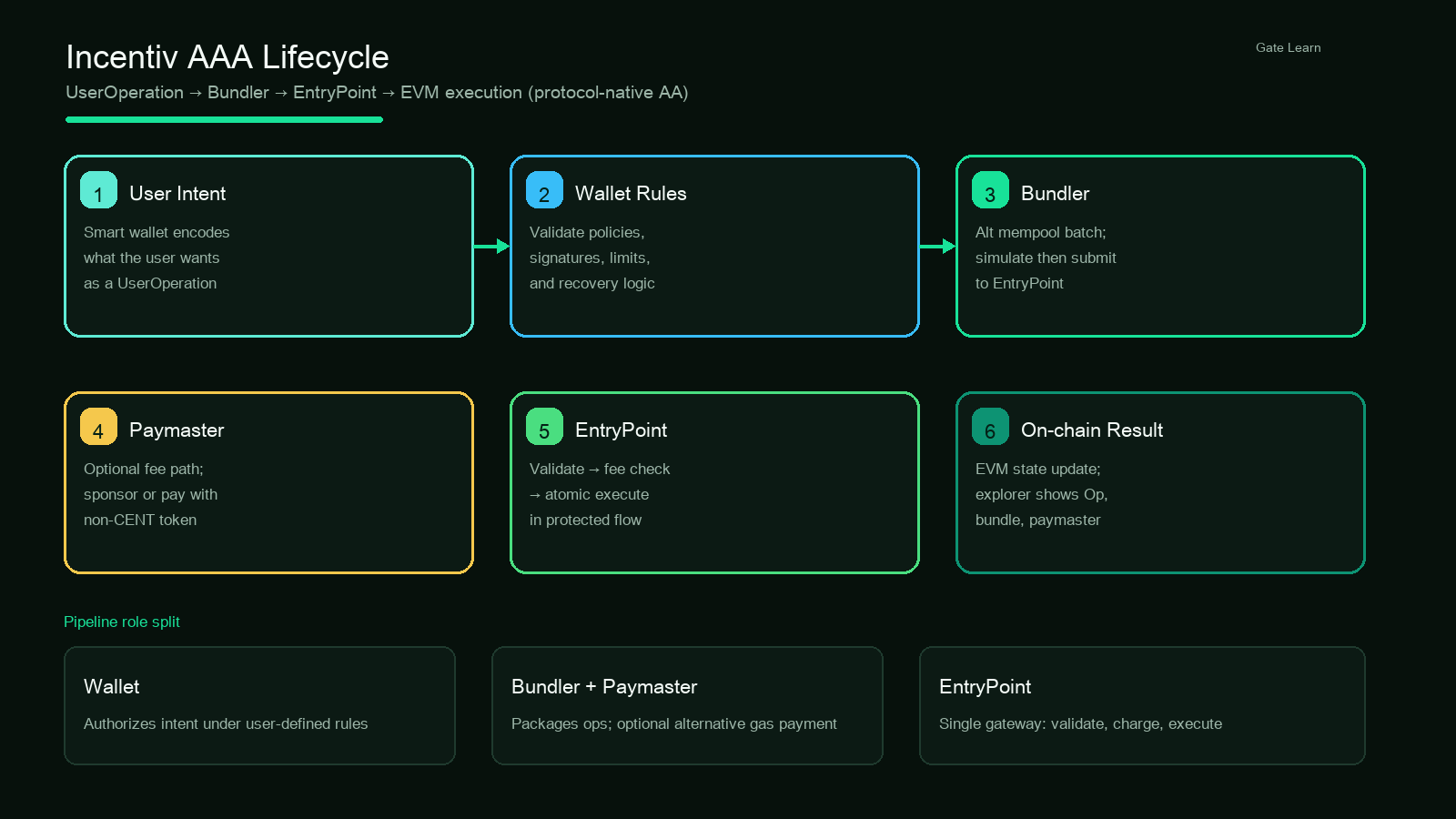
Figure 1. Incentiv AAA lifecycle: intent flows through the smart wallet, Bundler, and optional Paymaster, then EntryPoint validates and executes.
Versus AA that only sits as an application-layer patch, the key points are wallet-rule priority, EntryPoint as a unified gateway, and pluggable fee abstraction. Send, swap, and batch actions on Portal often surface as a single confirmation; developers can verify Bundler https://bundler.incentiv.io and Mainnet parameters.
How Does Unified Token Let Users Pay Gas With Non-CENT Assets?
Unified Token lets users choose a gas currency among supported assets: after Portal estimates fees, they can pick from tokens with sufficient balance. When CENT is held, CENT is the default, but WETH, USDC, USDT, and other listed assets can be selected. Under the hood, Paymaster and a native DEX move user-side charges onto a settleable path while preserving CENT settlement semantics.
The result is that a first interaction need not require a dedicated CENT purchase—but the chosen token must be on the support list and the balance must cover the estimate. Bridge-out and similar flows may still require the account to hold CENT directly; Paymaster coverage should not be assumed for every cross-chain fee.
How Does Incentiv+ Reward Participants Based on Contribution?
Incentiv+ maps network activity into contributor rewards: users, agents, dApps, miners, Bundlers, liquidity providers, and related roles can earn extra CENT from a limited pool based on measurable contribution—not transaction count alone.
Mainnet Portal rules include an example threshold: after more than 100 transactions in a day, the 101st and later qualifying trades receive a cashback equal to 50% of gas paid in CENT on those qualifying trades, calculated daily; below the threshold, that day’s cashback is 0. Full role scoring and the unified reward pool require cross-checking contribution metrics, in-pool shares, and epoch rules.
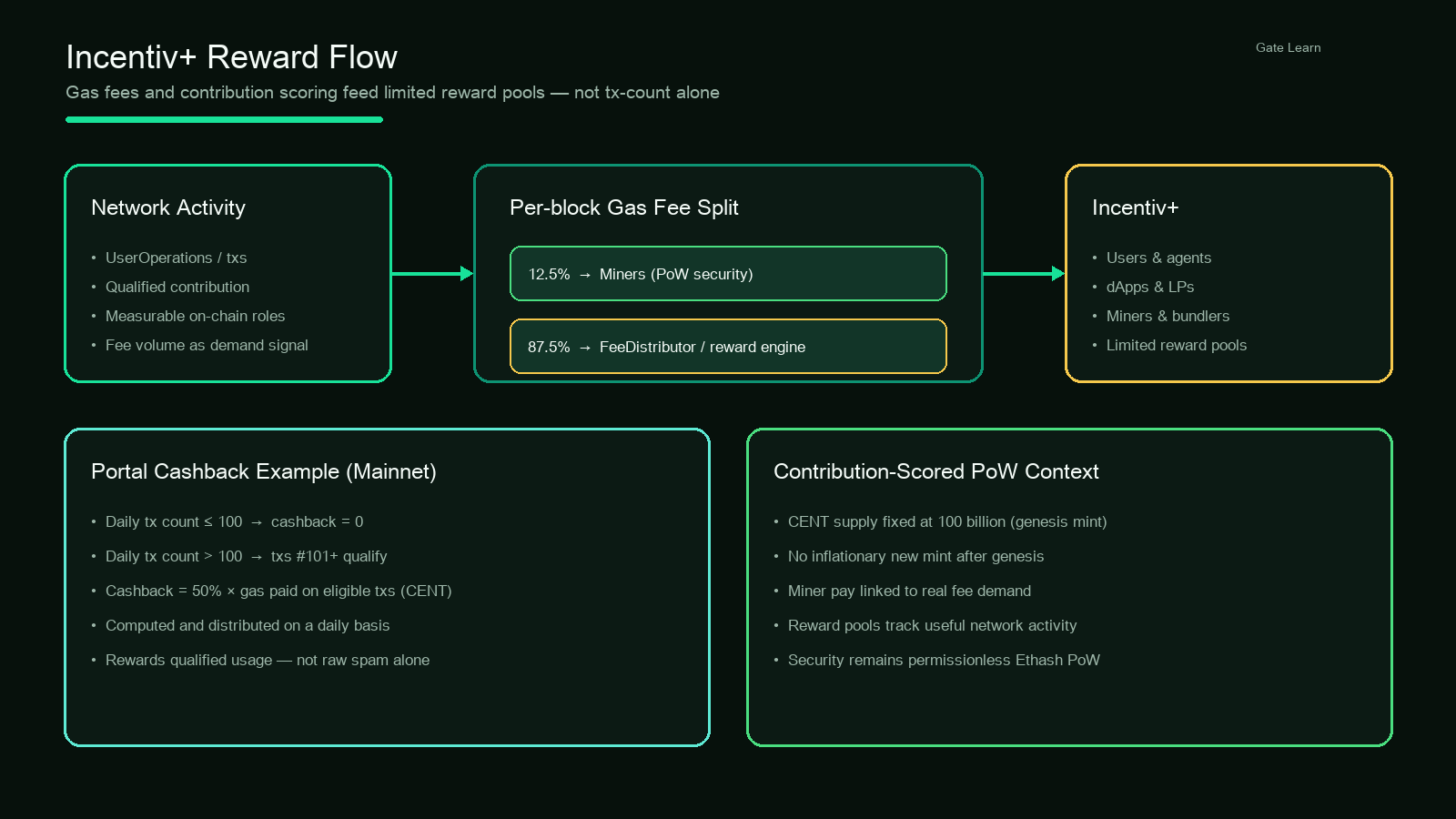 Figure 2. Incentiv+ reward split: block gas is allocated in fixed ratios to miners and the fee distributor, then returned to multiple participant roles under contribution rules.
Protocol-level fee splits must be kept distinct from Portal-visible cashback: cashback does not mean uncapped subsidy. Docs / Portal display rules and pool caps remain the source of truth.
What Is CENT, and What Roles Does It Play on Incentiv?
CENT is the native token and unit of account: it prices gas, anchors Unified Token settlement, and serves as the payout asset for Incentiv+ and related rewards. The whitepaper frames supply as fixed at 100 billion tokens, minted at genesis, with no inflationary new issuance—fees and contribution circulate inside existing supply. Total supply and allocation disclosures can also be cross-checked against the Gate Initial Listing: Incentiv (CENT) announcement.
The Currency Symbol remains CENT. Other supported tokens can pay fees, but quotes, explorers, and some cross-chain fees still resolve to CENT semantics. On Gate, CENT/USDT spot trading is the pair for observing quotes and depth. A fixed supply is not a yield or price promise; float, unlocks, and market depth still shape real costs.
What Is Contribution-Scored PoW, and How Does It Differ From Traditional PoW?
Contribution-Scored PoW keeps permissionless PoW block production, but shifts miner rewards from fixed inflation subsidies toward fee and contribution allocation tied to real usage. Per docs: from genesis, miners are not funded by inflationary block rewards; about 12.5% of each block’s gas goes to miners and about 87.5% enters the FeeDistributor. Mining leans Ethash-style, GPU-friendly, and memory-hard.
| Dimension |
Traditional inflationary PoW |
Incentiv fee-coupled PoW |
| Primary miner source |
Scheduled new-issuance subsidy |
Fee share + contribution-linked allocation |
| Tie to usage |
Empty and busy blocks can share similar subsidies |
Fees move with real execution demand |
| Token supply |
Ongoing inflation is common |
100 billion cap, genesis mint |
Whether the security budget stays adequate still depends on fee scale, hashpower distribution, and client quality—ongoing checks, not a one-time verdict.
How Does Incentiv Extend to AI Agents, and What Role Does Portal MCP Play?
Incentiv extends programmable accounts to agents: budgets, permissions, and revocable authorizations can be set. Portal MCP (mcp.incentiv.io) exposes discovery and callable tools; identity anchors to this chain, while assets can move across supported EVM networks via the official bridge before settling back to Incentiv.
| Capability / risk point |
Boundary |
| Read state |
Balances, blocks, UserOperations, network status; balances follow on-chain reads |
| Write path |
build_* emits unsigned ops; broadcast_* forwards signed results; hosted endpoints hold no keys and do not co-sign |
| Fees and bridges |
gas_token can be specified; bridge-out may still require self-held CENT |
| Accounts |
Owner can derive a smart account; first tx can deploy atomically; undeployed write paths need an owner |
| Main risks |
Over-broad permissions, treating MCP as a custodial wallet, wrong bridge route or receive chain, public tools that cannot locally co-sign |
A sound pattern keeps MCP on quoting and assembly while signatures and limits stay with the user or local policy.
What Risks and Limitations Should Users Weigh When Evaluating Incentiv?
On the strength side: native AAA reduces steps, Unified Token widens gas currencies, fee-coupled PoW softens endless inflation-subsidy narratives, and Portal MCP boundaries are checkable. On the limit side: PoW security budgets depend on fees and hashpower; a Bundler, Paymaster, or EntryPoint failure can stall confirmation; Unified Token only covers listed assets; Incentiv+ pools are finite and rules can change; bridges and over-broad agent permissions can cause fund loss. Parameters and contracts should be cross-checked against the website, Docs, and explorers.
Summary
Incentiv combines an EVM PoW Layer 1, native AAA, Unified Token, and contribution-oriented Incentiv+: intents leave smart wallets, land via Bundler and EntryPoint, fees can settle in non-CENT assets, rewards come from a limited contribution pool, and agents use Portal MCP in a build–self-sign–broadcast path. Baseline parameters are Chain ID 24101, RPC https://rpc.incentiv.io, and explorer https://explorer.incentiv.io. Evaluation should return to the pipeline, fee splits, and the MCP capability table.
FAQ
What is Incentiv?
Incentiv is a live EVM-compatible Proof-of-Work Layer 1 built around native Advanced Account Abstraction so smart wallets, Paymaster, and Unified Token can reduce operation and gas friction. The native token is CENT; entry points include the website, Docs, and Portal.
What is the CENT token, and how is supply set?
CENT is Incentiv’s native token for gas pricing, fee settlement, and reward payouts. Under the whitepaper framework, supply is fixed at 100 billion tokens, minted at genesis, with no inflationary new issuance; float and unlocks still need public allocation disclosures, the listing announcement, and on-chain data. Gate’s spot pair is CENT/USDT.
Can users pay gas without holding CENT?
Within Unified Token support, yes: Portal can select supported tokens such as USDC, USDT, or WETH for gas, settled via Paymaster / DEX paths. When CENT is held, CENT is the default; bridge-out and related flows may still require holding CENT directly.
What are Incentiv’s Chain ID and RPC?
Mainnet Chain ID is 24101, Currency Symbol is CENT, RPC is https://rpc.incentiv.io, explorer is https://explorer.incentiv.io, and Bundler is https://bundler.incentiv.io. Network additions should be checked item-by-item against Docs network configuration.
What are the main risks of using Incentiv?
Main risks include PoW security tied to fee scale, multi-component AAA dependencies, reward-rule and pool-cap changes, bridge and address errors, and over-broad Agent / Portal MCP permissions. Hosted MCP not holding keys does not make on-chain actions risk-free; permissions, asset lists, and UserOperations on explorers still need review.