These reward mechanics suit intermediate readers who already know how Incentiv frames AAA, Unified Token, and CENT, and who want to verify fee-into-pool mechanics, five-role scoring, and epoch settlement. Incentiv+ is the protocol economy every fee participates in; Portal daily cashback and unified-pool weekly scoring are different observation surfaces—cross-check Economic Engine: Incentiv+ and Incentiv Plus as currently published. Key checks include fee splits, role scoring, epoch/claims, CENT’s role, a verification checklist, and common misconceptions.
Key Takeaways
- Incentiv+ maps network activity into measurable contribution and recycles CENT from a unified reward pool by role—not a pure “spam txs for rewards” loop.
- Protocol fee-split parameters are about 12.5% paid immediately to the block miner and about 87.5% into the unified reward pool, then allocated on a weekly epoch.
- Five roles score and claim pool shares independently; user/developer scoring may include CENT holdings and other metrics, with parameters subject to docs and governance updates.
- Verification should cross-check Docs, explorer fee splits, and contract/Portal display rules, and keep protocol-level allocation separate from Portal daily cashback.
What Is Incentiv+? How Is It Different From “Farm Volume for Rewards”?
Incentiv+ sits at the protocol economic layer: it turns on-chain activity into contributor rewards so fees enter a recyclable unified pool instead of flowing one way out. The core difference is that scoring targets measurable contribution, and five roles compete only within their own quotas without cannibalizing each other.
“Farm volume for rewards” usually treats count or notional size as the only signal and is easy to inflate with empty activity. The Economic Engine stresses multi-metric scoring and weekly resets so new participants can compete immediately; developer rewards depend on how much a contract is used, not merely that it was deployed. Portal’s “cashback on eligible txs after more than 100 txs in a day” is a user-side daily recirculation example—it is not the same as the protocol unified pool’s full-role weekly formula.
How Do Transaction Fees Enter the Unified Reward Pool? How Are They Split?
Fees follow the standard EVM model: Fee = Gas Used × Gas Price. Users experience one fee; the protocol splits it into an immediate block-producer compensation stream and a unified reward-pool stream that accumulates inside the epoch and is then distributed by contribution.
Per the current Economic Engine parameter table (subject to governance change):
| Fee destination |
Share (docs) |
Timing |
| Miner Block Rewards |
~12.5% |
Immediate to coinbase after the block |
| Unified Reward Pool |
~87.5% |
Accumulates in-epoch; weekly allocation |
Flow: execute and consume gas → fee is calculated → about 12.5% goes to the block producer → about 87.5% is credited to the unified pool → at epoch end, distribution runs by role. Pages also list illustrative figures such as a simple transfer around $0.03 USD and a typical UserOperation around 550k gas; those change. Do not treat sample fees as fixed yield—use current docs and on-chain observation.
Inside the unified pool, docs list role shares (labeled of unified pool): miners’ deferred participation 12.5%, developers 28%, users 18%, LPs 20%, Bundlers 9%; the five lines sum to 87.5%, matching the unified pool’s share of total fees. Docs also state miners receive about 25% of all fees in aggregate (12.5% immediate + deferred participation). When verifying, keep “immediate split” and “in-pool share” in separate columns so denominators are not mixed, and treat current Docs plus contracts as authoritative.
How Do the Five Participant Roles Score? (Users / Developers / Miners / Bundlers / LPs)
The five roles score independently and do not compete for each other’s quotas: miners, developers, users, liquidity providers (LPs), and Bundlers—each competes only within its own class by contribution share.
| Role |
Pool share (docs) |
Main scoring dimensions (docs examples) |
| Miners |
12.5% (participation rewards; plus 12.5% immediate block rewards) |
Uptime, reliable block production, participation that supports network health |
| Developers |
28% |
Contract throughput, tx count, unique wallets, CENT holdings |
| Users |
18% |
Volume, frequency, fees paid, dApp diversity, CENT holdings |
| Liquidity Providers |
20% |
Facilitated volume, supported trades, provision duration, capital size |
| Bundlers |
9% |
UserOperation volume, gas efficiency, inclusion success, operation diversity |
Cross-app user activity usually ranks above stacking volume on a single contract; developers are scored on usage, not deployment alone; LPs balance depth and duration; Bundler rewards favor reliable inclusion and efficiency, and protocol rewards are usually a supplement rather than a substitute for service fees. Shares and metrics follow the current Economic Engine text and may change via governance.
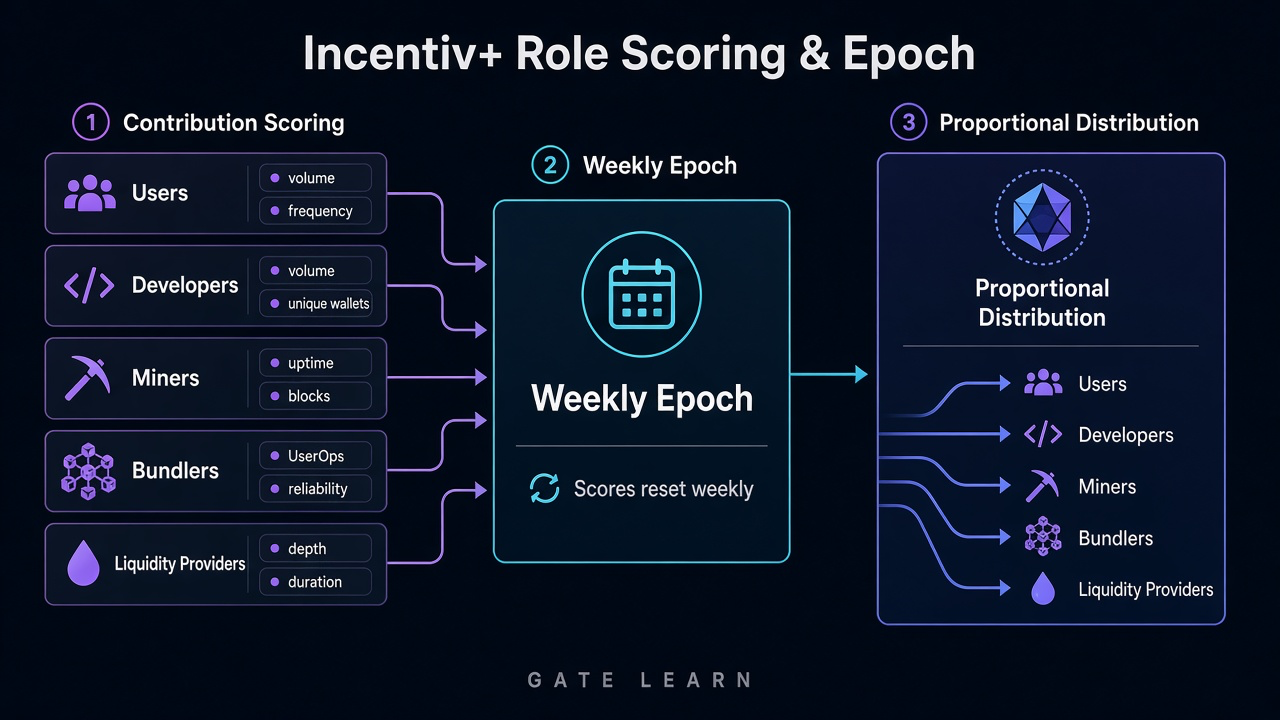
Figure 1. Incentiv+ five roles score independently and distribute CENT by contribution share each weekly epoch (illustrative; shares follow Docs).
How Do Epoch and Claim Rules Work? What Happens If Rewards Are Unclaimed?
Under the protocol framing, the unified pool accumulates inside an epoch and distributes weekly; scoring resets each week, so ongoing contribution matters more than early lock-in. Splits and scoring rely on on-chain data, distribution runs through contracts, and parameters can change via governance.
Portal also runs a separate daily user cashback: after more than 100 txs in a day, the 101st and later eligible txs cash back 50% of Gas paid in CENT on those eligible txs; below the threshold, that day’s cashback is zero. That rule runs in parallel with the weekly unified pool—do not treat daily cashback as the five-role epoch formula.
On “unclaimed” rewards, public pages do not fully describe expiry, return-to-pool, or retention windows. Treat current Docs / Portal copy and contract events as the source of truth, and confirm distribution and credit on an explorer; until rules are explicit, do not assume unclaimed rewards auto-roll or auto-void.
What Role Does CENT Play in Rewards and Scoring?
CENT is both the payout asset and a scoring signal: the unified pool recirculates in CENT, and developer/user scoring may include CENT holdings as a long-term participation signal. Gas can still be paid in supported assets via Unified Token, but accounting and reward issuance return to CENT semantics.
Under the whitepaper framework, CENT has a fixed supply of 100 billion, minted at genesis with no inflationary new mint; fees and contribution recirculate inside that existing supply (see Incentiv Whitepaper V2.0). Total supply and allocation can also be cross-checked against the Gate Initial Listing: Incentiv (CENT) announcement. Holdings in the score ≠ holding tokens equals yield, and it is not a price or return promise; circulating supply, unlocks, market depth (for example CENT/USDT spot), and pool size set how much can be distributed.
How Can Reward Claims Be Verified? (Explorer / Docs Checklist)
A practical checklist:
- Open Economic Engine and Incentiv Plus; record the fee split, role shares, epoch length, and Portal daily threshold/cashback rate.
- On an explorer (for example
https://explorer.incentiv.io), sample Gas and coinbase / reward-contract credits for alignment with “immediate ~12.5% + pool ~87.5%” (implementation details may differ, but the direction should be explainable).
- Cross-check Mainnet contracts and distribution events for epoch / role batch records—not marketing screenshots alone.
- Separate protocol-level contribution allocation from Portal daily cashback: the latter can be recomputed from daily tx count and eligible Gas; the former needs role scoring and pool shares.
- For “guaranteed rebate / permanent subsidy” claims, check Docs language that parameters can change and that the pool is finite: cashback exists ≠ uncapped subsidy.
If docs ratios, explorer splits, and contract events cannot be reconciled, treat the claim as lower confidence until the explanation is updated.
What Are the Risks and Common Misconceptions Around Incentiv+?
Main risks: reward rules and pool shares can change via governance; pool size tracks real fees, so allocatable space shrinks in low-activity periods; spam volume, spam interactions, or holdings-weighted scoring can distort rankings; Bundler / miner failures affect confirmation and inclusion; mixing Portal cashback with protocol epochs creates wrong expectations. When paying Gas in non-CENT assets, confirm the token is on the supported list and that balances cover estimated fees.
Common misconceptions: treating Incentiv+ as unlimited subsidy; assuming maxing tx count alone maximizes rewards while ignoring multi-metric scoring and weekly resets; treating Portal’s “>100 txs / 50% of eligible Gas” as the only five-role unified-pool formula; treating CENT holdings in the score as principal-protected yield. Fee recirculation correlates with contribution, but distributable size, personal share, and rules can all change—keep verifying with Docs plus an explorer.
Summary
As a protocol-level economic engine, Incentiv+ splits Gas into immediate miner compensation and a unified reward pool, then distributes CENT by measurable contribution across five roles. Unlike pure volume farming, scoring is multi-metric, role-isolated, and weekly-epoch reset; Portal daily cashback is a separate observation surface. Evaluation should return to current Economic Engine ratios, scoring dimensions, and explorer/contract paths, while recognizing that rules can change and the pool is finite.
FAQ
What is Incentiv+ and how does it reward participation?
Incentiv+ is Incentiv’s protocol-layer economic engine: most transaction fees enter a unified reward pool and are then distributed as CENT to five roles by measurable on-chain contribution. Scoring is independent per role and allocated proportionally at the end of the weekly epoch described in the docs; Portal separately offers a user-facing daily cashback rule.
What is the CENT token?
CENT is Incentiv’s native token for Gas pricing, fee settlement, and reward issuance in systems such as Incentiv+. Under the whitepaper framework it has a fixed supply of 100 billion, minted at genesis with no inflationary new mint; in developer and user scoring, CENT holdings can serve as one long-term participation signal. Gate’s spot pair is CENT/USDT.
Can Gas be paid without holding CENT? How do fees enter the reward pool?
Within Unified Token support, Gas can be paid in supported assets such as USDC, USDT, or WETH and settled via Paymaster / DEX paths. Whatever supported asset the user pays with, the protocol still splits fees under the Gas fee model: about 12.5% immediately to miners and about 87.5% into the unified reward pool; some flows such as bridging out may still require holding CENT directly.
How is contribution scored, and who can earn rewards?
The unified pool covers five roles—miners, developers, users, liquidity providers, and Bundlers—each scored independently. Docs-listed metrics include user-side volume/frequency/fees/dApp diversity/CENT holdings; developer-side contract usage and unique wallets; miner-side uptime and block quality; Bundler-side UserOperations and reliability; LP-side depth, duration, and capital. Shares and metrics follow the current Economic Engine text.
What are the main risks of using Incentiv or joining Incentiv+?
Main risks include adjustable reward parameters and pool shares, smaller allocatable space in low-fee periods, spam and scoring games, infrastructure-component failures, and confusing Portal daily cashback with protocol weekly allocation. Cross-check Docs, explorers, and contract events, and avoid reading finite-pool recirculation as an uncapped yield promise.