
Square
Following
Hot
News
Profile
Share your thoughts
placeholder
Article
Three aircraft carriers are bearing down, yet Trump calls for a halt! $CL falls to 90.5—who between the bulls and bears is lying?
Three U.S. aircraft carriers are about to arrive in the Middle East. The Pentagon has even drafted the strike plans, but Trump has vetoed them five times, while saying that U.S.-Iran negotiations are “productive.” Saying no while acting otherwise—the aircraft carriers have already set sail.
Geopolitical risks remain, but the situation has not escalated into military action. Oil prices have retreated from 92.88, with the current price at 90.52, below the Bollinger m
post-image
CL+0.79%
NVDA-2.86%
MU-4.83%
SNDK-4.91%
#FedSeptemberMinutesLeanHawkish
The Federal Reserve’s September meeting minutes have delivered a significant signal to global financial markets. Policymakers remain concerned about persistent inflation, higher energy costs and the possibility that additional monetary tightening may be required.
On September 15–16, the FOMC unanimously approved a 25-basis-point rate increase, taking the federal funds target range to 3.75%–4.00%. The minutes, released October 7, revealed differing views about the reasons for tightening, but most participants considered another increase likely to be appropriate
Gold wins twice in a row intraday
Went long at 4166, exited at 4173, 7 points, 1095🔪$XAUT .
post-image
XAUT+0.80%
A few days ago, my hand trembled as I set the stop-loss; this morning, I realized that was unnecessary filial piety. A few days ago, before bed, I saw $DOGE 's rebound was running out of steam, with clear resistance above and low trading volume—no one would buy into the move. I said it was bullish at the time; the short position's logic was sound.

Managing risk in advance is called rationality; cutting after taking a loss is called decisively cutting off one's own wrist.

Panic comes from having no plan; losses come from overthinking.

Shorted from 0.09586 to 0.08473, +824.58%—nailed it, a
post-image
DOGE-4.18%
SOL-4.91%
LAB-1.30%
🔻 𝐁𝐈𝐓𝐂𝐎𝐈𝐍 & 𝐄𝐓𝐇𝐄𝐑𝐄𝐔𝐌 𝐀𝐑𝐄 𝐃𝐑𝐎𝐏𝐏𝐈𝐍𝐆 — 𝐇𝐎𝐖 𝐋𝐎𝐖 𝐂𝐀𝐍 𝐓𝐇𝐄𝐘 𝐆𝐎?
Bitcoin ($BTC) and Ethereum ($ETH ) are facing renewed selling pressure, putting the market's bullish momentum under serious examination.
🔶 𝐖𝐡𝐚𝐭 𝐭𝐡𝐢𝐬 𝐦𝐞𝐚𝐧𝐬:
🔸 Bitcoin ($BTC): If BTC continues making lower highs and lower lows, sellers may remain in control. A breakdown below key support could trigger further downside and liquidations.
🔸 Ethereum ($ETH): ETH could face additional pressure if Bitcoin's weakness continues. Watch whether ETH holds its own support or underperforms BTC d
post-image
ETH-3.00%
$PLTR Based on the 4-hour (4H) technical chart for Palantir Technologies (PLTR) provided in the image, here is a detailed technical analysis and key price targets in English:
1. Technical Overview & Structure
Current Market Price: $198.73 (+2.40%) 
Overnight / Extended Trading Price: $199.07 
Trend Structure: The stock has established a strong short-term bullish momentum off its $164.69 base, breaking above a prior horizontal resistance zone shaded in red (~$190.00 – $195.96). 
Trendline: An aggressive, steep green ascending trendline supports the recent leg up toward the $200.00 psycho
post-image
PLTR+2.39%
The whole $ZEC saga is so absurd it makes me laugh.
Someone posted online that they held from 1700 all the way down to 1100. Even eight years of war resistance didn’t involve tactics like that. They gave themselves the title of “the most resilient bagholder.” Fair enough—bro, you can really hold the line. I salute you.
An old coin that once valued privacy has fallen this far and ended up as a meme across the entire internet, which shows just how badly everyone has been fleeced—so broke they can only survive on jokes.
Laugh all you want, but I genuinely wouldn’t dare catch it at this level. Let
post-image
ZEC-6.86%
#GateMoneyOfficiallyLaunches #GateMoney正式上线
A painful lesson: when using a U card, make sure it is issued by a major exchange. Whatever you do, don't use U cards issued by miscellaneous projects or small exchanges. A few days ago, VCard, which I had used for nearly three years, disappeared without a word, taking all the more than 1,000 U in private funds Old Tang had painstakingly stashed inside. The loss was devastating.
I now use only one U card: Gate Card. Today, Gate's global user base surpassed 60 million. With a major exchange like this backing it, I feel reassured—and that's the most i
post-image
V+0.83%
GT-1.74%
#GatePartnersWithVisaToLaunchCrypto-LinkedCard From Crypto Trading to Everyday Spending: Gate’s Next Big Move
1. The Next Chapter of Crypto Is About Utility
For years, the cryptocurrency industry has focused on trading volume, token prices, exchange listings, blockchain development, and investment opportunities. But an important question remains: How can digital assets become useful in everyday financial life?
Gate’s newly announced partnership with Visa brings this question into focus.
On October 8, 2026, Gate announced plans to launch a crypto-linked Visa card across more than 40 countries a
post-image
  • 4
MARKET PREDICTION
live-cover
LIVE975
#美联储9月纪要偏鹰 #每周来晒 Fed's September Meeting Minutes Send Important Signal: “Insurance Rate Hikes” Are Making a Comeback!
The key change revealed in the Fed's September meeting minutes is not simply a “more hawkish” stance, but the return of risk-management thinking to policy decisions. Barclays believes the minutes show that the Fed is beginning to place greater emphasis on guarding against inflation risks in advance. Some officials believed further tightening remained necessary under the baseline scenario, while others viewed additional rate hikes as “insurance” against the risk of demand exceed
post-image
ThisIsTranslateContent:
#美联储9月纪要偏鹰 #每周来晒 The Fed’s September Minutes Send an Important Signal: “Insurance Rate Hikes” Are Making a Comeback!
The key change revealed in the Fed’s September meeting minutes is not merely a “more hawkish” stance, but the return of risk-management thinking to policymaking. Barclays believes the minutes show that the Fed is beginning to place greater emphasis on proactively guarding against inflation risks. Some officials believed further tightening remained necessary under the baseline scenario, while others viewed additional rate hikes as “insurance” against the risk of stronger-than-expected demand or renewed supply-side shocks. At the September meeting, the Fed raised the federal funds target range by 25 basis points to 3.75%-4.00%, with all participants supporting the decision; most officials believed that one more rate hike before year-end “could be appropriate.” The Committee also emphasized that subsequent policy would depend on economic data and the balance of risks. Goldman Sachs believes the minutes show a strong consensus among officials in favor of further tightening, but that “insurance rate hikes” do not mean future action has been determined, with whether to continue raising rates ultimately depending on inflation and economic data. The two institutions have broadly similar views on the near-term path: no move in October and one more rate hike in December. Their main difference is that Goldman Sachs believes the FOMC may ultimately conclude that no further tightening is necessary as the data change, while Barclays expects rates to remain unchanged for most of 2027 after a December hike.
I “Insurance Rate Hikes” Return: Risk Management Becomes the Policy Logic Again
The minutes show that many participants supported a higher policy-rate path, mainly for risk-management reasons. If demand remains stronger than expected or the supply side is hit by another shock, raising rates in advance could reduce the risk of inflation remaining above target for an extended period. However, some officials believed that further rate hikes were necessary under their baseline scenario, rather than merely serving to guard against potential risks. This distinction determines the flexibility of subsequent policy: if rate hikes are primarily a risk-management measure, the Fed can stop tightening once inflation data improve and the balance of risks changes; if further hikes are necessary under the baseline forecast, it means rates still have room to rise. Barclays believes this is the exact opposite of the logic during the previous rate-cutting cycle. At that time, the Fed believed downside employment risks outweighed upside inflation risks, allowing it to cut rates preemptively; now the balance of risks has tilted back toward inflation, and policy is once again leaving room in advance for a potential inflation rebound.
II Hawkish Bias Clear, but December Still Depends on the Data.
The hawkish judgments in the minutes mainly stemmed from inflation. All participants believed inflation remained elevated and that progress in reducing it had been insufficient in recent months; nearly all officials saw inflation risks as tilted to the upside, with some believing those risks had increased further. At the same time, risks in the labor market were viewed as “broadly balanced” and were no longer considered a major obstacle to further policy tightening. Several officials also believed that the policy rate before the hike was “not restrictive or only mildly restrictive,” while several others raised their estimates of the neutral rate. However, the minutes repeatedly emphasized that policy would “depend on the incoming data.” Goldman Sachs expects another 25-basis-point hike in December, but believes that as more data are released, the Fed will ultimately “likely conclude that further tightening is unnecessary.”
III AI Investment Becomes a New Inflation Variable
Another notable change in these minutes is that AI investment was explicitly identified as a potential source of inflation for the first time. Several officials pointed out that as the effects of AI infrastructure construction gradually emerge and the impact of tariffs gradually fades, core goods inflation could remain elevated; some officials warned that the AI construction boom could push aggregate demand above aggregate supply, creating new inflationary pressure. At the same time, some of the pressure on PCE inflation may simply reflect temporary distortions caused by statistical methodology. A few participants noted that software and asset-management fees had made significant contributions to recent PCE data, and that this impact was expected to fade as the U.S. Bureau of Economic Analysis (BEA) adjusted its statistical methods. According to a Barclays report, Fed staff expected at the September meeting that the BEA revision would lower year-over-year PCE and core PCE growth by approximately 0.2 percentage points, but the actual revision was about twice as large as expected, bringing year-over-year core PCE growth down to 3.0%, with the three-month annualized rate close to 2%. This means that the inflation backdrop at the September meeting was in fact more severe than indicated by the latest data: AI investment could generate genuine demand-driven inflationary pressure, while software and asset-management fees included a degree of statistical distortion. The revision to the latter weakened part of the basis for supporting further rate hikes at the time.
IV Economic Outlook Improves, Leaving Room for a Policy Shift
Fed staff raised their inflation forecasts for 2026 through 2028, expecting the effects of tariffs, geopolitics, and AI-related factors to gradually fade, with inflation eventually returning to the 2% target in 2029, though risks remained tilted to the upside. At the same time, the economic and employment outlook improved. Staff expected real GDP to rebound in the second half of this year and remain above potential growth through 2028; the unemployment rate was expected to remain below its long-run level through 2029. Goldman Sachs noted that some officials attributed the rise in long-term U.S. Treasury yields to a stronger economy, increased expectations of AI-related borrowing, and geopolitical factors, while most officials believed overall financial conditions remained supportive of economic growth. Barclays maintained its baseline expectation of a 25-basis-point hike in December, but believed that the inflation revisions, recent weakness in economic data, and a slowdown in labor supply could ultimately lead the Fed to abandon further rate hikes. Therefore, the current policy path is becoming clearer: the Fed is once again adopting a risk-management approach to rate hikes, but whether this “insurance” is actually needed still depends on subsequent data. If inflation continues to cool, the need for a December hike will diminish; if AI investment drives continued demand expansion and inflation comes under renewed pressure, the case for further tightening will strengthen.
repost-content-media
GS-0.60%
  • 3
In the rapidly changing Web3 industry, I increasingly believe:
True competitiveness is not how many people you know or how many events you attend, but how many trends you can understand and how many correct judgments you can make.
Stay curious, stay independent, and stay committed to the long term.
Rather than rushing to become someone riding the wave, I would rather become someone who understands the cycles.
#Web3 #Token2049 .
post-image
ETH Bad Boy Watch
The bad boy hasn’t mentioned Ethereum in a long time.
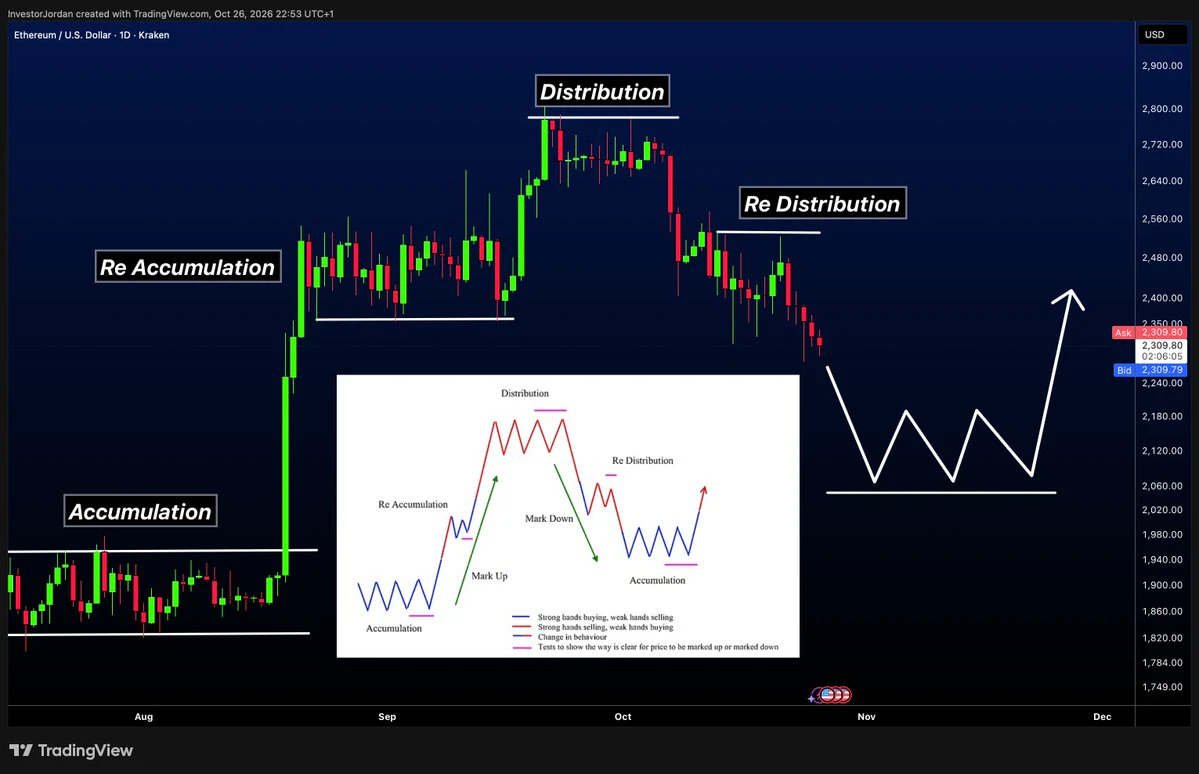
Today, cryptocurrencies fell again. Let’s take a look at what the bad boy should do next. As we can see in the chart, the decline in the previous trading session has pushed ETH’s price range back into the box formed by the large bullish candle created on 8.21. In the short term, we should look for rebounds around several midlines. Of course, we also need to be mindful of the possibility that the market could break down and plunge directly, in which case its price could fall to around 1900.
In the short term, let’s watch re
post-image
ETH-3.00%
Hit Targets to Earn USDT, Win 200 NVDA Shares in Three Reward Pools https://www.gate.com/campaigns/6394?ref=VLARBF1YAG&ref_type=132&utm_cmp=tC1WEtA2
post-image
NVDA-2.86%
In October, market sentiment toward Ethereum is bearish, with the vast majority of participants believing ETH has momentum to test below 2400.
Breaking below 2400 is the baseline expectation; a further decline to 2300 or 2200 would be an unexpected downside move with a significant odds advantage.
Overall, short-term downside expectations are strong, but the probability of an extreme plunge is limited, with the main strategy focused on trading range-bound bottom-finding.
post-image
ETH-3.00%
Very interesting $IBM chart, with support at $200.
They have been researching quantum computing, which is a topic that has been getting a lot of attention lately.
post-image
IBM+2.78%
$WDC You really broke my heart!
post-image
WDC-2.27%
BTC's price movement remains consistent with the approach I discussed in last night's livestream. Next, look for a rebound. The first range will be between 80,100 and 82,000, with prices oscillating within it. If the rebound is strong, 83,500-84,444 will both act as resistance. Pay particular attention to 82,000. $BTC
post-image
BTC-0.70%
Load More

Join 40 M users in our growing community

⚡️ Join 40 M users in the crypto craze discussion

💬 Engage with your favorite top creators

👍 See what interests you

Trending Topics

Gate Money Officially Launches

3.48k Views12.91k Discussing

Gate officially launches Gate Money, a global integrated financial services app that brings digital assets, fiat, stocks, ETFs, gold, bank accounts, and payments into one Gate App. Users can manage assets, invest, send and receive funds, convert currencies, and make payments — all from a single account. Which use case are you most excited about? [👉 Learn more](https://www.gate.com/announcements/article/102094)

BTC Pulls Back to 81000

25.4k Views35.65k Discussing

AIStocksFallALABDropsOver9%

24.52k Views542 Discussing

View More