






#Gate推出行业首个资金安全证明
Reserves Tell You How Much. PoSEC Asks Where It Sits.
For years, the standard question about an exchange was simple: does it hold enough assets to cover what users are owed? Proof of reserves answered that question, and it still matters. But a reserve ratio says nothing about how those assets are stored. Two exchanges can show identical reserve numbers while keeping very different shares in cold storage, hot wallets or third-party custody. That gap is what Gate is now trying to close.
What Gate announced
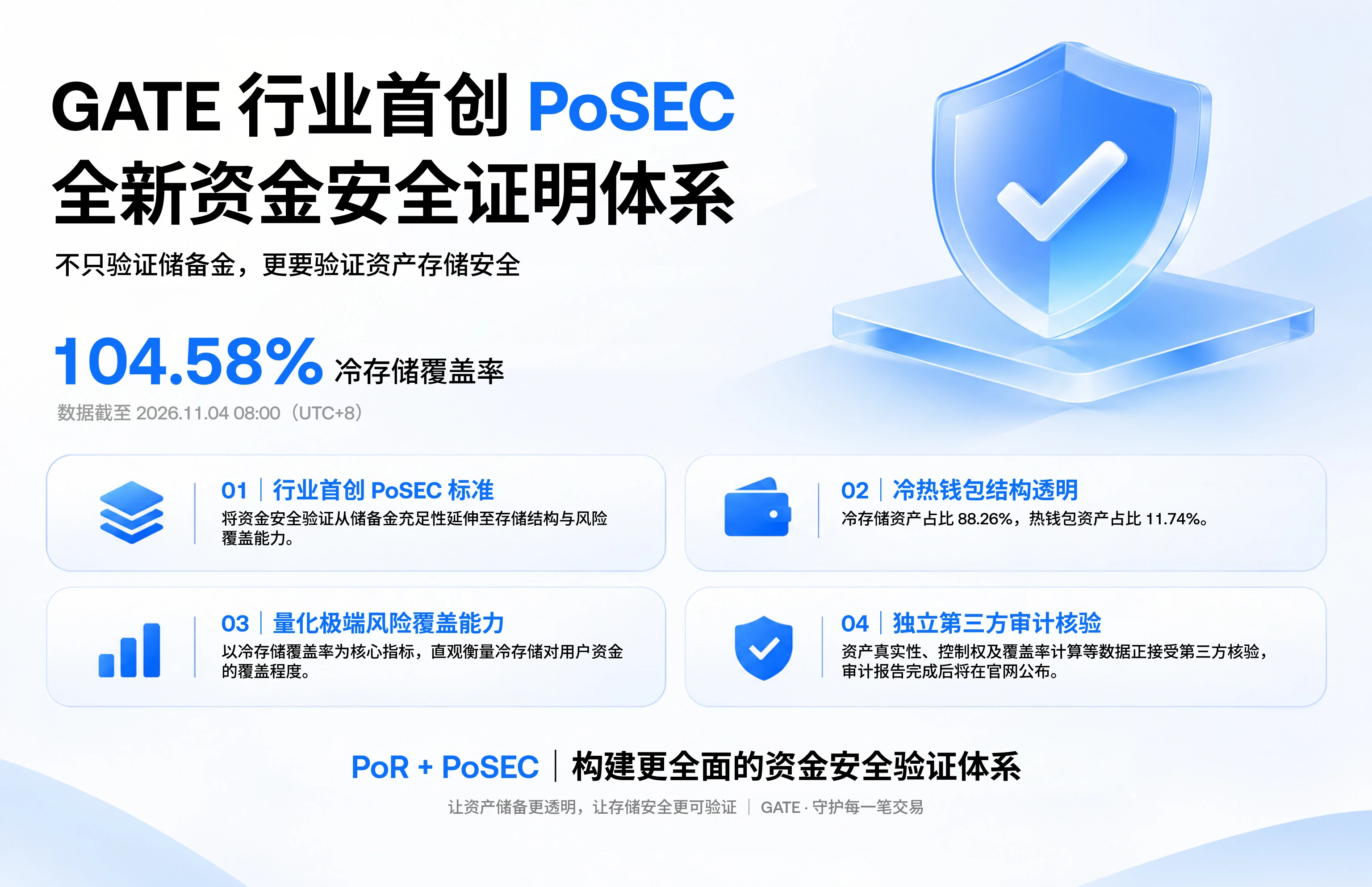
Gate has launched what it describes as the industry's first PoSEC, or proof of fund security, system. Where PoR confirms that assets exist and cover liabilities, PoSEC focuses on the storage structure behind those assets and on the coverage available to protect them. Gate's announcement reports cold storage coverage of 104.58% and says 88.26% of stored assets sit in cold storage. It also says an independent third-party audit mechanism has been introduced and that verification is underway.
Those are Gate's own figures. I could not confirm them from an independent source, and the audit is still in progress, so the results should be read as a company disclosure until the audit concludes.
Why cold storage share matters
Hot wallets are connected to the internet and are needed for daily withdrawals. Cold storage keeps keys offline and is far harder to drain through a remote attack. A higher cold-storage share generally means less of user money is exposed to a single compromise. The question for any exchange is not only whether it has the funds, but how many of those funds would be exposed if a hot wallet were breached.
What "coverage above 100%" can and cannot mean
Cold storage coverage above 100% suggests that cold-stored assets exceed the stated liability base that the system measures against. That can be reassuring, but it depends on how the liability base is defined, how often it is updated, and whether it includes every product. A figure is only as useful as its definition, so the methodology matters as much as the headline.
The audit gap is the real test
Any security claim is only as strong as its verification. Gate says an independent third-party audit mechanism is in place and that verification is underway. The key question is what the auditor will examine: wallet control, key management, custody procedures, and the reconciliation between reported and on-chain balances. Users should look for the scope, the auditor's name, the period covered, and whether findings are published in full.
What users should ask any exchange
Reserve ratios are the start of the conversation. Users should also ask for the share of assets in cold storage, the custody arrangements for each asset, how often balances are reconciled, whether an independent auditor has reviewed key management, what happens to user funds in a security incident, and how any insurance or compensation is funded and capped.
The bottom line
PoSEC is a step beyond proof of reserves, because it addresses where assets are kept and how they are protected. Gate's disclosed figures are encouraging, but they are company-reported, and the audit is still in progress. A good exchange should make its security data verifiable, specific and regularly updated, not just impressive at launch.