#Gate股票暢聊季 AI hasn’t collapsed; what collapsed is “narrative pricing”
The main shift in this pullback is that AI is moving from a “narrative pricing” framework to “cash flow pricing.” During the transition, the most profitable investments aren’t the purest AI stocks, but the companies that can turn capex into free cash flow.
I. How far have stocks fallen?
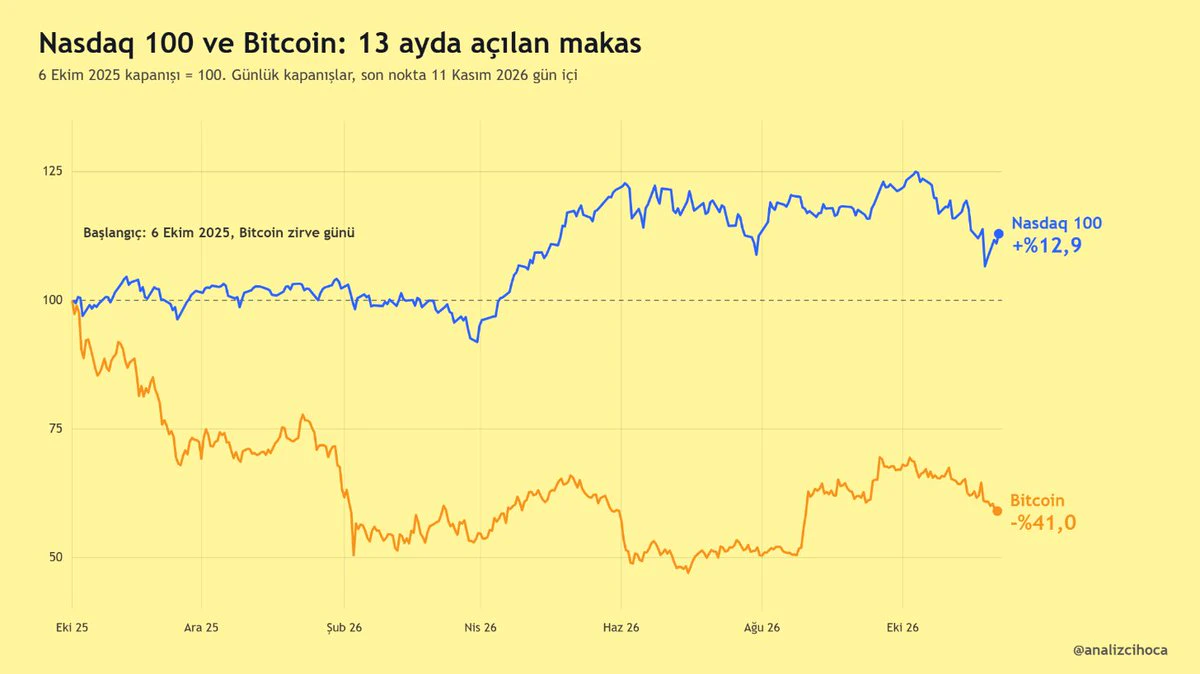
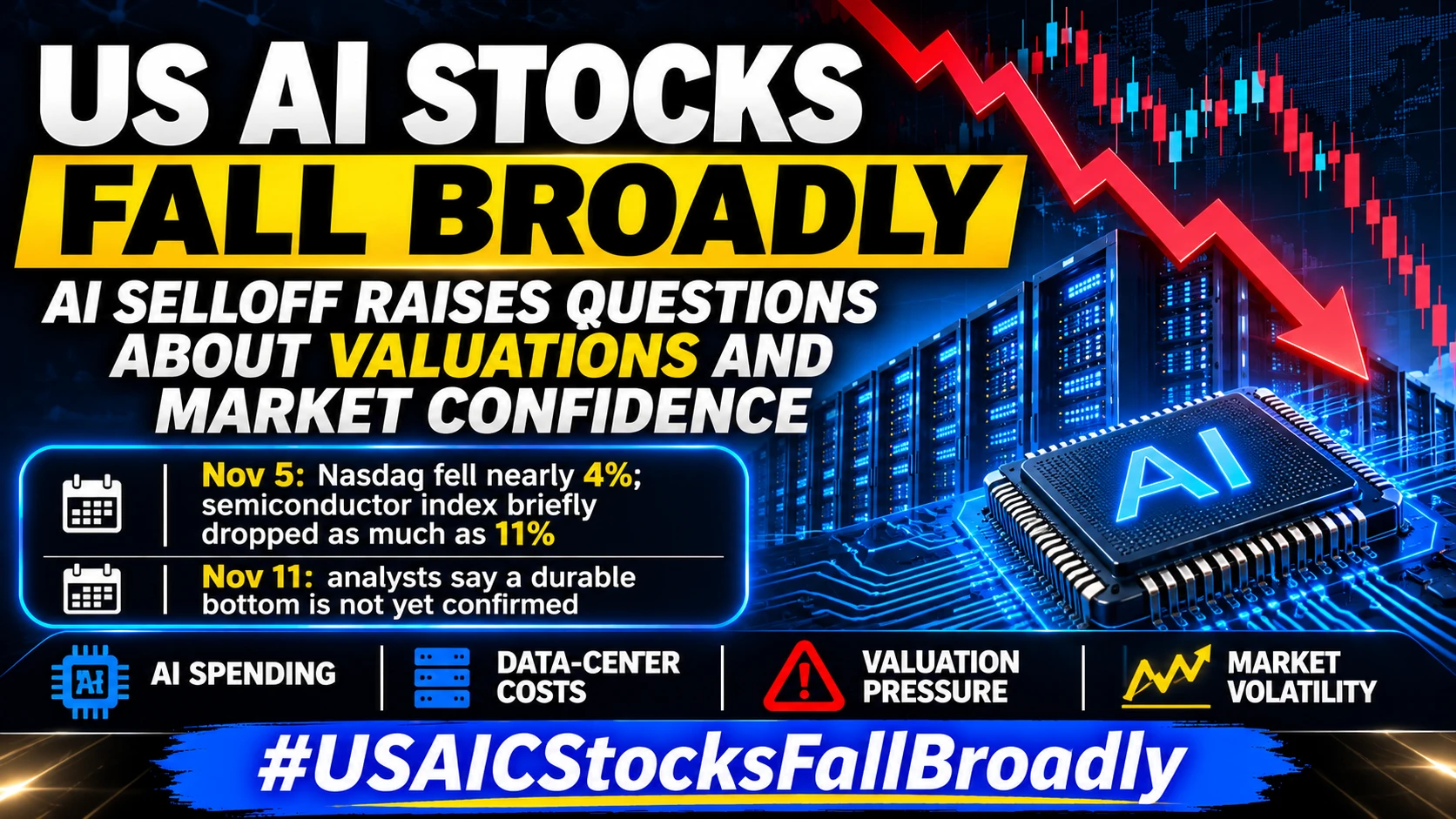
The Nasdaq 100 closed at 27,740, down about 14% over three weeks. Last Thursday, it fell 6.36% in a single day, its biggest one-day drop since March 2020; the tech sector shed about $2.5 trillion in a day, and the Magnificent Seven lost a combined $1 trillion. There was another such selloff on October 30, when about $1 trillion was wiped out in a single day and the Philadelphia Semiconductor Index fell 7.2%.
II. Why the selloff?
1) Political risk premium. After the midterm elections, Democrats won both chambers of Congress and key governorships. The market immediately applied a “regulatory discount” to data centers and AI infrastructure; new review procedures could push about one-fifth of US projects from 2028 onward.
2) Companies are still growing, but profits are starting to diverge. Alphabet’s third-quarter revenue was $127.6 billion, up 25% year over year, while net income was $26.2 billion, down 25% year over year, and EPS was $2.12 versus $2.87. Meta’s free cash flow turned negative at $2.12 billion; its stock fell 7% the day after earnings, and it still needs to raise $35 billion in equity financing to plug the gap. AI spending is starting to squeeze profits. This is a substantive change.
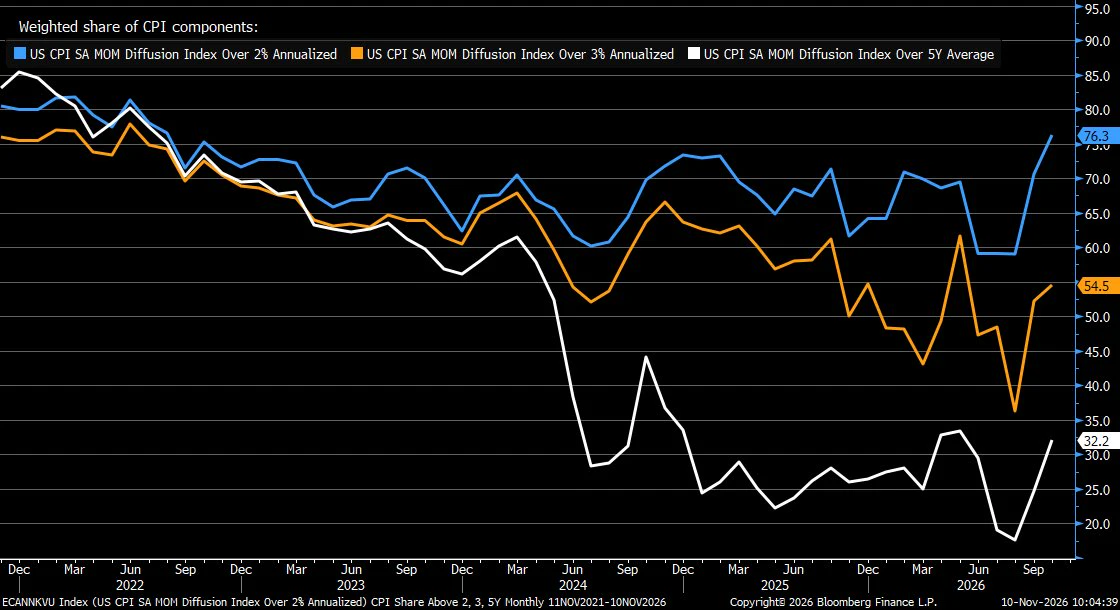
3) Interest rates are rising. After CPI came in above expectations, the 10-year Treasury yield rose above 5%. A 25-basis-point rate hike in December is now priced in at 88.5%, with long-duration assets taking the first hit.
III. Valuations have returned to a reasonable range, but earnings expectations haven’t adjusted enough
The Nasdaq 100’s forward PE has returned to 18x, the same level as before ChatGPT launched in November 2022; its PE-TTM is 26.4x, at the 1.35th percentile over the past year and the 19.1st percentile over the past decade.
But on the other hand, S&P earnings growth in the third quarter was 33%-35%, likely the peak of this cycle, while consensus for 2027 has already fallen to 18%. Mega-cap cloud providers’ capex growth is set to drop from 96% to 44%. Valuations have already adjusted substantially, but earnings haven’t started to adjust yet.
Sentiment hasn’t recovered either. Hedge funds have been net sellers for eight consecutive weeks. Monday’s 3.4% rebound was mainly driven by retail investors chasing the rally and short covering, while long-term investors are still on the sidelines. The VIX rose from 15 to 25 and then fell back to 19, with each trough higher than the last.
Of the three factors—valuation, earnings, and sentiment—only valuation currently passes the test. So my answer is: don’t buy the index; buy the structure.
IV. The four areas I’m watching now
1. The cash-flow discount trade: Google at $287 and 15x PE is the only member of the Magnificent Seven back to “2022 valuations.” With advertising and cloud as its two engines, it has the greatest earnings leverage after digesting capex in 2027. Microsoft at $533 and 27.8x PE lowered its 2026 capex outlook from $175 billion to $170 billion. That’s a sign of discipline, not weaker demand. In a market where “the more you spend, the harder you get hit,” restraint itself is a positive.
2. The event-driven overreaction trade: Nvidia at $168.89, 21x PE and about 14x forward PE, is down 17.5% so far in November. Its decline is due to a board investigation and congressional scrutiny triggered by an event involving Jensen Huang personally, not its orders. The market expects third-quarter revenue of about $109 billion and EPS of $2.47 after the close on November 17, and the company beat expectations in each of the past four quarters. But on November 18, three House committees are set to question the company behind closed doors, just hours after the earnings call. So this is event-driven, and it shouldn’t be bought as a trend trade.
How to calculate the risk/reward: In the extreme scenario where the CEO is removed and the company’s value falls 25%-30%, that implies $118-$127. At 12x forward PE, the price would be about $145. My entry point is to establish a first tranche below $145, with $120-$130 as the most extreme tranche. Don’t go all in before earnings; wait for guidance after the report to decide whether to add.
3. The second tier of picks-and-shovels plays: TSMC at $396 and 25.7x PE has the most diversified customer base. You could call it an “AI tax collector”: it doesn’t carry single-customer or single-CEO risk, making it the best-value source of certainty this cycle. Broadcom at $332 and 41x PE combines ASICs and networking, with strong order visibility, but its valuation isn’t cheap, so it’s suited to dollar-cost averaging, not chasing. AMD at $515 and 110x PE has genuinely strong results: third-quarter revenue was $13.4 billion, up 45% year over year; data center revenue was $8.5 billion, up 97%; and fourth-quarter guidance is $17 billion. But its valuation already fully prices in growth expectations for 2027. Its rebounds of 11% and 13% on November 6 and 9, respectively, also show that it’s a sentiment stock, not a core holding.
4. The defensive trade: Apple at $348 and 38x PE has no capex exposure and the cleanest cash flow, making it the cleanest safe haven in this cycle. But 38x is too expensive; it’s suitable for reducing volatility, not for offense. An even more fundamental alternative is electricity and gas turbines. As the saying goes, “the endgame for computing power is electricity”: data center power consumption is one of the most rigid parts of capex, and it isn’t exposed to the valuation selloff in AI chips.