Share your thoughts
placeholder
Article
My package is about to arrive, and I’m still short 15 thousand. Please help me. I’m not begging, okay? I’m asking anyone who’s willing to give me 15 thousand for help. I’ll definitely pay it back.
🔥 FATCOIN/USDT Analysis: Dead Cat Bounce or Macro Reversal?
FATCOIN (Perpetual) has surged over +138% to +141%, currently hovering around $0.00222 – $0.00225 after finding a local bottom at $0.00080. Trading volume has exploded to 1.03B FATCOIN with a 24-hour turnover of $2.30M - $2.33M USDT.
Technical Breakdown Across Timeframes
1-Hour Chart (Short-Term Momentum):
A massive bullish impulse pushed price action from the $0.00080 low up to a local high of $0.00274. The price is currently holding above key moving average
FATCOIN+135.11%
  • 6
  • 1
$ARB Signal】Long + 1H volume-contraction pullback/4H momentum continuation
$ARB 1H RSI 71.33, 4H RSI 77.12, the 4H Bollinger upper band at 0.2228 is capping price, while the 1H MACD histogram contracts to 0.0037 and the 4H histogram expands to 0.0062. Order book depth imbalance is -9.18%, the buy/sell ratio is 0.83, and selling pressure above 0.21504 is awaiting absorption.
🎯Direction: Long
⚡Entry/limit order: 0.2143949 - 0.2150400
🛑Stop-loss: 0.2128896
🚀Target 1: 0.2182656
🚀Target 2: 0.2198784
🛡️Trade management:
- Execution strategy: After reaching Target 1, reduce the position by 50%
post-image
ARB+29.51%
Zha Nan’s live trading: CRCL
CRCL is currently stuck at the 200-day moving average. CRCL recently launched its public chain, ARC, which uses USDC as its gas token. The development of the public chain will naturally further expand USDC’s application scope.
Zha Nan’s holdings are also nearing breakeven.
post-image
CRCL+5.69%
ARC-5.60%
USDC0.00%
ai waitlist humiliation rituals are getting out of hand
only real ones will recognize this one
post-image
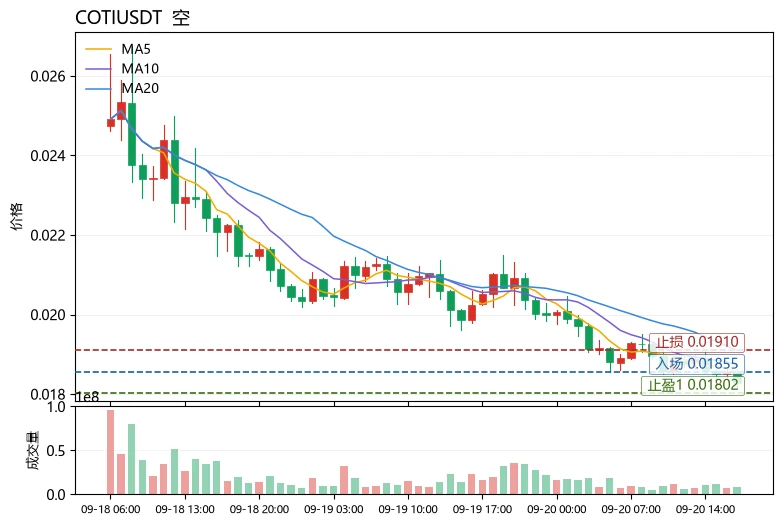
$COTI Signal】1H pullback to EMA20 with support + negative funding providing a floor; lie in wait for a long on a wick
$COTI On the 1H timeframe, price has pulled back to EMA20, with the current price of 0.02283 consolidating along the moving average. The 4H MACD bullish bars are contracting, while the 1H histogram has turned negative, indicating a short-term momentum rotation. The order book buy/sell ratio is 0.93, with a depth imbalance of -3.88% and relatively thin bids below. The funding rate is -0.0007%, meaning shorts are paying a small fee, while open interest remains stable. Pullback
post-image
COTI+17.49%
#SEC批准代币化股票有限链上交易 U.S. SEC Releases Tokenization “Innovation Exemption”: The Gate to On-Chain Stock Trading Opens, but DeFi’s Celebration Is Premature
The benefits brought by the innovation exemption are not evenly distributed. Projects across different sectors show clear divergence, ranging from direct beneficiaries and indirect winners to those largely unaffected and even those whose business models face disruption.
Tier One: Direct beneficiaries with a compliant entry ticket to the U.S.1. Uniswap v4 and AMM protocols supporting permissioned pools. This is the sector showing the strongest ma
UNI+28.05%
AERO+15.16%
RAY+15.29%
BLSH+8.66%
  • 1
Friends, today is day 36 of earning living expenses with 30U, and my total assets are currently 25.5U
It hurts so much
Once again, I failed to align my actions with my knowledge
But this time I will hold, take profit, or stop-loss
Continuing to build positions$XAU
post-image
XAU+1.60%
Live trading - Analysis hot crypto coin
live-cover
LIVE1,649
JUST IN: Intel $INTC is up 10.5% in pre market trading.
INTC+7.66%
🔹U.S. Stocks Rally Strongly After the Rate Hike! Chip stocks lead the rebound, but why is BTC still
live-cover
LIVE1,727
Up early!
Can I get a loud GM back?
post-image
The change of eras has never been another round of reshuffling, but a redistribution of the pie.
A true change of eras occurs the moment new value is created—payment efficiency, fairness, and RWA. These things may not sound sexy, but they are the foundation of a new order.
That is precisely what Pi Network is doing.
post-image
RWA+1.19%
PI+0.24%
$ZEC It has genuinely gone crazy lately, nearly multiplying 26-fold in a year and shooting straight into the top ten by market cap 🤯🤯
Personally, I think the main reasons behind this surge are pent-up pressure and forced buying, rather than the fundamentals suddenly improving 🤫
I think the biggest trigger was Grayscale's trust becoming an ETF

At the end of August, Grayscale converted its Zcash trust into a spot ETF (ticker: ZCSH), allowing ordinary stock investors to buy ZEC directly through their brokerage accounts. In less than two weeks after listing, it attracted nearly $500 million
post-image
ZEC+8.49%
Lao Xu's calls are always top-notch—an absolutely solid early call. Went long around 4340, already up nearly 60 points; I can't stop grinning this time.
$BTC $ETH $XAU #Gate股票永续合约覆盖数量行业第一
BTC+1.73%
ETH+1.88%
XAU+1.60%
Breaking: $XRP quick price action check! ⚡
Key figures right now:📍 Current Price: $1.3181 (+1.674%)📍 24h High: $1.3292📍 24h Low: $1.2877
Illustrative trade setups (not a price forecast):🔹 Long scenario: Entry ~$1.3181, SL ~$1.2786 (-3%), TP ~$1.384 (+5%)🔹 Short scenario: Entry ~$1.3181, SL ~$1.3576 (+3%), TP ~$1.2522 (-5%)
An example setup for risk management only. Not financial advice, do your own research (DYOR)! 📊
#XRP #GateIdleEarnAutoYieldUpTo3% #GateLaunchesTrenchesWith0GasFee
post-image
XRP+1.86%
🔥 What are we talking about today? Trending topics have been updated!
🇺🇸 U.S. AI-related stocks rebounded across the board, with the Nasdaq up 1.69% and Tempus AI gaining nearly 15%
🇯🇵 The Bank of Japan raised rates to 1.25%, a 31-year high—how will the yen and Japanese stocks move?
⚡ ZEC broke above $1,500 and NEAR gained over 21%—which will last longer, the privacy or AI sector?
🏛️ The U.S. House advances Bitcoin reserve legislation, while the SEC clears tokenized stocks—is the regulatory wind about to shift?
Post with a hashtag to participate in content mining and earn up to 60% in fe
post-image
GateSquare
🔥 What are we talking about today? Trending topics have been updated!
🇺🇸 U.S. AI-related stocks rebounded across the board, with the Nasdaq up 1.69% and Tempus AI gaining nearly 15%
🇯🇵 The Bank of Japan raised rates to 1.25%, a 31-year high—how will the yen and Japanese stocks move?
⚡ ZEC broke above $1,500 and NEAR gained over 21%—which will last longer, the privacy or AI sector?
🏛️ The U.S. House advances Bitcoin reserve legislation, while the SEC clears tokenized stocks—is the regulatory wind about to shift?
Post with a hashtag to participate in content mining and earn up to 60% in fee rebates. High-quality content will also receive traffic support.
💰 Write and earn as you go—good insights deserve to be seen by more people: https://www.gate.com/post/topic.
repost-content-media
NDAQ+2.83%
TEM+14.91%
ZEC+8.26%
BTC+1.72%
#美国众院推动比特币储备立法 The CLARITY Act Stumbles, While the Bitcoin Reserve Act Takes Its Place: An Overlooked Medium- to Long-Term Tailwind Is Already Underway
On September 16, the House Financial Services Committee passed the United States Reserve Modernization Act by a vote of 28 to 21, moving the Strategic Bitcoin Reserve from a presidential executive order to statutory law for the first time. On the same day, the House Ways and Means Committee passed the Digital Asset Tax Certainty Act by a vote of 38 to 5. On-chain transactions under $10 would be exempt from reporting, while miners and stakers wo
post-image
ThisIsTranslateContent:
#美国众院推动比特币储备立法 The Clarity Act Stalls, While the Bitcoin Reserve Act Takes Over: A Medium- to Long-Term Tailwind the Market Has Overlooked Is Underway
On September 16, the House Financial Services Committee passed the “American Reserve Modernization Act” by 28 to 21, moving the Strategic Bitcoin Reserve from a presidential executive order to statutory law for the first time. On the same day, the House Ways and Means Committee passed the “Digital Asset Tax Clarity Act” by 38 to 5. On-chain transactions under $10 would be exempt from reporting, while miners and stakers would be taxed only when they sell.
The failure of the Clarity Act determines the regulatory vacuum over the next few months. The Reserve Act changes how the 328k bitcoins held by the U.S. government are handled. Once the reserve moves from an executive order into law, these holdings—about 1.5% of the circulating supply—will be locked up for 20 years and cannot be withdrawn even if the president changes. The former affects prices this quarter; the latter could affect the coin distribution structure for the next 20 years.
What exactly does the Bitcoin Reserve Act change?
First, let’s look at what the U.S. government holds.
According to on-chain data, the federal government currently holds approximately 328k bitcoins, worth about $25 billion at current prices, making it the largest single government holder on Earth. Nearly all of these coins came from law-enforcement seizures: approximately 127k from the Prince Group case, about 94.6k recovered in the Bitf hack case, approximately 94k from the Silk Road cases, and the remainder from scattered enforcement actions by the Department of Justice and the Internal Revenue Service.
In the past, the fate of these coins depended on who occupied the White House. Some administrations auctioned them off, while others held onto them.
In March 2025, Trump signed an executive order establishing a Strategic Bitcoin Reserve. Seized bitcoins would no longer be auctioned off but transferred into the reserve for long-term holding. But executive orders have an inherent weakness: the next president can revoke them with the stroke of a pen.
The “American Reserve Modernization Act” aims to fix that. The bill was jointly introduced by Alaska Republican Representative Begich and Maine Democratic Representative Golden. Its core provisions include several requirements: The Treasury Department must establish a Strategic Bitcoin Reserve within 180 days after the bill takes effect, and all federal agencies must report their digital-asset holdings within 60 days. Bitcoins transferred into the reserve must be locked up for at least 20 years and may not be sold, exchanged, auctioned, or pledged as collateral during that period. The sole exception is using sale proceeds to repay federal debt.
The Treasury Department must publish quarterly proof-of-reserves reports, use cryptography to verify control of the private keys, and undergo independent third-party audits. Seized tokens other than Bitcoin would enter a separate digital-asset reserve, which would be subject to looser rules and could be converted into Bitcoin or liquidated to repay debt. The bill also makes clear that the government may not seize privately held bitcoins to fill the reserve. In addition, it requires the Treasury and Commerce Departments to study budget-neutral ways to increase holdings without imposing new taxes, issuing debt, or adding to the deficit. Potential avenues include disposing of other government-held digital assets, continuing law-enforcement seizures, and cooperating with private companies and state governments. The “one million bitcoins in five years” acquisition target discussed in the early stages was not included in the final text, leaving only a research mandate.
Another Tailwind
The Clarity Act was discussed for nearly a year and a half from introduction to its failed vote, incorporating more than 100 amendments, but ultimately died over partisan divisions.
Whether it can be revived after the midterm elections, and in what form, is unknown. Legislation of this kind involving market structure is inherently difficult, requiring simultaneous reassurance for the banking industry, regulators, state governments, and lawmakers from both parties.
The Reserve Act is taking a different path.
It does not redistribute regulatory authority or antagonize the banking industry. Its core purpose is simply to put into law something the government is already doing. The executive order has been in effect for a year and a half, and the reserve already exists in practice. The bill only needs to address its durability. That is why it has secured more than 20 bipartisan co-sponsors.
The implications for the market are also completely different. Whether the Clarity Act passes determines how exchanges register and which regulator oversees a given token. It would take years for these rule changes to feed through to prices.
If the Reserve Act ultimately becomes law, 328k bitcoins would be removed from potential sell-side supply for 20 years. This change would not depend on any agency’s willingness to implement it; it would take effect simply by being written into law. Relative to the circulating supply, this amounts to removing approximately 1.5% of the coins from the market for a generation.
There is another easily overlooked signal.
The quarterly proof-of-reserves reports and private-key verification required by the bill would mean that the U.S. government publicly discloses its Bitcoin holdings in an auditable manner for the first time.
By comparison, the last comprehensive physical audit of U.S. gold reserves was conducted in 1953. The fact that a country’s Bitcoin reserves would be more transparent than its gold reserves is itself worth recording in history.#Gate广场中秋团圆局 $BTC
repost-content-media
BTC+1.72%
  • 2
Grok won't let me escape North Korea
AI is retarded
Load More

Join 40 M users in our growing community

⚡️ Join 40 M users in the crypto craze discussion

💬 Engage with your favorite top creators

👍 See what interests you

Trending Topics

GateTopsStockPerpetualCoverage

36.85k Views2.11k Discussing

According to the latest DefiLlama report, Gate has listed 385 stock-related perpetual contracts, ranking first in coverage; average daily volume is about $1.15B and average open interest about $738M, both ranking third in the industry; liquidity depth for its five highest-volume contracts — SNDK, SKHYNIX, SPCX, SOXL, and MU — ranks first across the board. How do you view Gate leading in both coverage breadth and liquidity depth? [👉 Full Report](ttps://defillama.com/research/spotlight/deep-enough-trade-gate-case-tokens-stocks)

GateTrenchesExclusive0GasTrading

46.71k Views973 Discussing

USAIConceptStocksRally

32.83k Views195 Discussing

View More