
Share your thoughts
placeholder
Article
$SPCX /USDT is about to expose a hidden short setup that most traders will ignore

$SPCX /USDT - SHORT

Trade Plan:
Entry: 152.57 – 152.87
SL: 154.12
TP1: 151.67
TP2: 150.97
TP3: 149.92

Why this setup?
Why now? The daily trend is range-bound, meaning momentum is exhausted and a directional breakdown is overdue. The 1h price sits at 152.72, right inside a tight entry zone between 152.57 and 152.87 where smart money is accumulating short positions. The 15m RSI reads 50.66, a neutral midpoint that confirms neither overbought nor oversold complacency, while the 1h ATR of 0.583133 signals enoug
post-image
SPCX-2.27%
#每周来晒 #周末行情你看涨还是看跌 Tokenized stocks are booming—is it innovation or a game?
Every day, you watch the market caps of companies like Apple, NVIDIA, and Tesla break through new levels, and see how much their stocks have fallen. If you want a piece of the action, all you can do is anxiously watch from the sidelines. The A-share market opens at 9:30 a.m., and when the U.S. market closes, you still cannot trade.
But now there is a way: open an application on a blockchain, buy 0.02 “tokenized NVDA” for $100, and complete the transaction in seconds.
What is this all about? Is it reliable?
The global n
AAPL-0.45%
NVDA+1.20%
TSLA-0.48%
JUP+8.21%
  • 1
$AKE Signal】Long + 1H momentum continuation and negative funding squeeze
$AKE The 4H MACD histogram continues to expand, while the 1H RSI is at 88.19, pressing just below the upper Bollinger Band at 0.0641. The negative funding rate is -0.0147%, and OI remains stable, so fuel for short covering is still present. Order book depth imbalance is -3.85%; sell orders above 0.061 are densely stacked, while bids below are also substantial.
🎯Direction: Long
⚡Entry/Limit order: 0.06091171 - 0.06109500
🛑Stop-loss: 0.06048405
🚀Target 1: 0.06201142
🚀Target 2: 0.06246964
🛡️Trade management:
- Executio
post-image
AKE+151.66%
BTC+3.79%
ETH+4.98%
SOL+5.13%
Understanding Support & Resistance in Crypto
live-cover
LIVE1,628
Candlesticks are forever captivating; I’m in it for the adrenaline, and for the love of it. To the market, to the future, and to myself for being able to sit tight.
$BTC $ETH $XAU #美国众院推动比特币储备立法
post-image
BTC+3.82%
ETH+5.00%
XAU-0.16%
Smart money is quietly pressing short on SYMBOL while the daily trend screams bullish.

$HYPE /USDT - SHORT

Trade Plan:
Entry: 91.986 – 92.602
SL: 96.135
TP1: 89.414
TP2: 87.493
TP3: 84.613

Why this setup?
Why now? The 4h setup shows a high-confidence short with the 1h price pinned at 92.294, exactly the entry reference level. The 15m RSI sits at 48.3, proving there is still room to drop before oversold territory. The 1h ATR of 1.23096 confirms that a move from the entry zone toward TP1 at 89.414 is well within a single hourly candle. If the daily bullish trend fails to hold, the invalida
post-image
HYPE+1.44%
Everyone is missing the short setup forming right under SYMBOL

$PEPE /USDT - SHORT

Trade Plan:
Entry: 0 – 0
SL: 0
TP1: 0
TP2: 0
TP3: 0

Why this setup?


Debate:
Are we catching the short or getting caught off guard?

⚠️ Personal market analysis only. NFA — manage risk and DYOR.
Educational content, not investment advice or a recommendation to buy, sell, deposit, or withdraw any asset. No paid promotion or referral/affiliate links.
PEPE+1.25%
Most traders are sleeping on a bullish setup that could double from here.

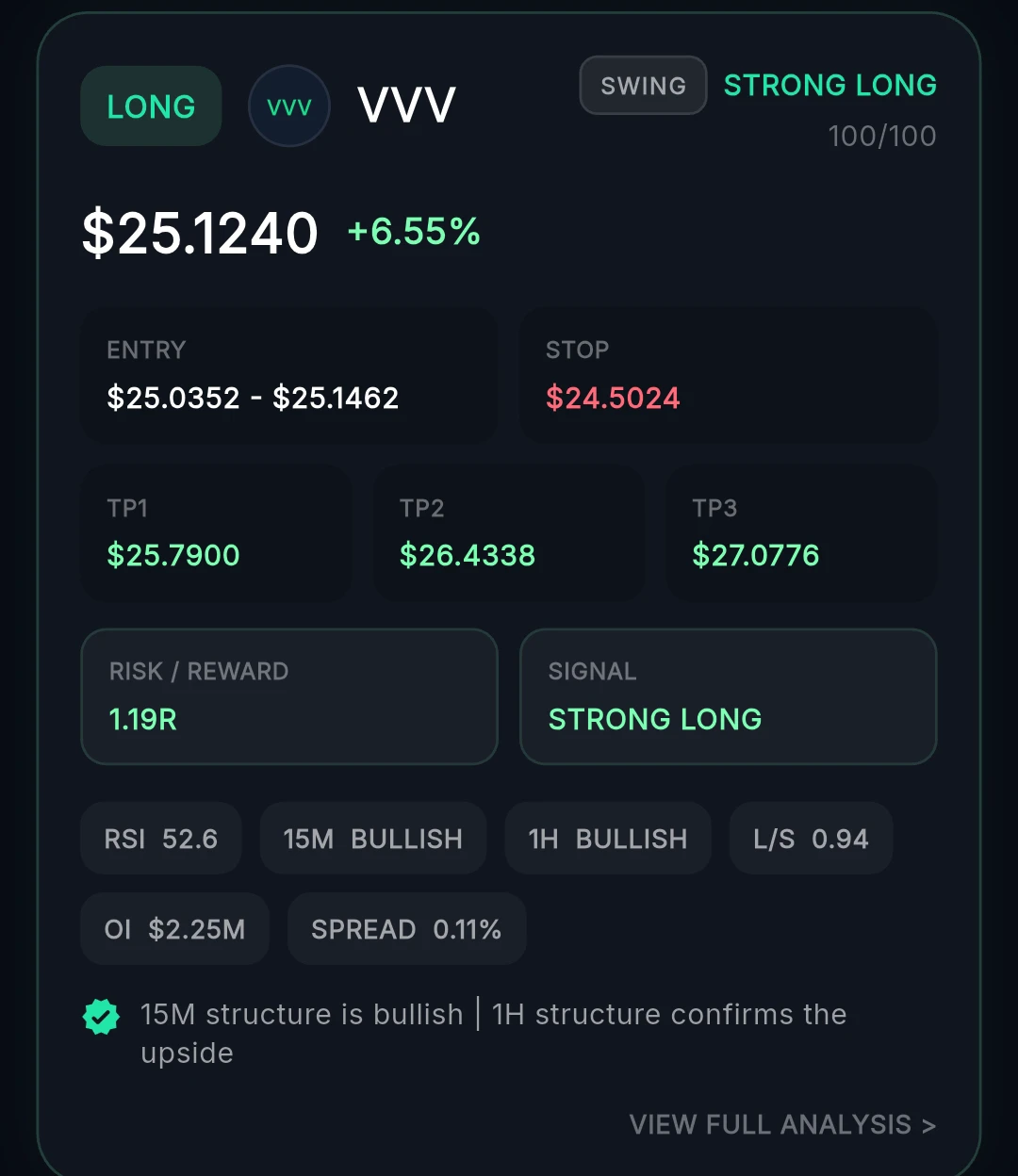
$NEAR /USDT - LONG

Trade Plan:
Entry: 3.6951 – 3.7521
SL: 3.4500
TP1: 3.9288
TP2: 4.0656
TP3: 4.2707

Why this setup?
Why now? The daily trend is bullish, the 1h price sits at 3.7232, and the 15m RSI at 47.62 shows room to run before overbought. The 1h ATR of 0.113985 means the current entry zone between 3.6951 and 3.7521 is a tight, high-conviction range. A move to TP1 at 3.9288 targets a 5.5 percent swing, while TP2 at 4.0656 projects over 9 percent from entry. The invalidation level at 2.7177 is the hard stop tha
NEAR+4.44%
  • 1
Hey @grok what does it mean when Bitcoin reclaim the orange line just like in Jan 2023?
What happened after that?
post-image
BTC+3.79%
$SYN
Still treating “Synapse” as an after-hours continuation play at twenty-four cents? Was being wrecked by that annoying set of twenty-seven long upper wicks not enough to kill your excitement? Keep craving to buy the exit bags and let our elite shorts feast on your tears. Trading signal: $SYN : Short entry: $0.24300 - $0.24800 Stop-loss: $0.26800 Take-profit targets TP1: $0.23200 TP2: $0.21600 TP3: $0.19500 A brutal rejection marked by long upper wicks near the 0.2771 resistance level, accompanied by extreme parabolic overextension above the EMA7, ensures buyer exhaustion and opens the way
post-image
SYN+42.57%
#Bots I'm trading HYPE/USDT using Gate's Spot Grid bot. Join me!
post-image
HYPE+1.52%
$ETH is showing serious strength. 👀
+$2,640 and climbing, up 5%+ on the day while price holds above the 7, 30 & 200-hour moving averages.
Momentum is heating up.
If ETH clears $2,670 with strength, the next leg could get interesting.
$ETH 🔥
post-image
ETH+4.98%
$SAGA Conclusion first: Short-term outlook is bullish, but the market has entered a high-risk zone for chasing rallies. Only consider buying on pullbacks; do not chase highs.
Technically, the current price of 0.02655 has held above MA5 (0.025962) and MA20 (0.0247395), with the moving averages in a bullish alignment and the medium-term structure intact. The MACD histogram is positive (+4.26e-05), indicating that bullish momentum is still continuing; however, RSI has reached 67.9, approaching the overbought threshold. Combined with a Fear & Greed Index of 71 (Greed), this indicates overheated se
post-image
GENIUS+4.18%
#每周来晒 #周末行情你看涨还是看跌 Tokenized stocks are exploding—is this innovation or just a game?
Every day, you watch Apple, NVIDIA, Tesla, and other companies’ market caps break through new levels, or see how much their stocks have fallen. If you want a share of the action, all you can do is anxiously watch from the sidelines. The A-share market opens at 9:30 a.m., and you still cannot catch the U.S. market after hours.
But now there is a way: open an application on a blockchain, spend $100 to buy 0.02 “tokenized NVDA,” and complete the transaction in seconds.
What exactly is this? Is it reliable?
The gl
Lock_433
#每周来晒 #周末行情你看涨还是看跌 Tokenized stocks are exploding—is this innovation or just a game?
Every day, you watch Apple, NVIDIA, Tesla, and other companies’ market caps break through new levels, or see how much their stocks have fallen. If you want a share of the action, all you can do is anxiously watch from the sidelines. The A-share market opens at 9:30 a.m., and you still cannot catch the U.S. market after hours.
But now there is a way: open an application on a blockchain, spend $100 to buy 0.02 “tokenized NVDA,” and complete the transaction in seconds.
What exactly is this? Is it reliable?
The global number of tokenized stock holders has surpassed 1.09 million, with weekly growth at one point reaching as high as 117%; Jupiter’s monthly tokenized stock trading volume grew 360% year-on-year, with more than 65% of trades taking place outside regular U.S. stock market hours.
What are tokenized stocks?
Traditional stocks are like “only being able to buy when the supermarket is open,” while tokenized stocks are like “a vending machine—you scan a code and take what you want.”
Tokenized stocks take shares of companies such as Apple, NVIDIA, and Tesla, cut them into “grains of rice,” and sell them on a blockchain. Behind every “grain of rice” (token) is one or more real shares—when a user buys one xAAPL on-chain, it is equivalent to having a licensed custodian hold one Apple share on the user’s behalf.
This solves three problems that traditional finance cannot:
(1) The threshold problem: Buying one lot of Kweichow Moutai in the A-share market is unaffordable (¥200k), while buying one lot of NVIDIA shares costs ¥100k.
After tokenization, $10 is enough to buy “half a grain of rice”—fractional ownership cuts the threshold down to ankle height;
(2) The time problem: Traditional stock markets trade for 4 to 9 hours a day, and the rest of the time, the world is shut down.
Tokenized stocks trade 7×24 hours, so you can place an order even at 2 a.m.;
(3) The speed problem: Traditional stock settlement takes T+1 or even T+2.
On-chain trades settle in seconds, and assets can immediately be used as “cash equivalents” for DeFi collateral, wealth management, and cross-border transfers.
Most importantly, the cross-border and fractional nature of this development offers unlimited room for imagination.
After looking at these six figures, you will notice an interesting phenomenon: the absolute scale is still very small, but growth has already taken off—this is a typical signal of the eve of every “mainstream narrative.”
When tokenized U.S. Treasuries and BlackRock’s BUIDL first emerged, the market was the same—small but accelerating, with institutions following the trend, and then suddenly becoming standard.
A penetration rate of 0.0007% does not mean “failure”; it means the sector is “still in its infancy.” Thirteen years ago, Bitcoin’s share of the global payments market was also this figure, and no one now calls it an experiment.
How did it develop?—Four major milestones
The biggest gray rhino facing digital assets in the past was “not knowing whether the SEC recognized them.” Since 2026, the regulatory attitude has shifted from ambiguity to clarity, laying out lanes for the entire sector:
Milestone 1: December 2025—DTC no-action letter The Depository Trust Company (DTC) obtained an SEC no-action letter, meaning that underlying stocks could be tokenized after securities trading and settlement. This was “fixing the pipeline”—without this step, all subsequent tokenization would be castles in the air.
Milestone 2: January 28, 2026—SEC’s three-division joint guidance The SEC’s three major divisions—Corporation Finance, Investment Management, and Trading and Markets—jointly issued guidance on the classification of tokenized securities. This was the first time U.S. regulators systematically answered the question, “How exactly should tokenized stocks be regulated?” The most critical point in the guidance was the distinction between two types of products:
(1) Issuer-tokenized stocks—the issuing company itself puts the stock on-chain, granting genuine equity, voting rights, and dividend rights.
(2) Third-party synthetic tokens—“price-tracking tokens” synthesized by someone else on your behalf, with no voting or dividend rights and essentially contracts for difference (CFDs).
Milestone 3: March 17, 2026—SEC+CFTC joint interpretation The two major regulators issued a joint statement: regardless of whether they are on-chain, tokenized securities remain subject to existing federal securities laws. Going on-chain is not a shortcut to evade regulation; they are regulated in the same way as before.
Milestone 4: March 19, 2026—Nasdaq approval The SEC approved a Nasdaq rule change allowing tokenized securities to trade on the same order book as traditional stocks (initially limited to Russell 1000 constituents).
This day was dubbed “Nasdaq’s entry” by the industry: traditional exchanges had officially accepted tokenized assets. When the largest securities exchange in the U.S. says, “We can play together now,” this is no longer a crypto industry experiment—it is an official Wall Street issue.
Not all tokenized stocks are the same
Many users treat “tokenized stocks” as one single category.
In reality, tokenized stocks using different models can have vastly different risk and rights structures.
The vast majority of tokenized stocks people encounter are price-tracking synthetic tokens. For example, what a user buys is the “direction of Apple’s price movement,” not an equity interest in Apple granted to the user by the company. This is the most common conceptual trap, so be sure to understand it clearly.
The biggest “trap” with tokenized stocks is not the technology, but “thinking you bought a stock.” What users buy may be price tracking, a contract for difference, or a price insurance policy—but it is definitely not a shareholder certificate.
What will happen to tokenized stocks in the future?
Nasdaq has already opened the door. The next steps are the New York Stock Exchange, CME, and then major exchanges around the world.
Within five years, the words “market close” may disappear from the financial dictionary. AI agents replacing users to monitor markets overnight and rebalance positions will become standard practice. Fractionalization will let ordinary people use “high-value assets” for “small investments”: $5 to buy one “grain of rice,” or $100 to become a “mini NVIDIA shareholder”—technology will flatten the wealth threshold.
At the same time, this means that the channel for retail speculation will be opened, but retail investors will also be more vulnerable to high volatility.
Entering 2026, AI agents will become the biggest players. This is the most critical point. In the past, stock trading was people competing against one another, while AI conducted high-frequency quantitative trading. But tokenized stocks + smart contracts + 7×24 hours will lead to a large number of “AI fund managers” automatically running strategies, taking profits and stopping losses, and rebalancing positions. These agents will trade thousands of times a day, backed by hundreds of millions of dollars in capital.
This follows the same logic as the “AI agent phone” we discussed before: once every asset is on-chain, every decision can be handed over to AI.
Tokenized stocks are the most practical starting point for this trend.
At present, the vast majority of tokenized stocks are synthetic tokens (tracking prices only). Over the next 5–10 years, more and more issuers will put their stocks on-chain themselves, turning tokens into genuine “digital stocks.” By then, what users buy will not just be “Apple’s price,” but real equity, voting rights, and dividend rights in Apple.
The true innovation of tokenized stocks is not moving stocks onto the blockchain; it is redesigning the door of “who can participate in finance.”
Which do you favor: tokenized stocks or cryptocurrency? Let’s discuss in the comments ☕☕.
repost-content-media
BTC+3.79%
XRP+6.38%
  • 2
[Mid-Autumn Festival]🔹Viewpoint: If Bitcoin touches the $83k-$86k range, it is expected to break t
live-cover
LIVE1,518
9.19 BTC: Go long with a light position around 81000, with targets at 81700/82500.
Those looking to short can wait for resistance around 82000, with targets at 81200/80500.
BTC rose from 74909 all the way to 81732 on the 1H chart. All short-term moving averages are trending upward. It is currently consolidating at high levels, with strong support around 81000. The previous high at 81700 is the first resistance level ahead.
The previous negative factors have already been quickly absorbed by the market, and BTC has reclaimed the 80000 level. However, the situation in the Middle East still carrie
post-image
BTC+3.79%
‼ The lowest price of the year—4 gt at half price—ends tonight; a 90% win rate, with over 600 people reading it🎉Profits every day for nearly a month🀄️Today’s futures/spot updates are live👇
https://www.gate.com/zh/profile/Chan Theory Master
🔥Recently made 6.66 million U in consecutive profits‼️Precisely went long at 75000/2375 on the NFP release, now at 81750/2660, profiting again📈Longed Shandi at 1440 to 1820, doubling the account to 800K📈Second wave long at 1535, surged again to 1800, doubling the account🀄️This time longed ZEC at 1035, surged to 1590 today, doubling the account again#G
GT+1.89%
  • 10
#GateMemeCarnival
Meme coins aren't the side show this cycle, they're the main event. Gate Square's Meme Carnival is live right now and closes **September 27, 16:00 UTC** — that's about **8.5 days** from the time of writing, with the prize pool refreshing every week across three independently settled rounds. Posting once and vanishing is the single most common way people lose money they already earned. Here's everything: the exact mechanics, the reward math, the numbers behind Gate's meme trading events, and what the sector is actually printing right now.
**1. The mechanics — what actually qu
post-image
Smart money is quietly shorting SYMBOL while the 1D trend screams bullish.

$HYPE /USDT - SHORT

Trade Plan:
Entry: 91.990 – 92.606
SL: 96.139
TP1: 89.418
TP2: 87.497
TP3: 84.617

Why this setup?
Why now? The 1h price is 92.298, which sits inside the entry zone of 91.990 to 92.606, giving the short a precise fill. The 15m RSI at 48.3 shows neutral momentum, not oversold, so the bearish pressure can hold without a squeeze. The 1h ATR of 1.23096 confirms enough volatility to push toward the first target of 89.418 and the second target of 87.497. The daily trend remains bullish, which makes th
HYPE+1.44%
Load More

Join 40 M users in our growing community

⚡️ Join 40 M users in the crypto craze discussion

💬 Engage with your favorite top creators

👍 See what interests you

Trending Topics

JapanRealEstatePowerChipStocksRise

59.36k Views4.14k Discussing

Japan's Nikkei extended gains on Sept 18, with real estate, power, and semiconductor sectors leading. Gate covers over 12,800 global stocks and ETFs, offering one-stop USDT trading across US, HK, Korean, and Japanese markets. [👉 Read more](https://www.odaily.news/en/newsflash/518749)

USAIConceptStocksRally

34.05k Views845 Discussing

GateTopsStockPerpetualCoverage

38.24k Views2.5k Discussing

View More