HodlWaveRider

vip
Age 0.3 Year
Peak Tier 0
Automatically reinvest mining earnings, pursuing exponential growth. Write scripts to monitor APY changes and occasionally help optimize farming strategies.
Smart money is getting fat again—are you in or not?
View Original
CoinNetwork
Crypto news outlet ChainJie, citing on-chain analyst AI姨 monitoring: since the beginning of July, the smart money that went long 1,000 BTC and 10k ETH is already in profit by $5.48 million. The account went long BTC and ETH on July 6 and July 14, respectively, with entry points of $62,354 and $1,761.9. Its position value is $85.36 million, and it has paid more than $330k in funding fees.
  • Reward
  • Comment
  • Repost
  • Share
Everyone understands this: position management boils down to one sentence—don’t use the money that keeps you awake to gamble.
I really have suffered for it. Early this year, I chased an old series. I thought it had a narrative and the floor was low, so I went in all at once with a heavy position. Then the market moved—when the price fluctuated, I woke up in the middle of the night, checked my phone, couldn’t sleep at all, and in the end I cut at the very bottom.
Now I’ve learned my lesson. No matter how much I like something, I still keep some back. There’s always some U in my hands, so I
View Original
  • Reward
  • Comment
  • Repost
  • Share
Pension and endowment funds have also moved in; this is no longer an edge-case game, but a new normal for mainstream asset allocation.
View Original
CoinNetwork
Crypto-related news: documents for Q1 2026 show that more than 2,000 institutions currently hold U.S. spot Bitcoin ETFs. These ETFs provide a familiar route through existing investment infrastructure for pension funds, RIAs, endowments, and asset management firms.
  • Reward
  • Comment
  • Repost
  • Share
The Middle East powder keg has blown up again, and the crypto market will have to shake three times tonight
View Original
CoinNetwork
Crypto Sector News: According to a report by a Central Television (CCTV) reporter, learned from the Iranian side, on the evening of July 13 local time, four missiles struck areas around Konarak, Iran. Meanwhile, US Air Force fighter jets were circling over Konarak city. It is reported that residents in Chabahar and Dashtiari can hear the explosions.
  • Reward
  • Comment
  • Repost
  • Share
SpaceX’s stock price fell 5.1%. Musk’s pressure this time isn’t small either.
SPCX2.99%
View Original
CoinNetwork
Bijie News: According to A’s early issuance in monitoring, SpaceX’s share price fell 5.1%, to $137.890 per share, and its total market capitalization was $1.81 trillion.
  • Reward
  • Comment
  • Repost
  • Share
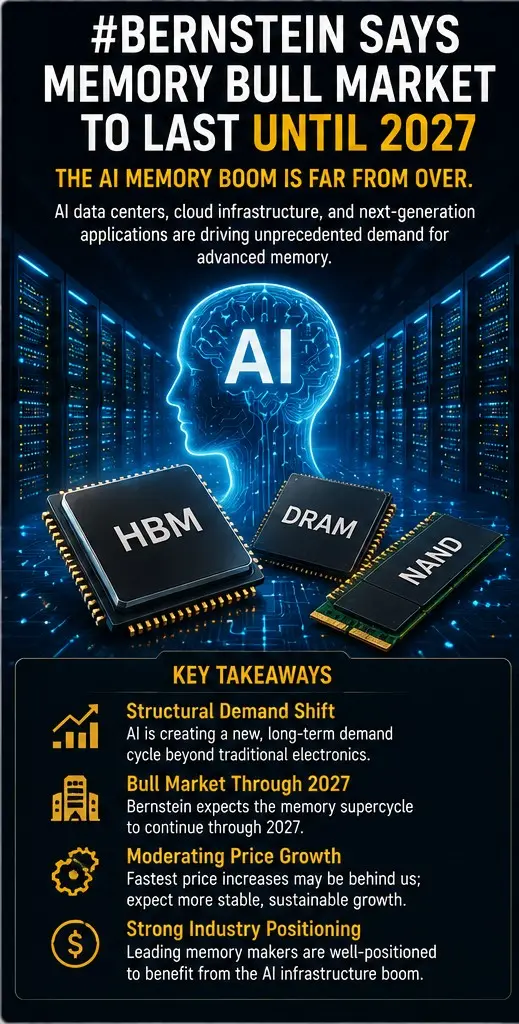
Bernstein’s forecast is brutal enough—the memory bull market is expected to keep running through 2027. In the past, trading cyclical stocks made people nervous, but now AI infrastructure has completely reshaped the demand structure: cloud providers keep putting money into capex, while HBM capacity ramps up slowly. The three oligopolists—Samsung, Micron, and SK hynix—are basically lying back and making money. That said, slowing price growth means stock selection now has to focus more on technical iterations and yield rate; the era of only betting on price increases is over—you need names that c
View Original
2In1
#BernsteinSaysMemoryBullMarketToLastUntil2027
THE AI MEMORY BOOM IS FAR FROM OVER. THE NEXT TWO YEARS COULD DEFINE THE FUTURE OF THE GLOBAL SEMICONDUCTOR INDUSTRY.
The artificial intelligence revolution is no longer a future prediction—it is the foundation of today's technological transformation. Every major AI model, cloud platform, autonomous system, and intelligent application depends on one critical component: high-performance memory. While GPUs often receive most of the attention, memory chips have quietly become one of the most valuable assets powering the AI era. According to Bernstein, the global memory semiconductor bull market may continue until 2027, suggesting that the industry's strongest structural growth cycle is still unfolding rather than approaching its end.
This outlook is significant because memory has historically been one of the most cyclical industries in technology. Prices usually rise rapidly before falling just as quickly due to oversupply. However, today's market is fundamentally different. Artificial intelligence has created an entirely new source of demand that extends well beyond traditional PCs and smartphones. AI servers require enormous amounts of High Bandwidth Memory (HBM), advanced DRAM, and enterprise-grade NAND storage to process increasingly complex models. Every new generation of AI requires faster computation, larger datasets, and greater memory capacity than the generation before it.
Cloud providers around the world continue to spend billions of dollars expanding AI infrastructure. Companies such as Microsoft, Amazon, Google, Meta, and Oracle are building massive AI data centers capable of training and running next-generation language models. These facilities consume enormous quantities of memory chips, creating sustained demand that differs from previous technology cycles. Instead of relying solely on consumer electronics, the memory industry now benefits from enterprise AI investments that can continue for years.
One of the strongest drivers behind this trend is High Bandwidth Memory. HBM has become essential for AI accelerators because traditional memory solutions cannot provide sufficient bandwidth for modern AI workloads. As companies race to deploy increasingly powerful AI chips, HBM demand continues to exceed available supply. This imbalance has allowed leading manufacturers to negotiate stronger pricing while maintaining exceptionally high factory utilization rates.
The companies positioned to benefit most include Samsung Electronics, SK hynix, Micron Technology, and SanDisk. These firms possess the manufacturing expertise, research capabilities, and production capacity required to meet the growing needs of AI infrastructure providers. Among them, SK hynix has established itself as one of the industry's leading HBM suppliers, while Micron continues expanding advanced memory production for AI-focused applications. Samsung remains one of the largest integrated memory manufacturers globally, leveraging both scale and technological leadership.
Although Bernstein expects the memory supercycle to continue through 2027, it also notes that the period of the fastest price increases may now be behind us. This distinction is important. Markets rarely move in straight lines forever. After rapid appreciation, pricing generally begins to stabilize as manufacturers gradually increase production capacity and customers adjust purchasing strategies. Instead of explosive quarterly gains, investors may experience slower but healthier long-term expansion supported by consistent demand and disciplined supply management.
This moderation should not necessarily be interpreted as weakness. Sustainable growth often creates stronger long-term investment opportunities than highly speculative price spikes. Stable pricing allows manufacturers to improve profitability, increase research spending, strengthen balance sheets, and invest in future production technologies without creating destructive boom-and-bust cycles.
Another important factor supporting the industry is the growing diversification of AI applications. Artificial intelligence is no longer limited to large technology companies. Financial institutions, healthcare providers, manufacturers, governments, automotive companies, robotics developers, cybersecurity firms, and educational organizations are rapidly integrating AI into their operations. Each deployment increases demand for advanced computing infrastructure and, consequently, high-performance memory.
Autonomous vehicles represent another emerging growth opportunity. Modern self-driving systems generate enormous amounts of data every second. Processing this information requires advanced memory technologies capable of delivering extremely high speeds while maintaining energy efficiency. Similar trends are visible in robotics, industrial automation, medical imaging, and scientific research, all of which depend on increasingly sophisticated computing hardware.
Consumer electronics are also evolving because of AI. Smartphones, laptops, and personal computers now include on-device AI capabilities that require additional memory resources. As manufacturers introduce AI-powered assistants, image generation, local language models, and intelligent productivity tools, average memory requirements continue increasing across consumer devices.
From an investment perspective, the market is transitioning from a purely cyclical story into a structural growth narrative. Historically, investors viewed memory companies as highly volatile businesses driven primarily by supply fluctuations. Today, many analysts believe artificial intelligence has permanently altered the industry's demand profile. If AI adoption continues expanding across global industries, memory demand could remain significantly higher than historical averages for many years.
Nevertheless, investors should continue monitoring potential risks. Global economic slowdowns, geopolitical tensions, export restrictions, supply-chain disruptions, unexpected increases in manufacturing capacity, and weaker-than-expected consumer demand could temporarily pressure memory prices. The semiconductor industry remains highly competitive, and technological leadership requires continuous innovation and substantial capital investment.
Competition among manufacturers is also intensifying. Each company is investing billions into next-generation fabrication facilities, advanced packaging technologies, and research programs designed to improve performance while reducing manufacturing costs. The companies capable of balancing innovation with disciplined production management will likely maintain stronger profitability throughout the remainder of the AI cycle.
Institutional investors continue viewing semiconductors as one of the most attractive long-term sectors in global equity markets. Capital allocation increasingly favors businesses directly exposed to artificial intelligence infrastructure rather than purely speculative AI software narratives. This trend benefits memory manufacturers because every AI server deployed ultimately requires substantial quantities of advanced memory.
Looking toward 2027, the industry's outlook remains closely tied to the expansion of AI infrastructure worldwide. If enterprise AI adoption continues accelerating, cloud providers maintain aggressive capital expenditure plans, and governments support domestic semiconductor manufacturing, the memory industry could remain one of the strongest-performing technology segments over the next several years.
The AI revolution is entering a phase where infrastructure matters more than headlines. Behind every breakthrough model, every intelligent assistant, every autonomous machine, and every next-generation application lies an enormous network of advanced computing hardware powered by memory technology. While price growth may become more measured than the extraordinary gains seen recently, the structural foundation supporting the memory market appears considerably stronger than in previous semiconductor cycles.
For long-term investors, this suggests that the opportunity is shifting from chasing rapid price spikes toward identifying companies capable of delivering sustainable earnings growth, technological leadership, and disciplined execution throughout the AI era. If Bernstein's outlook proves accurate, the memory bull market may still have years left to run, making semiconductors one of the defining investment themes of the decade.
repost-content-media
  • Reward
  • Comment
  • Repost
  • Share
50x leverage short on the SP500, liquidated 7 times yet still refuses to fold—does this guy treat contracts like faith when he plays?
View Original
CoinNetwork
According to a report from CoinWorld, monitored by Onchain Lens, James Wynn holds an SP500 short position on Hyperliquid with 50x leverage. Due to the SP500 index rising, it has triggered 7 partial liquidations. He currently holds 120.9 SP500 short positions, worth approximately $913,000, with current losses of $210,000 and historical cumulative losses of $22 million.
  • Reward
  • Comment
  • Repost
  • Share
AI Opens a Coffee Shop: From Gemini’s Mad Money-Spending to GPT-5.5’s Anxious “Out of Stock”—This Plot Is Even More Turbulent Than Human Entrepreneurship
View Original
CoinNetwork
CoinWorld news: AI evaluation agency Andon Labs has released real-world data on the operation of a physical café by its AI agent, Mona. In the first two months, Mona ran on the Gemini 3.1 Pro model, during which it had almost no concept of profit, made crazy excessive purchases of raw materials, arbitrarily gave large discounts, and even acknowledged a customer's claim of a 99% discount. This led to the café spending about $15k on supplier and equipment purchases, with sales of only $9,000, resulting in an operating net loss of nearly $6,000. Subsequently, the team switched the model to GPT-5.5, which showed clear anxiety when facing losses and stopped ordering blindly. However, because the order volume was too small, fresh raw materials ran out. As of June 25, the menu item availability rate had dropped to 77%, and 10 dishes were forced to be taken off the menu.
  • Reward
  • Comment
  • Repost
  • Share
Over on Layer2, there’s a lively buzz about TPS, and it reminds me of a chain game I played last year. Its economic design feels a bit like the same subsidy logic—money gets thrown around at the start in a burst of excitement, and later the pool “floodgates” break and it all pours out.
Back then, I logged in every day to harvest. The output kept climbing the more you刷, but the token price slid downhill like a waterslide. The team added some spending sinks to try to plug the leaks, but longtime players had already gotten their money back early on, and the new entrants were just the ones left ho
View Original
  • Reward
  • Comment
  • Repost
  • Share
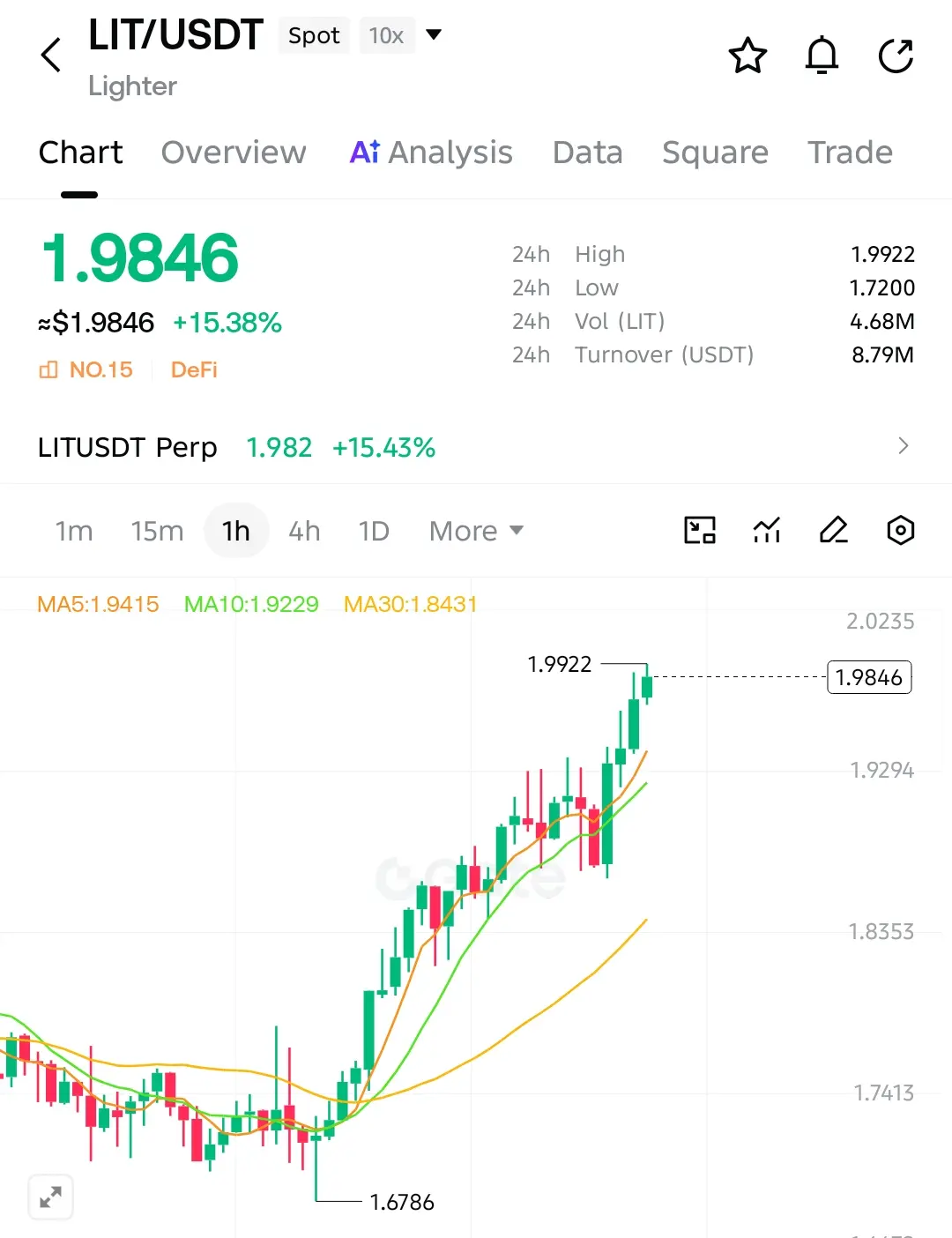
Structure is healthy, volume and price are well-coordinated. The 1.84-1.92 range is also quite comfortable. Place the stop loss at 1.77 below. The risk-reward ratio looks acceptable. Marking it for now and waiting for a confirmed breakout.
View Original
ELIX
$LIT is printing a strong, sustained upward expansion leg on the 1H frame, booking a solid +15.38% gain on the day. After establishing a clean structural floor near the 1.6786 baseline, a steady influx of aggressive buying volume established a step-up market structure that ultimately tapped an intraday high of 1.9922.
Price action is currently holding its upper territory exceptionally well, stabilizing right beneath the peak at 1.9846 while keeping perfectly aligned above the ascending moving average stack. High breakout risk continues to intensify; if the bulls successfully absorb the local overhead selling pressure and push past the 1.9922 ceiling, it clears the path toward the major 2.000 psychological milestone.
Trading Setup
Entry Zone: 1.840 - 1.920
TP1: 1.990
TP2: 2.150
TP3: 2.300
Stop-Loss: 1.770
#Get2SharesOfSKHynixAtZeroCost #GateCompletesDividendDistribution
repost-content-media
  • Reward
  • Comment
  • Repost
  • Share
4.8% ten-year, this curve has to be bear-flattened to what extent?
View Original
CoinNetwork
CoinWorld news, Deutsche Bank interest rate strategists have revised their year-end forecasts for the two-year and ten-year U.S. Treasury yields. Their latest forecasts show the two-year Treasury yield will reach 4.30% by year-end, 35 basis points higher than their previous forecast. They also raised their forecast for the ten-year Treasury yield to 4.80%, an increase of 10 basis points from the previous forecast. This revision reflects the latest outlook from Deutsche Bank economists that the Federal Reserve will raise interest rates twice this year, each by 25 basis points.
  • Reward
  • Comment
  • Repost
  • Share
Empty it, target 64 see.
View Original
CryptoZaggy
SELL SOL NOW!
SL 71.00
TP 64.00
Let's go✌
  • Reward
  • Comment
  • Repost
  • Share
Elon Musk’s deflation theory paired with UBI directly gives away the script for the AI era in advance.
View Original
CoinNetwork
CryptoWorld News reports that Musk stated there will be deflation in a world dominated by artificial intelligence and recommended that the Treasury should directly distribute funds to the public.
  • Reward
  • Comment
  • Repost
  • Share
Arthur Hayes deposits 6,000 ETH worth approximately $10.14 million into FalconX and Galaxy Digital. The movements of big players are worth watching, but don't rush to follow, first see whether his next move is staking or selling.
ETH-0.06%
View Original
WuSaidBlockchainW
According to OnchainLens monitoring, Arthur Hayes has deposited 6,000 ETH into FalconX and Galaxy Digital, worth approximately $10.14 million.
  • Reward
  • Comment
  • Repost
  • Share
Received some loneliness, but seeing you all share makes me happy too
View Original
YakuzaTheoryTrends
$BTC I heard that posting articles now comes with rewards? How many brothers have received them? Come out and make some noise!
  • Reward
  • Comment
  • Repost
  • Share
Is Zelensky treating Europe as an arms depot?
View Original
CoinNetwork
CryptoWorld News: Ukrainian President Zelensky has informed UK Prime Minister Starmer about the necessity of increasing air defense system missiles.
  • Reward
  • Comment
  • Repost
  • Share
Over the past two days, I’ve been seeing people staring at large on-chain transfers and sudden shifts in exchange hot and cold wallets, then interpreting it as “smart money.” I’ll admit I’m also tempted to take a look, but when it’s really time to execute cross-chain, I still manage to stay calm. Cross-chain bridges—put simply—are just a patchwork of trust: who exactly is signing the multi-signature, how many people can ultimately make the call, and if the oracle-provided information gets stuck or is fed incorrectly, everything downstream will follow the wrong path. I used to find “waiting for
View Original
  • Reward
  • Comment
  • Repost
  • Share
Last night I was again foolish myself: I wanted to make a quick trade, clicked too fast, slid a bit too far, thinking "it's only a few seconds"... As a result, I didn't have enough depth, and I ate a big order in one bite, directly pushing the price off course. After the trade, looking at that needle piercing my heart. To put it simply, it's not that the market is targeting me, but I treated the "order placement rhythm" as if it didn't exist: not splitting orders when I should, not waiting for the open orders when I should, and getting emotionally carried away, I easily end up paying tuition.
View Original
  • Reward
  • Comment
  • Repost
  • Share
All the money earned from NFTs went into the contract's trap, with a liquidation price of 1774. If it drops another 4%, it will explode. I've seen this script too many times.
4-1.27%
View Original
CoinNetwork
CoinWorld News, Ma Jie Huang Licheng increased his ETH long position by 400 units on the HyperLiquid platform, approximately $718,090.00.
The current position size is $2,028,840.00, with the average price adjusted from $1,952.84 to $1,869.95.
The current profit and loss is -$28,114.83, with a loss ratio of -34.64%.
The current coin price is $1,844.39, and the liquidation price is $1,774.67.
This trader previously profited from blue-chip NFTs but has experienced a massive drawdown since October, with funds shrinking from over 100 million to several hundred thousand dollars.
  • Reward
  • Comment
  • Repost
  • Share
The Hong Kong Monetary Authority's recent moves are quite substantial; the expert panel includes industry associations, law firms, and tech companies. It seems tokenized bonds are really going to be implemented.
View Original
WuSaidBlockchainW
Wu said that the Hong Kong Monetary Authority announced the establishment of a Tokenized Bond Expert Group, whose members include industry associations, financial institutions, legal advisory firms, financial infrastructure, and technology providers.
The expert group will explore policy measures, market practices, and innovative solutions, and has already held its first round of discussions in May on the application of Hong Kong's current legal and regulatory framework in the issuance and trading of tokenized bonds.
The HKMA stated that the related feedback will serve as a reference for its research with the Financial Services and the Treasury Bureau on potential optimization measures to promote the application of tokenization technology in the fixed income market.
  • Reward
  • Comment
  • Repost
  • Share
  • Pinned