torygreen

vip
Age 2.8 Year
Peak Tier 0
No content yet
Nvidia’s revenue is the proof that “agentic compute” is not a theory. It is already on the income statement.
$26B four years ago. $215.9B last year. That 8x happened while most AI was still sitting in a chat box waiting for you to ask it a question.
The important part isn’t just the growth. It’s that Nvidia turned its architecture into the non‑negotiable input for almost everyone else’s roadmap. Labs, clouds, enterprises. Different logos on the API, same silicon underneath. Almost every dollar spent on AI infrastructure in this cycle leaked into their stack somewhere.
Now take Jensen’s claim t
post-image
  • Reward
  • Comment
  • Repost
  • Share
I didn't expect Goldman's five year number to be this large.
Five hyperscalers are projected to spend $5.3 trillion on AI infrastructure between 2025 and 2030. In 2022 they spent $162B combined.
This year they're on track for $725B. By 2027 analysts project $1 trillion in a single year.
For anyone building AI products or infrastructure outside these five balance sheets, this trajectory is the most important number in your planning assumptions.
The gap between what they can deploy and what everyone else can access compounds every year this continues.
  • Reward
  • Comment
  • Repost
  • Share
Everyone predicted AI would take over repetitive admin work first. The data says something different.
Decision-making is now 28% of workplace AI activity. The number one use case isn't automation. It's judgment.
People are using AI to analyze options, weigh tradeoffs, and support conclusions they're responsible for and that shift matters beyond the labor market question.
Judgment-based workloads run continuously, require more context per session, and don't batch efficiently.
The infrastructure requirements for an AI that helps you make decisions all day look nothing like the infrastructure for
post-image
  • Reward
  • 1
  • Repost
  • Share
Millionairetasks:
Great opportunity for everyone to be
Global cloud infrastructure Q1 2026. $129 billion in a single quarter. Growing 35% year over year.
The market is expanding fast but the concentration isn't changing. AWS, Azure, and Google Cloud held roughly the same share two years ago that they hold today, but the absolute gap between them and everyone else is wider in dollar terms than it has ever been.
That's the part the percentage chart doesn't show. The Others slice isn't growing into a real alternative. It's staying proportionally the same while the three hyperscalers add tens of billions in absolute revenue every quarter.
The window f
post-image
  • Reward
  • Comment
  • Repost
  • Share
PJM runs the electric grid across 13 US states and 65 million people. It's the largest competitive wholesale electricity market in the world.
Its capacity market clearing price, the rate that signals whether future power supply can meet demand, has gone from $28.92 per MW in 2024 to $329.17 in 2026. Two auction cycles.
Data center demand identified as the primary driver. The 2027/2028 auction just cleared at $333.44, with PJM directly attributing 5,100 MW of the load increase to data centers.
That's not a supply shock or a geopolitical event. It's AI build-out hitting a grid that wasn't design
post-image
  • Reward
  • 2
  • Repost
  • Share
DiveNate:
2026 GOGOGO 👊
View More
Two numbers from this chart.
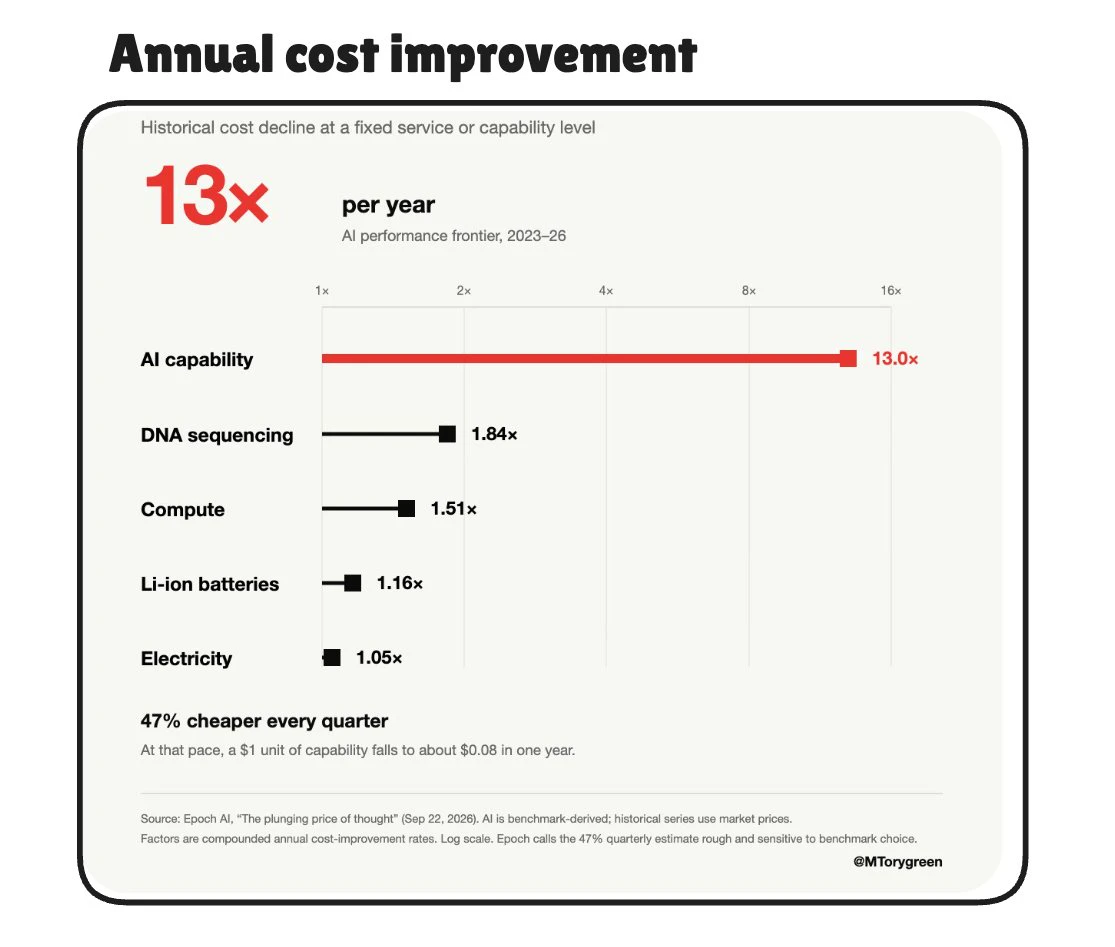
AI API price: down 96% since 2022.
Hyperscaler capex: up 12x in the same window.
Most people see the first number and call it democratization but nobody is building a strategy around the second one.
That's not a coincidence. That's a structural capture play.
Every AI startup celebrating cheap models is running on compute they don't own, on infrastructure they can't replicate, controlled by three companies.
Sovereign AI starts with sovereign infrastructure. Everything else is just a better priced dependency.
post-image
  • Reward
  • 1
  • Repost
  • Share
Yuhuan:
gsgsgshsokzkzkzkxhxj
The thing Friday revealed isn't that governments can shut down AI models.
It's that the entire global user base of the world's most capable models sits behind a single operational decision by a single company responding to a single directive. No redundancy or warning.
Three of the largest AI companies currently control 88% of frontier AI access and one compliance surface for all of it.
What Friday made visible is that when compute and model access sit inside a handful of companies, the entire stack inherits their single point of failure. That's not an argument against centralized AI. Both mode
post-image
  • Reward
  • Comment
  • Repost
  • Share
In 2024, the AI compute map had two superpowers. US at 53.7 GW, China at 31.9 GW.
In 2026, China is at 2.5 GW.
That's a controlled demolition of a nation's AI infrastructure capacity through export policy. No bombs, no sanctions, just chip rules.
What this proves is that compute is now a geopolitical weapon. Any country that doesn't own its infrastructure doesn't want to find out what being on the receiving end of that weapon feels like.
The question isn't whether decentralized compute wins. It's whether it arrives before the next policy decision restructures the map again.
post-image
  • Reward
  • Comment
  • Repost
  • Share
The largest tech IPO of the 2000s was Visa at $28B. The largest of the 2010s was Alibaba at $168B. Roughly 6x per decade.
Now extend the line. OpenAI and Anthropic each sit at $1T even before listing.
If you add up the biggest tech debuts of the last 25 years. Alibaba, Facebook, Uber, Rivian, Snowflake, Palantir, Cerebras, CoreWeave, all of them. You get roughly $800B.
OpenAI + Anthropic alone are worth nearly $2T. Still private. 2.5x bigger than a quarter century of Wall Street's biggest listings, combined.
But the biggest structural difference is that the likes of Visa and Alibaba and all th
  • Reward
  • Comment
  • Repost
  • Share
For most of history, capital scaled through machines.
Now it scales through cognition.
A startup can wake up with the equivalent of a million analysts, researchers, coders, and strategists running in parallel at near-zero marginal cost.
The AI revolution is unlike any previous technical revolution.
  • Reward
  • Comment
  • Repost
  • Share
you can't raise on an open charter and treat the open part as optional once the money shows up
the trial started on a question: can you charter a nonprofit, call openai your mission, attract 10 years of mission-driven engineers and donation capital on that promise, then convert to a profit-capped structure and call it an evolution?
elon left openai in 2018. the $130b in damages he's asking for goes to the nonprofit. whatever you think of him as a litigant, the question the case forces into court record is the right one: does a charitable trust have enforceable claims when the founding mission
  • Reward
  • Comment
  • Repost
  • Share
nvidia is now bigger than japan's entire economy and your AI bill is the reason
every dollar you spend on AI right now runs through one company's chips, on three clouds that resell them at a markup
> ai startups burn ~80% of their raised capital just to rent compute
> i've seen seed-stage teams paying $700k/month for a single chip vendor
> data centers are running at 12-18% capacity while your bill goes up every quarter
the entire industry just agreed to stand in one line and hand money to the same toll booth
there's idle compute in gaming rigs, old mining hardware, and half-empty data centers
  • Reward
  • Comment
  • Repost
  • Share
the ai-is-overbuilt crowd has never tried to buy an h100 this quarter
spending a week trying to buy h100s right now means: 12-month commit at aws (24/7 utilization locked in before you see a single gpu), gcp waitlist with no eta, lambda and coreweave both sold out, every smaller provider giving you the same answer in different words
hyperscaler construction is measured in years, cpu shortages are stalling the gpus that do exist, and demand continues to grow while the hyperscalers file permits
seed-stage ai teams are spending 70-80% of their runway on compute before a single user touches the pr
  • Reward
  • Comment
  • Repost
  • Share
Apparently Nvidia has quietly visited Korean power equipment companies, asking them to redesign data center infrastructure around 800V DC architecture.
That's an admission the centralized AI model has hit a physical wall, every new chip generation now drags a fresh substation retrofit somewhere in the stack.
Global data centers already run at 12 to 18 percent utilization. Crypto mining farms have powerful GPUs sitting idle since the Ethereum merge. Consumer gaming rigs with 4090s sit unused on desks all day.
The compute shortage is a distribution problem masked as physics. You cannot retrofit
ETH2.27%
  • Reward
  • Comment
  • Repost
  • Share
a lot of people are still architecting around a compute dependency that shipped its way out of existence
qwen3 32b, for instance is live on distributed community gpus right now, pipeline parallelism running across nodes no single operator controls, permissionless inference over the open internet
three layers, all open: open weights (alibaba released them), permissionless compute (community hardware, no custody), open transport (no private cluster, no api permission gate). ownership doesn't apply to any of them
the mental model that frontier-capable inference requires hyperscaler rails was a de
  • Reward
  • Comment
  • Repost
  • Share
google cloud next kicks off this week and every hyperscaler bull is about to cheer the exact move that historically kills the margin they're long
before: google paid nvidia a markup on every h100. margin flowing to santa clara.
now: google's in talks w/ marvell on custom silicon plus a new inference-specific TPU variant. the capex is moving internal.
amazon did it with graviton in 2018. microsoft announced maia in 2023. each time the hyperscaler stopped paying its supplier's markup because the markup became the biggest line item on the income statement.
inference pricing is already under the s
  • Reward
  • Comment
  • Repost
  • Share
we're still arguing about how many data centers to build while the supply is already sitting in every driveway
the build-out answer is planning 50-acre campuses on multi-year construction cycles
trillions of agents transact continuously, 24/7, against physical sensors, machines, and each other
i think about the 4090 gaming PC sitting idle at 2am, the Apple M-chip closed on a desk, the Tesla parked since thursday, and the math starts to look different
that's dark compute, untapped supply the user already paid for, sitting on the edge, running on someone else's electric bill
agent-to-agent payme
  • Reward
  • Comment
  • Repost
  • Share
Figma's valuation took a hit because Anthropic tweeted a landing page.
> What changed: the brand name and the vibes.
> What didn't: the underlying model, API pricing, output quality, or how your design team actually works tomorrow.
The market just spent the entire weekend having a full-body panic attack over marketing, not tech.
  • Reward
  • Comment
  • Repost
  • Share
here's something interesting I came across: 33% of planned us datacenters are actually shipping right now.
> the other 67%: delayed or cancelled outright
> meta building 10 gas plants just to power one facility
> china doubled its ai compute in 2 months without a single us chip
> +220% power demand projected by 2030, with a permitting queue that moves in years
the blocker is physical. permits, power interconnect queues, construction timelines.
stitchers who aggregate distributed compute across existing capacity don't wait in that queue at all.
the racks are already installed. the only thing mi
  • Reward
  • Comment
  • Repost
  • Share
Dario needs mythos to be a moat
Labs close capability gaps with more compute, better post-training, and faster eval cycles
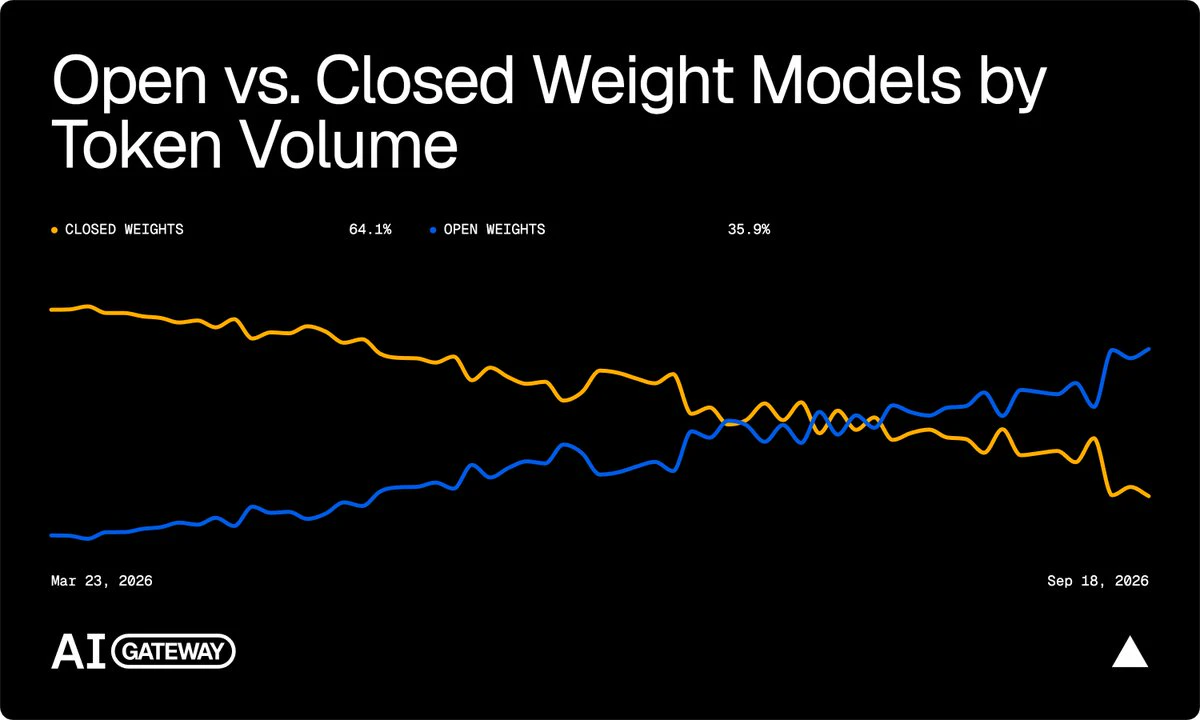
Open weight models like llama, qwen, and deepseek DO ship w/ capabilities on par with closed models a few months later, as free downloads
For you, that's a better model every quarter and no lab trying to finesse you into their max plans
The moat is decentralized compute where thousands of GPUs run as one supercomputer across Singapore, the US, Norway, etc
Dario's pitch has one benchmark cycle left
  • Reward
  • Comment
  • Repost
  • Share
  • Pinned