
Square
Following
Hot
News
Profile

ReorgSurvivor

vip
Active for: 0.5y
Peak Tier 0
After experiencing rollbacks and block stalls, conviction has turned into confirmation numbers. Focus on on-chain finality, block production, and infrastructure—cautious but not pessimistic.
169
Following
11
Followers
2
Liked
TON for ecosystem activity, CRO for the exchange narrative, and TRX for trend resilience—three angles, one principle: wait for volume-price confirmation before acting, and refuse to chase narratives.
Nayeem003
I’m watching , $CRO and $TRX as three network-focused setups, but I’m looking at each from a different angle.
$TON is interesting because its ecosystem can benefit from a large user base and growing on-chain activity. From a trading perspective, I want to see whether price can build higher lows instead of repeatedly losing support. If volume expands during a resistance reclaim, that would give the move more credibility.
$CRO is my exchange-ecosystem watch. I’m interested in whether renewed activity around the broader ecosystem can translate into sustained token demand. A clean move above resistance followed by a successful retest would be a stronger signal than a sudden pump.
$TRX is the relatively mature network setup. I’m watching whether it can maintain trend strength while the broader market remains volatile. If TRX continues holding important support and buyers keep appearing on dips, that would show resilience.
TON → ecosystem activity
CRO → exchange ecosystem
TRX → network resilience
Different catalysts, same rule: I want actual price and volume confirmation before treating the narrative as a trade.
#ShareWeekly #TON #CRO #TRX
CRO-2.42%
TRX+0.03%
Momentum is building; holding 0.0165 is key. Waiting for continuation.
CanDx
$AKE showing strong momentum, up 13.30% around $0.01685. Holding above $0.0165 keeps the move constructive. Watching for continuation.
MMT-4.45%
Lately, people in the group have been talking about all kinds of PFPs and membership cards again. Honestly, I’m pretty tempted, but after thinking it over, I decided to hold back. After going through rollbacks and stuck blocks, my first reaction when looking at a project now isn’t “how much can it go up?” but “will this thing still be around six months from now?” Short-term attention can indeed bring a wave of hype, but long-term value still has to be built gradually by the team. There’s no rushing it.
Hardware wallets have been sold out these past few days, which shows that everyone’s securit
After spending the whole day on task platforms, I suddenly feel like airdrop farming is increasingly becoming just another job. Checking in, completing tasks, maintaining accounts, and even researching how to deal with scoring models—one careless move and you get flagged as a Sybil, leaving you with nothing to show for your efforts. This isn’t farming airdrops; it’s clearly working for the platform, with all the KPIs kept hidden.
I was taught a lesson by rollbacks before, so now I only truly trust confirmations. Whenever I do anything on-chain, I need to see stable block production and finalit
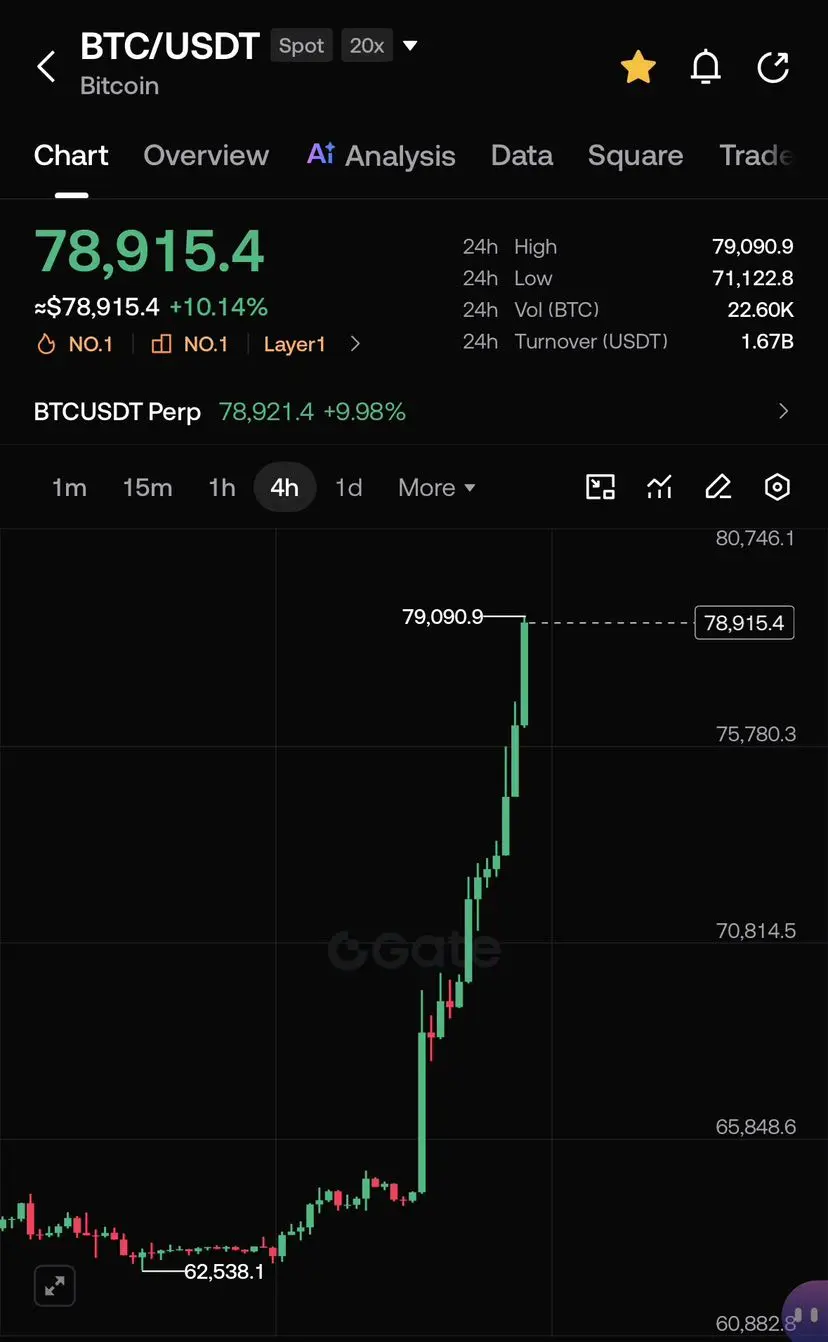
The 15-minute move has been so sharp that it’s best not to get carried away. 78.65K is the daily high, and only a breakout that holds above it would confirm real strength. I’d rather wait for a pullback to 77.8–78.2 before entering, with targets at 78.65, 79, and 80, and a stop-loss below 77.3. If it breaks out directly on strong volume and holds, follow the trend with a small position; if it falls below the recent breakout zone, wait patiently for the next clean candlestick.
EddieWalker
I’m watching $BTC here.
That 15m move is getting pretty stretched now. BTC is sitting around $78.5K after a near 10% run, and it’s already knocking on the $78.65K daily high.
I wouldn’t chase this candle. I’d rather see a small pullback and watch if buyers keep the breakout structure intact.
Entry: $77,800–$78,200
TP1: $78,650
TP2: $79,000
TP3: $80,000
SL: Below $77,300
For me, the next clue is simple: clear $78.65K and hold it, and BTC could keep squeezing higher. Lose the recent breakout area, and I’d wait for a cleaner setup.
#BTCBreaks77000
repost-content-media
RSI is even lower than during the 2020 crash—this level is definitely extreme. Is it the right time to buy the dip, or are you just catching a falling knife? First, let’s see whether the key support holds.
VANYA
$XRP just printed one of its most oversold RSI readings ever, even lower than the levels seen during the 2020 market crash.
Historically, extreme RSI conditions have appeared near periods of seller exhaustion and have often been followed by strong reversals. That doesn't guarantee an immediate bounce, but it does suggest downside momentum could be fading.
The next few weeks will be critical. If buyers defend key support and overall market sentiment improves, this rare RSI signal could mark the beginning of a significant trend shift.
Keep an eye on price action—this is a level worth watching
#USD1StakingEarnUpTo8%APR
The energy sector is really strong—oil prices are holding the broader market at $88.
Original content no longer visible
Just saw someone interpreting those big transfers from exchange cold wallets as “smart money,” and it kind of made me want to laugh. Honestly, once you’ve spent enough time looking at on-chain data, you’ll know that a lot of the time it’s simply normal consolidation and withdrawals—people just have to make up stories and turn it into “market-maker shenanigans,” like it’s a spy movie.
But lately, when I read through a few DAO proposals, I actually felt that this is where the real game is. On the surface, it’s governance and voting, but at the core it’s all incentives and the power-structure. Wh
Recently, I’ve noticed more cross-chain bridge incidents than usual. Multi-signature setups and oracles basically come down to trust issues—just that the trust has shifted from on-chain to off-chain. I used to think “waiting for confirmation” meant waiting a few minutes. But looking back, when the confirmation count isn’t enough and a block is truly reorganized/rolled back, cross-chain assets could end up getting stuck in the middle. Anyway, I try to use bridges that require higher confirmation counts—slower, but it feels psychologically safer.
Lately, in some places, tax policies have gotten
I just took a look at the funding rate, and it’s gotten extreme again. I’m watching ETF fund flows while also keeping an eye on US stocks’ risk appetite, and I don’t know whether these two things are mutually exclusive or symbiotic. Either way, public opinion always likes to interpret them together.
My thinking is pretty simple: an extreme funding rate is either the peak of a one-sided sentiment or a critical point in a battle of positions. I don’t want to bet on direction myself—if I take the other side (the counterparty position), it’s easy to get pulled into the swirl. If I do arbitrage, th
Just woke up and checked my phone—saw the community discussing that whole thing about extreme funding rates again. Honestly, every time this comes up, people split into two camps: one side says “a reversal is coming,” and the other says “the squeeze isn’t over yet.” I don’t know which is right; anyway, I’m not the kind of person who’d bet on direction in moments like this.
What I do want to talk about is impermanent loss. A lot of market makers at the beginning think it’s “easy profit,” but if you actually run the curve, when price volatility is high, the loss can be more than simply holding a
I just saw someone talking about AI Agents automatically doing on-chain interactions—it’s definitely pretty cool. But honestly, as someone like me who’s been messed up by rollbacks and got PTSD from it, seeing the words “automatic execution” still makes me a bit uneasy.
There’s a lot of controversy right now around on-chain data tools and tagging systems. Some people complain about lag and being misled. I actually think that’s pretty normal—on-chain state relies on confirmation counts, tags are maintained manually, and no matter how smart an AI Agent is, it can’t predict whether “this address
Recently I’ve been seeing a lot of people discussing “attention is mining”—social mining, fan tokens, and the like. Honestly, I’m a bit lost. It sounds pretty great, but I can’t shake the feeling that behind it there still has to be someone willing to put real money in. Otherwise, once attention drifts away, the “mining” collapses. Anyway, as cautious as I am, I’ll first see whether the basic infrastructure is solid.
When it comes to how I judge whether a project is truly reliable, the method I often use is checking GitHub and reviewing audit reports. Not to show off—just as a habit. A high nu
I just checked a few tasks on Galxe—everything is like binding a wallet and verifying social accounts, and you also have to wait for confirmation counts. It’s basically a whole KPI process. In the past, farming airdrops meant doing a few quick interactions and waiting for the tokens to drop; now it feels like clocking in for work. There’s scoring, anti-bot protection, and doing tasks has to factor in time cost. I’m lazy—I just left 0.1 ETH there and couldn’t be bothered to move, and even waiting five minutes for confirmations feels too long. Lately the group chat has also been arguing about th
ETH+0.14%
Just now I looked on-chain and saw an address repeatedly placing orders in a certain protocol. At first glance it looked like a whale was aggressively building a position, but after I pulled up the history more carefully, I found out they’re actually hedging—not betting on a direction. This has reminded me of something many times: before you follow their trades, think clearly about what they’re really doing—are they buying because they’re bullish long-term, or opening positions just to lock in risk. Don’t get excited just because large amounts are transferred in; they may still have short posi
USIDX+0.09%
Just saw someone talking about that issue with oracle price-feeding delays. Honestly, I’ve run into it one or two times where liquidation didn’t trigger because the price feed lagged, and the position ended up surviving a bit longer. Of course, the opposite happens too—if the delay drags on, the price jumps, and liquidation comes all at once, fast and hard. Anyway, now when I set stop-loss, I leave an extra chunk of room; I don’t dare to be too tight on the line, especially in pools with poor liquidity. Also, the recent wave of discussion about privacy coins is picking up again—where exactly t
Honestly, more and more people have been chasing testnet points lately. To be fair, I was pretty caught up at first too, thinking, “If I don’t go for it this round, I’ll lose.” But later I thought—who can say for sure before the mainnet goes live? Once you get used to waiting on-chain for confirmations, it makes sense that earning testnet points works the same way. When expectations are high, it’s easy to get anxious; then the time cost you put in turns into a sunk cost.
After I lowered my expectations, I actually felt more relaxed. I figured I’d just use it to get familiar with the new protoc
Which sleeps better: grid trading or going all in? For people like me, who’ve been educated by rollback, the answer is pretty clear. That night I basically didn’t sleep at all—I kept watching the block confirmations, afraid that if block production was slower by even a bit, it would blow up. Running DCA or a grid is much steadier; even if I wake up in the middle of the night, I just take a quick look. If I haven’t been liquidated, I keep sleeping.
That said, lately the testnet incentives have been coming thick and fast, and the expected points have been getting hyped a lot too. I’ve seen plent
Seeing new L1/L2s launch incentives to pull TVL, guys are both mining and complaining that “the sell is happening way too fast.” I’m actually pretty calm. I used to chase it too, but later I found that the “on-chain” data you see may lag the actual block production by several seconds—or even a few minutes. Between nodes not syncing, RPC requests timing out, and the indexer still catching up, this kind of infrastructure lateness is even more frustrating than market volatility. Anyway, my habit now is: if the confirmation count isn’t enough, I don’t move. I’d rather curse it as slow in my head t
Just saw in a group chat that everyone’s talking about another chain upgrade again, and people are starting to speculate whether ecosystem projects will take the opportunity to migrate. Honestly, I haven’t been keeping up with this kind of pace much over the past two years.
Assets in multi-chain wallets are getting more and more fragmented. There are already four or five L1s alone, not to mention L2s. Every time you switch chains, it feels like rummaging through drawers to find spare change. In the past, I always wanted to jump on every new chain as quickly as possible, and the result was that