Square
Following
Hot
News
Notifications
Profile

Stop-LossLineForTheEveningGlow

vip
Set your stop-loss in your plan, not in your prayers. Focus on trend following—it's better to miss part of the move than to stick with it all the way.
Peak Tier VIP 00.6 Year(s)
77
Following
11
Followers
3
Liked
Stuck at the top +1, already researching how to hedge. Protecting principal is more important than breaking even
Miger
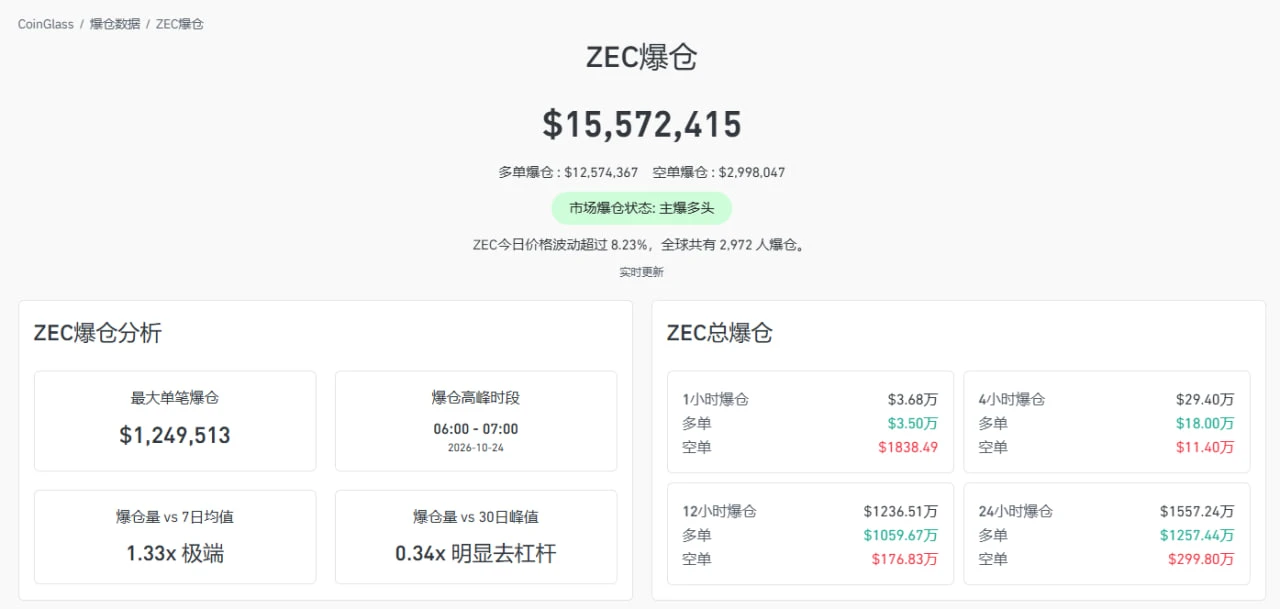
Grayscale dumps nearly $100 million! $ZEC Longs entered around 1250 are trapped 80 points underwater—can they be rescued? Check out this secret recovery strategy!

ZEC rose and then fell yesterday, mainly due to a coordinated dump by shady market makers! Grayscale's ETF saw net outflows of $93.6 million in a single week, compounded by whales dumping 15k ZEC at the highs, smashing through support and triggering a chain reaction of long liquidations. Along with legacy issues like the privacy pool vulnerability, institutional confidence has collapsed, and high volatility has accelerated selling.

Many followers went long around 1250 and are now 80 points underwater. Smart money data shows long whales are taking heavy losses while short whales are making a killing; the long-short ratio is just 18%, with bears overwhelmingly in control! The liquidation map shows dense liquidation zones all above 1250, creating heavy resistance.

Three ways to limit losses:
1. Reduce on a bounce: If it rebounds to around 1200–1210, decisively reduce your position or exit at a loss. Don't fantasize about making it all back at once.
2. Hedge with the trend: If it breaks below 1150, consider opening a small short position to hedge and cut losses.
3. Wait for a bottom before buying more: Patiently wait for the price to drop to the strong support zone at 1100–1050 and stabilize before considering buying the dip to lower your average entry price. Whatever you do, don't blindly add to your position now!

The short-term downtrend is established, and any rebound is weak. Don't blindly buy the dip—protecting your principal is always more important than betting on a rebound!

At what price is your ZEC long position underwater? Tell me in the comments, and I'll tailor a recovery strategy just for you!

#美股财报季
repost-content-media
The number of wallets keeps growing, and I now have addresses on seven or eight chains. Even checking balances takes forever. Before, I put everything in one multichain wallet for convenience, but when gas spiked on one chain and I wanted to rebalance urgently, I was stuck for twenty minutes, watching my stop-loss level get breached.

Now I know better: I keep my main holdings in a hardware wallet and use a few lightweight addresses for daily interactions. How much to keep on each chain and the maximum loss I can take are set in stone before the market opens. Put simply, it’s not that I don’t
The SEC only granted a temporary pass, but the market is already betting on a bigger narrative: stock liquidity becoming AMM-based.
Original content no longer visible
I’ve always felt that transparency is the defining feature of on-chain systems, but people shouldn’t be idealized either. Where the boundary lies between privacy and compliance is something many people have never really considered. Take the balance in your wallet, for example—anyone can look it up with a block explorer. If you think that’s what transparency means, fine, but you should know what you’re dealing with: things you can interact with at the push of a button were never designed to preserve your dignity.

Looking at the recent wave of blockchain game collapses, inflationary models coll
Now that AI Agents can run contracts and adjust liquidity on their own, it looks pretty convenient, but I still wouldn’t dare let one operate fully autonomously. The biggest fear in on-chain interactions is “misaligned contextual understanding”: you think it understood the intent of a proposal, but it ends up executing only the literal parameters, while the gas fee alone would have been enough to buy a cup of coffee. Then there are situations that require an ad hoc decision—for example, when a pool suddenly gets drained, an Agent will most likely just withdraw according to its preset logic. Bu
It feels like everyone has started watching stablecoin supply and ETF fund flows again, basically trying to find some certainty. But with on-chain data, correlation may look quite strong, while causation is not necessarily there. Sometimes market sentiment moves first and the funds follow, so looking back at the indicators can easily lead you to fool yourself.

Anyway, I’m still doing things the same old way: until a trend emerges, I treat inflows and outflows as background noise. I’ve been burned before, assuming that once the data was in place, the market had to move, only to wait for nothin
Just saw in the group chat more screenshots being circulated about various stablecoins de-pegging. To be honest, after seeing too many of these kinds of messages, I’m actually less panicked. In the past, when I saw something like this, my first reaction was to quickly check my own positions. Now it’s more like: just do what you’re supposed to do. If the stop-loss line is already set in place, then I won’t be afraid of it suddenly happening out of nowhere.

Recently, I’ve been researching modular blockchains and found something interesting: for regular users like us, how the technology is layer
Woke up and checked the chart for a couple of looks—the liquidity is really bad. The limit orders are thin like paper; move things just slightly and they slide away ridiculously. Someone in the group shouted “buy the dip.” I’m just an ordinary trend trader, so at a time like this I really don’t dare to move recklessly. To put it plainly: when liquidity dries up, staying alive matters more than anything else—don’t end up not catching the bottom, and getting buried yourself first.

Lately I’ve been seeing a lot of news about testnet incentives and points programs—everyone’s speculating whether t
Recently, all kinds of testnet points expectations are flying around nonstop. It’s really making people’s fingers itch—my whole brain is just “What if the mainnet goes live and the token price instantly takes off?”😅 When I get the urge to chase a pump, I force myself to stop and ask: did I truly understand the logic behind this position opening, or did the group’s trade showcases/“look at my results” posts push me into it?—and honestly, it’s embarrassing. I thought I was doing analysis based on the information flow, but when I reviewed everything again, it was completely fucking driven by emo
Just saw someone complaining that miners are stealing MEV with front-running, saying retail investors can’t even get fair ordering… I used to definitely join in and curse too, but now I feel that as long as the chain is transparent, even if you get sandwiched, at least you can see where the knife is going.

Back when I was new and buying PFPs, I always thought putting up a profile picture basically meant you were joining some kind of community. These days—brand or not, it depends on whether your membership card can survive two rounds of bear markets; otherwise it’s just a JPG with a price ta
Recently I chatted with a friend and saw a lot of discussions about re-staking, shared security, and compounding yields. Put simply, isn’t that just nesting dolls—stacking one layer on top of another? Some people say it’s stacking buffs, others say it’s stacking risk. I think the core issue is whether you can control your position.

A position-management version of the story: no matter whether it’s spot or perps, whether you can hold it is not determined by whether the market goes up. It depends on whether, if your money loses, it will affect whether you can eat your next meal. If you should c
The mempool is clogged again—so bad just now. Last night, a transaction got stuck for almost half an hour, and in the end it only went through after I added a small tip. Honestly, every time I see limit orders with slippage that’s wildly out of proportion, I wonder: are they really in a hurry, or do they just not care about losing money?? For my part, I’d rather wait through another round than follow it all the way down.

Recently, the RWA stuff that’s being compared alongside US Treasury yield products has been pretty hot too—lots of people are rushing in. I’m not sure which is actually stead
RWA-0.39%
Recently, I’ve seen a lot of people copy-trading big wallet addresses—and honestly, it kind of makes me nervous. A few days ago, a new L2 launched an incentive program. A bunch of people rushed in to farm, buy, and sell for rewards. But the whale had already placed buy orders there to hedge. It wasn’t about trying to capture upside at all—pure arbitrage.

I’ve also suffered from this kind of loss before. I saw an address buy and followed it, but they weren’t building a position and hedging with the same scale as me. My small position just watched it drop all the way to the stop-loss line befor
Long-established asset manager T. Rowe Price has also entered the space: its actively managed crypto ETF, TKNZ, began trading on Thursday, opening another gap in the gates of traditional finance.
Original content no longer visible
The path to Islamic finance compliance is not easy, so Pakistan has separated stablecoins and RWA for review, which is pragmatic.
WuSaidBlockchainW
A ruling on cryptocurrency religious law in Pakistan sparks controversy over the digital asset regulatory framework
The chairman of Pakistan’s Virtual Asset Regulatory Authority said after meeting with the Mufti that stablecoins, tokenized real-world assets, and blockchain products should each be assessed separately through technical and Shariah reviews, and should not be treated as the same category. Scholars such as Usmani had previously ruled that some cryptocurrencies are not Islamic wealth, and that transactions used to buy goods are invalid; Saqib did not say his position had changed. In March, the country passed the Virtual Assets Act, requiring industry participants to comply under the guidance of a Shariah board and pushing for a sovereign stablecoin, tokenization of national assets, and exchange licensing.
RWA-0.39%
AI pushes up the neutral interest rate, and the Fed's statement is worth a closer look—the crypto market needs to reprice liquidity expectations.
Original content no longer visible
Geopolitical conflicts have arisen again, and safe-haven assets should be on the move.
Original content no longer visible
After getting sandwiched on-chain for the third time, I finally adjusted my slippage tolerance to 0.5%.

I used to think MEV was just a game for programmers, until I realized my orders were always stuck "pending" and then executed at worse prices—basically, your transaction intent becomes public information the moment it's broadcasted. Now those AI agents are still hyping "automated on-chain interactions," but I'm more concerned about whether they have private mempools or are just as exposed.

Fairness? There's never been fairness on-chain, only priority auctions. I'd rather pay extra gas to u
Stablecoins are just sitting there, but before staking, first check the audit and reserves, don't just look at the nice numbers.
2In1
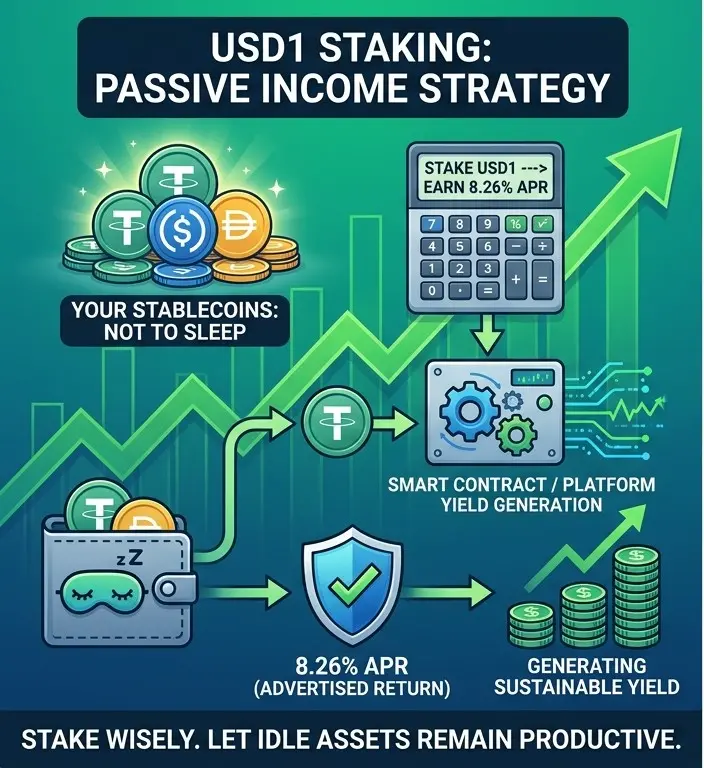
#StakeUSD1Earn8.26%APR

𝗦𝗧𝗔𝗞𝗘 𝗨𝗦𝗗𝟭. 𝗘𝗔𝗥𝗡 𝟴.𝟮𝟲% 𝗔𝗣𝗥. 𝗣𝗨𝗧 𝗬𝗢𝗨𝗥 𝗦𝗧𝗔𝗕𝗟𝗘𝗖𝗢𝗜𝗡𝗦 𝗧𝗢 𝗪𝗢𝗥𝗞, 𝗡𝗢𝗧 𝗧𝗢 𝗦𝗟𝗘𝗘𝗣.

The crypto market has entered a phase where capital efficiency matters more than hype. Simply holding stablecoins in a wallet may preserve value, but it does little to grow it. Opportunities that allow investors to generate sustainable yield while maintaining exposure to stable assets are becoming an increasingly important part of modern portfolio management. An advertised return of 8.26% APR on USD1 staking naturally attracts attention—but smart investors know that the yield is only one part of the equation.

Before chasing any APR, understanding how those rewards are generated is essential. Questions about sustainability, liquidity, lock-up periods, platform security, smart contract risks, and reserve transparency should always come before expected returns. In crypto, the highest percentage isn't always the best opportunity if the underlying risks are not clearly understood. Long-term success comes from evaluating both reward and risk with the same level of discipline.

The growing popularity of staking reflects a broader shift in digital finance. Investors are increasingly looking for passive income opportunities that allow idle assets to remain productive instead of sitting unused. As decentralized finance continues to mature, staking has evolved from a niche strategy into a key component of portfolio optimization. However, responsible investing requires diversification rather than relying on a single product or protocol.

Risk management remains the foundation of every successful investment strategy. Even stablecoin-based products deserve careful research before allocating capital. Investors should review the credibility of the platform, examine audit reports, understand withdrawal conditions, and avoid committing funds they may need in the short term. A disciplined investor focuses on protecting capital first and maximizing returns second.

The emergence of attractive staking opportunities also signals the increasing competition among digital asset platforms. Projects are working harder to attract liquidity, improve user experience, and deliver consistent returns. For investors, this creates more choices—but also greater responsibility to separate sustainable opportunities from short-term marketing campaigns.

Ultimately, staking should be viewed as part of a broader financial strategy rather than a shortcut to wealth. Consistent growth is built through patience, research, and disciplined decision-making. If USD1 staking aligns with your investment goals and risk tolerance, it may serve as a useful source of passive income. But in every market cycle, knowledge remains the highest-yielding investment an investor can make.

Stake wisely. Research deeply. Protect your capital. Let your money work—but never stop managing the risks that come with every opportunity.
repost-content-media
Magic Eden the melon is ripe, the consumer protection law is even harsher than the securities law, the founder is probably going bald.
WuSaidBlockchainW
Magic Eden sued collectively by ME token buyers
A class action has been filed against Magic Eden in the U.S. District Court for the Eastern District of New York. Plaintiffs Pagan, Ruano, and Sadowski allege that the defendants made misleading statements in promoting the ME token, presenting it as the core token supporting the growth of the online asset marketplace, but multiple promises were not fulfilled or were delayed, causing investor losses. Defendants include Magic Eden co-founders, Euclid Labs, and the ME Foundation. This case does not assert securities law claims but seeks relief under New York consumer protection law, negligent misrepresentation, and unjust enrichment.
ME-0.31%
Load More