Square
Following
Hot
News
Profile

rickawsb

vip
Active for: 3.6y
Peak Tier 0
No content yet
0
Following
5.5k
Followers
621
Liked
After mathematics was solved by AI, physics appears likely to be next
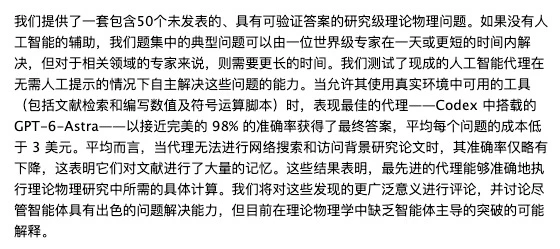
GPT-6 Astra achieved 98% accuracy in the latest physics evaluation
A paper titled “TheoPhysEval: Assessing AI agents at autonomous theoretical physics problem solving,” jointly published by multiple scholars in high-energy physics and theoretical physics,
built a benchmark evaluation set for cutting-edge theoretical physics, comprising 50 research-grade theoretical physics problems that had not been publicly published (unpublished) and had definite, verifiable answers.
If independently derived by a top expert in the specific
post-image
We are experiencing the transition from automation to self-evolution
Based on the current development of AI, its most likely profound impact on society will be neither a completely equal “Hayekian utopia” nor a purely totalitarian “digital Leviathan,” but rather a form of “Neo-Feudal Layering” structured like an inverted pyramid.
This structure is a forced combination of Popperian evolutionary trial and error, Hayekian spontaneous order at the margins, and Peter Thiel’s monopolistic realism across different physical layers.
The most likely development pattern can be clearly divided into three levels (as shown in the figure):
Top level: the “neo-feudal monopoly”
PLTR-7.21%
I don't believe the so-called technology path of large world models advocated by Yann LeCun, Fei-Fei Li, and others can replace or succeed LLMs as the next mainstream trend.
Because language is an abstraction of the world, language models are world models.
The limits of my language mean the limits of my world (我语言的界限意味着我世界的界限)
---Tractatus Logico-Philosophicus, Ludwig Wittgenstein
Of course, world models can complement language models.
As AI’s capabilities continue to expand, science, industry, business, and society are not adapting at the same pace. The misalignment between these different boundaries will continue to create new entrepreneurial opportunities.
Understanding these misalignments requires in-depth research into and understanding of AI capabilities, which are constantly changing, as well as the industries themselves. And at critical moments, it requires the courage to place a bet.
Therefore, entrepreneurs in the AI era may increasingly need to resemble scientists, while scientists may also increasingly need to re
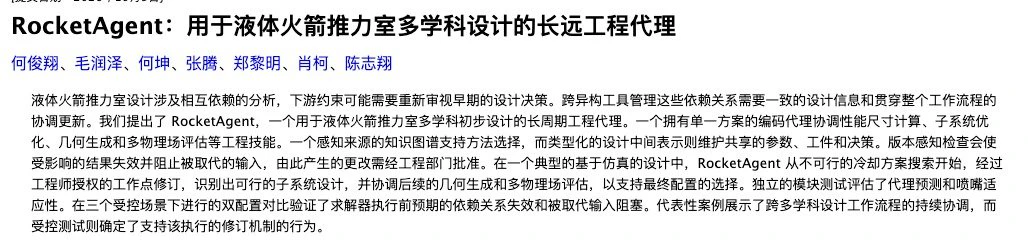
AI builds rockets!
A recent paper from Peking University highlights RocketAgent’s capabilities in complex physical engineering system design: its core value lies in enabling AI to act as a chief engineer/high-level orchestrator, managing complex cross-disciplinary engineering and problem-solving.
RocketAgent in the paper is a long-horizon engineering agent architecture for the multidisciplinary preliminary design of liquid rocket thrust chambers.
The biggest bottleneck in complex system design is the “disciplinary silos” problem, where thermodynamics, structural mechanics, aerodynamics, and ma
post-image
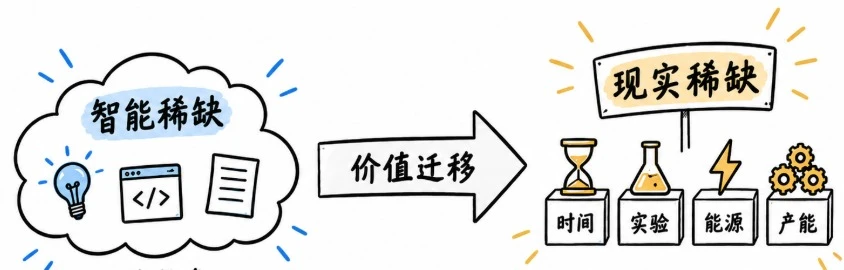
AI will continuously reduce the scarcity of intelligence, knowledge, and complex engineering,
The Industrial Revolution replaced physical labor with machines, reducing the scarcity of muscle and (relatively) increasing the scarcity of intelligence
The AI revolution is now using machines to replace mental labor...
The scarcities that are hardest for AI to compress mainly include: physical limits, incompressible time, real-world feedback, rights/licenses, occupying slots, trust, and attention (but attention must be contested against increasingly powerful models for a limited supply).
“Technical
post-image
The consumer electronics boom is imminent, but not in the way the market expects.
Over the past few days, a new Strata architecture has enabled cards with 12 GB of VRAM paired with 128 GB of memory to run 100B or even larger models.
The market immediately voted with its feet: inference architectures optimized for DDR3 already exist, and solutions using iPhones—even Apple computers—to expand memory are already available.
Old cards and old memory are now being hyped, from the 5090 to the 3090 to the V100, and from DDR5 to DDR3.
Soon, I think this will expand from iPhones to Android phones for co
AAPL+0.43%
Science is essentially “reality compression”: a good theory is, at its core, using less information to describe more of reality.
Kepler → Newton is the classic example:
Kepler first summarized the laws of planetary motion from a large amount of astronomical data; Newton then went a step further, explaining that these laws could actually be unified through the laws of motion and universal gravitation.
And AI is continuously accelerating the entire chain of scientific discovery.
Lately, I often find myself thinking of a chilling line:
The people of Chang’an, living in the prosperous Tang dynasty in the early Tianbao era, could never have imagined that most of them would die in the An Lushan Rebellion that followed.
Watching all the arguments about AI safety these past few days
Whether for or against
I only want to say
When the avalanche comes, no snowflake is innocent
Can an open-source model that runs locally reach OpenAI Astra’s current level in two months?
The Information, citing people familiar with the matter, reports that Astra uses limited recurrent depth (recurrent depth / looped transformer)—the same set of layers runs through the internal state several more times before generating the next token; the report describes this as a technique that improves performance while reducing visible chains of thought.
If this is true, it would be great news for open-source models, because recurrent depth provides a greater performance boost for smaller models th
How powerful is astra, exactly?
I have a complex semi-automated customer support workflow. When running on gpt 5.6 sol high, it requires at least half an hour of human involvement per project.
astra shortened this time to 5 minutes.
At the same time, the task success rate has increased significantly (I haven't had time to calculate it yet, but visually it appears to have at least doubled).
But I have to say, it really burns through tokens fast.
Leading robotics company Wandercraft announced on September 4 that its Calvin‑40 industrial humanoid robot has secured 12 large enterprise customers across automotive, logistics, retail, healthcare, and defense.
Interestingly, the company did not try to make the robot perform every human task from the outset, instead initially focusing on:
Tires, boxes, panels, carts, packages, and other material handling.
It is then gradually expanding into more sophisticated tasks such as picking and sorting.
Wandercraft’s approach is increasingly aligned with recent signals from Hyundai, Geek+, agricultural
How much capital does it take to push a coin to $1 billion? Today’s top whale tells us that it only takes less than $9 million
And if a certain player wanted to cash out $1 million now, the market cap would instantly drop to $800 million,
For many top holders, one person’s holdings alone could crash the entire market to zero at the current coin price
Why do people say crypto is a casino? Because in the end, only a very small number of people are often able to walk away from the table with money
post-image
The most shocking discovery today was that nonfarm payrolls beat expectations, and even on-chain memes fell 😂
MEME+0.28%
Buffett likened capital markets to “a church with a casino attached”
For crypto, this is a huge opportunity to upgrade from a casino to a church
The PANW boss is bearish on neo cloud, believing computing power supply may be excessive
This makes me even more bearish on PANW
PANW-7.63%
NEO-0.76%