Why Do Investors Keep Making the Same Mistakes?
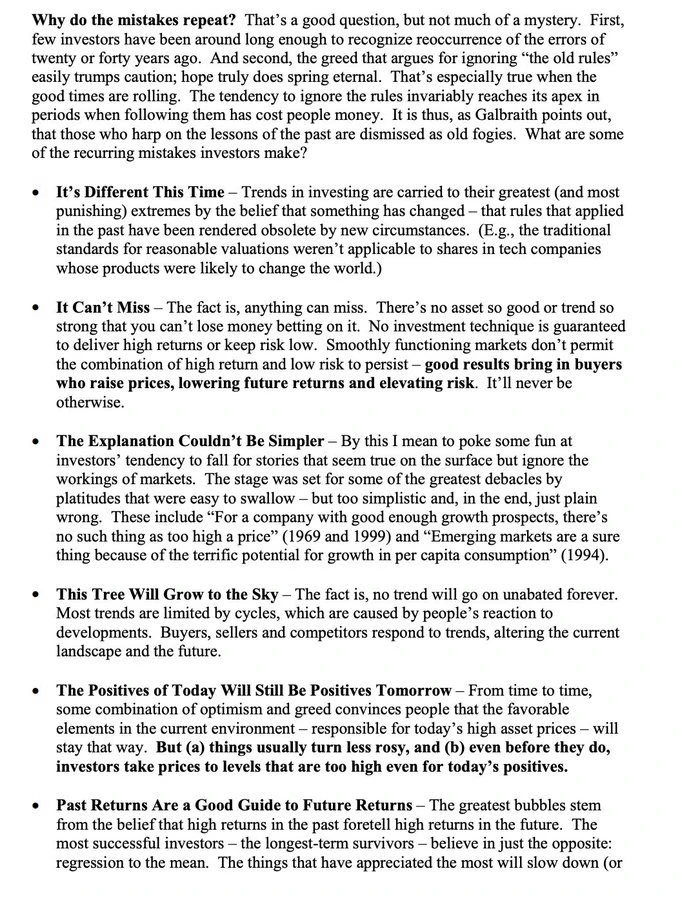
This is a good question, but the answer is not mysterious.
First, few investors have experienced investment cycles long enough to recognize the same mistakes from two or three decades ago playing out again.
Second, greed often easily overwhelms caution, leading people to ignore the “old rules”; hope, meanwhile, seems never to fade.
This is especially evident during market booms. Ironically, people’s tendency to ignore the rules often peaks precisely when following them costs them money. As Galbraith pointed out, those who keep emphasizing the lessons of history are instead seen as outdated old fogeys who can’t keep up with the times.
So what are the mistakes investors keep making?
1. “This Time Is Different” (It’s Different This Time)
Investment trends are often pushed to extremes, a process usually built on the belief that something has fundamentally changed, rendering the rules that applied in the past obsolete in the new environment.
For example, traditional standards of reasonable valuation are said to no longer apply to tech stocks whose products could change the world.
2. “This Investment Can’t Miss” (It Can’t Miss)
The fact is, any investment can fail.
There is no asset so good that you cannot lose money on it, and no market trend so strong that it can completely eliminate risk.
No investment strategy can guarantee consistently high returns while keeping risk low.
A well-functioning market cannot sustain a combination of high returns and low risk.
Good investment returns attract more buyers, who keep pushing prices higher, thereby lowering future expected returns while raising investment risk.
Markets cannot keep operating according to the opposite logic forever.
3. “The Explanation Couldn’t Be Simpler” (The Explanation Couldn’t Be Simpler)
I want to use this to poke fun at a tendency among investors: they readily believe narratives that sound plausible on the surface but ignore how markets work.
Some of the worst investment disasters in history were caused by these seemingly simple, easy-to-accept clichés, which were oversimplified or entirely wrong.
For example:
“For a company with sufficiently good growth prospects, there is no such thing as a stock price that is too high.” (1969 and 1999)
“Emerging markets have huge growth potential because there is enormous room for per capita consumption to rise, so investing in emerging markets is a sure bet.” (1994)
4. “This Tree Will Grow to the Sky” (This Tree Will Grow to the Sky)
The fact is, no trend can continue forever.
Most trends are constrained by cycles, which are precisely shaped by people’s responses to market changes.
Buyers, sellers, and competitors all adjust their behavior in response to trends, thereby changing the current market landscape and further altering the direction of future developments.
5. “Today’s Positives Will Still Be Positives Tomorrow” (The Positives of Today Will Still Be Positives Tomorrow)
From time to time, optimism and greed work together to make investors believe:
The favorable factors in the current environment that are driving asset prices higher will continue forever.
However, the fact is:
(a) Favorable market conditions usually deteriorate over time, and risks rise along with them.
(b) Even if these positive factors have not yet disappeared, investors have often already pushed asset prices to extreme levels—so high that they are difficult to justify even based on the most optimistic fundamentals today.
6. “Past Returns Are a Good Guide to Future Returns” (Past Returns Are a Good Guide to Future Returns)
The worst asset bubbles in history have often stemmed from the belief that:
Assets that delivered high returns in the past will inevitably continue to deliver high returns in the future.
However, the most successful investors, those who survive in the market over the long term, believe precisely the opposite:
Regression to the Mean.
Assets with the largest gains in the past will rise more slowly in the future, or even fall
This is a good question, but the answer is not mysterious.
First, few investors have experienced investment cycles long enough to recognize the same mistakes from two or three decades ago playing out again.
Second, greed often easily overwhelms caution, leading people to ignore the “old rules”; hope, meanwhile, seems never to fade.
This is especially evident during market booms. Ironically, people’s tendency to ignore the rules often peaks precisely when following them costs them money. As Galbraith pointed out, those who keep emphasizing the lessons of history are instead seen as outdated old fogeys who can’t keep up with the times.
So what are the mistakes investors keep making?
1. “This Time Is Different” (It’s Different This Time)
Investment trends are often pushed to extremes, a process usually built on the belief that something has fundamentally changed, rendering the rules that applied in the past obsolete in the new environment.
For example, traditional standards of reasonable valuation are said to no longer apply to tech stocks whose products could change the world.
2. “This Investment Can’t Miss” (It Can’t Miss)
The fact is, any investment can fail.
There is no asset so good that you cannot lose money on it, and no market trend so strong that it can completely eliminate risk.
No investment strategy can guarantee consistently high returns while keeping risk low.
A well-functioning market cannot sustain a combination of high returns and low risk.
Good investment returns attract more buyers, who keep pushing prices higher, thereby lowering future expected returns while raising investment risk.
Markets cannot keep operating according to the opposite logic forever.
3. “The Explanation Couldn’t Be Simpler” (The Explanation Couldn’t Be Simpler)
I want to use this to poke fun at a tendency among investors: they readily believe narratives that sound plausible on the surface but ignore how markets work.
Some of the worst investment disasters in history were caused by these seemingly simple, easy-to-accept clichés, which were oversimplified or entirely wrong.
For example:
“For a company with sufficiently good growth prospects, there is no such thing as a stock price that is too high.” (1969 and 1999)
“Emerging markets have huge growth potential because there is enormous room for per capita consumption to rise, so investing in emerging markets is a sure bet.” (1994)
4. “This Tree Will Grow to the Sky” (This Tree Will Grow to the Sky)
The fact is, no trend can continue forever.
Most trends are constrained by cycles, which are precisely shaped by people’s responses to market changes.
Buyers, sellers, and competitors all adjust their behavior in response to trends, thereby changing the current market landscape and further altering the direction of future developments.
5. “Today’s Positives Will Still Be Positives Tomorrow” (The Positives of Today Will Still Be Positives Tomorrow)
From time to time, optimism and greed work together to make investors believe:
The favorable factors in the current environment that are driving asset prices higher will continue forever.
However, the fact is:
(a) Favorable market conditions usually deteriorate over time, and risks rise along with them.
(b) Even if these positive factors have not yet disappeared, investors have often already pushed asset prices to extreme levels—so high that they are difficult to justify even based on the most optimistic fundamentals today.
6. “Past Returns Are a Good Guide to Future Returns” (Past Returns Are a Good Guide to Future Returns)
The worst asset bubbles in history have often stemmed from the belief that:
Assets that delivered high returns in the past will inevitably continue to deliver high returns in the future.
However, the most successful investors, those who survive in the market over the long term, believe precisely the opposite:
Regression to the Mean.
Assets with the largest gains in the past will rise more slowly in the future, or even fall