RefrigeratorMagnetContract

vip
Active for: 0.5y
Peak Tier 0
Write the key risk points as fridge magnets: permissions, upgrades, oracles. Not an auditor but love to nitpick—help friends avoid pitfalls.
When gas fees are high, transactions queue up in the mempool—it’s just like squeezing onto the subway during rush hour. You can see the transaction has been broadcast, but it remains stuck in the pool. Sometimes your wallet shows “pending,” making you think something is wrong. Usually, it’s simply that the validator hasn’t gotten around to including your transaction yet; higher-paying transactions get priority, just like cutting in line.
When the network is congested, I don’t rush. I check the median gas price in the pending pool, compare it with mine, and cancel and resend if the gap is too l
Recently, some friends dragged me into checking out a few “attention is mining” projects—social mining, fan tokens, and one scheme after another. Do you think attention is valuable? Honestly, it is. But being valuable and being monetizable are two different things. Some projects heat up fast and cool off just as quickly, leaving a bunch of people stuck holding the bag and comforting each other.
I like picking things apart, so when I assess a project, I first look at risk points like permissions, upgrades, and oracles, listing them one by one like refrigerator magnets. But memecoins are differe
MEME+1.16%
I just checked some on-chain data, and I realized it a bit late—almost thought the wallet had been stolen (it wasn’t). Actually, things like node RPC indexing aren’t truly real time; sometimes it’s normal for it to lag by a few minutes. The “latest block” you see might already be history, like a phone bill lapse causing delay.
Lately I’ve been playing a blockchain game, and its economy collapsed fast—studio-generated gold-farming output was like printing money. Reward inflation, the coin price spiraled downward, and players ran away even faster than rabbits. If you observe a bit slower, you ca
XTZ+4.57%
I just finished checking a few DAO voting proposals. To be honest, they look pretty busy, but when you dig into them, a lot of the incentive designs are just a “lock-and-get-power” façade. Put simply, the way voting weight is allocated doesn’t really correlate with contribution amounts—it’s more like a compounding machine for early big holders.
With the market recently swaying back and forth, rate-cut expectations and the US dollar index have been pulling risk assets every which way. At this time, many project teams are rushing to push lock-up proposals—basically, they want to use everyone’s c
USIDX-0.22%
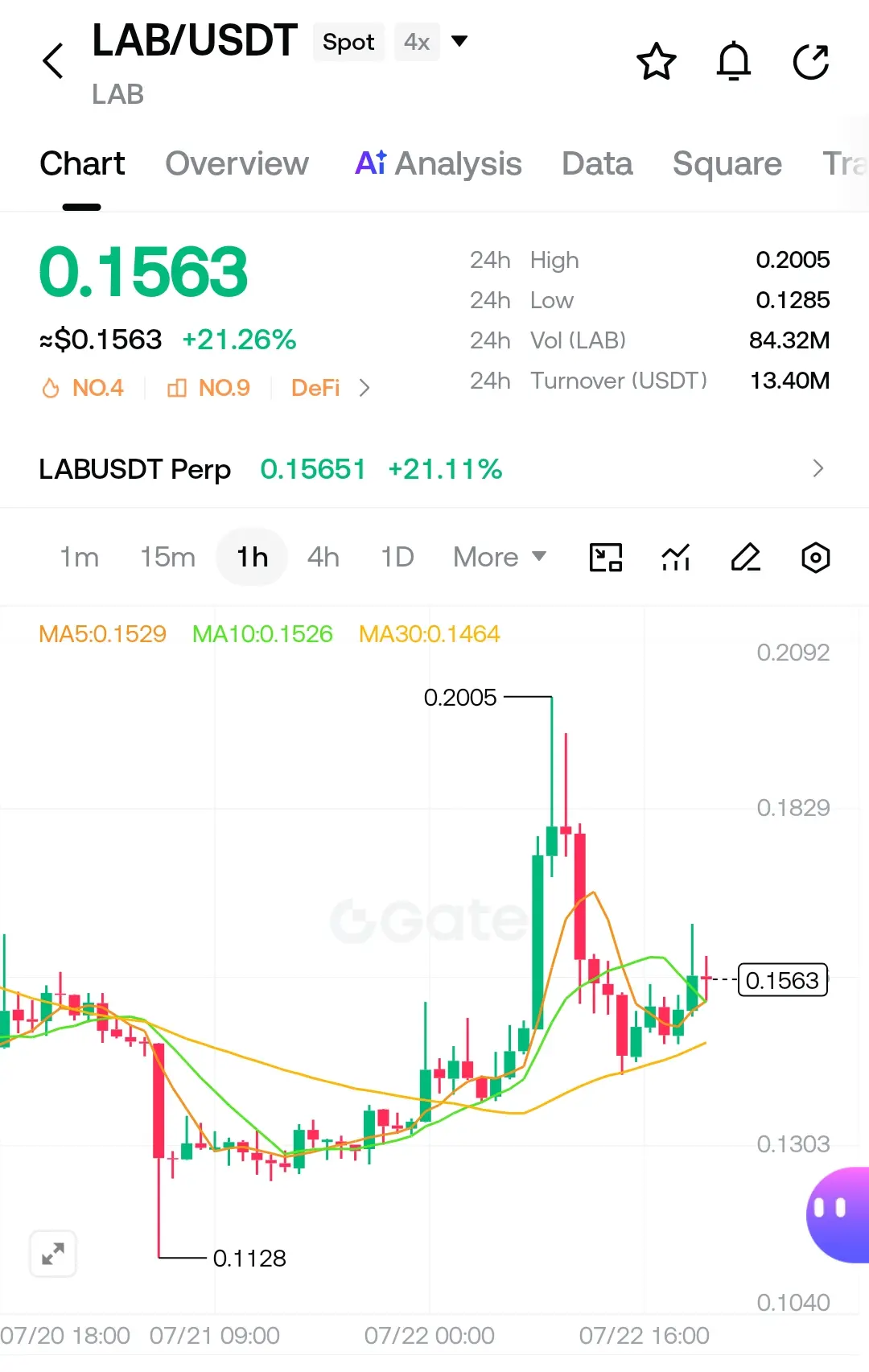
Breaking above 0.1829 is when the real start happens, but it’s severely overbought. A pullback to 0.156 could be considered for a low long entry, with a stop-loss set at 0.14, which is more stable.
Mason_Lee
$LAB
Ripping from 0.1040, now cooling under 0.2005. MAs stacked—price above all three. Break above 0.1829 triggers continuation; rejection retests 0.1303. Momentum strong but overextended.
Entry Zone: 0.1560 – 0.1565
TP1: 0.1700
TP2: 0.1829
TP3: 0.2005
Stop-Loss: 0.1400
#LAB #EventContractsLaunch #TrumpAgreesToClarityEthicsClause #GUSDYieldRisesto3.8% #SummerCreationCamp
repost-content-media
To be honest, you don’t really need to dig too deep into this stuff like bundles and block builders. Anyway, the more those articles get written, the more far-fetched they sound—things like order flow auctions, JIT… Honestly, knowing just that you might get “sandwiched” is enough. For day-to-day trading, just watch your slippage and don’t post orders that are too obvious. I’m basically just keeping an eye on my own little pile of funds—so long as MEV doesn’t get to it. Let robots compete and sort out the complicated things.
Recently, there was news about a certain region raising taxes, and my
I just saw a case where an AI Agent automatically interacted with a system. The process went pretty smoothly, but the moment it got to the part about abnormal oracle price quotes, it immediately stalled. Put simply, this kind of “wait for confirmation” mechanism is basically trading time for certainty. The same thing happened the time a cross-chain bridge was stolen: the contract layer was locked, but the off-chain consensus didn’t keep up, which is what gave the attacker an opening.
Anyway, I always feel that no matter how smart an Agent is, when it comes to permission upgrades, new contract
This yield aggregator—just looking at it, the APY is absurdly high. My first reaction is to check the contract. Permissions, upgrades, oracles—what isn’t a risk point? Basically, behind those pretty numbers, who knows how much counterparty risk is lurking.
A friend already fell into a trap before. Seeing a high APY, they rushed in—then the contract permissions got changed, and all the funds got locked.
As for on-chain games, don’t even mention it—economic collapse has been going on for more than a couple of days. Inflation, studios, and a spiral in the coin price—three words: stay away. Anyway
Just saw a social mining protocol—honestly my first reaction was: what about the price feed delay? Did they really think about it? 😅
In reality, the oracle quote and liquidation are only separated by a few seconds. If the chain gets congested, or the oracle gets arbitraged, and the quote doesn’t update in time, your collateral could get liquidated instantly. By the time you realize it, it’s already too late. I’ve seen plenty of friends make this mistake—everything was still just a little away from the right price, and then the bots precisely targeted them, wiping them out straight to zero.
To
Just saw a post about arbitrage, saying they found an on-chain opportunity that’s basically a sure thing… but my first reaction was: where would the profit come from? Either you’re grabbing someone else’s slippage, or someone is currently getting sandwiched. Anyway, the moment I see words like “risk-free arbitrage,” I instinctively check the contract permissions first—most likely it wasn’t set up for you.
With this recent macro shift, the US Dollar Index and risk assets have been rising together—pretty interesting. It feels like rate-cut expectations are getting even more vague; liquidity is e
USIDX-0.22%
I just came across a post about a big on-chain transfer being wildly interpreted as “smart money,” and the comments are full of people rushing in as well… I was so angry my blood pressure went up. To be honest, regular users really shouldn’t put too much faith in this stuff. In many cases, it’s just internal hot/cold wallet aggregation by an exchange, or a big holder being too lazy to split addresses—there’s absolutely no real connection to “market signals.”
Instead of researching this kind of mysticism, it’s better to keep the wallet security string pulled tight. Once your seed phrase has tou
I just saw a post discussing sandwiches, and everyone in the replies kept saying “arbitrage feels so great.” My first reaction was: you’re looking at money from someone else’s pocket, but other people are looking at the fees you paid. As for those on-chain bots, to put it plainly, they’re getting a head start—you rush in, and every single transaction you send could end up being used to benefit someone else instead of you. Later I thought it was pretty funny: a lot of people focus only on returns, don’t check on-chain permissions, don’t set slippage, and in the end they end up handing money to
Just now I was arguing with someone in the group about a project. I took a look at its treasury spending and how its milestone payouts are handled. Honestly, quite a lot of project teams, after they finish distributing tokens, don’t really keep moving the treasury funds. They either transfer a bit of money to some address every few months, calling it “ecosystem incentives”—but once you check what happens with that address afterward, you’ll understand. 🚬
Personally, I’m trying to figure out whether the team is really doing serious work. First, I check their on-chain spending records, especiall
Just about sent myself away… I wanted to check whether the contract of a certain restaking protocol is still alive, but I accidentally tapped the authorization limit and set it to the maximum. I quickly canceled and raised the gas so nothing bad happened 😅
Back to the main point: lately I keep seeing people in groups spamming about staking unlocks and token unlock calendars, and the selling-pressure anxiety is back. My own feeling is that the yields from LSTs and restaking are definitely tempting, but where does the money actually come from? In plain terms, it’s basically new incoming liquidi
Just saw an address label saying “top-tier restaking whale.” Click in and take a look: there are a bunch of protocols being staked, but they’re all nested, matryoshka-style contracts, and you can’t figure out what the underlying assets actually are. Address profiles and “account portraits” like this—sure, the data is public, but the credibility of the picture isn’t great. How many “whales” are just farmed by activity and scoreboarding? Especially with the heated debate in the restaking space about “shared security” right now: many so-called “security layers” are basically another staking pool.
I just saw some gossip about a stablecoin reserves audit, and the group is also forwarding “de-pegging” screenshots. Honestly, every time I see posts like this, my hands itch—I want to rush in and buy the dip.
But I’ve developed a habit: first, ask myself—did this anxiety come from my own analysis, or is it being pushed on by the group’s emotions? In other words, those screenshots don’t even include a contract address; it’s just a clickbait title. And the people forwarding it probably didn’t read the original text either.
Before, I followed a few accounts that specifically dig into on-chain re
I just went back and looked at the options stuff again—the concept of time value is really a seller’s favorite and a buyer’s headache. The seller collects rent every day; once time passes, the premium (options price) lands in their pocket. Retail buyers, meanwhile, always hope to wait for a big move. In the end, they often watch the time value drain away day by day, and then they don’t even hear a thing. It’s similar to how miners are getting burned by MEV today: retail ends up with no benefits on either side, with both time and orders getting eaten.
To put it bluntly, options are basically a
Let’s talk about something else. Recently, the royalty disputes in the creator economy have flared up again—lots of people are shouting that “the secondary market should share profits with creators,” but honestly, I looked through those contracts. Once you get a little more detailed—permissions settings, oracle price-feeding logic—you can spot plenty of traps. Some projects, on the surface, claim “on-chain royalties auto-distribute,” but they hide an upgradeable contract that can change the rules at any time, even the royalty ratio.
Anyway, I don’t really trust this kind of “short-term hype.”
I’ve come across several aggregators that are pushing up APY, and when you click in, the contract layer is pretty interesting. Some simply drop users’ funds into a pool that nobody seems to control, claiming “automatic reinvestment,” but the pool’s permissions are like a siphoning toilet—you can shut it off when you want, and you can withdraw when you want.
To be honest, when comparing RWA and on-chain yield products right now, many people only watch the APY number, as if whoever has the higher APY is the more impressive one. But the logic in the contracts—like how oracles feed prices, who has
RWA0.00%
View More