RugcheckRoommate

vip
Active for: 0.5y
Peak Tier 0
Reminds you every day not to sign things carelessly, just like a roommate. Former security audit assistant, loves reviewing permission settings and unusual upgrade logic.
The signal from July 6, 2025 was indeed accurate; I followed it this time.
JsBigShark
ETH bull market trend officially confirmed
There’s one last chance to get on board!
The last time this signal appeared was July 6, 2025
Good night 💤 everyone.
Seriously, I’ve followed the RWA narrative for a long time, and something has always felt off. You say putting assets on-chain is about liquidity, but the liquidity blockchain offers is just an illusion. What really determines whether you get your money back is still that redemption clause. So now, whenever I look at an RWA project, I make a point of checking the redemption-related function in the contract state first. It’s a habit left over from my time as an audit assistant, and I can’t shake it.
These past few days, on-chain data tools have been criticized as lagging and easy to mislead. Th
RWA-2.59%
People assume that with stablecoin supply rising and ETFs seeing continued inflows, the market should keep heading north; in reality, the two are at most “living in the same neighborhood” as price, not even next-door neighbors. The increase in supply may just be market makers temporarily shifting positions, while ETF inflows may include arbitrage capital moving back and forth to harvest profits. The correlation looks intimidating, but several links in the causal chain are missing. Anyway, I remember seeing some projects before whose on-chain data looked impossibly good, only to find pitfalls e
Will the zero tariff on generic drugs be extended for another two years—can ordinary people buy medicine a bit cheaper? Hopefully it’s not just loud thunder and little rain.
CoinNetwork
CoinJie.com News: Trump announced that starting August 1, 2026, all generic drugs imported into the United States will continue to enjoy zero tariffs for two years. This policy is intended to lower drug costs and ease the public’s medical burden.
Another one has blown up again; the investors’ money is just gone like that.
CoinNetwork
According to a report from Coinworld, a Dutch court has declared the crypto platform Knaken bankrupt. The reason is that prosecutors said 7 million euros (about 8 million US dollars) in customer funds are missing, and the company lacks sufficient assets to repay users.
The Iran-U.S. situation is such a tough variable that any demand-side tailwind gets fully neutralized without a trace—so the next round of diplomatic chess will be even more complicated.
CoinNetwork
CryptoWire news: In recent days, tensions between the US and Iran have intensified. Despite strong demand for ETFs, this could lead to higher volatility in global markets, affecting investor sentiment and making future diplomatic efforts more complex.
Reverse stock split + impairment loss—this plot is way too familiar. Veteran crypto old-timers can smell it and come running.
WuSaidBlockchainW
According to Bloomberg, the shares of American Bitcoin co-founded by Eric Trump is down more than 95% from its peak, and over the past 10 months the market value of its roughly 6% stake has shrunk by more than $600 million. The company this week carried out a 1-for-15 reverse stock split to maintain its Nasdaq listing status, and the stock hit a new all-time low on Wednesday. American Bitcoin still adheres to a Bitcoin mining and accumulation strategy; on Monday it increased its holdings by another 500 BTC, and its total holdings are now over 8,000 BTC. In the first quarter, it recorded an operating loss of $118.2 million after a $117.2 million impairment of its Bitcoin reserves.
Traditional financial infrastructure has officially opened up to multi-chain, and Clearstream's latest expansion has basically swept through all major L1s. The story of institutional entry is just beginning.
CoinNetwork
CoinWorld News, Clearstream, a subsidiary of Deutsche Börse Group, announced the expansion of its institutional cryptocurrency custody services, adding support for XRP, Stellar (XLM), Cardano (ADA), Solana (SOL), Litecoin (LTC), and Avalanche (AVAX). Previously, the service only covered Bitcoin (BTC) and Ethereum (ETH). Clearstream stated that this expansion aims to meet the growing demand from institutional finance for digital assets compliant with the MiCA (Markets in Crypto-Assets Regulation) standards.
LOL, I suggest directly airdropping two jin of ribs to the wallet address.
Original content no longer visible
At 2 AM, I scrolled past a comparison table of RWA yields, and my finger was already hovering over the "add position" button.
Suddenly, I remembered the last time I was in this exact same stance—I thought I had figured out the U.S. Treasury yield numbers, but when I jumped in, I realized I was buying into a pool whose permissions could be arbitrarily changed. The annualized rate looked nice, but the contract hid a line of logic allowing the owner to make emergency withdrawals.
Now I've learned my lesson. When I feel the itch, I first lock the screen, go get a glass of water, and come back to a
RWA-2.59%
The MiCA requirement of 60% uninsured deposits is truly absurd, locking users' funds into small banks. Who will cover the fallout if something goes wrong? Paolo skipping this round is a lifesaver.
CoinNetwork
Coin World News, Tether CEO Paolo Ardoino stated that Tether has not applied for a MiCA license because it is very dangerous for stablecoins. He noted that the relevant rules could force issuers to place 60% of their reserves in "uninsured cash deposits" at small European banks that cannot handle redemptions. He described this as a "poorly considered legislation" and added that he "skipped MiCA to protect over 400 million Tether users."
Ki Young Ju's words are cutting; the more aggressively Saylor buys, the less BTC can rise, as liquidity is drained.
CoinNetwork
Coin World News reported that CryptoQuant CEO Ki Young Ju said Michael Saylor’s ongoing large-scale buying strategy may be hindering Bitcoin (BTC) from recovering. He noted that Saylor’s buying behavior appears more like liquidity consumption rather than a price catalyst, and suggested pausing purchases, rebuilding cash reserves, and adopting a systematic buying-timing framework. In the current high selling-pressure environment, buying may only be able to maintain a trading price range and cannot push the price higher. Although Bitcoin’s realized market cap has grown by $467 billion over the past two years, the price has fallen by 1%. He believes that continued buying may prevent deeper market corrections, thereby creating the conditions for a historical cycle bottom pattern.
BTC+0.19%
Lubin's words are quite firm; credibility and neutrality truly are a moat.
WuSaidBlockchainW
Wu Shuo learned that Ethereum co-founder Joseph Lubin posted a statement saying that the world needs a trusted neutral digital asset settlement platform, and currently only Ethereum fits this role. Lubin stated that Ethereum's trusted neutrality, censorship resistance, open source nature, and privacy features come from its high level of decentralization. He also mentioned that in the future, more well-funded and trusted neutral organizations will support the Ethereum Foundation's work, promote the adoption of technologies such as mainnet, L2, and private Ethereum environments, and ETH will circulate within a broader Ethereum ecosystem.
Solana got hit hard, with daily costs dropping from 33,000 SOL to 5,300. The on-chain popularity cooled off much faster than expected. Are those who called for SOL Summer doing okay now?
CoinNetwork
CryptoWorld News reports that, according to The Block, the graduation rate of pump.fun tokens has dropped by 80% over the past three months, and the 7-day average has fallen to 0.26%. In June, pump.fun’s daily average revenue was about $800,000, down from $4.8 million six months earlier, and pump tokens have fallen by 40% over the past six months. pump.fun’s decline has also affected the Solana network: in June, the Solana network’s daily average fees fell to 5,300 SOL, down from 33,000 SOL in January.
SOL+2.29%
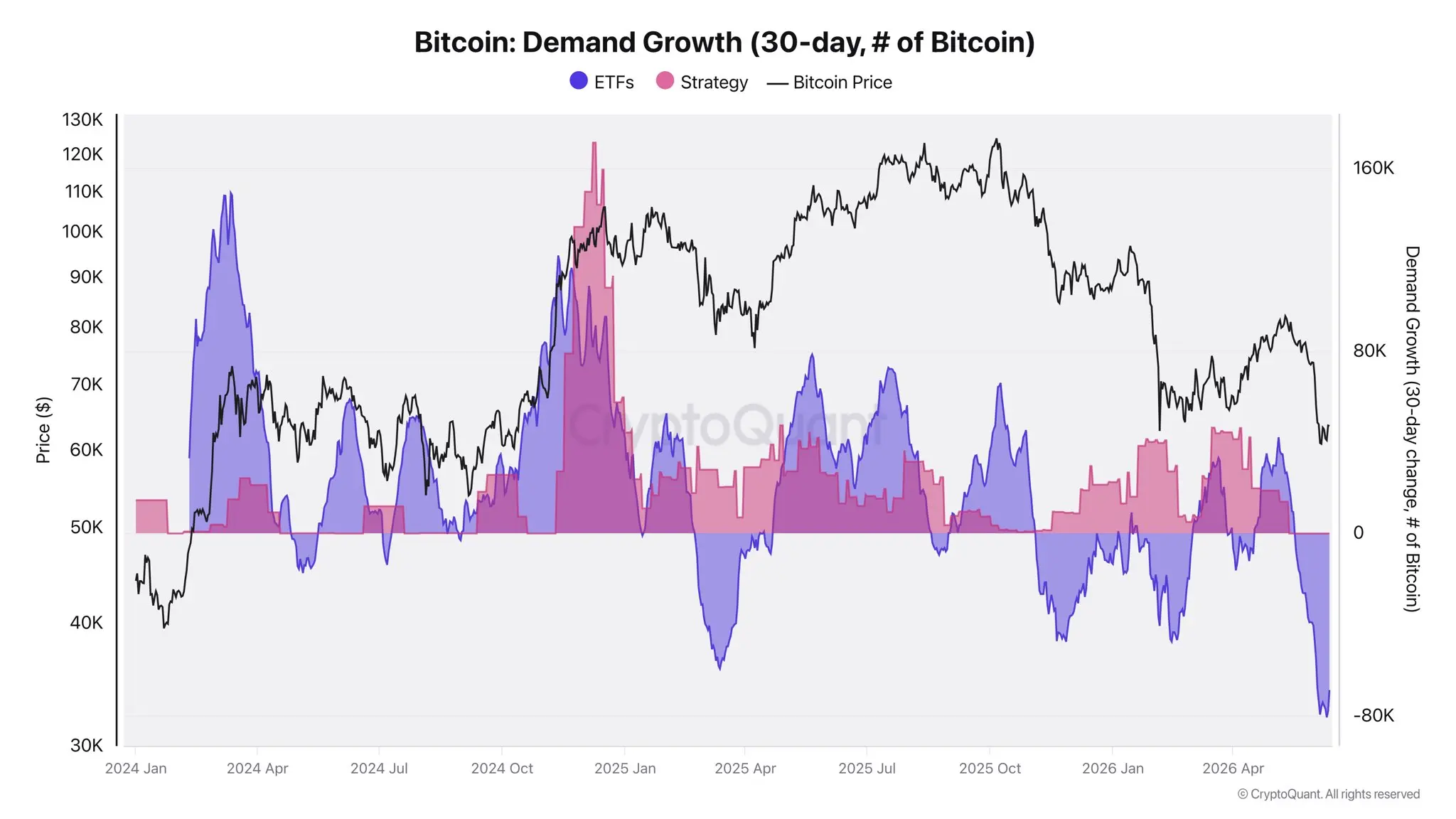
-66k in monthly net outflows, after institutional buying dried up, the market can only rely on retail investor sentiment and macro narratives to hold up, with short-term pressure quite significant.
AriaNaka
$BTC Spot demand remains relatively weak and is therefore increasingly driven by two main sources :
Strategy
- Bitcoin ETFs
The issue is that Strategy has significantly reduced its BTC purchases, and we recently even witnessed its second Bitcoin sale.
As for ETFs, outflows have been occurring week after week. As a result, monthly average demand growth has turned negative.
At approximately -66,000 BTC, we have reached a level of net outflows never seen before.
While these two channels represent only part of overall demand, their combined impact has often been significant enough to influence Bitcoin's price action.
repost-content-media
The fact that Tehran doesn't acknowledge the Apache issue is the savvy move; admitting it would just invite trouble.
CoinNetwork
Although the US and Iran have attacked each other, neither side wants to engage in "infinite war."
Political analyst Magnier states that although the US and Iran are exchanging fire, neither side wants to escalate to "infinite war." The US aims to rebuild deterrence and protect its troops and freedom of navigation through a new round of strikes; Iran wants to demonstrate that attacks will come with a cost. Both sides face significant consequences, affecting Gulf energy, regional security, and the global market. Regarding the Apache crash, Iran does not acknowledge responsibility to avoid provoking a stronger response, indicating that they are willing to go to war if necessary but know that the US is reluctant to strike first.
New York State's move to align with the federal government means stablecoin regulation will finally have a unified framework.
CoinNetwork
CryptoWorld News: New York State is pushing to align stablecoin regulation rules with the Genius Act, bringing state-level oversight closer to the federal cryptocurrency framework.
A few days ago, I saw a bunch of people talking about LST/re-staking, "lying down to earn extra income," and I immediately had a conditioned reflex... The profit, to put it simply, is twofold: one is the original staking yield, and the other is someone willing to spend money to buy "security/consensus endorsement" or subsidize to increase TVL. When the subsidies disappear, the value shrinks—don't treat it as a fixed salary.
The risks are not mysterious: if you repeatedly use the same collateral to get stamped, and the underlying asset has an issue, it’s all at risk; add another layer of protoc
Recently, doing tasks on these platforms really feels like clocking in for work: today you have to connect this chain, tomorrow you have to post that, and you also need to watch the separate scores dropping. Once the “witch rules” change, everyone’s working overtime… To put it plainly, it’s not about experiencing the product—it’s about adapting to risk control. Even more outrageous is that, to boost your score, people dare to click through all kinds of one-click authorizations, unlimited limits, and inexplicable “upgrade contract” pop-ups. Just thinking about it makes my scalp tingle.
And some
AI + multi-chain narratives are still going on, but keep a tight watch on the divergence between price and volume—don’t get swept up by FOMO.
FortuneAi
⬛ FORTUNE AI QUANT | $ALLO
🔲 Directional Bias: Bullish
⚡ Spot Synthesis: Price is advancing while trading volume shows a slowdown, yet the token benefits from exposure to AI, big data, and multiple blockchain ecosystems.
🩸 Leverage Profile: Open interest is sizeable compared to the market size, and the funding rate is positive, indicating that longs are paying shorts; no additional leverage metrics are provided.
📉 Narrative Catalyst: The token’s tags span AI‑big‑data and several chain ecosystems, which aligns with the observed elevated activity, though the weakening volume velocity suggests the narrative drive may be losing steam.
View More