
#ChipStocksRebound
After weeks of heavy selling that wiped out trillions in market value, semiconductor stocks staged a sharp rebound on November 3, 2026 — U.S. midterm election day — as investors returned to the AI-driven growth story that has defined the sector for years.
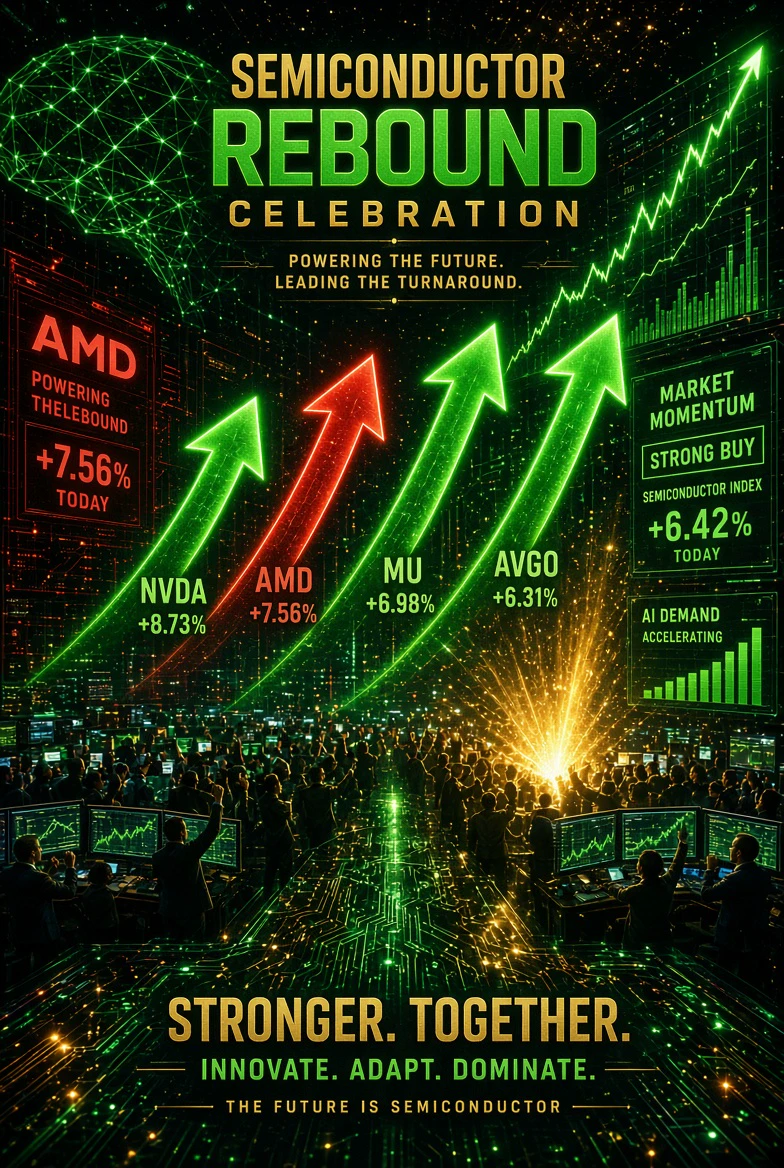
The Philadelphia Semiconductor Index (SOX) climbed approximately 2.64%, snapping a multi-day losing streak and helping lift the broader technology complex. The Nasdaq Composite rose about 0.8% to close near 25,372, while the S&P 500 edged higher. The recovery was led by the biggest names in chips and memory, many of which had been among the hardest hit during the recent correction.
Key movers included:
- **Nvidia (NVDA)**: Gained roughly 2.3%, reclaiming a market capitalization above $5 trillion. The AI leader had absorbed the largest dollar losses during the prior sell-off but found buyers as sentiment stabilized.
- **AMD (AMD)**: Rose about 3.65% in regular trading and then surged an additional 7.6% after hours following stronger-than-expected third-quarter results. Data-center revenue nearly doubled year-over-year, reinforcing demand for its AI accelerators and server processors. Full-year guidance also came in ahead of expectations.
- **Micron (MU)**: Climbed in the 2.5–4% range as memory stocks participated in the bounce. Broader memory and storage names, including Sandisk, Seagate, and Western Digital, also moved higher.
- **Broadcom (AVGO)** and **Intel (INTC)** posted solid gains as well, with Intel recovering some of the steep losses it had suffered in recent sessions.
The backdrop to the rebound was a painful stretch for the sector. Since early October, chip and memory stocks had shed an estimated $3.7 trillion in market value amid growing investor skepticism about the pace and returns of AI infrastructure spending, rising debt concerns among some neo-cloud providers, and broader questions about valuation after a multi-year run. Nvidia absorbed the largest absolute losses, while Intel’s percentage decline was among the steepest of the major players.
Several factors helped turn the tide on Tuesday. Election-day uncertainty appeared to ease as voting got underway, removing one near-term overhang. More importantly, the market began to re-focus on underlying demand signals rather than the recent price action. AMD’s earnings provided concrete evidence that data-center and AI-related spending remains robust. Strong results and guidance from other AI infrastructure names after the close further supported the narrative that the multi-year build-out of compute capacity is continuing.
Memory stocks also found support. Reports of tight supply in high-bandwidth memory (HBM) and rising memory prices — highlighted in recent commentary from industry participants — suggested that the pricing cycle for DRAM and related products remains favorable. When AI accelerators require advanced memory, the entire ecosystem benefits.
The rebound does not erase the questions that drove the earlier sell-off. Investors continue to debate how long corporate capital expenditure on AI can remain elevated, whether returns will justify the investment, and how sensitive the sector remains to higher interest rates and shifting macroeconomic conditions. Breadth in the broader market was mixed even as the indexes rose, with some traditional sectors lagging while semiconductors and selected technology names led.
Still, the speed of the recovery underscores how central the semiconductor industry has become to equity market leadership. AI remains the dominant growth theme in technology, and chips sit at the center of that story — from GPUs and custom accelerators to the memory, networking, and power solutions that enable large-scale training and inference.
For longer-term investors, the recent volatility may ultimately be viewed as a healthy digestion of prior gains rather than a fundamental break in the AI investment cycle. For shorter-term traders, the bounce offered a reminder that heavy selling can create opportunities when earnings and guidance continue to support the underlying demand thesis.
As the market digests AMD’s results, monitors the outcome of the midterms, and looks ahead to further AI-related earnings and commentary, attention will remain focused on whether this rebound can extend or whether skepticism about spending levels reasserts itself. The semiconductor sector has delivered extraordinary returns over the past several years precisely because demand for advanced compute has consistently outpaced even optimistic expectations. The latest price action suggests that many investors are not yet ready to abandon that view.
What do you think — is this the start of a sustained recovery for chip stocks, or just a temporary bounce in a still-uncertain environment? Share your take below.
#ChipStocksRebound #Semiconductors #AI #Nvidia
After weeks of heavy selling that wiped out trillions in market value, semiconductor stocks staged a sharp rebound on November 3, 2026 — U.S. midterm election day — as investors returned to the AI-driven growth story that has defined the sector for years.
The Philadelphia Semiconductor Index (SOX) climbed approximately 2.64%, snapping a multi-day losing streak and helping lift the broader technology complex. The Nasdaq Composite rose about 0.8% to close near 25,372, while the S&P 500 edged higher. The recovery was led by the biggest names in chips and memory, many of which had been among the hardest hit during the recent correction.
Key movers included:
- **Nvidia (NVDA)**: Gained roughly 2.3%, reclaiming a market capitalization above $5 trillion. The AI leader had absorbed the largest dollar losses during the prior sell-off but found buyers as sentiment stabilized.
- **AMD (AMD)**: Rose about 3.65% in regular trading and then surged an additional 7.6% after hours following stronger-than-expected third-quarter results. Data-center revenue nearly doubled year-over-year, reinforcing demand for its AI accelerators and server processors. Full-year guidance also came in ahead of expectations.
- **Micron (MU)**: Climbed in the 2.5–4% range as memory stocks participated in the bounce. Broader memory and storage names, including Sandisk, Seagate, and Western Digital, also moved higher.
- **Broadcom (AVGO)** and **Intel (INTC)** posted solid gains as well, with Intel recovering some of the steep losses it had suffered in recent sessions.
The backdrop to the rebound was a painful stretch for the sector. Since early October, chip and memory stocks had shed an estimated $3.7 trillion in market value amid growing investor skepticism about the pace and returns of AI infrastructure spending, rising debt concerns among some neo-cloud providers, and broader questions about valuation after a multi-year run. Nvidia absorbed the largest absolute losses, while Intel’s percentage decline was among the steepest of the major players.
Several factors helped turn the tide on Tuesday. Election-day uncertainty appeared to ease as voting got underway, removing one near-term overhang. More importantly, the market began to re-focus on underlying demand signals rather than the recent price action. AMD’s earnings provided concrete evidence that data-center and AI-related spending remains robust. Strong results and guidance from other AI infrastructure names after the close further supported the narrative that the multi-year build-out of compute capacity is continuing.
Memory stocks also found support. Reports of tight supply in high-bandwidth memory (HBM) and rising memory prices — highlighted in recent commentary from industry participants — suggested that the pricing cycle for DRAM and related products remains favorable. When AI accelerators require advanced memory, the entire ecosystem benefits.
The rebound does not erase the questions that drove the earlier sell-off. Investors continue to debate how long corporate capital expenditure on AI can remain elevated, whether returns will justify the investment, and how sensitive the sector remains to higher interest rates and shifting macroeconomic conditions. Breadth in the broader market was mixed even as the indexes rose, with some traditional sectors lagging while semiconductors and selected technology names led.
Still, the speed of the recovery underscores how central the semiconductor industry has become to equity market leadership. AI remains the dominant growth theme in technology, and chips sit at the center of that story — from GPUs and custom accelerators to the memory, networking, and power solutions that enable large-scale training and inference.
For longer-term investors, the recent volatility may ultimately be viewed as a healthy digestion of prior gains rather than a fundamental break in the AI investment cycle. For shorter-term traders, the bounce offered a reminder that heavy selling can create opportunities when earnings and guidance continue to support the underlying demand thesis.
As the market digests AMD’s results, monitors the outcome of the midterms, and looks ahead to further AI-related earnings and commentary, attention will remain focused on whether this rebound can extend or whether skepticism about spending levels reasserts itself. The semiconductor sector has delivered extraordinary returns over the past several years precisely because demand for advanced compute has consistently outpaced even optimistic expectations. The latest price action suggests that many investors are not yet ready to abandon that view.
What do you think — is this the start of a sustained recovery for chip stocks, or just a temporary bounce in a still-uncertain environment? Share your take below.
#ChipStocksRebound #Semiconductors #AI #Nvidia