
GlitchOrchard

vip
Active for: 0.4y
Peak Tier 0
Prefers structured products and hedging strategies, dislikes reckless all-in bets. Writes like debugging: first reproducing the issue, then drawing conclusions.
After using a multichain wallet for a long time, the account list really starts to look like a wardrobe full of old clothes from unknown seasons: everything looks familiar, but after digging around for ages, you still have no idea which pieces are wearable. Recently, people have been saying those on-chain labeling tools are “outdated” or even “misleading,” and I think the criticism is fair. A few days ago, I checked an address that the tool labeled as “donation,” but clicking through led to a phishing site. I almost died laughing.
So these days, I basically no longer try to be an “all-chain su
View Original
  • Reward
  • Comment
  • Repost
  • Share
Who knew Qixi could be celebrated this way? Enter Gate Square with your original insights, see how far persistence and content can take you, and climb the leaderboard together!
View Original
Nayeem003
I didn’t expect Qixi to turn into a trading content challenge, but here we are. 😄
The idea is pretty simple: share original crypto or stock insights on Gate Square and compete with other creators through the Trading Master leaderboard.
I’m more interested in seeing how far good content and consistency can take me.
Who’s competing this time?
#MyQixiTradingShare #Qixi
  • Reward
  • Comment
  • Repost
  • Share
I just took a look at USDC’s reserve report. To be honest, it’s transparent, sure—but that “bank-run panic” psychology thing is basically mystical. Having enough reserves doesn’t mean nobody panics; when panic kicks in, it’s always everyone running first. The same goes for that controversial re-staking setup—no matter how pretty the stacked returns look, once the underlying structure gets complicated, it can actually make people feel uneasy. In any case, I feel like with stablecoins, even with higher transparency, it’s only a safety net—the real thing that decides life or death is confidence.
USDC0.00%
View Original
  • Reward
  • Comment
  • Repost
  • Share
Recently I’ve been playing with address profiling, and it honestly feels a bit like mysticism. For example, I watched a particular address—the transaction history looked so clean and textbook-perfect. I followed it for two weeks, only to find it was basically a Matryoshka doll bot: all the trades were limit orders used to rack up volume. And then there are those that interact every day right on schedule at 3:00 a.m.; it’s clearly a studio script. No matter how fancy the profiling looks, it’s just a pretty empty shell. To put it bluntly, on-chain data can tell you what “he did,” but you’ll neve
View Original
  • Reward
  • Comment
  • Repost
  • Share
I almost went to my own grave just standing there a moment ago… I copied a RWA project’s contract address to prepare a transfer, but the clipboard had an old interaction record in it. If I hadn’t checked that the gas fee was wrong, I probably would’ve sent it straight into a black hole.
After going through something like this once, it actually made me rethink the whole idea of putting RWA on-chain. A lot of people believe that on-chain tokenization is just “digitalizing” assets, and that liquidity will automatically improve. But based on real experience, liquidity is still largely propped up b
RWA1.23%
USDC0.00%
View Original
  • Reward
  • Comment
  • Repost
  • Share
When I hear people say they’re “buying the dip,” I’m actually a bit afraid.
When liquidity dries up, it’s not a question of how much the price drops. It’s whether you have ammunition in your hands. I’ve seen too many people who got hit and kept firing their position halfway down—then when the real bottom finally came, they could only watch. I’d rather make a little less profit than force myself into a corner.
Lately, the US dollar index has been rising and falling in sync with risk assets, which hasn’t been very common in the past. Market logic is changing, and the hedging framework that worke
USIDX0.56%
View Original
  • Reward
  • Comment
  • Repost
  • Share
This real blue-black play is rock-solid— the young goalkeeper locks the deal early, and the other top clubs will have to look for other targets.
View Original
CoinNetwork
Crypto news, Atlanta announced that it has locked in young goalkeeper Marco Carnesecchi. The team’s decision not only strengthens squad stability, but also impacts the transfer market by limiting the choices of top young goalkeepers.
  • Reward
  • Comment
  • Repost
  • Share
The RSI oversold signal has appeared—does anyone start buying/accumulating WTRE at this level?
View Original
CoinNetwork
CoinWired.com news: During Monday’s trading, the WisdomTree New Economy Real Estate Fund ETF (WTRE) broke through a key technical indicator. The stock price entered an oversold range, with the lowest traded price reaching $23.85 per share. The oversold range is defined based on the Relative Strength Index (RSI), a technical analysis indicator.
  • Reward
  • Comment
  • Repost
  • Share
The energy + AI data center wave is indeed riding the tailwind—an IPO fundraising amount of $6.7 billion shows that the public market has finally recognized it.
View Original
CoinNetwork
Trading volume in the climate technology sector hits a record high, with power demand spurring market demand
In the first half of 2026, global climate technology listings and M&A hit a new high. A total of 153 deals were announced, up 70% year over year, and the share of M&A also rose sharply by about 65%. There were 17 IPOs, raising $6.7 billion, the highest level since 2022. Among the acquired companies, the energy sector accounted for more than one third, while energy made up nearly 60% of IPO companies. Against the backdrop of rising interest rates and tighter markets, the industry rebounded quickly. Investors are focusing on companies that can provide power for AI data centers and broader electrification through their technologies. It is expected that by 2030, global data center electricity use will double, and the public markets have begun to recognize the value of such companies.
  • Reward
  • Comment
  • Repost
  • Share
After trying the AI Agent automated market making for two days, to be honest, it rebalances faster than me, but it still freezes during extreme market conditions — like when the chain gets congested, the oracle is delayed, or a certain pool suddenly loses depth. That's when you realize that behind the "automation," someone still needs to keep an eye on the stop-loss line.
Recently, I saw people arguing about royalties in the NFT space. It's actually the same principle: code can force transfers, but it can't force anyone to keep playing. The more complex the on-chain environment, the more hidde
View Original
  • Reward
  • Comment
  • Repost
  • Share
Yen breaks 162; intervention firepower is more than enough, but what the market really wants to know is: will they actually make a move this time?
View Original
CoinNetwork
CoinWorld news, Maybank analysts pointed out that the yen breaking through the 162 level against the U.S. dollar has triggered intervention risks, as this level is seen as the threshold for possible official action. In their report, they wrote that it remains unclear whether intervention is imminent or ongoing, but officials have continued to issue warning remarks. Maybank is closely monitoring the sharp exchange rate fluctuations that may accompany intervention and noted that Japan's "ammunition" such as deposits and securities is ample, far exceeding the scale of the previous intervention that cost approximately $74 billion. "Currently, we are watching whether the pair can hold the 162.00 level in the short term. If it breaks, the next resistance level is 164.00." Maybank set support levels at 158.00 and 155.00 respectively.
  • Reward
  • Comment
  • Repost
  • Share
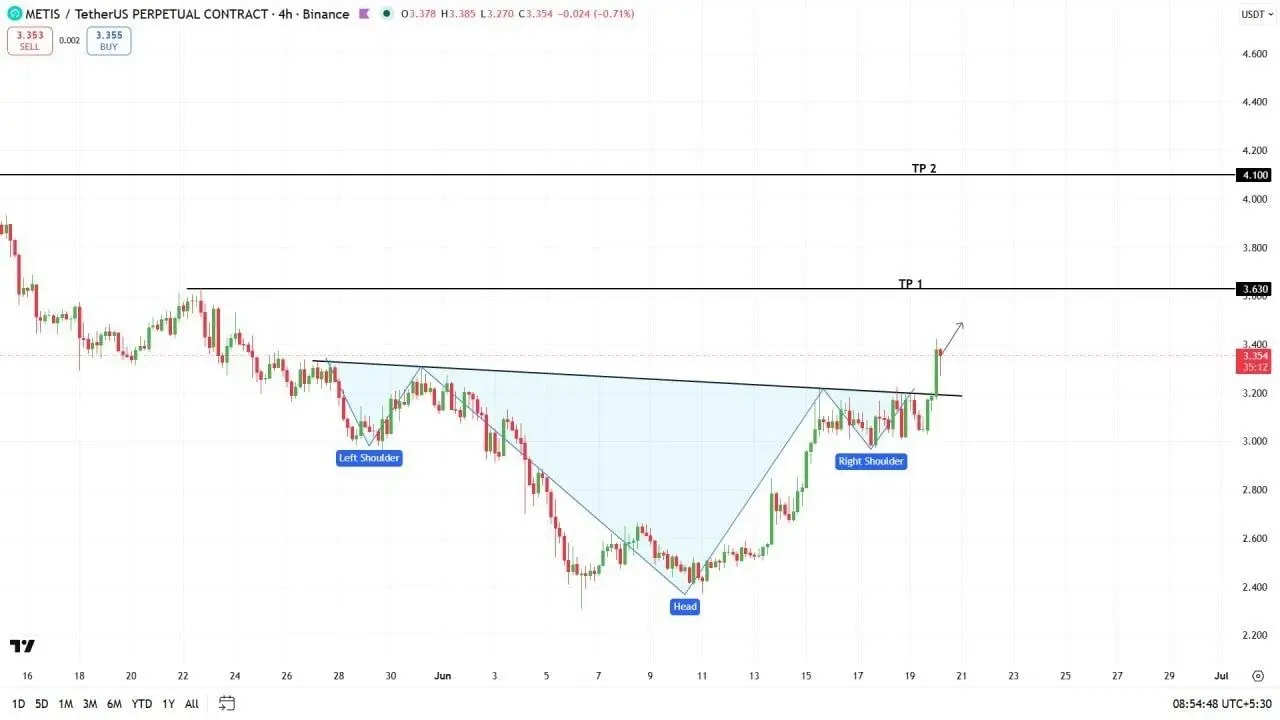
Head and shoulders bottom breakout confirmed, $METIS the bulls are about to exert effort, holding the neckline is the key!
METIS0.99%
View Original
MarcusCorvinus
$METIS has successfully broken out of an Inverse Head & Shoulders pattern, a classic bullish reversal structure.
The breakout confirms growing buyer strength and suggests momentum could continue pushing price toward higher targets.
Bullish Trigger:
Holding above the neckline breakout level.
Bearish Invalidation:
A breakdown back below the neckline support.
With the pattern now confirmed, $METIS could be preparing for a strong upward move. If buyers maintain control, the projected targets may be reached sooner than expected.
repost-content-media
  • Reward
  • Comment
  • Repost
  • Share
The expectation for interest rate hikes jumps from 16% to 40%—this reversal in sentiment is even more electrifying than DeFi mining profits. Is Powell’s blowhard routine about to start up again?
View Original
CoinNetwork
Crypto News, a survey of global fund managers conducted by U.S. banks in June found that 40% of investors expect the Federal Reserve to raise interest rates at least once in the next 12 months, up from 16% in May. The survey found that 28% of investors expect at least one rate cut this month, a significant decrease from 50% last month. Meanwhile, 28% of respondents expect the federal funds rate to remain unchanged in the next 12 months. The survey was conducted from June 5 to June 11.
  • Reward
  • Comment
  • Repost
  • Share
Nine independent metrics are scored separately. Fable 5 underwent a major architecture overhaul, and when the quantitative results failed, it had the nerve to roll back and start over—yet Opus 4.7 only makes small template tweaks. Self-correction and memory management are the real hard currency; writing prompts has genuinely become impossible to keep “pushing the envelope.”
View Original
CoinNetwork
AI Aunt: Achieve six times the performance of Fable 5 with an independent referee
BitWorld reports that Anthropic, in comparative testing, used CMA outcomes to generate a scoring agent as a judge within an independent context window, evaluating it based on nine metrics. The results show that the independent judge loop increased Fable 5’s improvement over the training pipeline by 6 times compared with Opus 4.7. Fable 5 demonstrates resilience, daring to make major architectural changes, and continues to fix even in the event of quantization regression; by contrast, Opus 4.7 is inclined toward template fine-tuning due to decision limitations. Experimental conclusion: a feedback-enabled self-correction loop and autonomous memory management are more valuable in real-world applications than directly writing prompts.
  • Reward
  • Comment
  • Repost
  • Share
Recently, I've seen people claiming that "increasing stablecoin supply = an immediate price rally" as an iron law, but honestly, this correlation looks appealing but doesn't equal causation. More stablecoins might mean funds are entering the market, or it could just be that traders are switching to a more convenient parking spot; the same goes for net inflows/outflows in ETFs—off-chain money coming in doesn't mean it's immediately hitting spot prices. Many of these are related to market making, hedging, or futures basis trades, and the price impact takes several steps to transmit.
I personal
View Original
  • Reward
  • Comment
  • Repost
  • Share
Zavaton’s words sound familiar, but it’s true: without policy backing, every builder has to “grease the wheels” themselves.
View Original
CoinNetwork
CoinJie.com news reports that the new DeFi Political Action Committee, Defend Developers PAC, has joined the fundraising efforts that have pushed the crypto industry onto the political stage in recent years. The committee plans to raise and contribute more than six figures of funds in the midterm elections to support incumbent legislators who have already proven to be its allies, in order to protect the legal rights of crypto developers and decentralized finance projects. Gavin Zavatton, the founder of the committee, said, “We are building political infrastructure to ensure that the United States remains the best place to build blockchain technology.”
  • Reward
  • Comment
  • Repost
  • Share
Recently, I saw someone say "just toss it into the pool and earn passively," and I started to want to debug a bit: first reproduce—AMM's fundamental curve is essentially automatically "sell low, buy high," and as prices fluctuate back and forth, your position will be swapped to the side that is rising more slowly; when transaction fees aren't thick enough, impermanent loss will grind you down to doubt your life. Market making is more like taking volatility as an opponent, earning transaction fees and incentives, and bearing the cost of passive rebalancing, not a deposit.
Looking at the current
View Original
  • Reward
  • Comment
  • Repost
  • Share
Recently, I’ve been seeing a bunch of new L1/L2 projects start rolling out incentives to boost TVL again. I get the old users’ complaints about “mining, selling” too… so for whether a project is “reliable,” I basically don’t go by slogans. I start by checking three things: GitHub, audit reports, and multi-signature upgrades.
For GitHub, I treat it as a way to “replay the environment”: are people actually changing the code recently, are there responses to issues/PRs, and it’s not just that someone makes a batch of commits and then leaves everything to go idle. For audit reports, don’t just look
View Original
  • Reward
  • Comment
  • Repost
  • Share
BHYP's first month at 0% looks attractive, but in the long run, HYPG, which is listed on Nasdaq, is more stable.
The 2.2% annualized return isn't high, but institutions are focused on compliance.
NAS100-0.41%
View Original
CoinNetwork
Grayscale launches the lowest-cost Hyperliquid ETF in the United States
Grayscale launches a trading product called HYPE on Wednesday, with a fee rate of 0.29%, the lowest among similar products in the United States. Hyperliquid Staking ETF HYPG is listed on Nasdaq, with a fee rate lower than THYP and BHYP, with THYP at 0.30% and BHYP at 0% in the first month, then 0.34%. Grayscale states that HYPE's staking annualized yield is approximately 2.2%, indicating that institutional investors are paying attention to crypto infrastructure beyond Bitcoin and Ethereum.
  • Reward
  • Comment
  • Repost
  • Share
Lately, I feel like I'm debugging an attention loop: whenever a hot topic comes up, I get itchy to act; after a few days when the hype dies down, I realize I bought into "emotional premium." To put it simply, to avoid being repeatedly cut off, I first reproduce the process—when I see a breakout, I ask myself: what is this narrative relying on to survive? Is it cash flow/real demand, or is it purely riding the wave of reposts? Then I add a small threshold for myself: if there's no hedging strategy, I won't add to my position, at most a small position as an "observation sample," saving bullets f
View Original
  • Reward
  • Comment
  • Repost
  • Share
  • Pinned