Square
Following
Hot
News
Profile

Melarin

vip
Active for: 1.4y
Peak Tier 0
No content yet
0
Following
5
Followers
24
Liked
Stale and orphan blocks: small details that matter in Bitcoin mining.
In mining, finding a block is a big achievement, but timing matters too.
A stale block happens when a miner finds a valid block, but another block has already been accepted at the same height. An orphan block is commonly used to describe a block that isn’t part of the accepted chain, often because its parent block isn’t available or recognized.
Network latency, propagation delays, and competing blocks can all play a role.
That’s why mining pools work to spread blocks quickly, maintain reliable connections, and reduce unnece
BTC+1.36%
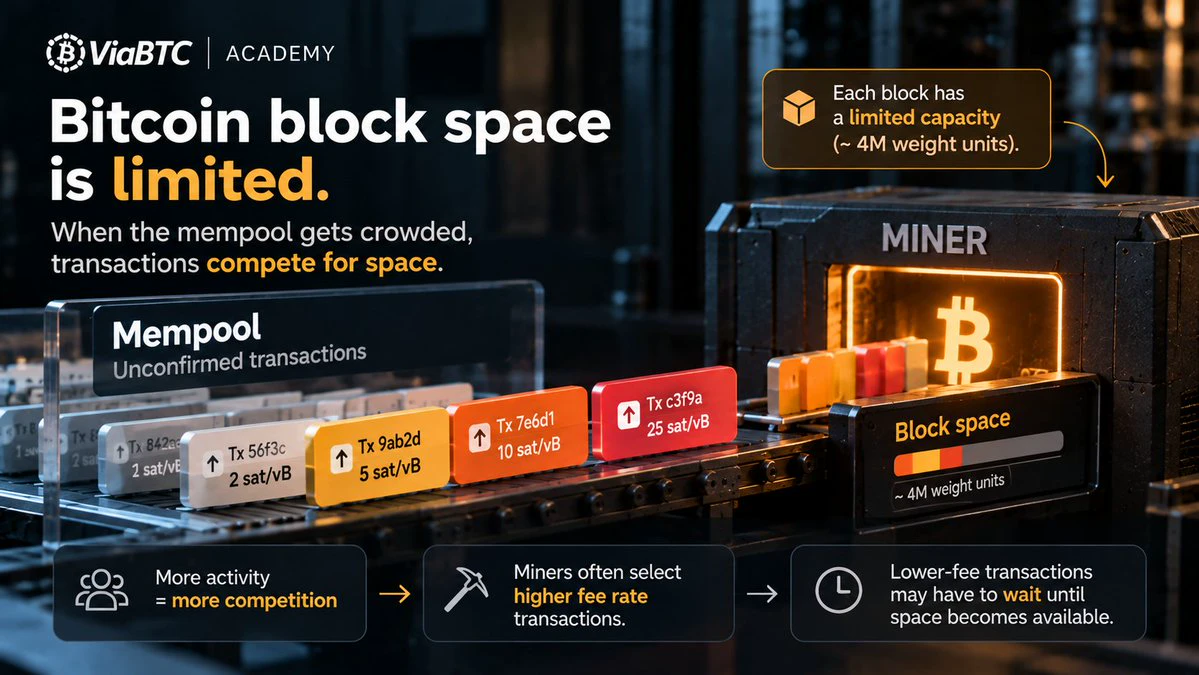
Bitcoin doesn’t have unlimited room for transactions.
Every block has a capacity limit, and when the mempool gets crowded, transactions compete for that space.
Miners select transactions for their blocks, often favoring higher fee rates. Lower-fee transactions may have to wait until space becomes available.
Sometimes, it’s not about whether your transaction is valid. It’s about how competitive its fee is.
#ViaBTCacademy
post-image
BTC+1.36%
Your miner might be making money… but are you actually profitable?
Here’s the catch: Hashrate gets attention, but J/TH + electricity cost decide how efficiently you mine.
A 3,000W miner running at $0.08/kWh costs $5.76/day in electricity alone.
Now add pool fees, hosting, and hardware costs. Suddenly, the real picture looks very different.
Smart miners don’t just ask, “How much can I earn?”
They ask, “How much do I keep?”
Want to understand mining economics beyond the hashrate?
Learn the fundamentals with @ViaBTC Academy and make every mining decision more informed.
#ViaBTCacademy #Bitcoin
post-image
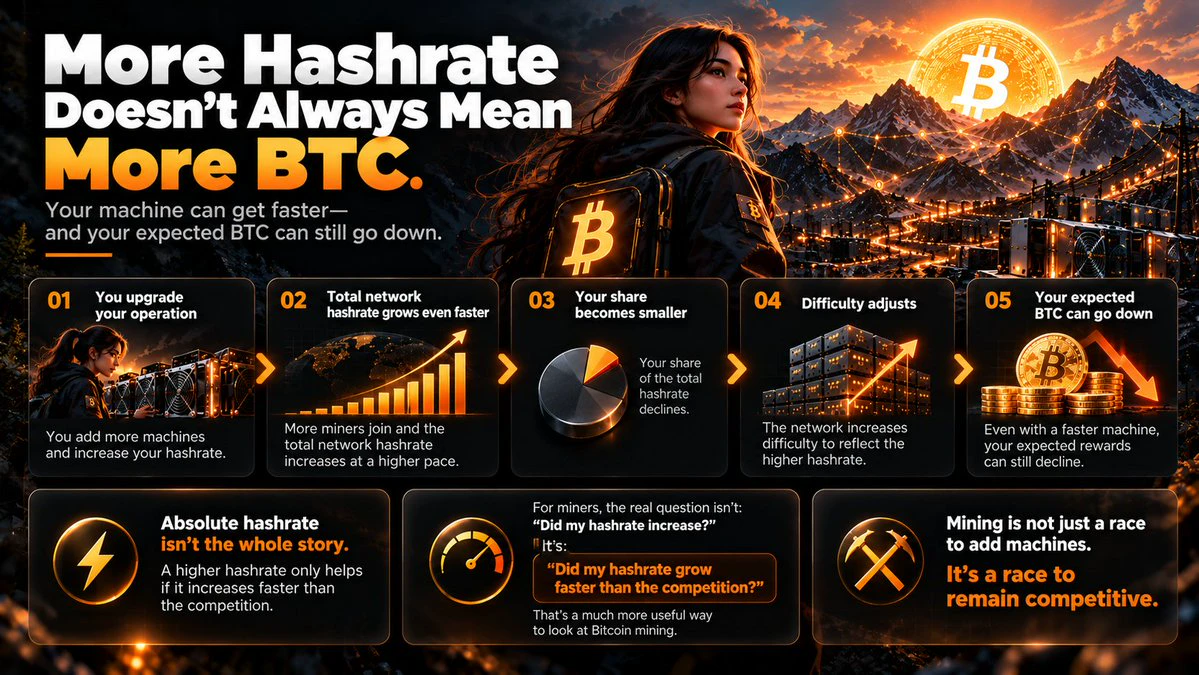
Your mining machine can get faster and your expected BTC can still go down.
Sounds strange?
It’s one of the realities of Bitcoin mining.
Imagine you upgrade your operation and increase your hashrate.
Great.
But if the network grows even faster, your slice of the total network hashrate becomes smaller.
Then the difficulty adjustment reflects the changing network conditions.
This is why absolute hashrate isn’t the whole story.
For miners, the question isn’t simply:
“Did my hashrate increase?”
It’s:
“Did my hashrate grow faster than the competition?”
That’s a much more useful way to look at Bitco
post-image
BTC+1.36%
PPS+ or PPLNS which one makes more sense for miners?
The difference isn’t complicated, but it can make a difference in how your payouts look.
With PPS+, your earnings are generally more steady. Pool luck has less effect on what you receive in the short term.
With PPLNS, your payout is more connected to the blocks your pool finds. Good luck can mean better payouts, while a rough streak can mean more variation.
So, in simple terms:
PPS+ → steadier payouts
PPLNS → more payout variation
It really comes down to what you prefer: more predictability or more exposure to pool luck?
What would you choo
post-image
@formanite602 I don't think so
@cas_abbe @Acurast Interesting shift from data centers to devices
ACU+3.20%
The # S53 ladder, tier by tier
20K USDT → top 480 → 10 $
50K → top 350 → 20 $
200K → top 150 → 80 $
500K → top 50 → 200 $
5M → TOP 1 → 2,000 $
You need the rank AND the threshold. Miss either one and it pays zero.
Closes Tue Jul 28, 15:59 UTC
post-image
  • 1
$AKE is up nearly 1000% in just 4 days, and even though things are starting to cool off, I don't think the move is necessarily over.
If buyers step back in after this reset, we could easily see another leg higher.
Still HIGH RISK though small size, tight stop loss, and don't chase it.
Definitely one to keep on the watchlist.
AKE+8.69%
Locked supply and SOL momentum could work in its favor if volume follows 🔒
SOL+1.24%