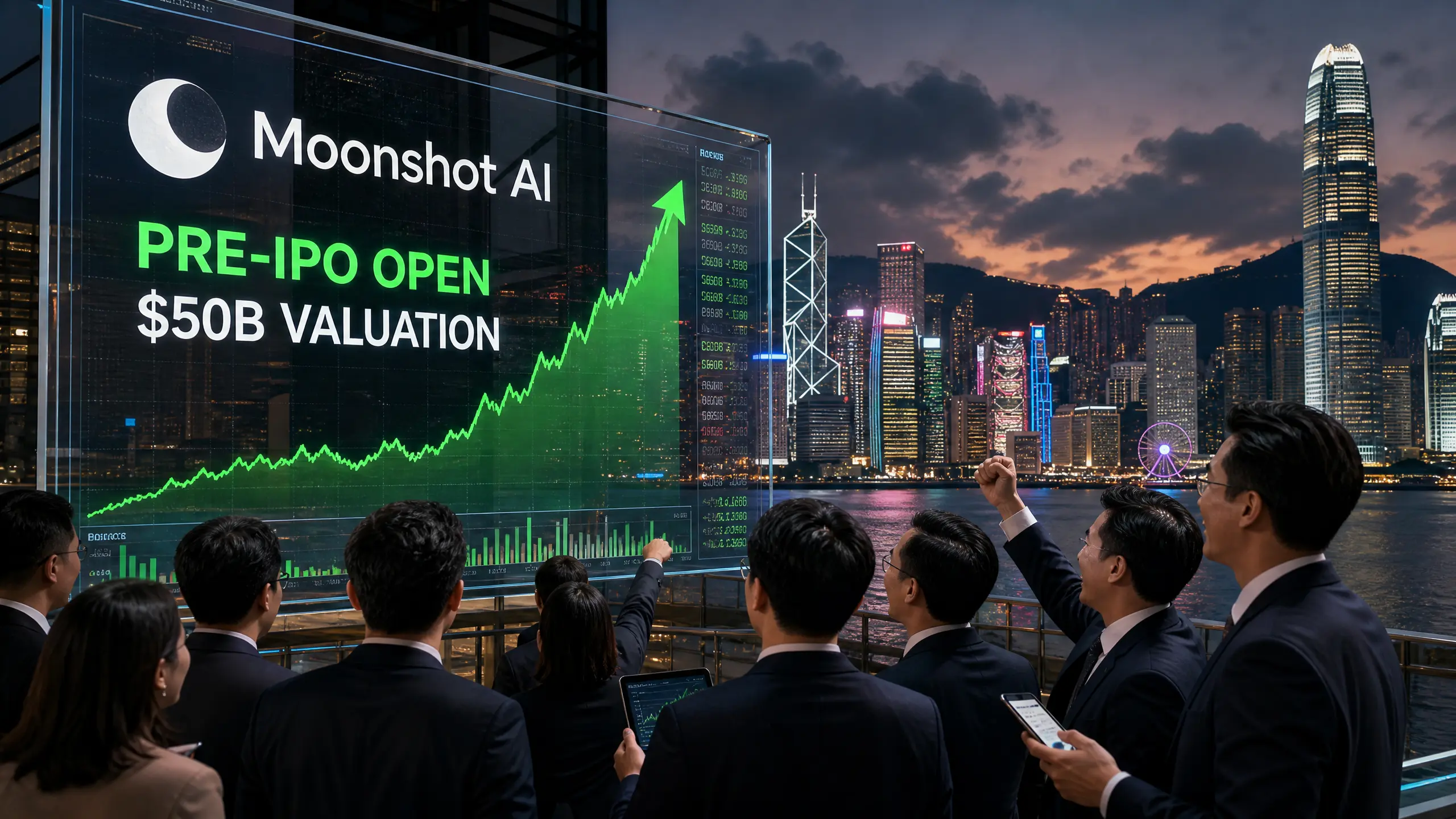
#MoonshotAIPreIPOsOpen — AI’s Next Investment Story Is Taking Shape
Artificial intelligence has quickly become one of the most important technology themes in global markets. From AI assistants and foundation models to autonomous agents, enterprise automation, and advanced computing, the industry is moving from experimentation toward real-world adoption.
That is why is attracting attention.
Moonshot AI is one of the companies participating in the highly competitive AI ecosystem, with its Kimi platform and large-model technology putting it on the radar of investors following the next generation of artificial intelligence companies.
But when looking at any pre-IPO opportunity, the most important thing is to separate potential from certainty.
A pre-IPO opportunity is not the same as owning a publicly traded stock. Investors need to understand the exact structure of the offering, valuation, eligibility requirements, liquidity restrictions, fees, potential lock-up periods, and what happens if an expected IPO is delayed or does not happen.
The AI opportunity itself is significant.
The global market is moving beyond simple chatbots. AI systems are becoming increasingly capable of reasoning, coding, researching, analyzing information, generating content, assisting businesses, and completing complex workflows.
The next major development could be the rise of AI agents.
Instead of simply answering questions, AI agents aim to perform multi-step tasks and interact with software, information, and digital tools. If this technology reaches large-scale adoption, it could transform enterprise software and productivity.
Companies capable of building powerful models while keeping operating costs under control could have a major advantage.
That makes several factors important when evaluating Moonshot AI.
Technology
AI competition is moving extremely fast. Model performance can improve dramatically within a short period, so maintaining technological competitiveness will be critical.
User Adoption
A large user base can provide a strong foundation, but user numbers alone are not enough. Retention, engagement, paid conversion, and actual product usage matter.
Monetization
The long-term value of an AI company depends on its ability to convert technological capabilities and user demand into sustainable revenue.
Computing Efficiency
Advanced AI requires significant computing resources. Improving model efficiency and reducing inference costs could become an important competitive advantage.
Enterprise Growth
Consumer AI is only one part of the opportunity. Enterprise customers could provide another major market for AI assistants, APIs, automation, research, and agent-based products.
Competition
Moonshot AI operates in an environment filled with powerful competitors. Technology leadership can change quickly, meaning investors should continuously monitor the broader AI landscape rather than focusing on one company alone.
There is also a major difference between a great company and a great investment.
A company can have excellent technology but still be overpriced.
This is particularly important in AI, where investor expectations can become extremely high. If expectations rise faster than revenue, profitability, or user growth, valuations can eventually face pressure.
That means valuation should always be considered alongside technology.
Investors researching should ask several basic questions:
What exactly is being offered?
What valuation is being used?
Who is providing the opportunity?
Is the source officially verified?
What rights does the investor receive?
Are there lock-up or transfer restrictions?
What happens if the IPO is delayed?
What happens if the IPO never takes place?
What fees apply?
And what is the maximum amount that could realistically be lost?
These questions are more important than social-media hype.
The AI industry has enormous potential, but it also carries significant uncertainty.
Regulation, computing costs, competition, data requirements, capital requirements, cybersecurity, privacy, and changing consumer preferences can all influence the future of AI companies.
Another important factor is the broader market environment.
Technology valuations can be sensitive to interest rates, liquidity, investor sentiment, and economic conditions. Even a strong AI company can experience significant valuation changes when market sentiment shifts.
For that reason, investors should avoid assuming that a potential IPO automatically means an immediate profit.
The eventual public-market price will depend on financial performance, investor demand, market conditions, valuation, and expectations at the time of listing.
The bigger story, however, remains extremely interesting.
AI is becoming a foundational technology across finance, education, software, manufacturing, healthcare, research, media, logistics, and countless other industries.
The companies that ultimately succeed may be those that combine strong research with efficient infrastructure, excellent products, strong distribution, sustainable monetization, and long-term execution.
Moonshot AI is therefore a company worth watching as the AI ecosystem continues to evolve.
is not simply about an IPO narrative. It represents a broader question for the technology market: which AI companies will successfully transform advanced models into sustainable businesses?
That answer will be determined by execution.
For investors, the best strategy is to stay informed, verify information through reliable sources, understand the structure of any pre-IPO opportunity, evaluate valuation carefully, and manage risk rather than chasing excitement.
The AI race is still in its early stages.
New models will appear.
New products will emerge.
New competitors will enter.
And the relationship between AI technology and financial markets will continue to develop.
The opportunity may be significant, but disciplined research remains essential.
Research first. Verify the opportunity. Understand the risks. Think beyond the headline.
#MoonshotAI #ArtificialIntelligence #PreIPO #AIInvesting