GateUser-9d67589f

vip
Active for: 0.5y
Peak Tier 0
Focus on trend-following indicators, favoring EMA and SAR. Dislikes short-term noise, adds positions when the trend is clear. Community members speak calmly, often drawing lines to share opinions.
I’ve been staring at gas late into the night until I’m numb. I saw one guy’s transfer stuck in pending while he raised the fee more than a dozen times, and when it finally went through, I actually felt relieved. Stop-losses are really the same thing. It’s like a breakup: you know it’s not going anywhere, but you keep dragging it out, paying more and more in fees. In the end, what you lose isn’t just your principal—it’s your energy. I’ve learned one rule: cut it when the time comes, and don’t fall in love with your position.
AI Agents have been hyped even harder than the market lately. Every au
Sometimes I really feel that unrealized losses keep you more wide-awake at night than unrealized gains. Making money may make you happy for a while, at most; losing money can have you repeatedly going through your trade history and wondering whether you were out of your mind at the time. Put simply, it’s loss aversion—the pain of losing 100 bucks probably takes making 200 bucks to offset. It’s the same on-chain: whenever people see a large transfer, someone starts shouting that “smart money is entering,” but who knows whether it’s just an exchange moving funds between hot and cold wallets? The
Honestly, I only have one expectation when it comes to on-chain privacy: don’t think you’re invisible. Mixers have been watched like a hawk for ages, and I’ve seen plenty of addresses get flagged over a momentary lapse in judgment. You think you’re being clever, but every on-chain move is being recorded by someone. The NFT royalty flame war is pretty interesting too—on the surface it’s about creator income, but in reality it’s all a liquidity game with nothing whatsoever to do with privacy. Still, that whole “the protocol should make decisions for users” attitude gets old enough to make you sn
To be honest, after using L2s for a long time, I’m starting to feel like escaping back to mainnet again… It’s not that L2s are no good—gas really has been pretty cheap since Cancun, and for small transfers you basically don’t have to think twice; just click confirm and it goes through. But have you noticed that, in order to save a few dollars in gas, you actually worry ten times more: which cross-chain bridge to choose, whether the liquidity is deep enough, and what to do if the chain gets congested and the proof gets stuck? Anyway, I’m a little tired of it. Let small interactions of 10–20 U s
Just went through a round of task platforms, and the more I looked, the more it felt like there’s really no difference from going to work… It’s all about farming points and preventing Sybils—now even your interaction history has to be “raised” like a real person, or they’ll just reject you and send you back to square one. Honestly, it’s pretty annoying. I originally just wanted to mess around and milk the “meme/money-making” charts for fun, but now it’s like performance reviews and scoring.
Recently I’ve been watching those AI agent auto-interaction stories that hype everything to the heavens,
Honestly, I’ve always been “if you can make it easier, make it easier” about taxes, but when it’s really time to tally things up at year-end, the one who gets a headache is me. My current habit is to keep tx records from on-chain signed transactions; for CEX or DEX interactions, I manually save a screenshot or export a CSV each time. Leaving an extra trail doesn’t hurt. After all, some project teams look really lively with积分 or testnet rewards before they disappear, but if mainnet token issuance and withdrawals get checked and you have no record, you’d be genuinely stuck.
I’m also too lazy to
Banks profit from earning the spread by creating choice dilemmas, and stablecoins are the real universal capital pool that breaks the binary divide.
CoinNetwork
CoinJiex.com news: Coinbase CEO Brian Armstrong said banks force users to choose between zero-yield checking accounts and savings accounts that they can’t access for spending, in order to achieve a larger net interest spread. He noted that stablecoins eliminate this split, allowing users to use them as payment tools, for trading, and for DeFi. He asked, “Why can’t there be a pool of funds that can both be spent and earn a reasonable return?”
SpaceX’s stock has been a roller coaster: after three days, it plunged back to around its IPO price, with tens of billions wiped out in the process. The high-valuation, leveraged game is indeed thrilling
CoinNetwork
CoinDesk news: After three days of losses, SpaceX’s share price is nearing its IPO price, with losses totaling tens of billions. This volatile performance highlights the challenge of maintaining market confidence under speculative valuations and financial leverage.
SPCX-1.29%
The custodian’s actions moved faster than expected, with stocks and government bonds being moved to the blockchain. This move was executed steadily.
CoinNetwork
Coin Circle News: Today, the custodian DTCC announced that it will begin a soft launch of its tokenization services, covering specific stocks, ETFs, and U.S. Treasuries, with a full rollout expected in October.
Revenge is a principle, but can international legal mechanisms really get justice back? How will the US and Israel’s attack be accounted for?
CoinNetwork
Crypto World News reports that Iran’s Foreign Ministry spokesperson Baghaei said today (July 13) that Iran will seek revenge for the killing of Iran’s top leader Ali Khamenei and for all Iranians who were killed or injured in attacks by the US and Israel—“this is a basic principle and a common public demand.” Meanwhile, Iran’s Foreign Ministry is recording the crimes through international legal mechanisms and seeking justice. Iran also accused the US of applying pressure on Oman. In addition, Baghaei said that Iran had originally planned to cooperate with Oman to establish a “joint management mechanism for the Strait of Hormuz,” but the mechanism failed to be realized due to the US’s overt and covert pressure on Oman. Over the past week, there have been four rounds of mutual attacks between the US and Iran, and the conflict has escalated rapidly. Baghaei emphasized that Iran will defend its own security without hesitation, and any other country’s territory used to attack Iran will be brought within the scope of Iran’s defensive strikes.
SK hynix is really going for it with that premium—on HyperLiquid, the funding rates on the two sides are one positive and one negative, and the arbitrage hunters catch the scent and come running.
CoinNetwork
According to data from Cbi World, SK Hynix’s US stock ADR trades at a premium of about 23.4% over its South Korean shares. As of the time of publication, on HyperLiquid, the SK Hynix Korea contract SKHX is currently priced at $1245.4, with a 24-hour trading volume of about $1.021B. The US stock ADR contract SKHY is currently priced at $153.69, with a 24-hour trading volume of about $136 million. Based on a conversion of 10 ADRs to 1 share of South Korean common stock, SKHY’s current equivalent price is $1536.9, which is $291.5 higher than SKHYNIX. Back-calculating implies that the South Korean shares are discounted by about 18.97% versus the US ADR. Regarding funding rates, SKHYNIX is currently at +0.06132% per hour, while SKHY is at -0.00463% per hour; the difference between the two is about 0.06595 percentage points.
SK Hynix+6.41%
SKHY-0.38%
SKHYNIX-0.31%
HYPE+1.13%
South Korea’s foreign exchange reserves buffer looks as thick as 92%, but if the semiconductor sector even flinches and foreign capital runs for the exits, the KOSPI’s 30x PE could end up performing a full-on dive on the spot.
CoinNetwork
According to Coin Jie Network news and Tantu macro analysis, South Korea’s current financial risks have structural similarities to the 1996 Asian financial crisis. The semiconductor export share is 41%, foreign investors’ equity holdings in the stock market reach 40%, and external debt as a share of GDP rises to 39.6%. The key differences are that the foreign exchange reserves adequacy ratio is 92%, the share of short-term external debt falls to 9.4%, the exchange rate is freely floating, and the growth rate of corporate leverage has slowed. Currently, South Korea’s KOSPI price-to-book ratio is 2x, the price-earnings ratio is 30x, and total outstanding financing is 38.6 trillion won. Model calculations estimate a 5% probability that South Korea will fall into negative growth over the next year, but the risk of a vicious cycle is lower than during the 1996 Asian financial crisis. If the semiconductor cycle reverses or tightening by the Federal Reserve triggers foreign capital to withdraw, the stock market could become a key conduit for risk transmission.
Traditional financial giants are finally starting to get serious, directly issuing products on-chain instead of just applying a digital label after the fact. Marketnode's role as a node is also critical, and it's worth watching the subsequent scale disclosure.
WuSaidBlockchainW
HSBC announced on July 10 that it has completed the issuance of its first digital native structured product, privately placing USD-denominated structured notes in Hong Kong. The notes were issued directly on the blockchain, rather than being digitized after issuance. Euroclear, HSBC, Singapore Exchange Group, and Marketnode — an Asia-Pacific digital market infrastructure operator backed by Temasek — served as tokenization agent and digital payment agent, handling payments between the issuer and investors. HSBC did not disclose the issuance size, reference assets, tenor, number or identity of investors, nor the blockchain used. (The Defiant)
Strategy cashed out 216M, with 2.55B in cash on hand—ready to bottom fish or is it a full shift to a bear market? Should BTC holders start panicking?
CoinNetwork
CoinJie.com news: Strategy sold $216 million worth of Bitcoin to pay dividends and currently holds $2.55 billion in cash.
BTC-0.27%
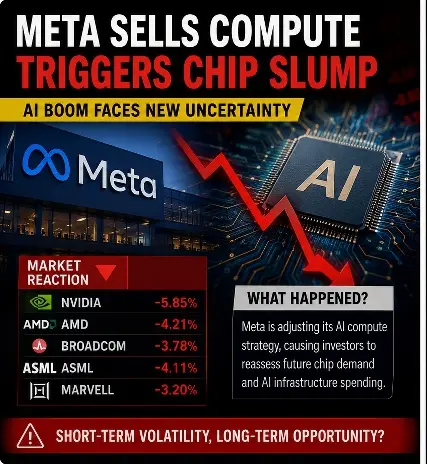
Meta's move directly shocked the chip sector, short-term sentiment is hit hard, but the AI supercycle isn't over yet, so isn't the dip actually an opportunity to pick up chips?
Ai_Power
#MetaSellsComputeTriggersChipSlump
THE AI BOOM ISN'T SLOWING DOWN—BUT META'S LATEST COMPUTE DECISION HAS SHAKEN THE ENTIRE CHIP MARKET. IS THIS A TEMPORARY PULLBACK OR THE START OF A BIGGER SHIFT?
Artificial Intelligence has become one of the most powerful forces driving global technology investment. From cloud computing to advanced AI models, demand for high-performance chips has fueled record growth across the semiconductor industry. However, when one of the world's largest AI companies adjusts its strategy, the entire market pays attention.
Background & Context
Over the past two years, companies like Meta, Microsoft, Amazon, and Google have invested billions of dollars in AI infrastructure. This massive spending created unprecedented demand for GPUs, AI accelerators, and data-center hardware, making semiconductor companies some of the market's biggest winners.
What Happened?
Recent reports indicate that Meta is changing part of its AI compute strategy, prompting investors to reassess expectations for future AI infrastructure spending. The news triggered weakness across several semiconductor stocks as traders questioned whether AI investment growth could become more disciplined.
Key Facts & Data
• AI infrastructure spending has reached record levels.
• Semiconductor companies have benefited from soaring GPU demand.
• Major technology firms continue investing heavily in AI, but spending priorities are evolving.
• Investor sentiment can shift rapidly when leading AI companies adjust their capital allocation strategies.
Why It Matters
Meta is one of the largest AI infrastructure investors in the world. Even relatively small strategic changes can influence expectations for chip demand, cloud expansion, and future technology investment across the entire industry.
Market Impact
Following the reports, parts of the semiconductor sector experienced selling pressure as investors evaluated whether the move represented a temporary optimization or a broader slowdown in AI hardware spending.
Despite the short-term volatility, many analysts believe AI adoption remains in its early growth phase.
Investor Perspective
Long-term investors often view market pullbacks differently from short-term traders. While headlines can create temporary volatility, disciplined investors focus on company fundamentals, innovation, earnings growth, and long-term AI demand rather than reacting to every market move.
Opportunities
Market corrections often create opportunities to identify fundamentally strong companies at more attractive valuations. Businesses leading AI innovation, cloud infrastructure, and advanced semiconductor development may continue benefiting from the long-term expansion of artificial intelligence.
Risks & Challenges
• Slower-than-expected AI infrastructure spending.
• Rising competition within the semiconductor industry.
• Geopolitical tensions affecting global chip supply chains.
• High market valuations increasing downside risk during periods of uncertainty.
Expert & Industry Insight
Many industry experts believe the AI revolution is transitioning from aggressive expansion toward greater efficiency. Future success will depend not only on purchasing more computing power but also on optimizing existing infrastructure while maintaining innovation.
Future Outlook
AI remains one of the strongest long-term technology themes globally. Although individual companies may adjust spending strategies, demand for advanced computing, AI software, cloud services, and next-generation chips is expected to remain an important driver of future technological development.
Key Takeaway
Meta's reported compute strategy highlights how quickly market sentiment can change in the AI sector. While short-term uncertainty may pressure semiconductor stocks, the broader AI transformation continues to reshape the global technology landscape.
Do you believe this is simply a healthy correction for AI chip stocks, or could it signal a new phase in the AI investment cycle? Share your thoughts below!
#MetaSellsComputeTriggersChipSlump
✍️ Ai_Power
repost-content-media
META-2.53%
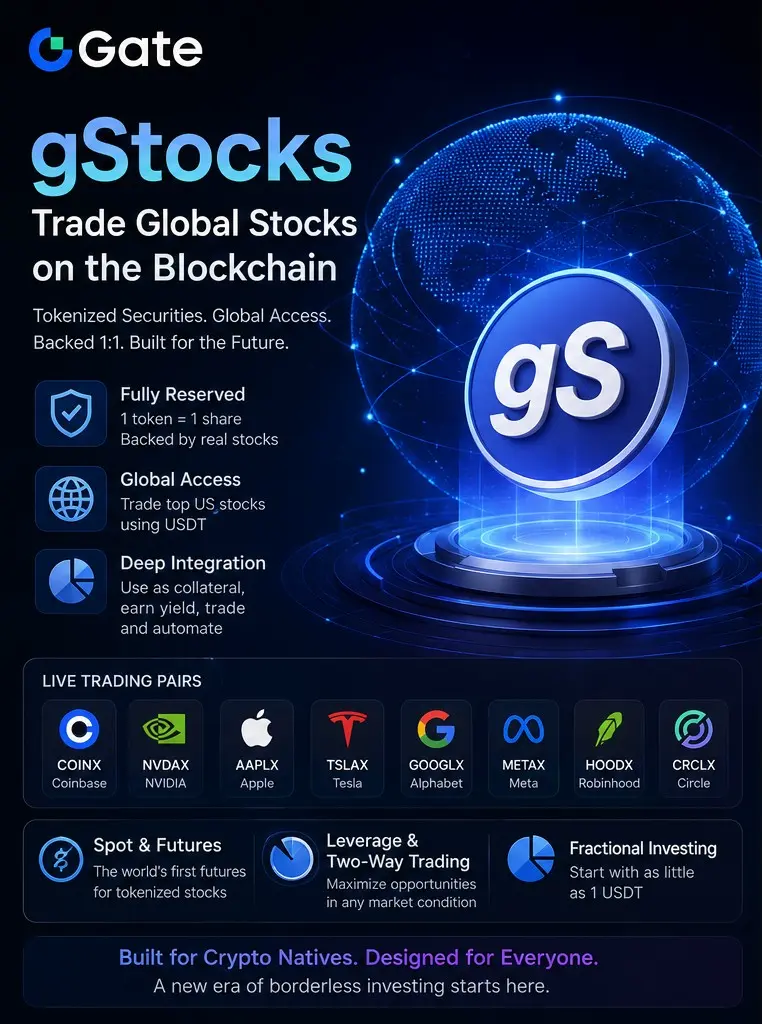
Gate's gStocks are indeed something special: fully reserved 1:1 pegged to US stocks with the ability to open contracts, trade TSLA and NVDA with USDT 24/7 — traditional brokers would be speechless.
2In1
#gStocksTokenizedStocksLive
The emergence of tokenized securities represents one of the most transformative developments in modern finance, bridging the gap between traditional capital markets and blockchain-based infrastructure. Gate has positioned itself at the forefront of this revolution with the launch of gStocks, a comprehensive tokenized securities platform that enables seamless access to global equities through a fully collateralized, blockchain-native framework.
At its core, gStocks operates under a rigorous fully reserved model where each tokenized security maintains a one-to-one backing with its corresponding underlying stock. This structure ensures that every digital representation of equity ownership is substantiated by actual shares held in reserve, providing users with verifiable asset backing and institutional-grade transparency. The mechanism addresses one of the fundamental concerns in tokenized finance: ensuring that digital assets maintain genuine value correlation with their real-world counterparts.
The initial launch encompasses fifteen carefully selected tokenized equity trading pairs, featuring prominent international companies that span diverse sectors of the global economy. Early listings include technology leaders such as Micron and AMD, alongside innovative enterprises like SanDisk and SpaceX. This curated selection reflects Gate's strategic approach to offering exposure to high-growth, globally relevant companies that resonate with both traditional investors and the crypto-native community.
Gate's xStocks trading section represents a sophisticated multi-market infrastructure that supports both spot and futures trading for tokenized equities. The platform's initial release provided access to eight major tokenized stocks including COINX, NVDAX, CRCLX, AAPLX, METAX, HOODX, TSLAX, and GOOGLX. These tokens enable global users to trade fractional ownership of major corporations directly using cryptocurrency assets like USDT, eliminating traditional barriers to entry.
What distinguishes Gate's offering in the competitive landscape is its pioneering status as the first platform globally to launch a futures market for tokenized stocks. This achievement establishes a fully closed-loop trading infrastructure that operates at the intersection of digital and traditional finance. Users can now apply leverage and execute two-way trading strategies on United States stocks within a USDT pricing framework, enabling more dynamic risk and return management than traditional equity markets typically permit.
The trading infrastructure has undergone comprehensive optimization to support this innovative product category. Enhancements to matching engines, sophisticated pricing models, and robust risk control systems have been specifically tailored to accommodate the unique liquidity profiles of United States stocks while catering to the behavioral patterns characteristic of crypto-native traders. The result is a high-performance system delivering exceptional responsiveness, strong compatibility, and a seamless user experience across both spot and futures market segments.
The true innovation of gStocks extends beyond simple tokenization to encompass deep integration within Gate's comprehensive financial ecosystem. Tokenized equities can be managed within unified accounts alongside traditional cryptocurrency holdings, creating a consolidated portfolio management experience that was previously unavailable to retail investors. This unified approach eliminates the fragmentation that typically characterizes multi-asset investment strategies.
Perhaps most significantly, these tokenized assets serve functional purposes beyond mere speculation. Users can employ gStocks as collateral for margin lending activities, unlocking liquidity without requiring the sale of underlying positions. Additionally, the assets can be incorporated into yield-oriented products such as Simple Earn, enabling investors to generate passive income from equity holdings in ways that traditional brokerage accounts do not support.
The platform further enhances accessibility through automated trading tools including sophisticated bots and grid strategies. These features allow users to implement systematic trading approaches that would typically require significant technical expertise and infrastructure investment. Fractional investment capabilities starting from as little as one USDT dramatically lower entry barriers, democratizing access to global equity markets for investors who may lack the capital typically required for meaningful diversification.
Within the broader context of Real-World Asset tokenization, securities represent a critical bridge between conventional finance and blockchain-based markets. The sector has witnessed substantial institutional adoption, with major financial entities successfully executing the initial phases of RWA tokenization roadmaps. Industry research indicates that approximately thirty-one billion dollars in alternative and fixed-income assets have migrated onto blockchain infrastructure, though only a fraction currently participates actively within decentralized finance protocols.
This observation highlights both the achievement and the opportunity represented by Gate's gStocks initiative. While tokenization has successfully delivered on the promise of ledger migration, the challenge of making tokenized capital genuinely productive remains. Gate's approach addresses this by embedding tokenized equities within a functional trading ecosystem that supports lending, yield generation, and sophisticated trading strategies.
Traditional equity investment has historically been constrained by geographic boundaries, regulatory fragmentation, and settlement complexities. Gate's tokenized stocks services fundamentally restructure this paradigm by offering globally accessible trading that operates continuously without the time restrictions of conventional market hours. Unlike traditional brokers that require regional accounts and fiat currency settlement, the platform enables borderless participation using cryptocurrency assets.
This accessibility model significantly reduces entry barriers for global participants, providing a seamless pathway for cross-border capital movement and international portfolio allocation. Investors from regions with limited access to United States equity markets can now gain exposure to major technology companies and growth stocks through a streamlined, cryptocurrency-native interface.
Gate has articulated ambitious plans for expanding its tokenized product range across additional stocks, exchange-traded funds, and other real-world asset categories. The development roadmap includes enhanced multi-chain functionality that will extend interoperability across diverse blockchain ecosystems. Perhaps most intriguing is the planned implementation of one-to-one two-way conversion between tokenized assets and underlying shares, which would enable seamless movement between traditional and tokenized ownership structures.
The platform currently provides access to more than twelve thousand stocks and exchange-traded funds across United States, Hong Kong, and South Korean markets, with twenty-four-hour trading availability. Additional features include fractional share trading, dividend distribution mechanisms, cross-broker transfers for United States and Hong Kong equities, and support for corporate actions such as stock splits and reverse splits. The ecosystem further encompasses Pre-IPO and IPO Access products, creating a comprehensive investment platform spanning private markets through listed equities and tokenized assets.
The launch of gStocks represents more than a product introduction; it signifies Gate's commitment to transforming the relationship between users and assets. As articulated by the platform's leadership, the mission extends beyond merely adding a new asset class to creating a genuinely global, borderless investment platform that empowers universal access to worldwide financial opportunities.
This initiative marks a significant phase in the convergence of cryptocurrency finance and traditional markets. By building crypto-native infrastructure for traditional assets, Gate is actively redefining how users access and interact with global capital markets. The platform's pioneering futures market for tokenized stocks establishes a template for how digital asset exchanges can extend their value proposition into traditional finance while maintaining the innovation and accessibility characteristics that define the cryptocurrency ecosystem.
The integration of automated trading tools, yield generation mechanisms, and margin lending capabilities creates a comprehensive financial environment that exceeds the functionality typically available through conventional brokerage relationships. For investors seeking exposure to global equities within a cryptocurrency-native framework, gStocks offers a compelling alternative that combines the accessibility and innovation of digital assets with the stability and familiarity of traditional securities.
As the tokenized securities sector continues to mature, Gate's early positioning and comprehensive feature set establish a foundation for sustained leadership in this emerging market segment. The platform's commitment to regulatory compliance, asset backing transparency, and user experience optimization suggests continued evolution and expansion of this innovative product category.
repost-content-media
TSLA-0.48%
NVDA+1.20%
The EU finally spoke clearly—mere condemnation is useless; it needs real actions to support Ukraine and hit Moscow's vital point.
CoinNetwork
Bijie.com News, EU High Representative for Foreign Affairs and Security Policy Kallas: Condemnatory rhetoric alone cannot stop (Russia’s) attacks on Kyiv. Only sustained military support for Ukraine and increased pressure on Moscow can achieve this.
If semiconductor stocks suddenly reverse, the Fed's dovish response plus BTC bottoming out early—I've gone over this transmission logic three times, and I feel on-chain data is more reliable than macro narratives. Let me bookmark it for observation.
CoinNetwork
CoinWorld News, Bitwise European Head of Research André Dragosch stated that July is a turning point for BTC from a bear market to a bull market. If semiconductor stocks experience a sharp reversal, the Federal Reserve may react dovishly, and BTC is likely to bottom out early before the expected market bottom in October.
BTC-0.27%
Can Google Notes be fake too? From now on, only install extensions from the official store. After you copy the address, you still have to check it character by character. This time, the Indian brothers got scammed too many times.
CoinNetwork
According to a report by The Hacker News, a message from CoinWorld about McAfee Labs disclosed a cryptocurrency clipboard replacement attack campaign named Silent Swap. The attackers deploy a malicious Chromium browser extension disguised as “Google Notes” via unsigned installers. When users trade, it replaces the wallet address in the clipboard, sending the funds to a wallet controlled by the attacker. McAfee stated that the campaign uses Etherhiding technology to obtain information about command-and-control servers through the blockchain, impacting addresses such as BTC, ETH, BCH, XRP, DASH, and SOL. The infections are distributed worldwide, with more concentrated victims in India.
Finally, someone has taken the lead in setting standards for AI safety. The crypto community says they’re on board—after all, no one wants to get farmed by a jailbroken model.
CoinNetwork
CoinBoundary News, Anthropic announced that it will collaborate with Amazon, Microsoft, Google and other Glasswing partners to develop a framework for assessing the severity of AI jailbreaks. Ensure its safety and compliance.