
YieldGardenKid

vip
Active for: 0.5y
Peak Tier 0
Treating DeFi like farming: sowing, weeding, harvesting, and sometimes falling into new pitfalls. I enjoy sharing small-cap strategies and risk-avoidance checklists, all in a casual, down-to-earth tone.
When liquidity tightens, memes are the first to cool off. Attention ≠ real demand—worth etching onto your forehead.
SulaimanZerohunter
#MemeTokensPullBackAcrossChain
The meme trade is cooling—and the numbers show why attention matters.
The recent crypto pullback has spread across multiple meme-token ecosystems as broader market liquidity weakened. At the same time, meme tokens remain among the most active segments for short-term speculative trading.
That creates an important distinction:
A meme token can have strong social attention without having sustainable demand.
When the broader market turns defensive, speculative assets often experience the fastest change in participation.
The next signal worth watching isn't simply which meme token rebounds first.
It's whether trading activity returns across the sector or only concentrates in a few names.
Is the meme cycle cooling—or just resetting?
#GateMeme
$STANDARD
$BONER
$FLYBRAIN
MEME+3.19%
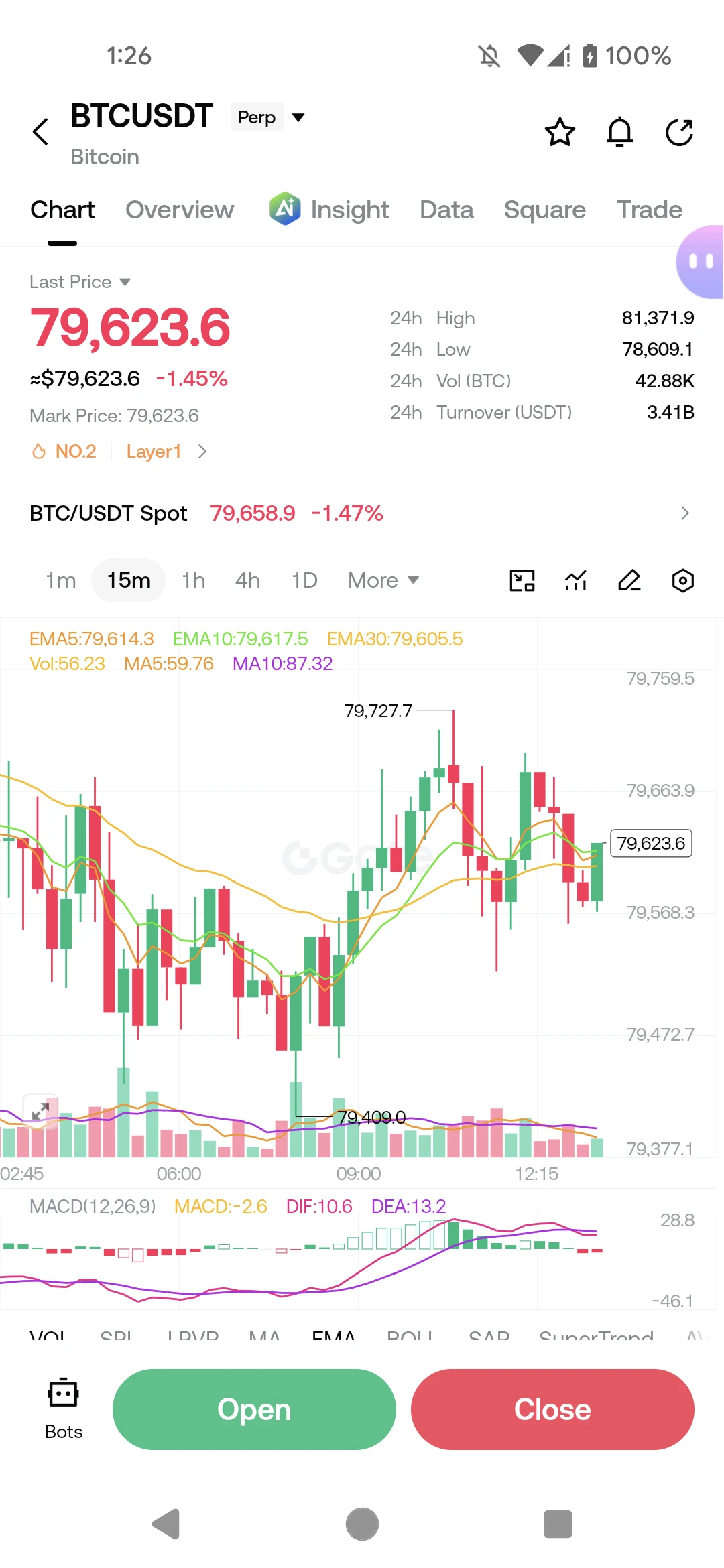
All EMAs are below the price—I know this script well. I’ll first place a bid at 79,600 to test the waters, set the stop-loss, and go to sleep.
CryptoJourney1
"Hey everyone, $BTC ‌ is testing a key support zone – I'm watching for a bounce!"
Bitcoin is down -1.45% at $79,623.6, holding just above the 24h low of $78,609.1. The EMAs are all clustered tightly – EMA5 at $79,614.3, EMA10 at $79,617.5, and EMA30 at $79,605.5 – price is above all of them, which is a bullish sign. MACD is slightly negative at -2.6, but DIF (10.6) is above DEA (13.2) – the gap is narrowing, suggesting bearish momentum is fading. Volume is declining, which often precedes a reversal. I'm expecting a bounce toward $80,000 and $80,500 if support holds.
Trading Plan:
· Entry: $79,600 – $79,650
· Stop Loss: $78,500
· TP1: $80,200
· TP2: $80,800
· TP3: $81,200
👇 Do you think BTC will bounce from here or break lower? Drop your view below!#GateEventContractTradeSharingChallenge
repost-content-media
To be honest, after playing DeFi for a long time, you end up with just one takeaway—don’t only look at how high the APY is being hyped; first check whether they’re actually planting anything in the “soil.” Lately, new L1/L2 projects have been throwing out incentives one after another, and old users have been complaining about “mine-and-sell.” That’s honestly normal—if there are no bugs in an empty field, who would believe it?
I usually judge a project’s trustworthiness with three checks—kind of old-school, but they work. First, open their GitHub. Don’t look at whether the code has loopholes; l
For the past two days, everyone in the group has been rushing to chase airdrops, paying interaction fees more diligently than buying groceries at a market. I’m not against doing it, but please don’t turn yourself into a miner—once your gas is used up and you check your wallet, you end up losing more than you received.
Let me share my own crude approach: set the budget in stone first. For example, use the money you would have spent on groceries to test—if you lose, just treat it as paying for someone’s meal. For new projects, just watch from the sidelines for the first two days, and see where o
Finally taking action? Wait and see.
CoinNetwork
Crypto news: On Wednesday, the U.S. House of Representatives passed the Stop Insider Trading Act, which would restrict members of Congress and their family members from buying and selling stocks. The bill passed 232 to 198, with 13 Democratic members voting in favor. Because some Democrats believe the bill is not stringent enough, divisions emerged within the party; another bill requiring members of Congress and their family members to sell their existing holdings did not advance to a full House floor vote. That bill will be submitted to the Senate for consideration.
To be honest, I’ve been a bit confused lately watching all kinds of group discussions about block builders and bundles. As for the technical details—whatever ordering strategies, MEV extraction—retail users really don’t need to understand all that clearly.
Do you know how to grow vegetables? You just need to know that fertilizer can make the vegetables grow faster—you don’t have to figure out the amino acid synthesis pathway. In any case, that’s how I feel: it’s enough to know that this kind of thing exists, that on-chain front-running does indeed happen, and that transaction order can be manu
My phone just popped up another staking unlock reminder—there were a bunch of red dots. I tapped in and, sure enough, it was another project about to unlock how many ten-thousands of tokens. Honestly, whenever I see this kind of “countdown calendar,” I get chills. Back then I’d run after it, and after chasing one I’d get cut; then after clearing the pop-up I’d rush to rotate positions, only to get slapped in both directions.
Now I’ve learned my lesson: I’ve turned off most notifications, and I only keep a few pools where I grow my own crops. The hot topics rotate in and out—anyway, since my fu
I just watched on-chain transfers for a bit, and then I saw a bunch of people follow whales as they shift their positions, calling it “smart money.” Honestly, it’s really easy to get antsy—put bluntly, it’s the mindset of “someone else cut the line and profited, and I want to cut in once too.” That whole MEV sorting privilege is like a market where someone slips money to the stall owner so they can get to pick the best vegetables first; retail traders just stare on helplessly. What I’m getting antsy about isn’t really wanting to front-run—it’s seeing that the people who cut the line really do
Just staring at my positions, those numbers of unrealized losses are so much more unsettling than the occasional gains—enough to keep me from sleeping… Even gardening is like that: when the seedlings turn yellow, my heart feels clogged up, but once they finally grow, I end up thinking, “It’s the way it was always supposed to be.” That “loss aversion” thing—plainly speaking—is that my brain’s reaction to “losing” is several times stronger than its reaction to “getting.” I know full well that all I have to do is hold, but I can’t stop myself—I keep checking the price chart, wanting to tinker.
La
Just finished looping through the on-chain activity and had a bit of a feeling. AI Agents are getting more and more capable now—automatically sowing, harvesting, and even monitoring when gas fees are low to execute trades for you. It looks pretty worry-free. But honestly, there are still several places where humans are needed to backstop things—for example, risk-control parameter settings. If you don’t set your slippage or approval limits correctly, no matter how smart the AI is, it can’t save you. Also, if you run into contract vulnerabilities or extreme market conditions, the machine may stu
Last week I went over to AAVE again and cast another round of delegated votes—over a million votes. My hand was sore from clicking when I was done. Now, can you guess what happened? The votes held by the whales are still firmly pressing down on everything. In plain terms, these governance tokens are like the corn in the vegetable patch—the way they grow is determined by the whales’ rainwater. I can’t really say who this “governance” is actually governing. Anyway, every time I plant my vegetables and then go check the voter turnout, it’s always a bunch of big fish floating around, while the lit
AAVE+1.12%
ETH-0.50%
These past few days watching the charts, I feel a bit dazed. Posts that put ETF fund flows and U.S. stock risk appetite in the same conversation have been flooding the feed—like everyone’s nerves are stretched tight too. In a market where liquidity is drying up, to be honest, “buying the dip” is a tempting trap, but there might be traps inside the trap.
My own simple, down-to-earth way is: don’t think first about how to make money—think about how not to lose. Stack a few stablecoins in your wallet, place a handful of low-valued limit orders, and then manually go dig up some “safe pool” vegetab
Just saw a chain game mining pool—its output collapsed straight away, and the price dropped even faster than the price of vegetables. To put it simply: inflation is too brutal. The output is so excessive that nobody is willing to take the bags anymore. Everyone wants to cash out and run quickly, and as the pool is mined, it keeps getting shallower.
It’s like growing vegetables: the soil fertility is limited. If you only scatter seeds and don’t fertilize, the roots eventually rot too.
These days, cross-chain bridges have been getting stolen again. The oracle reported an abnormal price, and the
I just saw someone in a group chat reposting “a whale address is moving—it’s going up”... honestly, with all the on-chain automated block-scanning and test transfers right now, the smart money won’t let you see through it at a glance.
Back to the main point—how do you tell whether a DeFi project is reliable? You don’t necessarily need to know how to write code. My few “dumb” methods are: first, check GitHub—there should be at least some code submission history; don’t have only an empty “shell” repository. Then check audit reports—go to the audit firm’s official website to find them; don’t trus
Just got stuck in the mempool for half an hour—watching gas rocket up, and the transaction still wouldn’t confirm after ages… that feeling is like lining up to water a vegetable plot: someone cuts the queue and then goes wild throwing money around 😅. To be honest, I don’t regret the outcome (I ended up paying a bit more gas), but not setting up max fee in advance, or avoiding peak times. With so many phishing links out there and hardware wallets being out of stock, everyone now has to get the basic operations right first—learn how not to get fleeced when queuing, then talk about everything el
In the early hours, a little after 2 a.m., I was scrolling and came across that whole cross-chain bridge situation, and then saw a few groups shouting, “It’s a good chance to buy the dip after the oracle anomaly.” My hands were itching so badly—I almost clicked buy. Later I forced myself to drink a glass of cold water and cooled down. Honestly, I don’t even know whether that impulse was because I saw the update and was afraid of missing out, or because I truly felt confident. Anyway, I’ve learned my lesson for now. First question: is this position driven by confidence from information, or by e
Today my coffee cools down especially fast—just like on-chain earnings: you only just taste the sweet benefit, and then it turns cold… But lately I’ve found that this modular blockchain stuff doesn’t really feel any different to end users—kind of like swapping out the dirt for something more breathable for growing vegetables. You still sow the seeds and deal with pests, but the harvest is more stable. Back then I was messing around with RWA and U.S. Treasury yield things; now on-chain yield products are starting to get compared alongside traditional U.S. Treasuries too. Honestly, the yields ar
RWA+0.14%
Just took a look around the Layer2 space—people are still comparing TPS and fees. Honestly, it’s pretty annoying. For someone like me with small funds, I’ll just use whichever is cheaper. I’ll take whatever ecosystem incentives I can and then bolt—this isn’t farming, so I don’t need to keep staring at it like you’re watering every day.
Lately, I’ve been thinking about putting RWA on-chain. It looks like liquidity is great—almost like the real thing—but if you read the redemption terms closely, some have lock-up periods, and some require KYC with a long line to get through. In plain terms, it’s
I was just looking at a few restaking projects—the yield sources are actually pretty straightforward: staking rewards from the underlying nodes, plus extra incentives provided by the upper-layer protocol. In plain terms, it’s one layer wrapped in another—each layer gives you a little sweetness, but the risks stack up too: smart contract vulnerabilities, node penalties, liquidity locked up… It’s not like planting a crop and just watering it; you have to keep an eye on the status from time to time.
Recently I’ve seen a few new L1/L2s rolling out incentives—TVL shot up fast—but long-time users ar
Lately, a lot of people have been talking about NFT royalties and creator income. After looking around, I feel it’s the same as social mining and farming points—everywhere is “badges,” “levels,” and “identities,” and it makes you itch for them. Honestly, don’t drain your time for just a few virtual badges—I’m a cautionary tale. A while back, I rushed to get an “early contributor” badge; I didn’t even have time to think about my mining strategy. I just pushed several transactions during the highest gas fee period. Looking back, I really lost big.
In fact, DeFi is like farming: sowing, pest cont