TokenomicsMechanic

vip
Active for: 0.4y
Peak Tier 0
Dissecting a token model is like fixing an engine: you need to consider release, buyback, and incentives. The worst thing is relying on passion alone.
Low-risk arbitrage has become harder to do, which instead suggests that the Bitcoin market is becoming more mature: with easier money becoming less available, capital can only work more intelligently.
BTC0.58%
View Original
DanniéX
Most traders focus on price.
Smart traders watch the spread.
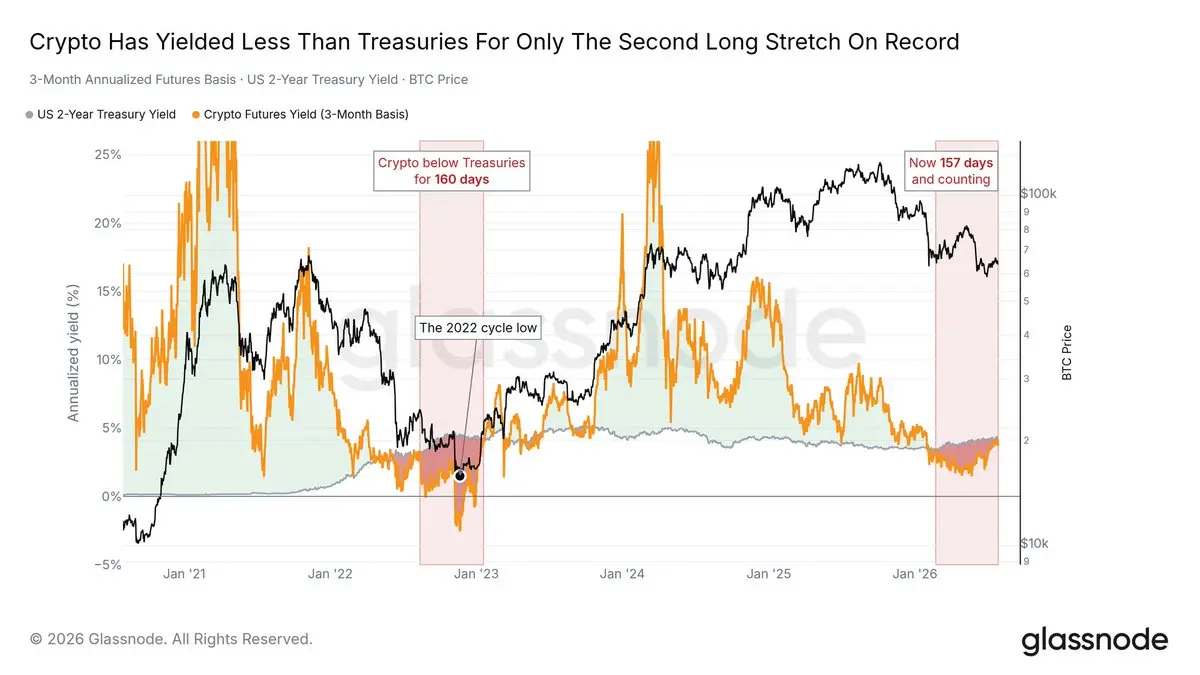
Right now, the 3-month $BTC futures premium has stayed below 2-year Treasury yields for over five months—an uncommon signal.
That reduces the appeal of low-risk arbitrage, leading to lighter leverage and slower derivatives activity.
At the same time, it shows Bitcoin's market is becoming more efficient, where easy returns are harder to find and capital has to work smarter.
Less easy money. More mature markets.
#GateReserveRatio117% #BitcoinSmallTransfersHitPostFTXHigh
repost-content-media
  • Reward
  • Comment
  • Repost
  • Share
Just checked the on-chain mempool and it’s completely jammed—gas is skyrocketing. Honestly, whenever I watch those token models patch and tweak things, it usually doesn’t feel as intuitive as it does when you actually end up in a queue: the fee you set is like an auction bid. The people who are in a rush keep cranking the price higher and higher, while the ones who aren’t can only stare blankly as your transaction just sits there, bubbling away in the mempool. If back then I had set a low gas to “run the deal,” I’m guessing I’d still be stuck in the pending pool, collecting dust.
Lately, haven
View Original
  • Reward
  • Comment
  • Repost
  • Share
After scrolling for a while, I realized that many projects are doing PFPs and memberships. In essence, they’re just selling “social entry tickets.” Put plainly, it’s a traffic business: first they capture a wave of attention, and as for how the tokens will be released later or how buybacks will work—looks like they haven’t thought it through.
I’m more of a slow burner, and I don’t really chase hot trends. So when I see something that starts by dumping a bunch of NFTs and urging you to buy right away, I always feel a bit uneasy. For long-term value, you need to see whether the brand actually ha
View Original
  • Reward
  • Comment
  • Repost
  • Share
Honestly, I also joined in a few times when that Meme wave was at its liveliest. But now I’m increasingly feeling that even if the narrative blows up, there has to be a stop-loss point. I’m not saying you have to be ruthless and cut. You just need to think it through: are you betting on emotion, or is there really someone willing to be the next buyer?
Social mining and fan tokens—plainly put, they’re all part of the attention economy. But the shelf life of attention is even shorter than fruit. I’ve read a lot of tutorials: everything from technical indicators to on-chain analysis. Still, hones
MEME-0.76%
View Original
  • Reward
  • Comment
  • Repost
  • Share
I just came across a guy complaining. He said his restaking position shows the earnings are going up, but when he tried to make a move, he couldn’t get it to execute for half a day. In the end, he found it was a delay on the node side. Honestly, this is pretty common.
I’ve run into it a few times too—on-chain data being delayed isn’t unusual. For example, with the RPC node you see, sometimes it’s because the cache or the index hasn’t finished running. You panic and think the transaction didn’t go through, but the chain has already confirmed it. Last time, this almost made me resend a transacti
View Original
  • Reward
  • Comment
  • Repost
  • Share
To be honest, I tried a few address profiling tools recently—looking at label clustering and fund flows—and it still feels like there’s quite a bit of “water” in the analysis. Some addresses look spotless on the ledger at first glance, but if you dig into where the funds actually go, it’s all that kind of token shuffling back and forth between new accounts… you know the drill. Even though the AI Agents are getting a lot of hype and automated trading runs fast, as far as on-chain security goes, I just feel that there aren’t many teams that really obsess over the details. How much can address pr
View Original
  • Reward
  • Comment
  • Repost
  • Share
Over the past couple of days, reading the team’s financial reports has gotten a bit overwhelming for me. To put it plainly, there’s one thing I really care about: whether the project team’s spending pace matches the milestones they keep talking about. I’m not just looking at how much they spent today—I’m looking at whether, after spending it, they actually built the walls that needed to be built and ran the tests that needed to be run. You can just say, “We have money,” but where did the money go? Did they hire people to genuinely write code, or did they dump everything into point expectations
View Original
  • Reward
  • Comment
  • Repost
  • Share
I just glanced at my wallet and suddenly remembered something: contract approvals with unlimited amounts—this is really like not locking the door before bed. It looks fine, but it still doesn’t make me feel at ease.
After a few recent cross-chain bridges were stolen and oracle quotes went abnormal, everyone only then realized that confirming consensus is actually pretty important. But many people’s approvals are still set to unlimited. If a protocol gets hacked, or contract permissions are abused, your money could be drained overnight.
I, for one, always go revoke after using a new protocol. T
View Original
  • Reward
  • Comment
  • Repost
  • Share
Recently when I opened groups and Twitter, it felt like everyone was discussing whether, after a certain public chain upgrade, projects would migrate. All kinds of PFPs, membership cards, and brand “team-up” posts got spammed through another round of hype. Honestly, it gets a little exhausting to keep seeing it. You click on someone’s profile signature and they hype the community’s value like it’s real.
Sometimes I think: pause. Don’t rush to follow. The public chain upgrade is making all the noise, but when you break down those so-called “long-term value” token models, how many of them can tr
View Original
  • Reward
  • Comment
  • Repost
  • Share
To be honest, after talking about modularity for so long, what has it really changed for end users? In my view, in day-to-day interactions there hasn’t really been any obvious leap you can see with the naked eye. Back then, one L1 could handle everything—now it’s broken up and outsourced, but don’t users still have to connect to different RPCs and put up with all those bridges going back and forth? The experience actually adds a few extra steps, and if something goes wrong, you still have to figure out which layer failed.
Recently I saw news about a certain region raising taxes and tightenin
View Original
  • Reward
  • Comment
  • Repost
  • Share
Yeah, a lot of people are always talking nonstop about how cheap Layer 2 is, and how clogged the mainnet is. I get it, I get it.
But honestly, lately I’ve been looking at that staking unlock calendar, and there are a bunch of people there calculating sell-pressure anxiety—now it’s got me annoyed too. You know, I don’t even make many transfers day to day. I moved to Arbitrum to save on a bit of gas, and the experience wasn’t that smooth either. Sometimes after bridging back, I have to wait for half a day.
Anyway, I’m doing things based on the situation now. For small liquidity operations, I’d r
ARB-1.37%
View Original
  • Reward
  • Comment
  • Repost
  • Share
I had some time and thought it through again before re-staking this thing. Logically, it’s pretty smooth—shared security, basically bundling a few pieces of wood together and using them as a column rather than relying on a single one. But the problem is that when many people hear “stacked/combined rewards,” they get excited and start treating the wood like gold bars. The risks are compounded too: once something goes wrong with the underlying layer, all those points, expectations, and testnet incentives on top will collapse with it. Lately I’ve been seeing people trading points and expectations
View Original
  • Reward
  • Comment
  • Repost
  • Share
Just saw that wave of blockchain gaming—quite a few project tokens had serious inflation. Once the studio exited, the price just spiraled down. It’s really the kind of “go all in” moment—brothers who did it are probably not sleeping soundly right now.
Actually, grid trading and DCA are like using a dull knife to cut your losses, but the upside is that it lets you sleep easy. Going all in may be exciting, but at night you end up tossing and turning, wondering whether you’ll be liquidated—so you end up even more exhausted.
Anyway, I’m the type who warms up slowly, so I’d rather start with DC
View Original
  • Reward
  • Comment
  • Repost
  • Share
Just watched a few whale addresses, and it’s kind of interesting.
I feel like some people, the moment they see a large deposit, they rush to follow. But you really need to first check whether the address is accumulating positions or hedging. For example, if an address suddenly sends a bunch of tokens to a CEX, it doesn’t necessarily mean they’re going to dump them—it could also be taking leverage and hedging for protection. Either way, I’ve learned to be smarter lately: first look at the collateralization ratio in the on-chain lending pool, then decide whether to act or not.
Speaking of that,
View Original
  • Reward
  • Comment
  • Repost
  • Share
Lately, I’ve been watching whale wallets on-chain a bit too intensely. There’s an address that, over the past week, has been continuously adding ETH into a certain trading pool—on the order of a few tens of millions—seemingly like accumulation. Later, I found that it was also opening an equal amount of short positions in another protocol, and it even sent a small amount to a mixer contract. This isn’t setting up a position at all; it’s clearly hedging plus hiding. Before following the crowd, you really need to figure out what it’s actually doing—otherwise you’ll charge in while treading on the
ETH0.11%
View Original
  • Reward
  • Comment
  • Repost
  • Share
I’ve been watching those on-chain big transfers lately, and I’ve got a little hooked—people call it “smart money,” but to put it bluntly, isn’t it just that a big wallet moved a bit, so that’s “smart”? I’ve pulled apart the code of several mining models and found that a lot of the points and badge designs are basically no different from the way exchanges’ hot and cold wallets move—signals that are manually produced. I was even dumb before: I grinded for two straight weeks just for a golden badge, then I found that if the pool’s release rate is adjusted, the points I’d saved immediately shrink
View Original
  • Reward
  • Comment
  • Repost
  • Share
Social mining, honestly—it gets a little tiring once you’ve been at it for a while. You stare at that points leaderboard, every day checking in, doing tasks, grabbing badges, and in the end you realize that, aside from a virtual identity, nothing really gets left behind—plainly speaking, it’s just working for a membership card that won’t make you any money.
After a few recent cross-chain bridges ran into trouble, everyone’s started getting used to “waiting for confirmation.” Even if an oracle reports an abnormal price, people still want to watch for a few days first. In fact, that same logic a
View Original
  • Reward
  • Comment
  • Repost
  • Share
Is sandwich arbitrage really an opportunity? Think about it: every cent you make might be someone else overpaying in slippage. Put simply, it’s just fees repackaged. That recent NFT royalties flame war also made me pause—creators want income, and the secondary market needs liquidity; both sides fight hard, but in the end, don’t retail traders still end up paying the bill? It’s the same as sandwich trading: what you see is profit, while others see your trading fees. Anyway, I’m pretty particular—every time I see an arbitrage opportunity, I calculate gas and slippage first, so I don’t end up as
View Original
  • Reward
  • Comment
  • Repost
  • Share
Just looked at a round of delegated voting data, and honestly it’s a bit heartbreaking. Governance tokens are, in essence, voting power—but big whales and institutions have taken up most of the seats through delegated voting, while retail votes are basically just air. If this keeps going, won’t governance just turn into an internal game for a few big players? I’m really tempted to patch things—small fixes or tweaks might delay the problem, but the core structure is hard to change. Privacy coins and mixers are similar: the regulatory boundaries are being pulled and torn a lot, yet some projects
View Original
  • Reward
  • Comment
  • Repost
  • Share
Can RWA on-chain really solve liquidity problems? …Forget it—no rush to reach a conclusion. I’ve looked at a few recent projects, and it feels like the redemption terms are the real bottleneck. Moving assets on-chain is easy, but when you want to convert those on-chain tokens back into the underlying assets, the terms are full of traps—things like lockup periods, minimum redemption amounts, and redemption windows. One slip, and you’re trapped. To put it plainly, it’s just a liquidity illusion; when you truly need money, you still have to look at someone else’s mood.
Recently, hardware wallets
View Original
  • Reward
  • Comment
  • Repost
  • Share
  • Pinned