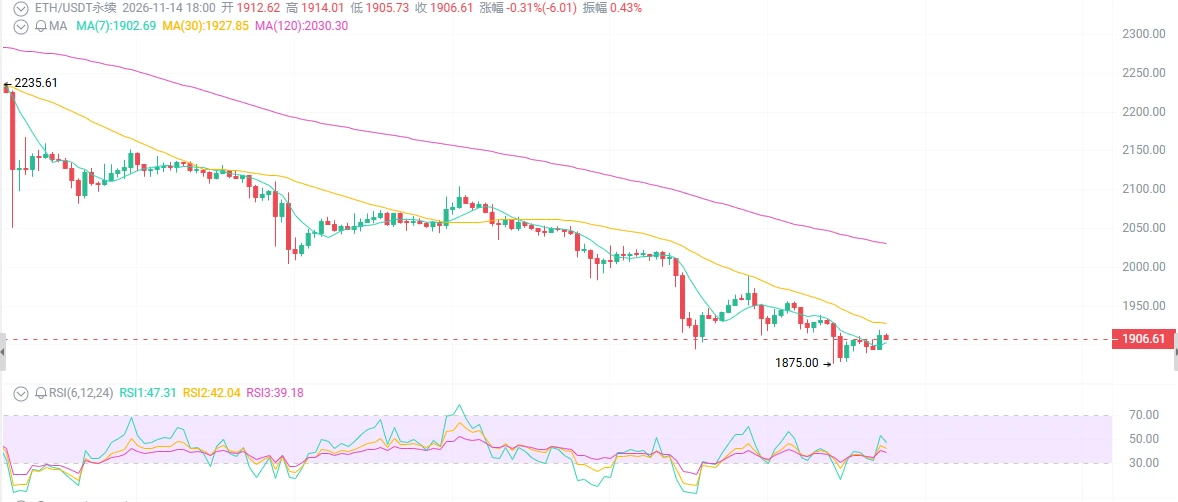
ETH at $1906—are you panicking?
RSI has plunged to 23, down over 15% in 7 days, ETFs are seeing outflows, the Foundation is selling, and an upgrade has been delayed—but just as everyone is calling ETH garbage, the amount staked has hit a record high, with 43.6 million ETH locked on-chain. Is this the final dip, or is the abyss only just beginning?
First, the surface: it’s all bad news, each item more painful than the last.
The price has fallen below $2000, the “ironclad floor” everyone believed in, and is now at $1906. It’s down 1.5%-4% in 24 hours, over 15% in 7 days, and over 20% in 30 days. The daily moving averages are bearishly aligned, with the 200-day moving average overhead above $2100—a typical weak consolidation after breaking down from a descending channel.
The daily RSI is 23, Stochastic is extremely low, and the price is hovering near the lower Bollinger Band—technically, this is called “severely oversold.” Historically, every time it reaches this level, a rebound follows.
The question is: a rebound or a reversal? They’re two different things.
First: everyone is running, but one group isn’t budging.
ETFs are seeing outflows. On November 11, daily net outflows were $145 million, with cumulative outflows of hundreds of millions over the surrounding days. Wallets linked to the Ethereum Foundation sold about 4,000 ETH in November, with 2,000 swapped directly for stablecoins.
Sounds like the end of the world?
But look closer: staking has hit a record, with 43.6 million-44.5 million ETH locked on-chain, accounting for over 36% of the total supply, and nearly 800,000 active validators.
In plain English: short-term capital is fleeing in panic, while long-term holders are sitting tight.
Second: Glamsterdam has been delayed, but this isn’t the first time ETH has been “late.”
Technical issues came up on the upgrade testnet, and the mainnet date is still undecided. Sentiment has taken a hit in the short term—people were counting on the upgrade to drive a rally, but now it’s been postponed.
But think back:
How many times was ETH’s Merge delayed? How many times was the Shanghai upgrade delayed? Every time, people shouted “ETH is finished,” and every time, the price spoke for itself after the upgrade went live.
ETH’s problem has never been that it’s “slow”—it’s “slow, but it doesn’t die.” L2s are still running, active addresses are holding steady, and staking is still setting records. A one-month delay to the upgrade doesn’t change the underlying fundamentals.
The real problem isn’t ETH itself; it’s the macro environment.
Third: macro conditions are draining liquidity, and ETH hurts more than BTC.
PPI/CPI are hotter than expected, expectations of a December Fed rate hike are rising, the dollar is strengthening, and real yields are climbing. U.S. stocks’ AI sector is wobbling, geopolitical tensions are flaring, and risk-off sentiment is in control.
What is ETH, in terms of its characteristics? A growth stock + tech stock + high-beta asset. When interest rates rise, it falls harder than BTC. It’s not ETH’s fault; it’s determined by its “nature”—it surges harder than BTC on the way up and suffers more than BTC on the way down.
In a bull market, ETH is your money-printing machine; in a bear market, it’s your meat grinder. Same coin, two different lives.
The bull-bear showdown: judge for yourself
On one side:
RSI at 23, severely oversold, with strong demand for a technical rebound
Staking at a record, with 36% of supply locked
Institutional tokenized funds continue to advance (Baillie Gifford, Deutsche Bank)
Cumulative ETF net inflows remain positive
1800-1830 is a strong historical support zone
On the other side:
ETFs have seen sustained net outflows recently, with institutions retreating in the short term
Foundation-linked wallets are selling
The Glamsterdam upgrade has been delayed, removing a short-term catalyst
Macro conditions are hawkish, and December rate hike expectations are weighing on risk assets
Hundreds of millions of dollars in long positions have been liquidated, and sentiment is in “extreme fear”
2000 has turned from support into resistance; the psychological level has been lost
Key levels
Resistance above: 1920-1950 (short-term rebound target) → 1980-2000 (former support turned resistance) → 2050-2100 (200-day moving average)
Support below: 1870-1890 (recent low) → 1850-1860 → 1800-1830 (strong support) → 1750 (extreme case)
Trading strategy
Short-term traders (1-3 days):
Try a small long position in the 1870-1900 range, with a stop-loss at 1860 and a target of 1920-1950, selling half first. If the price can’t break above around 1950, consider reversing into a short. If it breaks below 1870 on high volume and confirms, enter a small short position, targeting 1830-1800, with a stop-loss above 1900.
Swing traders (1-2 weeks):
A rebound into the 1950-2000 resistance zone is a place to sell into strength or go short, with a stop-loss above 2010-2050 and a target of 1850-1800. If it drops to around 1800 and volume contracts while the RSI diverges, consider building a medium-term long position. The bearish outlook currently has the upper hand, so don’t rush to buy the dip.
Long-term believers:
Accumulate spot or use low-leverage dollar-cost averaging in the 1600-1800 range, betting on the scarcity value of staking + institutional tokenization + the ecosystem’s long-term value. But remember—wait for macro clarity before taking a large position; for now, it’s only suitable for “sowing seeds,” not “going all in.”
What does ETH look like right now?
Like June 2022, that summer after it fell below 1000. Everyone was saying “ETH is dead,” the RSI was on the floor, there were no ETFs, no upgrade, and the macro environment was hiking rates.
And then?
A year later, it went from 880 to 4000.
I’m not saying this time will definitely be the same. I’m saying:
ETH won’t die, but people holding it often die from their own emotions.#黄仁勋辞职 #Gate直通IPO第三期Anthropic #Dr.Han牛津辩论社演讲 $BTC $ETH $AKE