Square
Following
Hot
News
Profile

TVBee

vip
Active for: 7.5y
Peak Tier 5
No content yet
0
Following
48
Followers
416
Liked
Trump pushed the issue of rising long-term Treasury yields onto Biden, and he may not simply be making excuses
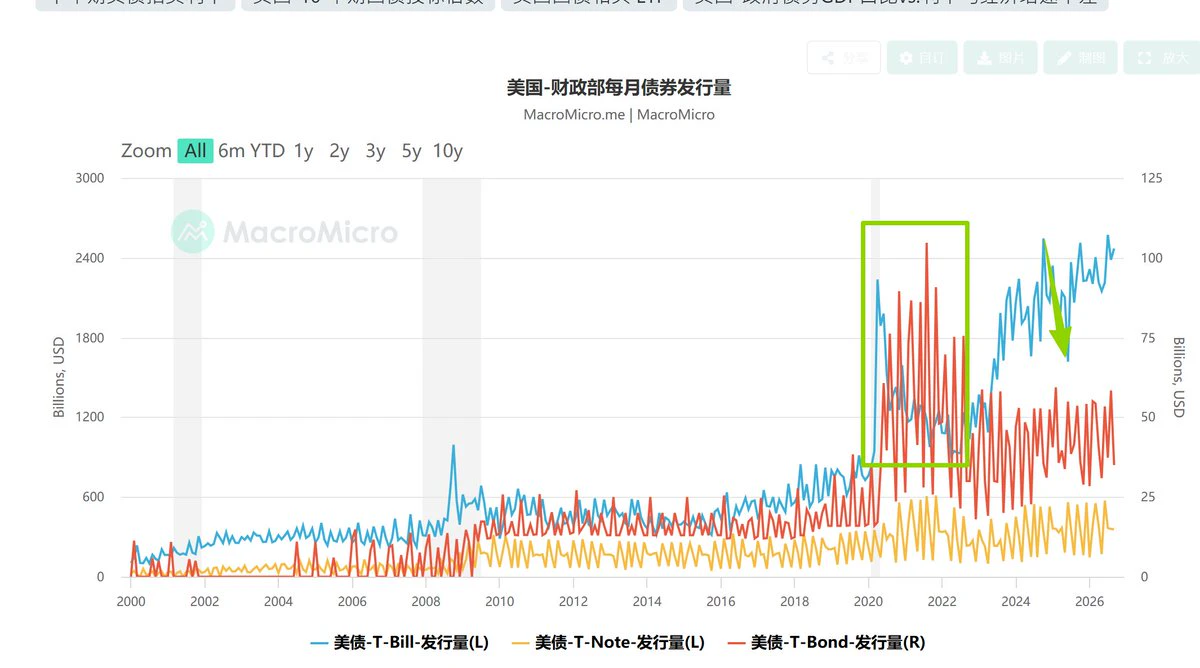
During the pandemic, the U.S. government sent money directly to American citizens several times, with the funds apparently coming primarily from revenue generated by issuing additional U.S. Treasuries.
┈➤Short-term U.S. Treasuries
T-Bill on the chart refers to short-term U.S. Treasuries with maturities of up to and including 1 year. A large number were issued from around April to December 2020, after which issuance returned to normal levels. This was during the Federal Reserve’s
post-image
DOGE+1.95%
Trump renaming AI as SI was absolutely not a spur-of-the-moment decision.
This industry may have a bearing on America's national destiny. The problem the United States is facing now is its national debt.
There are two reasons behind the rise in Treasury yields:
The first is inflation expectations, especially since long-term Treasury yields are linked to inflation expectations. As the dollar depreciates in the future, Treasuries will naturally depreciate as well.
The second is that the national debt is expanding too quickly, while domestic and international demand for Treasuries cannot grow by
post-image
  • 1
The dilemma facing Trump
Although the main forces within the Department of Defense support Trump, the budget for military spending requires a vote in both chambers.
The fiscal budget for FY2026 is $1.64 trillion, including a defense budget of $903 billion.
Trump’s proposed total fiscal budget for FY2027 is $1.814 trillion, including a defense budget of $1.5 trillion, an increase of approximately 50% from the previous year.
FY2027 has already begun. Since both chambers previously failed to approve it by a substantial majority, a stopgap budget based on the FY2026 budget level is currently in ef
PCE data came in below expectations across the board—take the bullish boost for now
┈➤PCE came in below expectations across the board
◆August core PCE year-over-year: 3%, below expectations (3.3%) and unchanged from the previous reading;
◆August core PCE month-over-month: 0.2%, below expectations (0.3%), but higher than the previous reading (0.1%);
◆Q2 core PCE: 3.3%, below expectations and the previous reading (3.6%). The final GDP price index was 6.3%, also below expectations and the previous reading (6.4%). The conclusions are consistent under both measures: Q2 prices were lower than expect
post-image
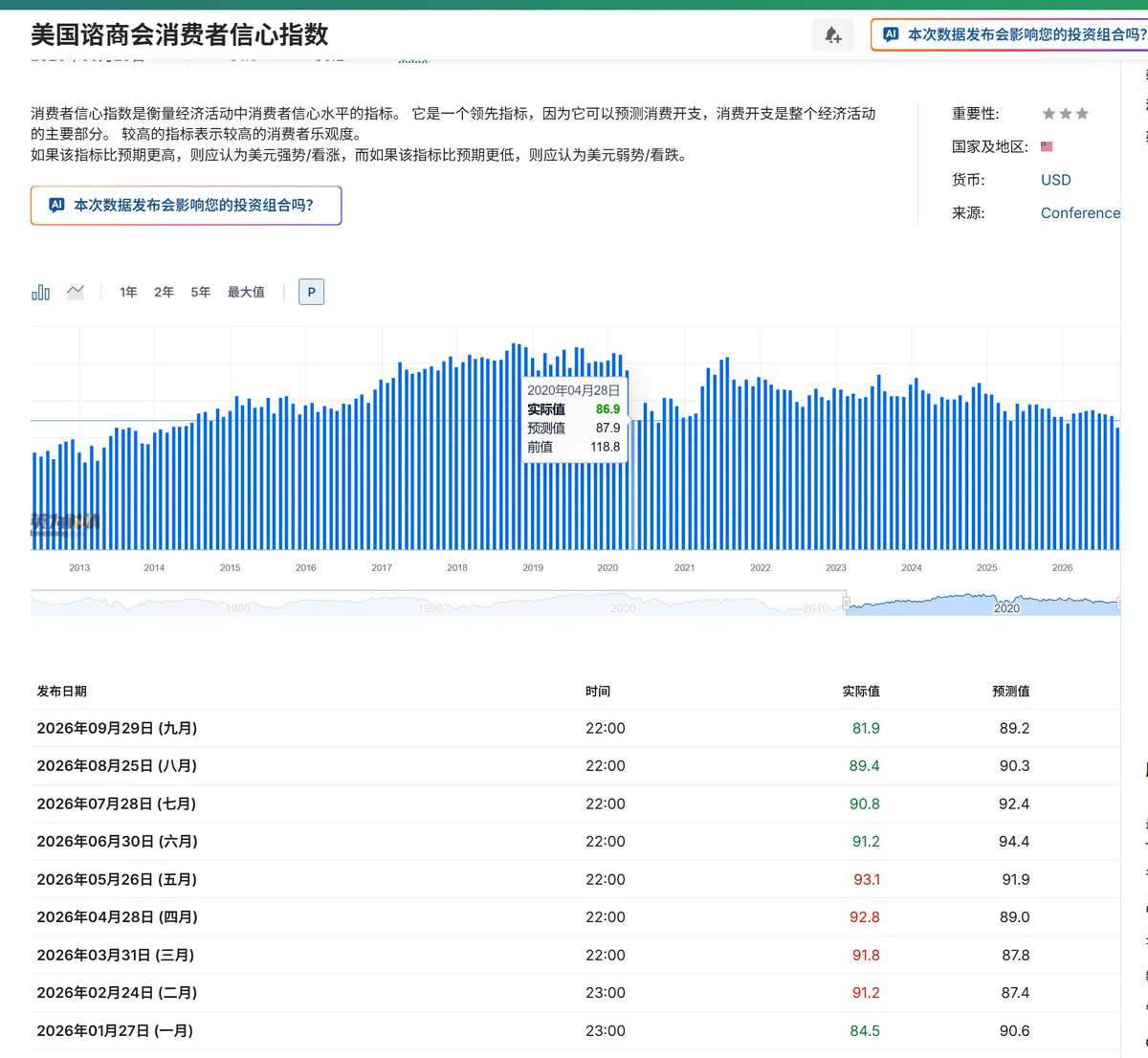
This should count as positive news, right? The September consumer confidence index hit a 12-year low.
The Conference Board Consumer Confidence Index came in at 81.9, far below 89.2, marking the lowest consumer confidence level since March 2014.
Even during the COVID-19 pandemic in 2020, it was somewhat higher than it is now.
The previous reading was also revised from 89.4 to 88.6.
This means demand is weakening, which can partially offset the impact of rising oil prices on inflation. September’s CPI may be somewhat stronger than expected; we will have to wait and see the wage data released on
post-image
Maitong’s Mid-Autumn gift box includes mooncakes, a small musical instrument, and a moon lamp.
Inside the lamp, floating particles form a mountain scene, and it looks quite nice displayed at home.
Thanks, @MSX_CN @BeliaSchoo91221!
The Chinese-speaking region should still be in holiday mode. The Mid-Autumn Festival holiday has ended, but the National Day holiday is only 3 days away.
Happy holidays, everyone—relax and recharge well!
Honestly, I’ve never seen a bull market that didn’t begin with BTC and USDT’s market cap rising together.
BTC is showing signs of a breakout now, but USDT’s market cap shows no signs of starting up, appearing unusually calm.
The biggest characteristic of this bear market is that it fell incredibly fast, while its sideways consolidation has dragged on.
Perhaps a longer period of sideways movement is needed to fill out the rhythm of the 4-year cycle?
BTC+0.12%
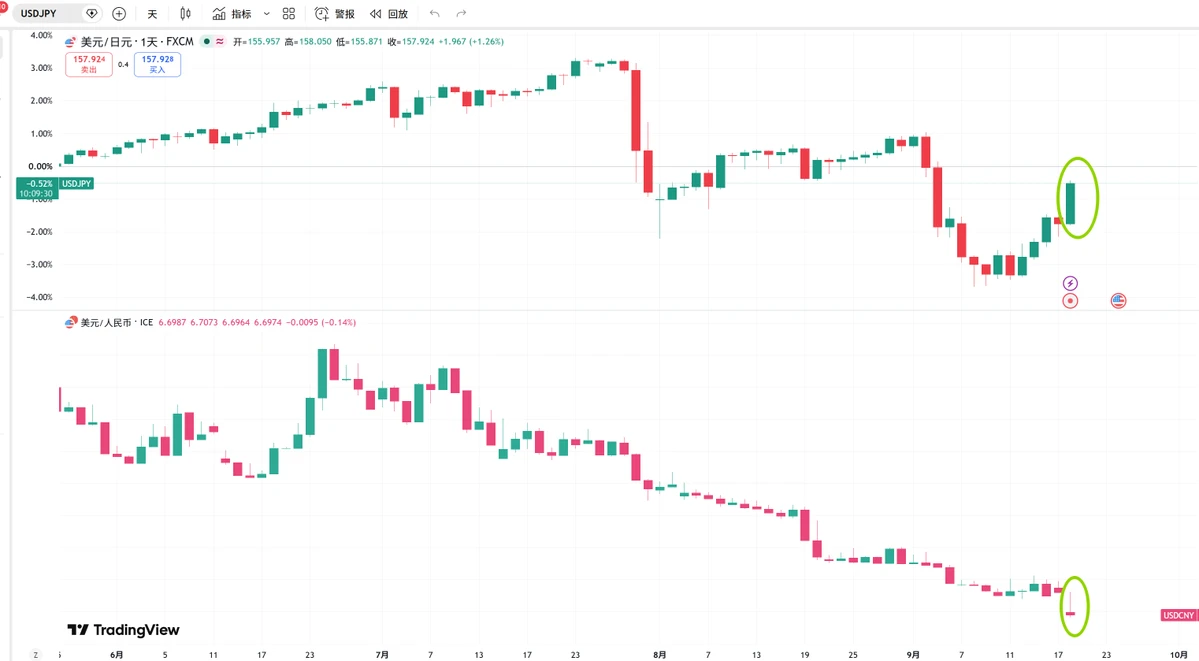
The Japanese yen fell, but the renminbi suddenly surged, breaking below 6.7.
For a moment, it was hard to tell whether it was the yen or the renminbi that had raised interest rates...
post-image
Great, the Federal Reserve has successfully demonstrated its independence and continued to disrupt market expectations with a slightly hawkish dot plot—as of the end of next year, it may raise rates 1–2 times
┈➤12:0 rate-hike decision
None of the 12 Fed officials showed any concern about Treasury yields, and none paid attention to Trump’s call for rate cuts…
Of course, officials are still concerned about the impact of rate hikes on the economy and employment. So the dot plot should be considered slightly hawkish, but not too hawkish.
┈➤Slightly hawkish dot plot
The dot plot has only 18 dots. W
post-image
The CLARITY Act procedural vote failed, but there is no substantive negative impact
┈➤There were actually 50 votes in favor, not 49
45 Democratic lawmakers: 1 abstained and 44 voted against.
2 independent lawmakers: both voted against.
53 Republican lawmakers: 3 voted against.
There were originally 49 votes against, but one Republican, Thom Tillis, changed his vote to oppose it.
Because the opposition had already exceeded 40 votes at that point, it was certain to be the winning side. Therefore, Thom Tillis changed his vote to oppose it, because only members of the winning side can initiate a "
Don’t overthink it! Even if the Crypto Clarity Act temporarily fails to pass tonight, BTC won’t see a sustained sharp decline.
It’s simple: BTC’s recent rise was not originally driven by the passage of the Crypto Clarity Act.
On the contrary, since July, @Polymarket’s predicted probability of its passage has been declining almost continuously.
If BTC didn’t rise on expectations that the bill would pass, how could it continue falling just because the bill temporarily failed to pass?
Interest rate hikes and the dot plot have a greater impact because they affect liquidity.
BTC+0.12%
The calls for the CLARITY Act seem to be getting a bit louder tonight. I’ll buy some Yes and have a little fun.
➘Although: Republicans may not be genuinely pushing for the CLARITY Act and could be doing so to win the votes of crypto voters.
➚However: Democrats do not necessarily have to oppose crypto voters.
➘Although: The two parties disagree over the CLARITY Act.
➚However: The SEC and CFTC are both technically providing support and assistance for the CLARITY Act.
➘Although: Once the House is “back in business,” only 4 days will remain.
➚However: If the Senate can pass the CLARITY Act, Trump
post-image
Whether to raise interest rates is no longer a mathematical issue, or even an economic one—it is a political issue.
Inflation and interest rates are not simply correlated. Inflation caused by oil prices is driven by rising costs on the supply side.
Raising interest rates cannot solve the problem. At most, it can suppress expectations of wage increases and prevent labor costs from rising, but high interest rates also increase companies’ financing costs.
All that can be said is that raising interest rates in response to inflation is directionally “correct.”
Especially during the midterm election
post-image
Here’s a pubic-hair theory:
Trump or the Republican Party may not necessarily be actively pushing the Crypto Clarity Act.
Could they simply be trying, during the midterm elections, to make American crypto voters and stakeholders resent or even hate the Democratic Party?
post-image