Sleepy0x13

vip
Active for: 5.3y
Peak Tier 0
No content yet
Zhang Yiming has become Asia’s richest person.
According to Bloomberg’s latest figures, 43-year-old Zhang Yiming’s net worth has surpassed $105 billion, overtaking Adani and making him Asia’s richest person for the first time.
When Bloomberg first estimated his wealth in 2019, it was only $13 billion. Seven years later, it has increased nearly sevenfold.
In the past, most of Asia’s richest people ran capital-intensive businesses. Adani operates ports, power, coal, and airports; Ambani runs energy, retail, and telecommunications; and Tadashi Yanai sells Uniqlo.
The most valuable assets Zhang Yi
Zhipu has directly raised its year-end ARR guidance from $2.4 billion to $3 billion, a 25% increase.
More astonishingly, its company-wide ARR has now reached $1.8 billion. In other words, over the next three-plus months, it still plans to generate another $1.2 billion in annualized revenue.
A key change is behind this upgrade. Zhipu has already signed revenue-sharing agreements with multiple leading domestic and overseas cloud providers, and the GLM series of open-source models will be deployed on overseas cloud platforms and sold as hosted APIs, with revenue recognition beginning in October.
ZHIPU AI+6.10%
A man's words are as deceptive as a ghost
Yesterday he was still saying they would hit the brakes, but how come GPT-6 Sol and Opus 5.2 are both set to launch this week today?
Looking back now, Meta may truly be the most underestimated winner in this AI cycle.
The model layer is increasingly becoming commoditized. OpenAI and Anthropic still have to keep a close eye on capability gaps every day, control their release cadence, and worry that open-source weights may catch up again someday.
Meta is in a much more comfortable position.
It may not need to come first on every model leaderboard. Once Agents truly start doing work for ordinary people, the advantage brought by Meta’s strength in distribution will become increasingly enormous.
If model capabilities continue to
META+0.71%
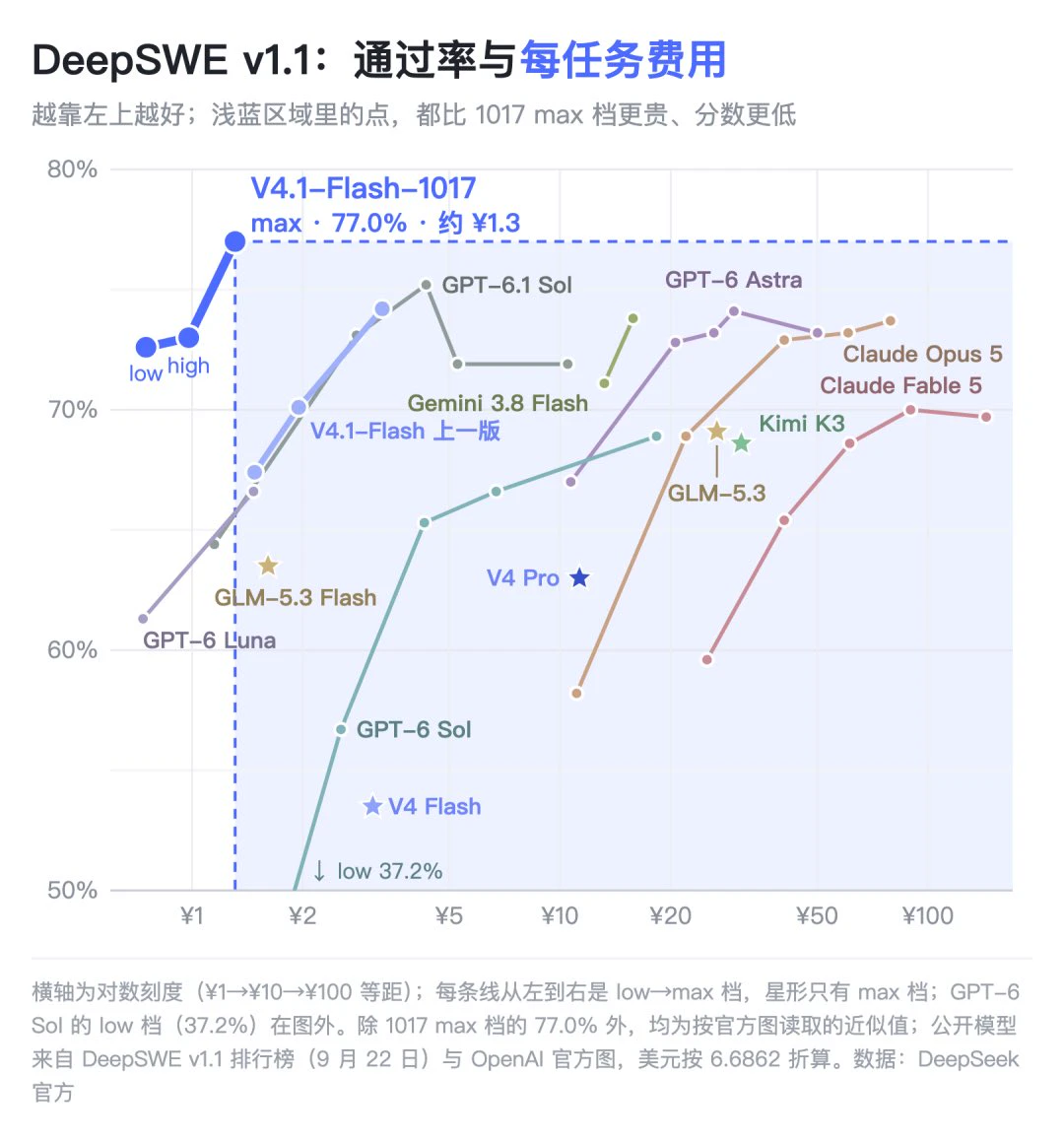
This should be the article I’ve read over the past few days that has affected me the most.
Liu Sheng, an operator engineer at DeepSeek, wrote a lengthy personal account. He said he wrote DeepSeek V4.1’s main Attention operator himself, but at the current pace, in another six months to a year, AI will most likely catch up with—or even surpass—his ability to write operators.
That isn’t actually the part that troubles me most.
A year ago, AI’s help to him was limited to looking up documentation, reading code, and finding bugs. Now it can read CUDA, PTX, and SASS on its own, analyze why each instr
DEEPSEEK-1.30%
The official desktop version of DeepSeek Harness has been merged into the main branch.
The current Desktop version is built with Electron, essentially packaging the existing Harness Web UI directly into a standalone app. Once it is ready for regular use, there will be no need to start a Web service or visit localhost yourself—just install it and launch it.
It also already appears to be fairly complete.
Builds for macOS and Windows are in place, along with macOS signing and notarization, Windows signing, automatic updates, version checks, and installation package uploads.
The latest few commits
post-image
DEEPSEEK-1.30%
Big tech companies keep competing to build workplace agents, only to wake up and find that Feishu has outflanked them.
post-image
  • 1
What OpenAI and Anthropic may really need to guard against in the future is not just customers switching models, but major customers directly buying GPUs and bringing AI back into their own data centers.
Latham & Watkins, the second-largest law firm in the United States, has already started doing exactly that.
The firm, which generated $8.3 billion in revenue last year, bought multiple Nvidia GPU servers and rented a closed-off area at an external data center that only its own employees can access. It has already purchased multiple H200s and is also researching Blackwell and Vera Rubin.
More i
NVDA+0.60%
MS-0.17%
Anthropic has recently been talking publicly about slowing AI down, yet it has now been revealed to have a $13.7 billion computing power deal, and the company receiving the money has remarkably surreal capital ties.
The Information’s latest disclosure shows that the previously unnamed $13.7 billion GPU customer of RUM Group is Anthropic.
The contract actually appeared in RUM’s SEC filing on August 23: 6 years and $13.7 billion, in three tranches to purchase GPU services at a data center in Maysville, Georgia. The third tranche still awaits the customer’s confirmation of the delivery date.
As t
post-image
USDT0.00%
If you haven't activated GPT Pro, I recommend doing so immediately.
For many tasks, there's no need to use Codex to consume credits calling Astra; just use Chat with 6 Pro, which is enough. You can use the saved credits for more important work.
Reuters reports exclusively that Anthropic is preparing a potentially record-breaking IPO, seeking to raise up to $100 billion at a target valuation of approximately $2 trillion.
NVIDIA is in talks to become an anchor investor, with its subscription potentially reaching as much as $10 billion. All of these figures are still under discussion, and the final plan could change.
NVIDIA was already one of Anthropic’s most important computing suppliers, announcing in 2025 that it could invest up to $10 billion in Anthropic; Anthropic also committed to purchasing $30 billion worth of Azure computing c
post-image
NVDA+0.60%
AMZN-2.01%
GOOGL-1.28%
Today, Zhipu is preparing another financing round, and it is very large.
The first part is the issuance of approximately 21.97 million H shares at HK$714 per share, representing a discount of about 10% to the reference closing price and raising nearly HK$15.7 billion, or $2 billion.
But that is only part of it.
At the same time, Zhipu is also preparing to issue approximately RMB20.14 billion in zero-coupon convertible bonds, worth about $3 billion, maturing in September 2027, with an initial conversion price of HK$892.5, 25% higher than the issue price.
Combined, the two offerings amount to ap
ZHIPU AI+6.10%
The future may really belong to the “hype dogs.”
I have a provocative take. The ability to generate hype will become the core competitive advantage of AI companies.
It may be more important than being six months ahead on the product or scoring a few points higher on some model leaderboard.
Let me start with why.
There is something very special about the AI industry: the shelf life of most advantages is simply too short.
A model may suddenly take the lead in Coding today, but its competitors will quickly catch up; a product may introduce a new interaction method, but as long as the market prove
I went back through Anthropic’s threat report from today from the beginning.
Among the malicious cases explicitly attributed by Anthropic, I did not find a single perpetrator explicitly identified as a US individual, US company, US government agency, or US organization.
The US certainly appears. But it appears as the target of attacks, the audience targeted by influence operations, the region involved in the data, or even simply the location of a US server used by the attackers. At least in the public text, the US never appears as a malicious actor named by Anthropic.
Now look at the actors An
BABA+0.10%
SENSETIME-1.21%
XIAOMI-0.65%
MINIMAX+0.80%
Suiyuan Technology is listing today, and the number most worth watching for this stock isn’t its $9.1 billion valuation, but its 4.16% public float.
This Tencent-backed AI chip company raised RMB 6.119 billion in its IPO, approximately $912 million, at an offering price of RMB 142.18, corresponding to a post-listing market cap of approximately RMB 61.2 billion, or around $9.1 billion.
But after the offering, its total share capital stands at 430 million shares, of which only 17.9 million shares can actually be traded in the market today.
The public float ratio is 4.1595%.
This makes Suiyuan’s
Looks like there’s no need to get a new phone after all.
post-image