Square
Following
Hot
News
Profile

AmberTeaSwirl

vip
Active for: 0.5y
Peak Tier 0
I like to view the market as a cup of tea: don’t rush to drink when it’s hot; I prefer a medium-term and grid strategy—slow but steady returns.
149
Following
10
Followers
1
Liked
I’ve been lurking in the group chat for several days, and finally felt like saying something.
RWA tokenization, bluntly put, is just taking things that exist on paper and putting them on-chain. But many people glance over the fine print in the redemption terms. Liquidity looks great on paper, but when a bank run hits, the on-chain funds arrive instantly while the off-chain legal process can hold you up for weeks. What kind of liquidity is that?
The cross-chain bridge and oracle issues lately are the same. Everyone in the group keeps saying, “Wait for official confirmation.” Didn’t we used to m
To be honest, I used to think that once royalties were written into a contract, they were locked in, and creators could keep earning from secondary sales forever. Later I realized that wasn’t how it worked: the market didn’t buy it and directly changed mandatory royalties to optional ones, yet just as many people kept going to the marketplaces. A beginner’s misunderstanding, I guess—thinking that putting something in code made it consensus. Now I understand that consensus only counts when all the markets recognize it.
Lately, people have kept asking which testnets have potential and whether po
I just saw someone arguing over “nested dolls” in restaking and shared security, which reminded me of something else: what exactly do cross-chain bridges trust?
Before talking about bridges, it’s worth first thinking clearly about where the message itself comes from, how it’s verified, and who packages it—the longer the chain of links, the more every step hides a “who do you trust?” question.
IBC’s design is relatively restrained: relayers only transport messages and don’t touch your assets. The actual verification takes place on the light clients of the two chains themselves. Put simply, what
What is this “time value” thing, is the buyer feeding the seller, or is the seller luring the buyer?
Basically, it comes down to this: an options buyer bets on direction and time, but every day you wake up, the time value is already shrinking—like hot tea cooling down drop by drop. If you can afford to wait, you can wait; the money, however, can’t afford to.
As for the seller, it’s more like selling you a service of “waiting.” They charge a premium and bet that you won’t rush to drink the tea before it gets cold.
Recently, when I look at those re-collateralization “nested doll” structure
The Fed’s move this time is very solid: it kept interest rates unchanged and continues to watch external price pressures. In plain terms, it doesn’t want to be led around by short-term data—it’s waiting for inflation to cool down on its own before taking action. This strategic resolve is worth pondering.
CoinNetwork
CoinJie News: Hodge, the former chief economist of the New York Fed, said that the Federal Reserve led by Chairman Jerome Powell will keep interest rates unchanged to observe whether the impact of external price pressures gradually weakens.
An industrial zone was hit by falling drone wreckage, and the name “Bashkortostan” took me three tries to say clearly—fighting has truly reached places that people would never normally pay attention to.
CoinNetwork
CoinWorld news reported that local officials said that wreckage from a drone crash fell within an industrial zone in the city of Salavat, in the Republic of Bashkortostan, Russia.
Gold falls below 4,000—geopolitics plus rate hikes are a double blow—and the market is once again pricing something in… what is it this time?
CoinNetwork
Crypto news, according to Gate data: spot gold continues to fall, breaking below the $4,000 per ounce integer level, for the first time since July 1. The intraday decline is more than 2.8%. Previously, U.S. President Trump announced that sanctions against Iran will be restarted, and Fed Governor Waller said that interest rates may need to be raised in the near term.
GLDX+1.30%
PAXG+0.96%
Geopolitical conflict → oil prices → inflation—this transmission chain is about to make risk assets shake again.
CoinNetwork
Crypto market news from CoinWorld reports that tensions in the Strait of Hormuz have driven crude oil prices higher, which may put pressure on the global economy, affect energy policy, and impact inflation rates.
The conflict between regulatory compliance and the philosophy of privacy will always be the hardest puzzle for crypto payments to solve.
CoinNetwork
CoinWorld news: A Strike user stated that after receiving a Lightning Network transfer of about $5 via Wallet of Satoshi, the platform requested the sender's name, warning that funds could be returned otherwise. The user questioned the requirement, saying it conflicts with Bitcoin's privacy principles. In response, Strike CEO Jack Mallers said: "Unfortunately, UK regulatory requirements force us to do this. It does not represent our values, but we must comply with local laws to continue operating in the UK."
NVIDIA Vera CPU is targeting $20 billion in expected sales revenue—Perplexity has jumped in first, and the AI agent race is about to intensify the competition for computing power again.
CoinNetwork
CoinJie.com News: Perplexity has purchased NVIDIA Vera CPUs to improve the speed at which AI agents handle tasks. NVIDIA expects that this product’s sales in this fiscal year will reach $20 billion.
Honestly, I used to find that pile of GitHub commits and audit reports overwhelming too — dense and like reading ancient scripts. Eventually, I found a crude method: first check the update frequency, then see if a well-known audit firm has stamped it, and finally glance at the multisig wallet address changes. At least these three things can filter out 90% of projects that are obviously slacking off.
The airdrop season has gotten so competitive lately; task platforms are getting increasingly aggressive with their anti-Sybil measures, and the points system feels like clocking in for work. I’m na
Wall Street is finally going to take ETH seriously, this combination is kind of interesting.
CoinNetwork
Coin World News reports that BitMine, Sharplink, and Joe Lubin have established a non-profit organization aimed at accelerating Ethereum's adoption on Wall Street.
ETH+0.58%
If Blackwell really can push NVDA to 400, then is adding to my position now considered buying the dip or chasing highs? I'm torn🤔
Original content no longer visible
NVDA-0.68%
Bain and ParaFi are both betting on it—this signal is clear enough: the on-chain yield infrastructure track is about to heat up.
WuSaidBlockchainW
Ground completes $3.6 million Pre-Seed round, offering on-chain yield API for institutions.
Ground is an on-chain yield infrastructure project founded by Reid Cuming, which has completed a $3.6 million Pre-Seed funding round led by Bain Capital Crypto and ParaFi Capital, with participation from Nascent, Robot Ventures, Chapter One, Consonant Ventures, and others. The funding utilizes a SAFE plus token warrant structure. Ground has launched a platform and API to help fintech companies, banks, wealth management firms, exchanges, and asset management institutions access on-chain yield products without needing to build their own blockchain infrastructure.
Stell proposal + Trump endorsement, now both sides have to tone it down a bit, let's see if it can pass.
CoinNetwork
CryptoWorld News reports that Wisconsin Republican Congressman Stier has introduced a bill prohibiting members of Congress and their families from betting on prediction markets related to policy, politics, and elections, and banning members of Congress from purchasing new individual stocks. The bill has received support from House Speaker Johnson and former President Trump.
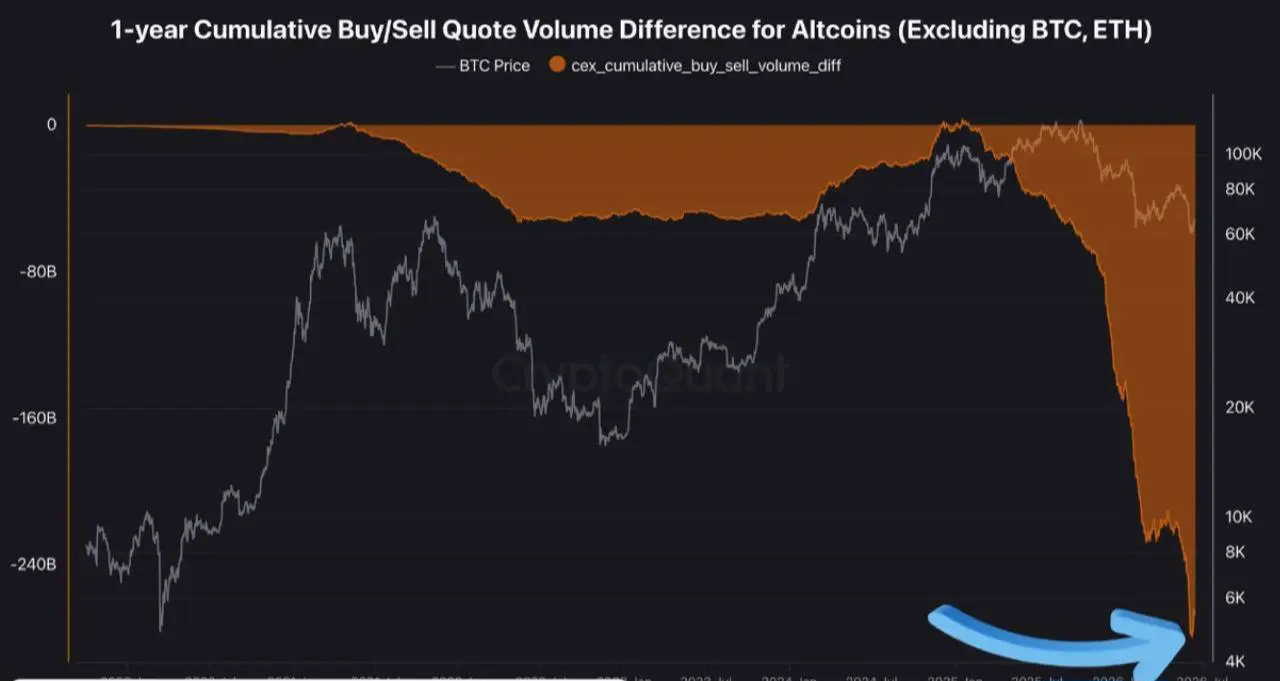
Net sell-off over 15 months, this data looks a bit suffocating
Crypto_WolfOG
📊 Altcoin Sell Pressure Hit a 5-Year Extreme
“This is not a dip. It’s 15 months of continuous net selling on Spot Exchanges. Cumulative buy/sell volume diff (alts excluded #BTC/#ETH): deepest negative reading since data began in 2020.”.
repost-content-media
Dubai's new regulations incorporate both proliferation financing and targeted sanctions into the framework, with updates every three months. Friends working in the Middle Eastern market should keep a close eye on the iteration of risk control models.
CoinNetwork
CoinWorld News reports that Wu said that the Dubai Virtual Asset Regulatory Authority (VARA) has issued the latest anti-money laundering guidelines, requiring local virtual asset service providers (VASPs) to adopt data-driven risk models, strengthen anti-money laundering and financial crime risk controls, and connect to the Financial Action Task Force (FATF) high-risk and blacklisted country information. Cryptocurrency-related risk assessments should be updated at least every three months. The guidelines also require companies to incorporate risks such as artificial intelligence operations, anonymous enhanced transactions, diffusion financing, and targeted financial sanctions into their compliance frameworks.
What kind of hellish therapy is this? Even Web3 people are speechless...
TimeProphecyMachine
Just saw a joke
A university female dormitory, 6 people, one has depression,
Whenever her mood is off, the other 5 dorm mates will hold her down,
One person mines, stopping as soon as there's a reaction,
Until the mined person begs for mercy, then they allow her to take off,
She will feel great and twitch for a while,
Later, it’s said that depression gradually disappears 🥲
Is it really like this, everyone?
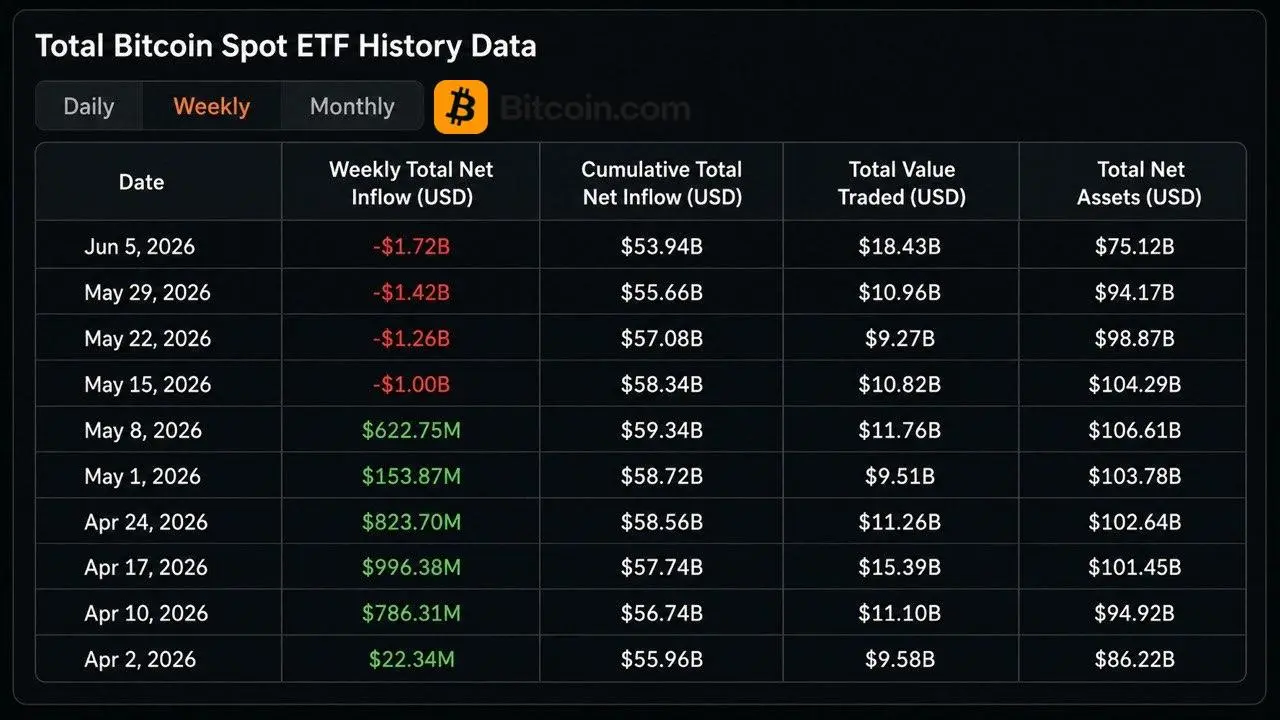
Mid-May 到现在没停过,$5.4B 说没就没,这 institutional distribution phase 还得熬多久?
Arewa_Crypto
Bitcoin ETFs Bleed $5.40 Billion Since Mid-May Following Relentless Sell-Off
There is no end in sight for the current institutional distribution phase. Net outflows from spot Bitcoin investment vehicles have reached a cumulative $5.40 billion over 28 days, signaling a macro shift toward risk-off sentiment.
repost-content-media
When the Middle East's powder keg explodes, BTC gets caught in the crossfire.
First, cut your positions and watch the show.
furan86999
The Iran–Israel situation heats up again, and market risk-aversion sentiment fully returns
Without a doubt, the weekend’s most closely watched development is the renewed escalation of the conflict between Iran and Israel.
According to publicly available information, Iran launched missiles at northern Israel on the evening of June 7—marking the first direct military confrontation since the ceasefire in April between the two sides. After that, Israel launched retaliatory actions. The situation in the Middle East quickly escalated, and concerns in the market that the conflict could further expand became clearly more pronounced.
Judging by market performance, money has already started to vote with its feet.
In the past 24 hours, international oil prices surged sharply. Brent crude briefly broke above around $96, with a single-day gain of more than 3%. Market worries about shipping risks through the Strait of Hormuz and the stability of Middle Eastern oil supplies have driven energy-sector funds to become the preferred choice for safe-haven positioning.
At the same time, risk assets showed clear signs of pressure. Bitcoin, which had been undergoing ongoing adjustments due to ETF fund outflows and rising interest-rate expectations, was again hit by geopolitical risks, further lowering market risk appetite. In recent days, BTC has fallen into the lowest levels seen in nearly 1.5 years, and funds have begun rotating into cash, gold, and energy assets.
For the crypto market, what needs the most attention right now is not short-term price fluctuations, but whether the Iran–Israel conflict will continue to expand. If the situation escalates further and oil prices move toward $100 or even higher, global inflation expectations could rise again, and the Federal Reserve’s rate-cut timetable would likely be affected. That would be bad news for risk assets—including both U.S. stocks and the crypto market.
The key variables for this week’s market are already very clear:
Not AI, not ETFs, and not altcoin hotspots.
Instead, it’s whether the Middle East situation will evolve from a localized conflict into a broader geopolitical risk event.
In the next few days, the correlation in the performance of oil, gold, and Bitcoin may become the most important signal for assessing global market risk sentiment. #伊朗袭击以色列 @Gate 广场
BTC+0.45%