Square
Following
Hot
News
Profile

OGKush

vip
Active for: 1.2y
Peak Tier 0
No content yet
394
Following
1
Followers
24
Liked
Share crypto content and earn up to 60% commissions through content mining.
$META $SPCX $META The one with better usability, I think, isn't it?
BlackoutCryptoBoy
[Ended] Market update
09-30 03:422,460 views
META-0.61%
SPCX+1.32%
🔥 Gate × CNPY CandyDrop & BTC Prediction are live!
Win from a 851,200 CNPY prize pool with simple tasks 👉: https://www.gate.com/candy-drop/detail/CNPY-362?pid=allPort&ch=lY0ok6yr
And Just post your BTC prediction for Sep 18, 12 UTC, closest 200 win extra rewards!
Mine: 78,910
CNPY-4.19%
BTC-0.22%
🔥 Gate × CNPY CandyDrop & BTC Prediction are live!
Win from a 851,200 CNPY prize pool with simple tasks 👉: https://www.gate.com/candy-drop/detail/CNPY-362?pid=allPort&ch=lY0ok6yr
And Just post your BTC prediction for Sep 18, 12 UTC, closest 200 win extra rewards!
Mine: 78,910
CNPY-4.19%
BTC-0.22%
$MU and I will have a think and see what I could find in a bit more to get a
CryptoGladiator
#NVIDIAEarnings
NVIDIA After Earnings: The AI Engine Is Still Running, but the Market Has Raised the Bar
NVIDIA has delivered another quarter that makes the scale of the AI infrastructure cycle difficult to ignore. Q2 FY2027 revenue reached $96.22 billion, up 106% year over year, while adjusted EPS came in at $2.22. Data Center revenue was the standout, reaching $89.0 billion, up 117% year over year and 18% sequentially. These numbers confirm that AI infrastructure demand is still expanding at extraordinary speed.
The forward guidance is arguably even more important than the quarter that just finished. NVIDIA expects Q3 revenue of approximately $108 billion, plus or minus 2%, with gross margin around 74%. The company is therefore guiding toward another substantial sequential increase in revenue while accepting some margin pressure as the business scales.
That margin story is where the next debate begins. NVIDIA generated a 75% gross margin in Q2, but management expects approximately 74% in Q3. Supply constraints and rising component costs mean investors are now watching not only how much AI infrastructure NVIDIA can sell, but how efficiently that demand converts into profit. A small margin decline is not necessarily a problem when revenue is expanding this quickly, but expectations are extremely high.
The demand signal remains the strongest part of the thesis. NVIDIA says its AI infrastructure buildout is continuing at full speed, with demand coming from frontier AI labs, startups, enterprises, sovereign customers and other parts of the ecosystem. Reuters also reported that management expects approximately 70% revenue growth for fiscal 2028, substantially above the growth rate many investors had been expecting.
Vera Rubin adds another layer to the story. NVIDIA says the Vera Rubin platform is already ramping into full production, with systems running at partners including CoreWeave, Google Cloud, Microsoft Azure, Oracle Cloud Infrastructure and Nebius. This matters because the growth thesis is increasingly becoming a multi-generation platform cycle rather than a story dependent entirely on Blackwell.
The AWS announcement strengthens that interpretation. NVIDIA and Amazon Web Services announced plans to deploy 2 million additional NVIDIA GPUs across AWS's global infrastructure while expanding cooperation across AI factories, networking, CPUs, open models and physical AI. That is a long-duration demand signal rather than simply another quarterly order.
China remains an important uncertainty. NVIDIA's Q3 revenue outlook assumes no Data Center compute revenue from China, meaning any future improvement in that market would represent potential upside to the current outlook rather than something already embedded in the guidance. At the same time, export restrictions make China a genuine geopolitical risk that investors cannot simply ignore.
Now look at the stock reaction. The latest available market data shows NVDA trading around $225.51, up approximately 7.56% during the August 27 session at the time of the latest quoted update. The stock opened around $222.79 and traded as high as $227.30, while the previous session closed at $209.66. That is a major repricing in a very short period and confirms that investors are responding positively to the forward growth outlook.
The technical picture has therefore changed from the $219 area referenced before earnings. $227–$228 is now the first immediate resistance zone because it overlaps the current session high and the previous August high near $227.92. A sustained move above that region would strengthen the breakout structure. The next psychological area is $230, followed by the broader $235–$236 zone.
On the downside, the first important reference is approximately $220–$222, which now sits close to the current breakout area. If buyers can defend that zone during any post-earnings pullback, the market would be showing that the earnings reaction is being absorbed rather than fully reversed. Below that, $213–$215 becomes the next meaningful support area, followed by the previous $209–$210 region.
Volume is especially important here. NVDA traded more than 143 million shares during the latest quoted August 27 session, compared with roughly 180 million shares on August 26 and 122 million on August 25. That tells us the earnings reaction is occurring with substantial market participation rather than on unusually thin liquidity.
The broader market is providing another tailwind. Reuters reported that NVIDIA's post-earnings move helped lift AI-related markets, while the Nasdaq also advanced. However, the macro backdrop is not completely risk-free: July PCE inflation remained elevated, and markets are preparing for Federal Reserve Chair Kevin Warsh's Jackson Hole speech. That means interest-rate expectations could still influence how far the AI rally can extend.
My bullish scenario is a sustained hold above $220–$222, followed by a decisive break through $227–$228 with strong volume. If that happens, $230 becomes the next psychological test, followed by $235–$236. The strongest confirmation would be a breakout followed by a successful retest of the $227 area as support.
The bearish scenario is different. If the post-earnings surge fails and NVDA loses $220, the market could begin digesting the enormous move more aggressively. A break below $213–$215 would weaken the immediate structure, while a return toward $209–$210 would indicate that investors are questioning whether the new growth expectations justify the current valuation.
The fundamental picture is therefore strong, but the technical setup is entering a higher-expectation zone.
NVIDIA has already answered one question: AI demand is still enormous.
The next question is harder: can NVIDIA continue delivering extraordinary revenue growth while protecting margins, managing supply, launching new platforms and navigating geopolitical restrictions?
At around $225.51, I would focus on three numbers: $228 for breakout confirmation, $220–$222 for near-term support, and $209–$210 for deeper structural risk.
The AI story has not weakened. If anything, the latest results have extended the runway.
But after a move of this magnitude, the market will demand more than another impressive quarter. It will demand evidence that the next stage of AI infrastructure spending can continue translating into sustainable earnings growth.
#GateSquare
$NVDA ‌
MU+3.03%
#CandyDrop1BTCForOldUsers and the boys are going to be 3Welcome to Gboard clipboard, any text you copy will be saved here.
  • 5
#CandyDrop1BTCForOldUsers MGI88ONEMGI88ONEMGI88ONEMGI88ONEMGI88ONE
  • 3
#CandyDrop1BTCForOldUsers MGI88ONEMGI88ONEMGI88ONEMGI88ONEMGI88ONEMGI88ONE
GateUser-9c22a72f
I came across a ride-hailing incident in which a passenger was asked by the driver to get out midway because of floodwater ahead.
The passenger filed a complaint, and the driver told him to complain all he wanted. The trip ended by the roadside.
Disputes like this can easily turn into an argument over whether the driver or passenger is in the right. The driver was worried about the vehicle taking in water and the resulting repair risks. The passenger had already booked and paid for the ride, so getting out halfway would cost time and might make it difficult to find another car immediately.
Both sides were trying to avoid their own losses, but the platform failed to provide a workable solution that would allow the trip to continue.
A more reasonable mechanism would be to flag flooded sections and other risky road segments before a ride is accepted, allowing drivers to make an informed decision. Once a trip is interrupted, the platform should immediately dispatch another vehicle and clearly explain the charges and liabilities.
The platform usually handles matching riders with drivers. Whether it can immediately dispatch another vehicle after a trip is suddenly interrupted is a better test of its ability to handle unexpected incidents.
Whose side are you on in this case—the driver’s or the passenger’s?
repost-content-media
#CandyDrop1BTCForOldUsers Currently using this medication.
#TopFiveLeaguesPreMatchPredictor
This week's marquee Premier League match
features Manchester United hosting their fierce rivals Liverpool at Old Trafford. This historic rivalry always promises an intense, high-stakes battle with absolute maximum effort from both sides.
For this highly anticipated match, I predict that Manchester United will secure a victory with a final score of 2-1.
My main supporting reason is Manchester United's massive home-field advantage and recent tactical improvements. Their midfield has been controlling the tempo effectively, and their forwards are showing clinical f
..
discovery
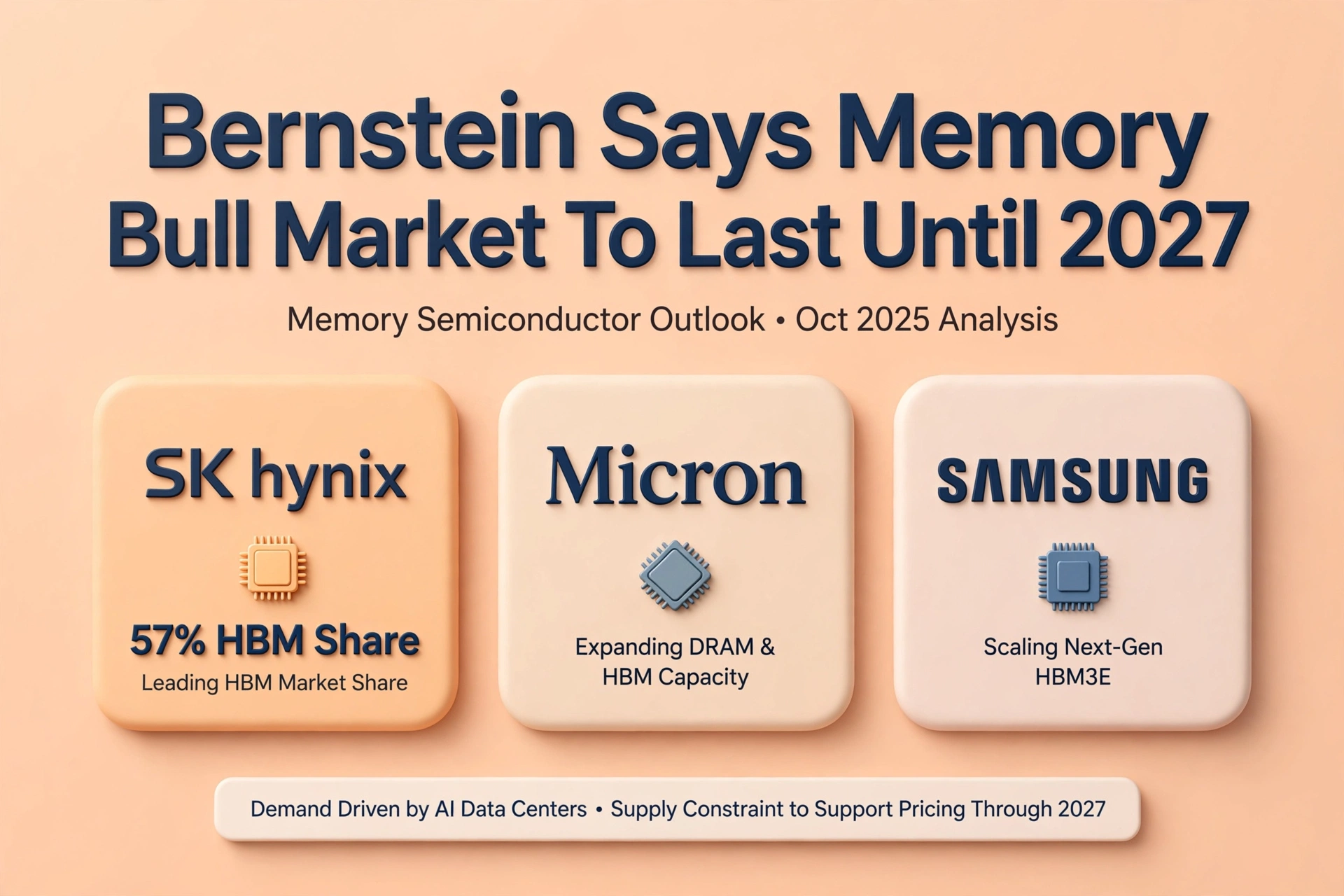
#BernsteinSaysMemoryBullMarketToLastUntil2027
Bernstein Says Memory Bull Market to Last Until 2027 as AI Demand Rewrites the Cycle
Bernstein just reset the clock on the memory market. Analysts Gautam Chhugani and Mahika Sapra argue the current bull run in DRAM and HBM won’t peak until 2027, breaking the traditional four-year cycle. The call isn’t about hype. It’s about structural supply, long-term agreements, and an AI build-out that keeps eating memory faster than fabs can ship it.
Why 2027 looks different
Historically, memory flipped every 18 to 24 months. Oversupply killed pricing, margins collapsed, and stocks reset. This time, three forces are changing the math:
1. HBM scarcity: High-bandwidth memory for AI GPUs is sold out through 2026. Bernstein expects 2 to 2.5 times year-over-year increases in HBM average selling prices heading into 2027, spanning HBM3, HBM3E, and the incoming HBM4. Jefferies models 40 to 50 percent quarter-over-quarter gains in Q3 2026 alone, with peak ASP near $2.23 per GB by 2027. 2. Long-term agreements: Roughly 35 percent of total bits for FY27-29 are already under LTAs at a contracted $0.26 per GB, only 10 percent below spot forecasts. That puts a price floor near current levels and dampens the old boom-bust pattern. Hyperscalers are signing multi-year deals to secure supply, giving SK Hynix, Samsung, and Micron visibility they never had. 3. Capex reality: Fabs take years. Micron’s $200 billion build-out, SK Hynix’s Yongin cluster, and Samsung’s Pyeongtaek expansion won’t meaningfully add bits until late 2027. Meanwhile, AI training clusters are doubling every 6 to 9 months. Demand is growing into a wall.
Who benefits
Bernstein raised targets across the space. SK Hynix holds 62 percent HBM share and has removed price caps on 2027 contracts, shifting pricing power to suppliers. Micron is sold out of HBM3E through 2026 and just guided margins higher. Samsung is catching up on HBM3E qualification and still dominates commodity DRAM, where spot prices are now rising after two years of pain. Equipment names like ASML see order books stretching to 2027 because EUV layers per HBM stack keep climbing. Power and cooling suppliers like Infineon benefit as AI racks pull more watts per GPU.
What could break the thesis
The risk isn’t demand disappearing. It’s supply arriving faster than expected or AI budgets pausing. China’s domestic HBM efforts, potential export shifts, and a macro slowdown could cool orders. Still, Bernstein’s point is that even at the cycle peak, the floor is higher than any prior top. The downcycle, if it comes, starts from $0.26 per GB, not $0.08.
Market takeaway
Memory stocks have already moved. SK Hynix is up eightfold in 2026, Micron hit new highs, and ETF flows are broadening beyond Bitcoin into semis and infrastructure. Bernstein sees trading volumes peaking in 2027, with earnings growth into 2026 and multiple expansion as investors re-rate memory from cyclical to secular.
For portfolio positioning, the message is clear: AI isn’t just about GPUs. The memory behind them is booked, repriced, and contracted for years. If Bernstein is right, the bull market in bits runs until 2027, and the companies that control those bits keep the pricing power.
This is market commentary for informational purposes only and not financial advice. Always review current research and risk disclosures before trading.
repost-content-media
Daily post in Square with a length of at least 50 characters
goog
Original content no longer visible
GOOG+0.98%
og
live-cover
0 views07-08 16:14
Ended • No Replay