Square
Following
Hot
News
Profile

Moon_Angel

vip
Active for: 0.3y
Peak Tier 0
No content yet
26
Following
61
Followers
2.1k
Liked
market rebound
live-cover
LIVE1,757
🔥 What are we talking about today? Gate Square’s trending topics have been updated!
🔹 The Fed’s September minutes were hawkish, and another rate hike this year remains possible! With high-rate expectations returning, how will $BTC and U.S. stocks perform?
🔹 Samsung’s Q3 operating profit surged 782.5%! With AI and memory demand continuing to explode, how much further can the semiconductor cycle go?
🔹 Robinhood will add $25 million in $BTC to its balance sheet! Following publicly listed companies, are brokerage platforms also starting to allocate directly to Bitcoin?
🔹 Hyperliquid’s open
GateSquare
🔥 What are we talking about today? Gate Square’s trending topics have been updated!
🔹 The Fed’s September minutes were hawkish, and another rate hike this year remains possible! With high-rate expectations returning, how will $BTC and U.S. stocks perform?
🔹 Samsung’s Q3 operating profit surged 782.5%! With AI and memory demand continuing to explode, how much further can the semiconductor cycle go?
🔹 Robinhood will add $25 million in $BTC to its balance sheet! Following publicly listed companies, are brokerage platforms also starting to allocate directly to Bitcoin?
🔹 Hyperliquid’s open interest market share in perpetual contracts rose to a record 11.9%! Are on-chain derivatives taking market share from CEXs?
🔥 Worth following today: Gate Money is officially live, gradually connecting digital assets, fiat currencies, stocks, ETFs, gold, bank accounts, and payments. Will managing assets through one app become the next-generation financial experience?
Post with trending topics to receive traffic support + featured recommendations for high-quality content, and participate in content-mining rewards.
💰 Have an opinion? Join the discussion: https://www.gate.com/post/topic
repost-content-media
BTC-0.23%
HOOD-2.29%
HYPE-1.93%
AI-related stocks pulled back sharply, with Astera Labs leading the decline. ALAB closed down 9.21% at $347.05, while the broader semiconductor complex also weakened. Coherent fell 9.63%, CoreWeave dropped 7.77%, Arm Holdings lost 6.48%, Intel declined 5.34%, and Nvidia slipped 2.94%.
The trigger for Astera Labs was specific. Zacks Research downgraded the stock from "strong buy" to "hold," citing valuation, cost pressures, and competitive concerns. The company trades at roughly 87 times forward earnings, and gross margins are expected to compress toward 70% as it scales. Reports of insider sel
User_any
AI-related stocks pulled back sharply, with Astera Labs leading the decline. ALAB closed down 9.21% at $347.05, while the broader semiconductor complex also weakened. Coherent fell 9.63%, CoreWeave dropped 7.77%, Arm Holdings lost 6.48%, Intel declined 5.34%, and Nvidia slipped 2.94%.
The trigger for Astera Labs was specific. Zacks Research downgraded the stock from "strong buy" to "hold," citing valuation, cost pressures, and competitive concerns. The company trades at roughly 87 times forward earnings, and gross margins are expected to compress toward 70% as it scales. Reports of insider selling added to the pressure, prompting traders to lock in profits after a sharp run that took the stock from the $252–$270 range in mid-September to nearly $389.80 in early October.
The broader selloff had two layers. The first was a report that OpenAI's annualized revenue was near $50 billion at the end of September, below the roughly $70 billion figure that had circulated in media reports the prior month. The discrepancy involved different methods of accounting for sales through cloud partners rather than a decline in actual revenue, but it was enough to prompt a reassessment of AI spending assumptions. The second was the funding side. Oracle, Broadcom, and SpaceX are all reported to be seeking large-scale financing for AI chip purchases, raising questions about the debt burden and return timelines behind the buildout.
The macro backdrop added pressure. The 10-year Treasury yield remains above 5.2%, and the 30-year is near 5.6%. When the risk-free rate is that elevated, the discount rate applied to future earnings rises, and high-growth stocks are more sensitive to that shift. Lower Treasury yields failed to cushion the decline, which tells you the selling was driven by concerns about the revenue outlook rather than by rate mechanics alone.
Apple was the only Magnificent Seven stock to finish higher, gaining 1.12%, while the Dow and Russell 2000 held modest gains. The divergence between the technology-heavy indices and the broader market shows that the selling was concentrated in AI and semiconductor names rather than a broad risk-off move.
The next data points that could shift the picture are the October CPI and PPI releases. Those reports will test whether inflation is genuinely cooling or whether the pressures that have kept yields elevated are still building. If the data supports a more dovish rate path, the environment for high-multiple growth stocks could improve. If it doesn't, the repricing of AI valuations may continue.
This article is not investment advice. Analysis is based on publicly available information and does not guarantee future outcomes.
#AIStocksFallALABDropsOver9%
Funding rates across major centralized and decentralized exchanges have turned negative, a shift that tells a specific story about how leveraged traders are positioned. The eight-hour average funding rate for Bitcoin sits at approximately -0.0044%, with one large venue dropping to about -0.00215%, its lowest level in nine months. In simple terms, shorts are now paying longs to keep their positions open. That is the opposite of the usual arrangement, where bullish traders pay to maintain leveraged bets on higher prices.
The Fear and Greed Index, by contrast, is still reading in the greed zone.
User_any
Funding rates across major centralized and decentralized exchanges have turned negative, a shift that tells a specific story about how leveraged traders are positioned. The eight-hour average funding rate for Bitcoin sits at approximately -0.0044%, with one large venue dropping to about -0.00215%, its lowest level in nine months. In simple terms, shorts are now paying longs to keep their positions open. That is the opposite of the usual arrangement, where bullish traders pay to maintain leveraged bets on higher prices.
The Fear and Greed Index, by contrast, is still reading in the greed zone. Depending on the data provider, the reading sits between 55 and 63, down from a seven-day average nearer 68, but not yet in fear territory. That combination is unusual. Leveraged traders are paying to bet against the market, while the broader sentiment gauge still leans optimistic.
One way to read this divergence is that the derivatives market has already absorbed the selling pressure that the spot market has not fully reflected. When funding rates go negative, it often means the crowded trade has flipped. Instead of longs paying shorts, the reverse is happening. That can happen during a sharp correction when leveraged longs get wiped out and shorts step in, or it can happen when traders expect further declines and are willing to pay for the privilege of being short.
The practical implication is not a directional signal on its own. Negative funding can precede a short squeeze if price stabilizes, because shorts are forced to cover and that buying pressure pushes the market higher. It can also persist for weeks if the broader trend remains weak. The funding rate is a measure of positioning, not a forecast.
What makes this moment worth watching is the combination of factors. Leverage has come down, with open interest in Bitcoin futures falling to around $52.57 billion, down 3.27% over a 24-hour window. Spot ETF flows have been uneven, with Bitcoin funds attracting capital while Ether funds see outflows. And the macro backdrop remains restrictive, with Treasury yields elevated and the Fed signaling no urgency to ease.
The $81,000 level is the immediate line. If it holds and funding stays negative, the setup for a squeeze improves. If it breaks, the negative funding simply confirms what the price is already saying.
This article is not investment advice. Analysis is based on publicly available information and does not guarantee future outcomes.
$BTC $GT ‌ ‌
#CEXandDEXFundingRatesTurnNegative
BTC-0.25%
GT-0.37%
#BTCPullsBackTo81000 Yo, so check it. Bitcoin slid under $82K for the first time in three weeks, and nah, it ain't one thing that did it. Three things hit at once, straight up.
First off, the Fed. Them September minutes dropped October 7, and all nineteen of 'em backed that quarter-point hike to 3.75–4.00%. Most said yeah, another one by year-end probably makes sense. But here's the thing — the market ain't buying it for October. Odds sitting at like 17% for October, but December? Around 70%. And that matters, 'cause when rates stay high, holding stuff that don't pay you nothing gets expensi
User_any
#BTCPullsBackTo81000 Yo, so check it. Bitcoin slid under $82K for the first time in three weeks, and nah, it ain't one thing that did it. Three things hit at once, straight up.
First off, the Fed. Them September minutes dropped October 7, and all nineteen of 'em backed that quarter-point hike to 3.75–4.00%. Most said yeah, another one by year-end probably makes sense. But here's the thing — the market ain't buying it for October. Odds sitting at like 17% for October, but December? Around 70%. And that matters, 'cause when rates stay high, holding stuff that don't pay you nothing gets expensive. 10-year yield hanging near 5.3%, 30-year near 5.67%. That's decades-high type energy.
Second thing — Iran. Word is the White House told the Pentagon to get strike options ready, but nothing popping off before the midterms. Strait of Hormuz still a mess. Brent at $101.53, WTI at $89.39. Expensive oil means inflation ain't going nowhere, and that keeps the Fed chilling on the sidelines.
Third thing, and this the one that really hurt — leverage. Around $709 to $769 million in positions got liquidated in 24 hours. Longs took $647 to $685 million of that. Bitcoin longs alone, $172 million. Roughly 140,000 accounts got smoked. Open interest dropped 3.27% down to about $52.57 billion. That ain't people changing their minds — that's forced selling, plain and simple.
Institutional money? Mixed bag. US spot Bitcoin ETFs pulled in $118.86 million last session, total assets near $110.68 billion. But Ether ETFs? Lost $202 million same day. Them two ain't moving together no more.
Supply side — government wallets moved 12,267 BTC, 'bout $1.01 billion, to fresh addresses. No exchange deposit, so looks more like reshuffling than dumping.
Chart-wise, Bitcoin ran from $83,299 down to $80,397 before settling near $82,063. The $80,500 to $81,500 zone? That's where last month's highs sat, and that's what everybody watching. Hold there, we cool. Break it, and now we asking if the forced selling is done.
Next real test? October CPI and PPI. That's gonna tell us if inflation really cooling or if this pressure still building.
This ain't investment advice, just keeping it real.
$BTC ‌
BTC-0.23%
GateMoneyOfficiallyLaunches
Switching between apps just to make one move has become a normal pain. You hold funds in one place, you need to pay from another, you check fee, you check FX rate, you wait for arrival, you track balance across three screens. Even a small cross border move can take more effort than it should.
Last month I had a clear case. I had to pay a partner overseas. My assets were in one app, my spend account in another. I had to shift assets to main balance, swap to local money, then open a third app for cross border send. Each step had its own fee, its own FX, its own wait.
discovery
#GateMoneyOfficiallyLaunches
Switching between apps just to make one move has become a normal pain. You hold funds in one place, you need to pay from another, you check fee, you check FX rate, you wait for arrival, you track balance across three screens. Even a small cross border move can take more effort than it should.
Last month I had a clear case. I had to pay a partner overseas. My assets were in one app, my spend account in another. I had to shift assets to main balance, swap to local money, then open a third app for cross border send. Each step had its own fee, its own FX, its own wait. Three apps, two extra checks, one full day of waiting for a task that should be one tap.
That case shows what really matters. It is not only speed. It is fewer steps, clear cost, and one screen control.
What should be priority?
For me three items stand out.
First, fewer steps. No app switch for one transfer. Asset swap, FX view, and send should live in one flow. One check, one confirm, not a chain.
Second, lower and clear cost. Fee and FX should show before you hit send. No hidden mark up. For small and frequent cross border moves, fee is the main cost driver, so clear fee view is key.
Third, fast and traceable move. Once you send, you should see where money is and when it will land. Live status, instant alert, no silent wait.
Why one app for money matters
Many of us keep money split. Saving in one place, spend in another, invest in another. Tracking balance across all of them takes time and brings error risk. One view for all balances, one place to swap and spend, removes that mess. When you travel, or pay in a new currency, direct spend from asset balance saves both time and FX loss.
Linking card spend and cross border pay in one flow is also vital. The old chain of swap first, move to card, then spend, adds FX loss each time. Direct spend from asset balance cuts that chain.
First view: what works, what can be better
What works well in new pay tools is simple flow. Pick asset, enter amount, send, track. Clean UI lowers error. Clear fee and FX before send builds trust.
What can be better is coverage and speed. More regions supported, more local currencies, 24 hour move, and wide card acceptance make daily use easy. Real time push alerts and full history also help a lot.
In the end, real luxury in payments is not speed alone, it is ease. Fewer apps, fewer steps, clear cost. A small snag in cross border pay can slow whole day. One screen for balance, clear FX and fee, fast track, gives real ease in daily life. Real use is still the best guide.
#PlanYourTradesThisWeek
#ShareWeekly #每周来晒 #布局本周交易
$BTC $ETH $SAND $NVDA $AAPL ‌ ‌
repost-content-media
Gate Money emerges as a new financial service layer introduced by Gate on the TOKEN2049 stage. Unveiled during Dr. Han’s keynote titled "One Gate, Everything Money," the product aims to consolidate digital assets, fiat currencies, stocks, ETFs, gold, bank accounts, and payment services into a single account. This is not a conventional exchange product; it embodies a broader ambition: to eliminate the boundaries between the storage, growth, and spending of assets.
To grasp this concept, one must first look at the current landscape. Today, a user’s crypto assets reside on one platform, stocks at
User_any
Gate Money emerges as a new financial service layer introduced by Gate on the TOKEN2049 stage. Unveiled during Dr. Han’s keynote titled "One Gate, Everything Money," the product aims to consolidate digital assets, fiat currencies, stocks, ETFs, gold, bank accounts, and payment services into a single account. This is not a conventional exchange product; it embodies a broader ambition: to eliminate the boundaries between the storage, growth, and spending of assets.
To grasp this concept, one must first look at the current landscape. Today, a user’s crypto assets reside on one platform, stocks at a brokerage, and cash in a bank. These three pools operate independently of one another. Moving funds between them requires executing sales, waiting for settlement periods, and tracking the transfer until it reaches the destination account. This process entails burdens in terms of both time and transaction costs. Gate Money seeks to resolve precisely this fragmentation.
At the core of the product lies the concept of a unified account. Users can open a global bank account in their own name via the Gate app. This account enables collections and transfers in over 60 local currencies. All transactions are conducted online, eliminating the need to deal with multiple institutions separately. Plans are in place to expand the service into markets such as Europe, Australia, and Dubai. The initiative aims to provide a one-stop solution for cross-border payments, offshore asset allocation, and international transfer needs. On the asset side, the channels connecting bank accounts and digital assets are being integrated. Users can convert between fiat currencies and digital assets, view stock and ETF positions on a single screen, and hold alternative assets—such as gold—within the same account structure. The bank account evolves from a single-purpose savings tool into a central hub linking fiat currency, digital assets, stocks, gold, and ETFs. This enables users to utilize their assets for daily expenses without needing to sell them beforehand.
The payment layer demonstrates how this structure operates in practice. Gate Money supports the use of account assets—including stocks—for everyday consumer payments. ATM withdrawals and local QR code payments are also available in authorized regions. The Gate Card allows for direct spending from the account and can be linked to popular digital wallets. The goal is to minimize the need to liquidate assets; this allows users to cover daily expenses while maintaining their investment positions.
A partnership with Visa further expands this ecosystem. A crypto-linked payment card will be launched across more than 40 countries and regions. When a user makes a payment, eligible digital assets in their Gate account are automatically converted into fiat currency at the point of sale. The card is accepted wherever Visa is accepted—covering over 150 million merchant locations worldwide—and supports both online and in-store transactions. Card applications and management are handled via the Gate app.
Dr. The central theme of Han's address was that the account should no longer act as a limiting factor. The statement, "An account should not become a limit on funds," encapsulates the product's underlying logic. This global bank account—opened under a single identity—links asset, fund, and payment boundaries, enabling the free flow of money. The phrase, "Let your assets continue to grow, and let your value move freely," defines the promise the product makes to the user.
A broader observation underpins this approach. While crypto assets have long been viewed primarily as investment vehicles, their integration into daily financial life has remained limited. The ability to have assets grow continuously while remaining accessible for use when needed is positioned as the next evolution of financial products. Realizing this requires capabilities across account management, payments, clearing, compliance, and auditing. Gate reports that it has established compliance infrastructure in markets such as Europe, Dubai, Australia, and Japan, and has forged partnerships with international payment providers, banks, and custody and clearing institutions.
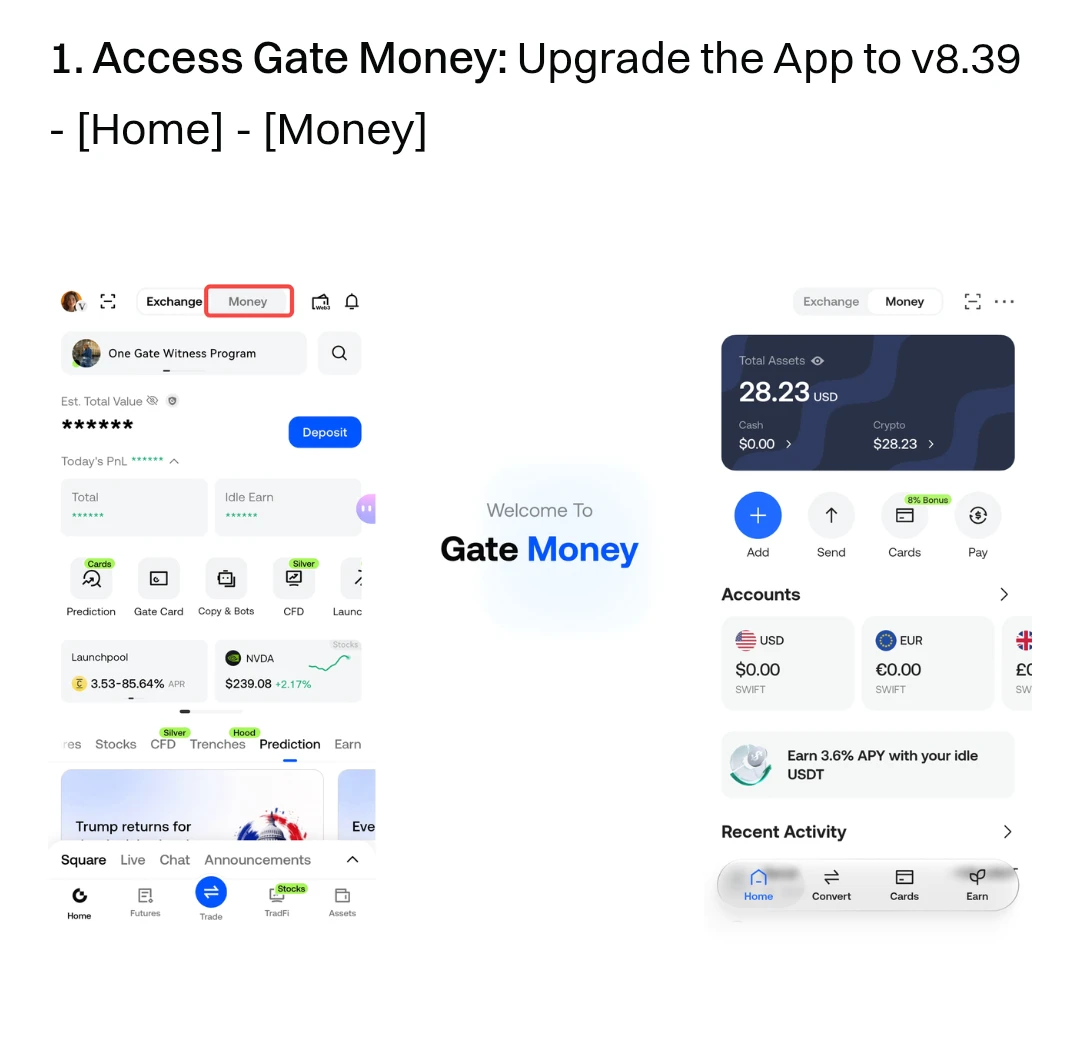
To gauge the impact this product will have, one must look at the seamlessness of its features. If the conversion process is swift, fees are reasonable, and the card acceptance network is extensive, digital assets can truly become viable for everyday spending. Conversely, if the process proves cumbersome or costly, users will likely continue to view crypto solely as an investment. Gate Money is available following the update of the Gate app to version 8.39.0. The rollout of the service across more than 40 markets will reveal the extent to which this promise is realized.
This article does not constitute investment advice. The analysis is based on publicly available information and does not guarantee future results..
#GateMoney正式上线
👉👉👉 https://www.gate.com/announcements/article/102094
$GT ‌
repost-content-media
V+0.83%
RobinhoodAdds$BTC
Robinhood has added Bitcoin to its corporate balance sheet for the first time. Johann Kerbrat, the company's Senior Vice President of Crypto and International Operations, announced at the Digital Asset Summit Asia conference on October 7 that Bitcoin worth approximately $HOODmillion had been included in the company's corporate assets. Based on prevailing Bitcoin prices, this amount equates to roughly 292 to 300 BTC. Kerbrat specifically emphasized that these assets do not belong to customers but are held directly in the company's own portfolio.
Kerbrat explained the motivatio
User_any
#RobinhoodAdds$25MBitcoinToBalanceSheet
Robinhood has added Bitcoin to its corporate balance sheet for the first time. Johann Kerbrat, the company's Senior Vice President of Crypto and International Operations, announced at the Digital Asset Summit Asia conference on October 7 that Bitcoin worth approximately $25 million had been included in the company's corporate assets. Based on prevailing Bitcoin prices, this amount equates to roughly 292 to 300 BTC. Kerbrat specifically emphasized that these assets do not belong to customers but are held directly in the company's own portfolio.
Kerbrat explained the motivation behind this move by stating, "We want to show how much we value Bitcoin and the ecosystem." However, he also acknowledged that a $25 million position would not materially alter the company's financial trajectory. With a market capitalization hovering around $100 billion, a $25 million Bitcoin allocation has a largely symbolic impact on Robinhood's balance sheet. Consequently, the move is best viewed as a demonstration of support for the company's crypto business line rather than a fundamental shift in its treasury strategy.
Robinhood is no newcomer to the crypto space. The company launched Robinhood Chain—an Ethereum-compatible Layer 2 network—in July 2026. This network facilitates the offering of tokenized stock products, a stablecoin named USDG, and yield-generating lending services via Robinhood Earn. The network is integrated with decentralized finance (DeFi) protocols such as Uniswap and infrastructure providers including Chainlink, Alchemy, and BitGo. The company has over 28 million funded customers worldwide, and its crypto business has become an integral part of its corporate identity.
This move places Robinhood among the publicly traded companies that hold Bitcoin on their corporate balance sheets. More than 170 firms globally have taken this step, with their combined Bitcoin holdings exceeding 1.2 million BTC. While Robinhood's position is small in comparison, the move is viewed as a strategic signal given the company's established standing in the crypto ecosystem.
The company has not made a statement regarding whether it will purchase additional Bitcoin or other tokens in the future; no such plans were shared in Kerbrat's remarks. What is known at this stage is that Robinhood is holding Bitcoin on its balance sheet for its own account for the first time, framing the move as a long-term commitment to the ecosystem.
This article does not constitute investment advice. The analysis is based on publicly available information and does not guarantee future results.
$BTC ‌$HOOD
repost-content-media
BTC-0.23%
HOOD-2.29%
USDG0.00%
UNI-5.80%
LINK-1.60%
Gate Money, the unified financial services application from Gate, was formally introduced by founder and CEO Dr. Han during a keynote address at TOKEN2049 in Singapore. The launch marks an expansion beyond digital asset trading into a broader financial ecosystem that brings together digital assets, fiat currencies, stocks, ETFs, gold, bank accounts, and payment services into a single account within the Gate App.
The central idea behind the product was expressed in a series of statements from Dr. Han during the keynote. He framed the account not as a boundary but as a starting point. "An accoun
User_any
Gate Money, the unified financial services application from Gate, was formally introduced by founder and CEO Dr. Han during a keynote address at TOKEN2049 in Singapore. The launch marks an expansion beyond digital asset trading into a broader financial ecosystem that brings together digital assets, fiat currencies, stocks, ETFs, gold, bank accounts, and payment services into a single account within the Gate App.
The central idea behind the product was expressed in a series of statements from Dr. Han during the keynote. He framed the account not as a boundary but as a starting point. "An account should not become the boundary of funds," he said, adding that Gate Money supports the one-click opening of a global bank account under the same name, connecting the boundaries between assets, funds, and payments so that funds can flow freely. The product's guiding principle was summarized in the phrase, "Let your assets keep growing. Let your value move freely."
The practical mechanics of Gate Money reflect that principle. Users can manage multiple fiat currencies and digital assets within a single account, with a consolidated view of asset balances and fund movements. The platform supports fiat deposits and withdrawals alongside on-chain deposits and transfers. A notable feature is the ability for eligible users to open a global bank account in their own name through the app, supporting transfers in more than 60 local currencies. The account is designed so that users can receive and transfer funds, manage assets, and handle payments without moving between separate platforms.
The payment layer extends the functionality into everyday spending. Gate Money supports using account assets, including stocks, for daily consumption payments. In eligible regions, users can also access ATM withdrawals and local QR-code payments. The Gate Card allows spending directly from the account and can be linked to widely used digital wallets. The design intent is to reduce the need to convert assets into cash before using them, so that holdings can remain invested while still being available for spending when needed. The platform also provides asset exchange, wealth management, and staking features, with eligible balances such as USDT offering up to 3.6% annualized return without a lock-up period.
The product's reach extends through a partnership with Visa, which will bring a crypto-linked payment card to more than 40 countries and territories. When a user makes a purchase, eligible digital assets held in their Gate account are automatically converted into fiat currency at the point of sale. The card works at any merchant that accepts Visa, covering more than 150 million locations worldwide, both online and in physical stores. Users can apply for and manage the card through the Gate App.
Dr. Han's remarks also placed the launch within a broader vision for the platform's direction. "Trading is only one piece of the puzzle," he said. "What people really need is a better way to manage money every day." He described a future in which stablecoins, on-chain payments, and digital securities are brought into real-world financial scenarios, enabling more assets to be held, transferred, and used. The company has established compliance foundations in markets including Europe, Dubai, Australia, and Japan, and has partnered with international payment institutions, banks, custodians, and clearing institutions to support the service.
The timing of the launch reflects a broader trend in the digital asset industry, where platforms are seeking to bridge the gap between crypto holdings and traditional financial services. The value of that bridge depends on how seamlessly it operates in practice. If the conversion process is fast, the fees are reasonable, and the card is accepted widely, it can make digital assets more useful for everyday spending. If the experience is cumbersome or the costs are high, users will continue to treat crypto as an investment rather than a payment method. Gate Money is available to users who update the Gate App to version 8.39.0, and the details of its rollout across the 40-plus markets will determine whether it delivers on the promise of connecting digital assets to real-world commerce.
This article is not investment advice. Analysis is based on publicly available information and does not guarantee future outcomes.
#GateMoneyOfficiallyLaunches
repost-content-media
V+0.83%
#FedSeptemberMinutesLeanHawkish
FED SEPTEMBER MINUTES LEAN HAWKISH
The latest Federal Reserve September meeting minutes are sending a clear message to global markets: inflation remains a serious concern, and the Fed is not ready to declare victory.
The minutes from the September 15–16 meeting show that policymakers remain divided over the exact reason for tighter policy, but the overall tone is clearly cautious and hawkish. All participants supported a 25-basis-point rate increase, taking the federal funds target range to 3.75%–4.00%.
INFLATION REMAINS THE MAIN PROBLEM
The biggest takeaway is
Moon_Angel
#FedSeptemberMinutesLeanHawkish
FED SEPTEMBER MINUTES LEAN HAWKISH
The latest Federal Reserve September meeting minutes are sending a clear message to global markets: inflation remains a serious concern, and the Fed is not ready to declare victory.
The minutes from the September 15–16 meeting show that policymakers remain divided over the exact reason for tighter policy, but the overall tone is clearly cautious and hawkish. All participants supported a 25-basis-point rate increase, taking the federal funds target range to 3.75%–4.00%.
INFLATION REMAINS THE MAIN PROBLEM
The biggest takeaway is that inflation is still running above the Fed’s 2% target.
Officials highlighted persistent price pressures, higher energy costs, geopolitical risks, and strong investment connected to the AI buildout. Many participants believed inflation risks were tilted to the upside, while several said the current policy rate was not restrictive enough or only mildly restrictive.
This is important because markets have been hoping for a faster return toward easier monetary policy. The minutes suggest that the Fed still wants to keep inflation under control before becoming comfortable with a sustained easing cycle.
MORE RATE HIKES STILL POSSIBLE
One of the most hawkish signals is that most participants judged another rate increase would likely be appropriate before the end of the year.
That does not guarantee another hike, because officials emphasized that future decisions will depend on incoming economic data. However, the possibility remains firmly on the table.
This creates a difficult environment for risk assets.
Higher interest rates generally increase the opportunity cost of holding riskier assets and can strengthen the dollar, while tighter financial conditions can reduce liquidity flowing into speculative markets.
WHAT THIS MEANS FOR BTC
For Bitcoin, the Fed message creates a mixed setup.
A hawkish Fed can produce short-term pressure because traders may reduce risk exposure when expectations for monetary easing decline.
But Bitcoin is also extremely sensitive to changes in liquidity expectations. If future economic data weakens enough to make the Fed reconsider further hikes, the market could quickly shift from hawkish expectations toward a more supportive liquidity narrative.
That means BTC traders should not react to the headline alone.
The next major move will depend on how inflation, employment, Treasury yields, the dollar, and Fed communication develop together.
MY MARKET VIEW
My view is that the September minutes are hawkish, but they do not necessarily signal an unlimited tightening cycle.
The Fed appears focused on preventing temporary inflation shocks from becoming persistent inflation.
Energy prices, geopolitical developments, and AI-related investment are now important parts of the inflation discussion. Officials are worried that sector-specific price increases could spread into broader inflation dynamics.
This is why the market should prepare for volatility rather than assume a straight-line bullish or bearish trend.
TRADING PLAN
My approach in this environment is to avoid emotional entries.
If BTC shows strength while Treasury yields and the dollar remain elevated, I would want confirmation from price action and volume before increasing exposure.
If BTC loses important support levels while hawkish Fed expectations strengthen, I would become more defensive.
If inflation data cools and Fed expectations turn softer, Bitcoin could receive a fresh liquidity-driven boost.
The key is confirmation.
MY BTC PREDICTION
My short-term view is cautious but not automatically bearish.
A hawkish Fed can create pressure, but Bitcoin can still rally if market liquidity, institutional demand, and risk appetite remain strong.
For me, the most important signal is whether BTC can absorb macro pressure without breaking major technical support.
If it can, that would demonstrate underlying strength.
If it cannot, the Fed narrative could become a stronger catalyst for a deeper correction.
WHAT I AM WATCHING NEXT
The October Fed meeting will be extremely important.
Markets are now trying to determine whether the Fed will pause in October and potentially raise rates again in December. Recent market expectations have shifted after softer employment and inflation signals, but officials remain divided.
I will be watching:
INFLATION DATA
TREASURY YIELDS
U.S. DOLLAR STRENGTH
LABOR MARKET DATA
FED SPEECHES
BTC VOLUME
BTC SUPPORT AND RESISTANCE
GLOBAL LIQUIDITY
FINAL THOUGHTS
The message from the September minutes is simple: the Fed is still fighting inflation.
The central bank wants to see convincing progress toward 2% before becoming comfortable with easier policy.
For crypto traders, this means the macro environment remains highly important.
BTC may continue to experience sharp moves as traders constantly reprice the probability of future Fed action.
My strategy is patience, confirmation, controlled risk, and avoiding over-leverage.
A hawkish Fed does not automatically mean Bitcoin must fall.
But it does mean traders need to respect macro risk.
The next major BTC move could be driven not only by Bitcoin itself, but by the interaction between inflation, interest rates, Treasury yields, liquidity, and Fed expectations.@GateSquare
BTC-0.23%
#SamsungQ3OperatingProfitSurges782.5%
Samsung Electronics has delivered a historic third-quarter earnings update, with operating profit estimated at KRW 107.4 trillion, or roughly $80.1 billion. That represents an extraordinary 782.5% increase from KRW 12.17 trillion a year earlier. Revenue is also estimated at KRW 195 trillion, up 126.6% year over year.
THE AI CHIP BOOM IS THE KEY DRIVER
The biggest reason behind this explosive growth is the continuing global demand for semiconductors used in artificial intelligence infrastructure.
AI data centers require enormous amounts of memory and high-
Moon_Angel
#SamsungQ3OperatingProfitSurges782.5%
Samsung Electronics has delivered a historic third-quarter earnings update, with operating profit estimated at KRW 107.4 trillion, or roughly $80.1 billion. That represents an extraordinary 782.5% increase from KRW 12.17 trillion a year earlier. Revenue is also estimated at KRW 195 trillion, up 126.6% year over year.
THE AI CHIP BOOM IS THE KEY DRIVER
The biggest reason behind this explosive growth is the continuing global demand for semiconductors used in artificial intelligence infrastructure.
AI data centers require enormous amounts of memory and high-performance computing hardware. Demand for DRAM, NAND and high-bandwidth memory has remained extremely strong, while supply has struggled to keep pace.
Samsung, as one of the world's largest memory-chip manufacturers, is directly benefiting from this imbalance.
This is not simply a normal earnings recovery. It shows how powerful the AI infrastructure investment cycle has become.
RECORD-BREAKING PROFIT
Samsung's estimated KRW 107.4 trillion operating profit would represent another quarterly record and the company's fourth consecutive quarter of record operating profit. It also puts Samsung among the first technology companies to reach this extraordinary level of quarterly operating earnings.
The scale of the increase is particularly impressive when compared with last year's KRW 12.17 trillion operating profit.
In one year, the company has moved from a relatively weak earnings base to an unprecedented profit level.
REVENUE ALSO EXPLODES
Profit is not the only impressive number.
Samsung expects third-quarter revenue of approximately KRW 195 trillion, compared with KRW 86.06 trillion in Q3 2025.
That represents growth of 126.6%, showing that the improvement is supported by a massive increase in business activity rather than a small accounting effect.
WHY MEMORY CHIPS MATTER
Memory has become one of the most important parts of the global AI infrastructure story.
Modern AI systems require huge quantities of memory to process and store information efficiently. High-bandwidth memory is particularly important for advanced AI accelerators because it allows massive amounts of data to move rapidly between processors and memory.
As AI companies continue expanding data-center capacity, demand for these components has surged.
Samsung is therefore positioned directly in the center of one of the biggest technology investment cycles in the world.
MY MARKET VIEW
For me, Samsung's numbers provide another powerful confirmation that the AI infrastructure cycle is still generating enormous economic demand.
The market is no longer discussing AI only as a software story.
The investment is spreading across the entire technology supply chain:
AI MODELS
DATA CENTERS
GPUs
HIGH-BANDWIDTH MEMORY
DRAM
NAND
NETWORKING
POWER INFRASTRUCTURE
SEMICONDUCTOR EQUIPMENT
This creates opportunities for companies across multiple layers of the technology ecosystem.
THE BIGGER AI STORY
Samsung's results show that AI investment is already translating into real corporate earnings.
That is important.
Investors have been debating whether AI spending can justify the enormous valuations attached to technology companies. Samsung's latest numbers provide another data point showing that AI demand is producing substantial revenue and profit throughout the semiconductor supply chain.
However, investors should also remember that extraordinary growth can create extraordinary expectations.
THE NEXT QUESTION: CAN THIS GROWTH CONTINUE?
The biggest challenge for Samsung is no longer proving that AI demand exists.
The bigger question is how long the current memory shortage and pricing environment can continue.
Analysts have warned that memory-chip price growth could eventually moderate, while competition from Chinese manufacturers and currency movements remain important risks.
That means the market will be watching future margins very closely.
A company can report record profits while investors simultaneously worry that the cycle may be approaching its peak.
INVESTOR REACTION IS IMPORTANT
Interestingly, record earnings do not automatically guarantee a rising stock price.
Samsung shares have faced pressure despite the enormous profit forecast, reflecting investor concerns about whether the current AI-driven semiconductor boom can remain this strong indefinitely.
This is an important lesson for traders:
GOOD NEWS DOES NOT ALWAYS MEAN PRICE GOES UP.
Markets trade expectations, not just headlines.
If investors were already expecting extraordinary earnings, even a record result can produce profit-taking.
MY TRADING THOUGHTS
My approach is to separate the fundamental story from short-term price action.
Fundamentally, Samsung's numbers are extremely strong.
Technically, however, traders should still watch confirmation.
If semiconductor stocks continue to attract strong buying volume and AI infrastructure spending remains elevated, the sector could maintain momentum.
If investors begin pricing in slower AI spending, falling memory prices, or weaker margins, volatility could increase.
WHAT IT MEANS FOR THE GLOBAL TECH MARKET
Samsung is not an isolated company.
Its results have implications for the broader semiconductor ecosystem.
Strong memory demand can benefit other chip manufacturers, semiconductor equipment companies, data-center suppliers, and AI infrastructure businesses.
At the same time, Samsung's performance can provide investors with another important indicator of the health of global technology spending.
If AI demand continues to support semiconductor prices, the earnings cycle could remain powerful.
If demand eventually slows, the market could quickly shift from an earnings expansion narrative toward a valuation and sustainability debate.
MY BULLISH TAKE
I remain impressed by the scale of this result.
A 782.5% year-over-year operating-profit increase is not a normal quarterly improvement. It demonstrates the extraordinary strength of the current semiconductor cycle.
The AI economy is creating demand at a scale that is affecting real-world manufacturing, supply chains, pricing, and corporate earnings.
Samsung's results make that reality difficult to ignore.
FINAL THOUGHTS
Samsung's Q3 update is one of the strongest corporate earnings signals of the current AI boom.
KRW 107.4 TRILLION OPERATING PROFIT.
782.5% YEAR-OVER-YEAR GROWTH.
KRW 195 TRILLION ESTIMATED REVENUE.
126.6% REVENUE GROWTH.
These numbers tell a powerful story about AI-driven semiconductor demand.
But the next chapter will be even more important.
Can memory prices remain elevated?
Can AI infrastructure spending continue accelerating?
Can Samsung expand its position in advanced HBM?
Can semiconductor supply keep pace with demand?
And can these record profits remain sustainable?
Those are the questions investors will be watching next.
For now, one message is clear:
THE AI BOOM IS NO LONGER JUST A TECHNOLOGY STORY.
IT IS A MASSIVE EARNINGS STORY.@GateSquare
#GatePartnersWithVisaToLaunchCrypto-LinkedCard
Gate is taking another major step toward bringing digital assets into everyday financial life through a new partnership with Visa.
The collaboration will introduce a crypto-linked Visa card expected to expand across more than 40 countries and territories, allowing eligible Gate users to connect their digital-asset balances with everyday payments. Users will be able to make purchases online and in physical stores wherever Visa is accepted, while the relevant crypto assets can be automatically converted into fiat at the point of payment.
FROM HOLDI
Moon_Angel
#GatePartnersWithVisaToLaunchCrypto-LinkedCard
Gate is taking another major step toward bringing digital assets into everyday financial life through a new partnership with Visa.
The collaboration will introduce a crypto-linked Visa card expected to expand across more than 40 countries and territories, allowing eligible Gate users to connect their digital-asset balances with everyday payments. Users will be able to make purchases online and in physical stores wherever Visa is accepted, while the relevant crypto assets can be automatically converted into fiat at the point of payment.
FROM HOLDING CRYPTO TO SPENDING CRYPTO
This is an important shift in the crypto adoption story.
For years, digital assets have mainly been associated with trading, investing, and long-term holding. Payments are different because they bring crypto into real-world economic activity.
With the Gate and Visa partnership, users can potentially use assets held in their Gate accounts for shopping, dining, travel, and other everyday expenses without requiring the merchant to directly accept cryptocurrency.
The merchant receives payment through the traditional Visa payment infrastructure, while the user's eligible digital assets are converted into fiat for the transaction.
ONE GATE, MORE FINANCIAL UTILITY
The timing of this partnership is also significant because it follows Gate's launch of Gate Money.
Gate Money is designed to bring digital assets, fiat currencies, stocks, ETFs, gold, banking services, and payments together inside the Gate ecosystem.
The new Visa-linked card adds another important layer: spending.
That creates a broader financial journey:
HOLD DIGITAL ASSETS
MOVE FUNDS
CONVERT ASSETS
INVEST
PAY
SPEND
The bigger vision is clearly moving beyond a traditional crypto exchange toward a more integrated financial platform.
VISA'S GLOBAL REACH
The partnership becomes particularly powerful because of Visa's enormous payment network.
Visa says its network operates across more than 200 countries and territories, while the company currently supports more than 160 stablecoin-linked card programs. Visa also reported that approximately 17% of stablecoin-linked card volume in fiscal 2026 year-to-date came through business and commercial card programs.
This demonstrates that crypto-linked payments are becoming more than a niche experiment.
The infrastructure connecting digital assets with traditional payments is developing rapidly.
WHY THIS MATTERS FOR CRYPTO ADOPTION
The biggest barrier to mainstream crypto adoption has never been only buying crypto.
The bigger challenge is usefulness.
If users can hold digital assets but cannot easily use them in everyday situations, adoption remains limited.
Payment cards can help bridge that gap.
A crypto-linked card gives digital assets a familiar payment interface. Users do not necessarily need to convince every merchant to accept Bitcoin, stablecoins, or another digital asset directly.
Instead, the crypto-to-fiat conversion happens within the payment process, while the merchant continues using the familiar card network.
MY MARKET VIEW
I see this partnership as a strong example of the convergence between crypto and traditional finance.
The future may not be about choosing between banks, cards, exchanges, or blockchain networks.
Instead, these systems could increasingly work together.
Crypto can provide digital ownership and global transferability.
Traditional payment networks provide merchant acceptance.
Financial platforms provide asset management.
Together, these components can create a much more practical digital financial ecosystem.
THE GATE MONEY CONNECTION
The crypto-linked Visa card also strengthens Gate Money's broader strategy.
Gate Money is designed to connect assets, funds, and payments within one ecosystem.
The card extends that idea into the real world.
Instead of keeping digital assets isolated inside an exchange account, eligible users can potentially connect those assets with everyday spending.
That is a major difference between simply owning crypto and actually integrating crypto into financial life.
REAL-WORLD USE CASES
Imagine holding eligible digital assets in a Gate account and using the linked card for:
EVERYDAY SHOPPING
DINING
TRAVEL
ONLINE PURCHASES
IN-STORE PAYMENTS
OTHER EVERYDAY EXPENSES
The important point is that users can potentially access these use cases without asking each merchant to build a separate crypto-payment system.
This reduces friction.
MY THOUGHTS
In my opinion, this partnership is more important than another ordinary product announcement.
It addresses one of the biggest questions facing the digital-asset industry:
HOW DO WE TURN CRYPTO INTO SOMETHING PEOPLE ACTUALLY USE?
Trading is important.
Investment is important.
But payments can create a completely different level of utility.
When digital assets become connected to everyday spending, crypto moves closer to becoming part of normal financial behavior.
THE BIGGER INDUSTRY TREND
Gate is not operating in isolation.
Visa has already been expanding stablecoin-linked card programs, and the company says more than 160 such programs are now live globally. Payment volume connected to these programs has also been growing rapidly.
This suggests a broader industry trend:
CRYPTO IS MOVING FROM EXCHANGES TO PAYMENTS.
STABLECOINS ARE MOVING FROM TRADING TO SETTLEMENT.
BLOCKCHAIN IS MOVING FROM EXPERIMENTAL TECHNOLOGY TO FINANCIAL INFRASTRUCTURE.
That transition could become one of the most important themes of the next phase of digital-asset adoption.
WHAT I AM WATCHING
I will be watching several things as this rollout develops:
SUPPORTED COUNTRIES
CARD ELIGIBILITY
SUPPORTED DIGITAL ASSETS
FEES AND CONVERSION RATES
PAYMENT LIMITS
USER EXPERIENCE
MERCHANT ACCEPTANCE
REGULATORY REQUIREMENTS
These details will determine how useful the card becomes for everyday users.
The announcement confirms an expected rollout across 40+ markets, but exact availability and eligibility will depend on the relevant market and local requirements.
BULLISH LONG-TERM IDEA
The strongest part of this development is the infrastructure behind it.
Crypto does not need to replace every existing financial system to become mainstream.
It can integrate with systems people already use.
Visa already provides a familiar global payment network.
Gate provides digital-asset infrastructure.
The partnership connects these two worlds.
That is the type of interoperability that can make digital assets more practical for mainstream users.
FINAL THOUGHTS
Gate's partnership with Visa represents another step in the transformation of crypto from a primarily investment-focused asset class into a broader financial utility.
A user can hold digital assets.
A user can manage funds.
A user can convert between assets.
And now, through the crypto-linked Visa card, eligible users can connect those assets with everyday spending.
The bigger picture is clear:
CRYPTO + PAYMENTS + FINANCIAL SERVICES = GREATER REAL-WORLD UTILITY.
For Gate, this partnership strengthens the Gate Money vision.
For Visa, it expands access to new forms of digital value.
For the crypto industry, it represents another bridge between blockchain-based assets and the traditional global economy.
The next phase of crypto adoption may not be defined only by how many people buy digital assets.
It may be defined by how many people can actually USE them.
GATE + VISA IS BUILDING THAT BRIDGE.@GateSquare
V+0.83%
#USGovernmentAddressesMove$670MInCryptoOver32Hours
A major on-chain movement is putting the crypto market on alert.
U.S. government-linked addresses transferred approximately $670 million worth of crypto assets over a 32-hour period, with a significant portion moving toward Coinbase Prime. The transfers included 6,215.7 BTC valued at around $520 million, $119 million in USDT, and 40,285 BNB worth roughly $31.63 million.
THE BIGGEST MOVE
The latest transaction involved 5,382.1 BTC, worth approximately $448 million, transferred to Coinbase Prime.
That single movement is large enough to attract
Moon_Angel
#USGovernmentAddressesMove$670MInCryptoOver32Hours
A major on-chain movement is putting the crypto market on alert.
U.S. government-linked addresses transferred approximately $670 million worth of crypto assets over a 32-hour period, with a significant portion moving toward Coinbase Prime. The transfers included 6,215.7 BTC valued at around $520 million, $119 million in USDT, and 40,285 BNB worth roughly $31.63 million.
THE BIGGEST MOVE
The latest transaction involved 5,382.1 BTC, worth approximately $448 million, transferred to Coinbase Prime.
That single movement is large enough to attract serious attention because government-linked wallets are closely monitored by crypto traders and on-chain analysts.
But there is one extremely important point:
A TRANSFER TO COINBASE DOES NOT AUTOMATICALLY MEAN A SALE.
On-chain data confirms movement of the assets, but it does not prove that the U.S. government has sold the Bitcoin or intends to sell it immediately. The funds could potentially be connected to custody, administration, settlement, or another operational process.
WHY THE MARKET IS WATCHING
Large government-linked transfers can create fear because traders immediately think about potential selling pressure.
When hundreds of millions of dollars in BTC move toward an exchange or institutional platform, market participants naturally start asking:
IS A SALE COMING?
IS THIS JUST CUSTODY?
ARE THE FUNDS BEING PREPARED FOR ANOTHER PURPOSE?
WILL MORE BTC MOVE?
These questions can influence sentiment even before any actual selling takes place.
MY MARKET VIEW
I would not treat this transaction alone as confirmation of a bearish Bitcoin trend.
The important distinction is between ON-CHAIN MOVEMENT and ACTUAL MARKET SELLING.
Until there is evidence that the transferred assets were sold or distributed into the market, traders should avoid assuming that a $670 million transfer automatically equals $670 million of immediate sell pressure.
However, the movement deserves attention because continued transfers could change the market's perception.
BTC AND LIQUIDITY
Bitcoin is currently trading in a highly sensitive macro environment.
At the same time as the government-linked crypto movements, U.S. Treasury yields have been moving sharply higher. The 30-year Treasury yield recently moved above 5.7%, while the 10-year yield reached around 5.33%.
Higher yields can tighten financial conditions and potentially reduce appetite for risk assets.
That means traders are watching two separate forces:
MACRO PRESSURE FROM HIGHER YIELDS
AND
ON-CHAIN PRESSURE FROM LARGE GOVERNMENT-LINKED MOVEMENTS.
This combination can increase short-term volatility.
WHAT I AM WATCHING
My main focus now is what happens AFTER the transfer.
If the assets remain within custody-related addresses, the immediate market impact could remain limited.
If BTC begins moving from Coinbase Prime into market-facing wallets or other addresses associated with liquidation, concerns about selling pressure could increase.
If additional government-linked transfers appear, traders may become increasingly defensive.
But if the market absorbs the news and BTC maintains important support levels, the event could ultimately become another example of a large transfer that did not produce a major sell-off.
BTC TRADING PLAN
My strategy in this type of environment is simple:
DO NOT PANIC SELL.
DO NOT CHASE A SHORT JUST BECAUSE OF A HEADLINE.
WATCH THE ACTUAL ON-CHAIN FLOWS.
WATCH BTC VOLUME.
WATCH SUPPORT LEVELS.
WATCH EXCHANGE INFLOWS.
WATCH TREASURY YIELDS.
The confirmation should come from price action rather than fear.
BULLISH SCENARIO
If Bitcoin absorbs the news, maintains support, and buying volume increases, the market could interpret the transfer as non-threatening.
A strong BTC recovery after the headline could actually demonstrate that buyers are willing to absorb macro and on-chain concerns.
In that situation, I would become more interested in a bullish continuation setup.
BEARISH SCENARIO
The risk increases if additional government-linked assets continue moving to exchange-related addresses while BTC simultaneously loses major technical support.
That combination could create a stronger fear narrative and encourage short-term traders to reduce exposure.
However, even then, the key confirmation would still be actual selling pressure.
THE BIGGER PICTURE
Government-held cryptocurrency is closely watched because these wallets contain assets seized through law-enforcement actions and other cases.
Earlier in 2026, U.S. government-linked wallets also moved large quantities of seized crypto to Coinbase Prime, and analysts repeatedly emphasized that such transfers do not necessarily indicate an imminent sale.
This is why I believe traders should separate FACTS from SPECULATION.
FACT:
Approximately $670 million in crypto moved over 32 hours.
FACT:
6,215.7 BTC was involved, valued at roughly $520 million.
FACT:
$119 million in USDT and 40,285 BNB were also included.
FACT:
BTC and USDT were transferred to Coinbase Prime.
NOT CONFIRMED:
That the government has sold the assets.
NOT CONFIRMED:
That the entire $670 million will enter the market.
That distinction is extremely important.
MY FINAL THOUGHTS
This is a major on-chain event, but it is not automatically a bearish signal.
The market will now be watching Coinbase-related addresses, government-linked wallets, BTC exchange flows, and subsequent transactions.
For me, the most important question is not:
“DID THE GOVERNMENT MOVE $670 MILLION?”
We already know the answer is yes.
The more important question is:
“WHAT HAPPENS TO THOSE ASSETS NEXT?”
That answer could determine whether this becomes a temporary headline or a meaningful source of market pressure.
Until further evidence appears, I remain cautious but avoid making an automatic bearish assumption.
TRADE THE DATA.
WATCH THE FLOWS.
WAIT FOR CONFIRMATION.
AND NEVER LET A SINGLE HEADLINE REPLACE A COMPLETE MARKET PLAN.@GateSquare
BTC-0.23%
BNB-3.25%
#RobinhoodAdds$25MBitcoinToBalanceSheet
Robinhood’s reported decision to add approximately $25 million worth of Bitcoin to its balance sheet is more than just another corporate crypto purchase. It represents another important step in the growing connection between traditional financial platforms and the Bitcoin economy.
The headline number is $25 million, but the bigger story is the signal behind the purchase. Robinhood is already deeply involved in digital assets through crypto trading and an expanding range of blockchain-related products. By putting corporate capital directly into Bitcoin,
Moon_Angel
#RobinhoodAdds$25MBitcoinToBalanceSheet
Robinhood’s reported decision to add approximately $25 million worth of Bitcoin to its balance sheet is more than just another corporate crypto purchase. It represents another important step in the growing connection between traditional financial platforms and the Bitcoin economy.
The headline number is $25 million, but the bigger story is the signal behind the purchase. Robinhood is already deeply involved in digital assets through crypto trading and an expanding range of blockchain-related products. By putting corporate capital directly into Bitcoin, the company is showing that its confidence in the long-term role of BTC extends beyond simply providing customers with access to buy and sell the asset.
This is an important distinction.
For years, Bitcoin adoption was largely driven by retail investors, crypto-native companies, miners and early institutional participants. The landscape is changing. Increasingly, established financial companies are exploring Bitcoin as part of their broader corporate strategy. When a recognizable financial technology platform chooses to hold BTC itself, it can contribute to the normalization of Bitcoin as a corporate treasury asset.
Robinhood’s move also comes at a time when the company is expanding its ambitions across the broader financial and crypto markets. Its strategy increasingly goes beyond being a simple brokerage platform. The company has been building a wider ecosystem around crypto trading, derivatives, tokenized assets and blockchain infrastructure.
That makes the Bitcoin purchase particularly interesting.
The investment can be viewed as a strategic alignment with the ecosystem Robinhood is trying to build. If Bitcoin continues to mature as a global digital asset, having BTC on the company’s own balance sheet gives Robinhood direct exposure to that long-term growth story.
From the Bitcoin market’s perspective, corporate purchases are important because they reinforce the idea that demand is becoming more diversified. Bitcoin is no longer dependent on a single type of investor. Retail traders, institutions, asset managers, technology companies and financial platforms can all become sources of demand.
However, traders should also keep the size of the purchase in perspective. A $25 million allocation is meaningful as a corporate signal, but it is not large enough by itself to dramatically change Bitcoin’s global market structure. The real significance comes from what this type of decision could represent if similar companies continue following the same path.
If more financial platforms begin holding BTC, the cumulative effect could become much more significant.
Another important factor is investor psychology. Bitcoin markets are heavily influenced by narratives surrounding institutional adoption. Every major corporate allocation can strengthen the perception that BTC is becoming an accepted component of modern finance. This can influence sentiment even when the direct buying pressure from an individual transaction is relatively small.
For Robinhood, there is also a strategic branding element.
The company has positioned itself as a bridge between traditional finance and newer financial technologies. Bitcoin fits directly into that narrative. Holding BTC on the balance sheet demonstrates that the company is not simply facilitating customer demand for crypto; it is also willing to maintain direct exposure to the asset itself.
This could become increasingly relevant as financial markets continue moving toward tokenization and blockchain-based infrastructure.
Bitcoin remains the largest and most established cryptocurrency, and its role within the broader digital-asset industry gives it a unique position. As companies build products around crypto, BTC can serve as an important benchmark asset and a gateway into the wider ecosystem.
For traders, the Robinhood announcement should therefore be viewed as part of a much larger trend rather than an isolated headline.
The short-term market reaction will depend on Bitcoin’s price structure, liquidity, macroeconomic conditions, interest-rate expectations, institutional flows and overall risk sentiment. A corporate BTC purchase does not guarantee an immediate price increase. Bitcoin can still experience sharp corrections, profit-taking and periods of consolidation.
But the longer-term adoption narrative remains important.
The market should watch whether Robinhood increases its Bitcoin exposure in the future, whether other financial platforms make similar decisions, and whether corporate treasury adoption continues expanding.
If the answer to all three is yes, the significance could extend far beyond this initial $25 million purchase.
There is also a broader message here: the boundary between traditional finance and crypto continues to become thinner.
Companies that once treated cryptocurrencies primarily as speculative trading products are increasingly exploring them as part of financial infrastructure, investment strategy and corporate positioning. Robinhood’s Bitcoin allocation fits directly into this transition.
My view is that traders should avoid looking only at the dollar value of the purchase. The more important question is what the purchase says about the direction of the financial industry.
Bitcoin adoption is increasingly becoming a corporate strategy conversation.
A $25 million allocation may not move the entire Bitcoin market by itself, but it can contribute to a much bigger institutional narrative. If financial companies continue moving from offering Bitcoin exposure to actually holding Bitcoin, the market could see a gradual shift in how BTC is perceived across the traditional financial system.
For BTC holders, this is another adoption milestone worth watching.
For traders, it is another reminder that Bitcoin’s story is no longer limited to crypto exchanges and retail speculation. The asset is increasingly becoming part of the conversation around corporate finance, financial technology and the future architecture of global markets.
The next phase of Bitcoin adoption may not be defined by one giant purchase.
It may be defined by hundreds of companies gradually deciding that they want Bitcoin somewhere inside their financial strategy.
Robinhood’s reported $25 million Bitcoin purchase could therefore be viewed as another piece of that much larger transformation.@GateSquare
HOOD-2.29%
BTC-0.23%
#USOpticalCommunicationStocksCloseLower
U.S. optical communication stocks came under renewed selling pressure as investors reduced exposure to high-beta technology and AI infrastructure names. The weakness was not limited to a single company; several major players across the optical networking ecosystem moved lower, highlighting a broader shift in short-term market sentiment.
Applied Optoelectronics, Ciena, Coherent, Credo Technology, Lumentum, Corning and Marvell Technology all faced pressure during the session. In pre-market trading, Applied Optoelectronics was down more than 4% at one poin
Moon_Angel
#USOpticalCommunicationStocksCloseLower
U.S. optical communication stocks came under renewed selling pressure as investors reduced exposure to high-beta technology and AI infrastructure names. The weakness was not limited to a single company; several major players across the optical networking ecosystem moved lower, highlighting a broader shift in short-term market sentiment.
Applied Optoelectronics, Ciena, Coherent, Credo Technology, Lumentum, Corning and Marvell Technology all faced pressure during the session. In pre-market trading, Applied Optoelectronics was down more than 4% at one point, Ciena fell more than 3%, Coherent declined over 2.5%, Credo dropped more than 2.4%, while Lumentum, Corning and Marvell also moved lower.
The selling comes at a sensitive moment for the AI infrastructure trade. Optical communication companies have benefited significantly from expectations that AI data centers will require increasingly fast and efficient connections. The expansion from 400G to 800G and eventually higher-speed optical networking creates a potentially powerful long-term demand story. However, investors are now questioning how quickly some of that expected demand will translate into actual orders and revenue.
One of the biggest short-term pressures is the broader macro environment. U.S. Treasury yields have moved sharply higher, with the 10-year yield around 5.29%, while Brent crude climbed above $104 per barrel. Higher yields generally make expensive growth stocks less attractive because investors demand greater returns for taking equity risk. At the same time, higher energy prices are increasing concerns about inflation and the possibility that interest rates could remain restrictive for longer.
The optical communication sector is particularly sensitive to these changes because many of its leading companies trade at valuations based on strong future growth. When market sentiment turns defensive, investors often take profits from companies that have already experienced large rallies. That can produce sharp sector-wide moves even when the long-term business fundamentals have not fundamentally changed.
Another issue is technology transition. Investors are closely watching the development of 1.6T optical modules and the potential impact of technologies such as co-packaged optics and linear-drive pluggable optics. These technologies could create major opportunities for companies that successfully adapt, but they can also introduce uncertainty about which architectures and suppliers will ultimately capture the largest share of future AI networking spending.
The current weakness therefore looks like a combination of macro pressure, profit-taking, valuation concerns and questions surrounding the timing of AI infrastructure deployment rather than one isolated negative development.
There is also an important distinction between short-term stock performance and long-term industry demand. AI models are becoming more computationally intensive, data-center clusters are expanding, and the amount of data moving between servers continues to increase. These trends require faster bandwidth, lower latency and more efficient optical connectivity. The broader photonics and optical networking market therefore remains connected to a powerful structural trend.
At the same time, investors should not ignore the possibility of near-term order digestion. If cloud companies temporarily slow purchases after major infrastructure spending cycles, optical suppliers can experience periods of inventory adjustment or slower order growth. Such periods can create significant volatility because the market tends to price these companies based on future expectations rather than only current earnings.
Applied Optoelectronics has faced additional company-specific pressure following its recently completed $600 million at-the-market equity offering, which can create dilution concerns for shareholders. Its shares were also under pressure as the broader optical communication selloff continued.
From a market perspective, the next phase will depend heavily on whether buyers return to the sector. If Treasury yields stabilize, technology sentiment improves and investors regain confidence in AI infrastructure spending, optical communication stocks could attract renewed buying interest. Conversely, continued increases in yields combined with weaker expectations for near-term AI orders could keep pressure on the group.
For traders, the most important signal may not be one individual stock but the behavior of the entire sector. If multiple names begin stabilizing together, it could indicate that the current selling wave is losing momentum. If major optical stocks continue making lower lows despite improvements in the broader market, that would suggest investors are becoming more cautious about sector-specific valuations and demand expectations.
The long-term story remains compelling, but the market is clearly demanding stronger evidence that AI infrastructure spending can continue at an aggressive pace. Optical communication companies sit at an important point in the AI data-center supply chain, yet strong structural demand does not guarantee uninterrupted stock-price gains.
My view is that this pullback should be watched as a potential reset rather than immediately interpreted as the end of the optical networking growth story. The sector has moved rapidly in recent months, and periods of consolidation can be healthy after strong rallies. However, investors should closely monitor earnings, cloud-capex guidance, order trends, optical module adoption and the direction of Treasury yields.
Overall, #USOpticalCommunicationStocksCloseLower reflects a market that is becoming more selective. Investors still recognize the long-term importance of optical connectivity, but they are now paying much closer attention to valuation, deployment timelines, financing conditions and the actual pace of AI-related demand.
The key question is simple: is this a temporary profit-taking phase inside a long-term AI networking trend, or the beginning of a deeper valuation reset?
The next earnings updates, cloud-spending signals and developments in next-generation optical technologies should provide important clues. For now, volatility remains elevated, and the optical communication sector is likely to remain one of the most closely watched segments of the AI infrastructure trade.@GateSquare
AAOI-13.57%
CIEN-4.61%
COHR-9.68%
MRVL-3.53%
#GTBurnsNearly2MTokensInQ3
GateToken (GT) has completed another major quarterly on-chain burn, with 1,987,321.2431520 GT transferred to a burn address during Q3 2026. The destroyed tokens were valued at more than $22.35 million, adding another significant step to Gate’s long-running deflationary strategy.
This latest burn is important because token burns permanently remove assets from circulation. Unlike ordinary token transfers, tokens sent to a designated burn address are effectively taken out of the available supply, creating a continuing supply-reduction mechanism.
Since the launch of Gat
Moon_Angel
#GTBurnsNearly2MTokensInQ3
GateToken (GT) has completed another major quarterly on-chain burn, with 1,987,321.2431520 GT transferred to a burn address during Q3 2026. The destroyed tokens were valued at more than $22.35 million, adding another significant step to Gate’s long-running deflationary strategy.
This latest burn is important because token burns permanently remove assets from circulation. Unlike ordinary token transfers, tokens sent to a designated burn address are effectively taken out of the available supply, creating a continuing supply-reduction mechanism.
Since the launch of Gate Chain’s mainnet in 2019, Gate has maintained a recurring GT burn program. Following the Q3 burn, cumulative destruction reached 191,934,541 GT, while the total supply has been reduced by approximately 63.98% from the original 300 million GT. Gate reports that the cumulative value of burned GT exceeds $1.504 billion, calculated using average quarterly prices.
The significance of this mechanism goes beyond the headline number. In crypto markets, supply dynamics can play an important role in long-term token economics. When demand remains stable or increases while the available supply gradually declines, scarcity can become a stronger component of the asset's value proposition. However, a burn by itself does not guarantee that the token price will rise; market demand, utility, adoption, liquidity and overall crypto sentiment remain critical factors.
GT's role within the broader Gate ecosystem also makes the burn particularly relevant. GT is used as a platform and ecosystem token, while GT also has utility within Gate Chain, including functions such as paying gas fees for on-chain transactions. As Gate continues expanding its products, trading infrastructure and broader financial ecosystem, the relationship between token utility and the shrinking supply becomes an important theme for investors to monitor.
Another key point is consistency. Gate's burn strategy has continued through different market conditions rather than being limited to periods of strong token performance. That consistency is significant for investors evaluating whether a deflationary model represents an ongoing part of the token's economics rather than a one-time promotional event.
The Q3 burn also highlights how rapidly GT's supply profile has changed since 2019. Starting from 300 million tokens, nearly 192 million GT has now been permanently removed through the cumulative burn mechanism. That represents a substantial reduction in the original supply base.
For the market, the next question is how this declining supply interacts with future demand. If Gate continues expanding its global user base, trading products, payment infrastructure and on-chain ecosystem, greater ecosystem activity could potentially increase the practical demand for GT. On the other hand, investors still need to consider volatility, market cycles and changing crypto valuations.
The current burn therefore represents both a supply-side event and a statement about long-term tokenomics. Nearly 2 million GT removed in a single quarter demonstrates that the deflationary mechanism remains active, while the cumulative reduction of almost 192 million GT shows the scale of the strategy since the beginning of Gate Chain.
From my perspective, the most interesting part of this development is not simply the $22.35 million headline value. The bigger story is the continued reduction in total supply and the potential interaction between scarcity and ecosystem growth. A token with declining supply still needs genuine utility and sustained demand, but a consistent burn mechanism can strengthen the scarcity side of that equation.
As the crypto market continues to mature, investors are increasingly looking beyond short-term price movements and examining tokenomics, circulating supply, utility, ecosystem growth and long-term sustainability. GT's latest burn provides another data point for that broader evaluation.
The Q3 2026 burn can therefore be viewed as another milestone in Gate's long-term GT strategy: less supply, continued utility development and an ongoing focus on deflationary token economics.
The key number is clear: 1,987,321 GT burned in Q3, taking cumulative burns to 191,934,541 GT.
The next phase will be watching whether continued supply reduction is matched by stronger ecosystem demand and utility. That combination—not the burn alone—will ultimately determine how meaningful GT's deflationary model becomes over the long term.@GateSquare
GT-0.37%
#CFTCProposesNew���CryptoAssetMarket”Category
The U.S. Commodity Futures Trading Commission has taken a major step toward creating a clearer federal framework for crypto trading, proposing a new “Crypto Asset Market” (CAM) category for exchanges offering leveraged, margined or financed crypto trading to retail customers. The proposal was announced on October 5, 2026, through an Advanced Notice of Proposed Rulemaking.
This is an important development because the U.S. crypto market has operated under a complicated mix of federal and state-level rules. The CFTC's proposal would create a potentia
Moon_Angel
#CFTCProposesNew���CryptoAssetMarket”Category
The U.S. Commodity Futures Trading Commission has taken a major step toward creating a clearer federal framework for crypto trading, proposing a new “Crypto Asset Market” (CAM) category for exchanges offering leveraged, margined or financed crypto trading to retail customers. The proposal was announced on October 5, 2026, through an Advanced Notice of Proposed Rulemaking.
This is an important development because the U.S. crypto market has operated under a complicated mix of federal and state-level rules. The CFTC's proposal would create a potential federal pathway for qualifying crypto exchanges, allowing platforms to operate under a more uniform national regulatory structure instead of depending primarily on a patchwork of state licenses.
The proposed framework consists of Regulation Crypto Asset Transactions (CTX) and Regulation Crypto Asset Markets (CAM). Regulation CTX focuses on crypto transactions involving leverage, margin or financing, while Regulation CAM would establish the new exchange category specifically designed around these crypto activities.
One of the most important aspects is that the proposal is not the same as giving the CFTC complete control over the entire U.S. spot crypto market. Ordinary, unleveraged spot transactions remain outside the main scope of this proposal because the CFTC says it does not currently have congressional authority to mandate that all spot crypto exchanges register with the agency.
Under the proposed structure, exchanges offering margined or financed retail crypto trading could potentially register as a Crypto Asset Market and operate under federal oversight. The framework would include requirements designed around market integrity and customer protection, including anti-manipulation controls and proof-of-reserves obligations.
Another significant element is the role of registered Futures Commission Merchants (FCMs). The CFTC proposal would require customer trades on these federally regulated crypto venues to be intermediated through registered FCMs, adding another layer of oversight and customer-asset protections.
For the crypto industry, this could represent a meaningful shift from uncertainty toward a more structured regulatory environment. Exchanges have repeatedly argued that fragmented state-by-state requirements make it difficult to build national products in the United States. A single federal pathway could potentially reduce that complexity for platforms willing to meet CFTC requirements.
For traders, the implications could be equally important. A federally regulated framework for leveraged crypto trading could introduce clearer rules around how exchanges handle customer funds, market manipulation, risk controls and trading operations. The goal is not simply to restrict leverage, but to create a framework in which leveraged products can operate under defined regulatory standards.
However, investors should remember that this is a proposal, not a final rule. The CFTC is seeking public comments, with comments due within 60 days after publication in the Federal Register. The agency will use that feedback to determine potential future regulatory action.
The timing is also significant. Congress recently failed to advance comprehensive crypto market-structure legislation, leaving regulators with limited tools to address some of the industry's biggest regulatory questions. The CFTC is now attempting to use its existing statutory authority to create clearer rules for the portions of crypto trading that fall within its jurisdiction.
This means the proposal could be viewed as a bridge between the current regulatory environment and a future, more comprehensive crypto market structure. It does not replace legislation from Congress, and the CFTC itself acknowledges that agency action cannot permanently substitute for a statutory framework.
From a market perspective, clearer rules could have both positive and challenging consequences.
The positive side is obvious: regulatory certainty can make it easier for legitimate companies, institutional investors and financial-service providers to participate in the U.S. crypto economy. Businesses may be more willing to build products when they have a clearer understanding of the rules they must follow.
The challenging side is that compliance requirements could increase costs for exchanges. Proof-of-reserves requirements, customer protection standards, FCM intermediation and additional market-integrity obligations could make it more expensive to operate a federally regulated platform. Smaller companies may find the requirements more difficult to satisfy than larger established exchanges.
The proposal could also intensify competition between U.S.-regulated platforms and offshore exchanges. Many offshore platforms have historically attracted traders through high leverage and a broad range of perpetual products. A clearer U.S. federal pathway could give domestic platforms an opportunity to compete more effectively while bringing more trading activity into a regulated environment.
For the broader crypto market, this development reinforces a growing trend: regulators are increasingly moving toward specific crypto-focused rules rather than attempting to force every digital asset activity into traditional financial categories.
That distinction matters.
Crypto exchanges, spot markets, perpetual contracts, leveraged products, tokenized assets and prediction markets do not all function in exactly the same way. A regulatory system that recognizes these differences could potentially provide better protection while still allowing technological innovation.
The creation of a dedicated Crypto Asset Market category is therefore significant because it acknowledges that crypto trading infrastructure may require purpose-built rules.
The biggest question now is how the final framework will look after the public-comment process. Market participants will be watching the definitions, registration requirements, leverage rules, customer-protection standards, treatment of decentralized platforms and the relationship between CAM venues and traditional designated contract markets.
For investors, the key takeaway is that the United States is moving closer toward a more defined federal framework for crypto trading, particularly where leverage and financing are involved.
#CFTCProposesNewCryptoAssetMarketCategory is therefore more than a regulatory headline. It represents another step toward transforming crypto from a largely fragmented regulatory environment into a market with clearer federal pathways for exchanges and traders.
If implemented successfully, the framework could encourage more institutional participation, improve transparency and give U.S. crypto businesses greater regulatory certainty. At the same time, the final outcome will depend heavily on public feedback, implementation details and whether Congress eventually passes broader market-structure legislation.
The crypto industry is entering a new phase where regulatory clarity, market integrity, consumer protection and innovation will increasingly have to develop together.@GateSquare
#CFTCProposesNew���CryptoAssetMarket”Category
The U.S. Commodity Futures Trading Commission has taken a major step toward creating a clearer federal framework for crypto trading, proposing a new “Crypto Asset Market” (CAM) category for exchanges offering leveraged, margined or financed crypto trading to retail customers. The proposal was announced on October 5, 2026, through an Advanced Notice of Proposed Rulemaking.
This is an important development because the U.S. crypto market has operated under a complicated mix of federal and state-level rules. The CFTC's proposal would create a potentia
  • 3
  • 1