Square
Following
Hot
News
Profile

Maneki_neko

vip
Web3 Creator
DeFi Analyst
GameFi Analyst
招 · Attract market opportunities 財 · Wealth grows with discipline 猫 · Stay calm through every market 霖 · Fortune flows, wealth increases
2
Following
1.3k
Followers
326
Liked
What Is the Risk-Reward Ratio? How High Does a Trade’s Win Rate Need to Be to Break Even?
In crypto trading, many people focus only on the distance between prices when setting stop-loss and take-profit levels, without carefully calculating the relationship between potential profit and potential loss. The Risk-Reward Ratio helps traders assess how much risk a trade is worth taking, but it must be considered alongside the win rate to better evaluate a strategy.
First, what is the Risk-Reward Ratio?
The Risk-Reward Ratio typically compares a trade’s potential profit with its potential loss. For e
post-image
Why can a profitable historical strategy fail in a different market environment?
Markets shift between rallies, declines, sideways trading, and changing liquidity conditions. One fixed historical sample may not reveal how well a strategy adapts.
Walk-forward backtesting moves the time window forward, repeatedly developing or updating a strategy and testing it on subsequent data.
It helps evaluate consistency, provided you avoid look-ahead bias, excessive parameter tuning, and unrealistic assumptions about fees and slippage.
Do not focus only on a beautiful cumulative equity curve. Examine perf
post-image
What Is Trading Expectancy? Why Can a High-Win-Rate Strategy Still Lose Money Over the Long Term?
In cryptocurrency trading, many people treat win rate as the primary benchmark for evaluating a strategy, believing that winning seven out of ten trades must be better than a strategy that wins only four. But what truly determines a strategy’s long-term performance is not just how many times it wins, but also the amount gained and lost on each trade. This is the significance of trading expectancy (Expectancy).
First, what is trading expectancy?
Trading expectancy is the average expected profit or
post-image
What Is Losing-Streak Risk? Why Can a Seemingly Reasonable Position Also Harm Your Account After a Losing Streak?
In cryptocurrency trading, even a strategy with positive long-term expectancy does not mean every trade will be profitable. Losing streaks can occur in any trading system, and without risk planning in advance, seemingly reasonable positions can gradually erode account capital.
First, what is losing-streak risk?
Losing-streak risk refers to the impact of multiple consecutive losing trades on account equity, trading discipline, and psychological state. Even if the probability of a lo
Why Do You Need to Gain 100% to Break Even After Losing 50%? Unpacking the Asymmetry of Compounding
In cryptocurrency trading, many people focus only on how much they lost in a single trade, while overlooking how much it takes to recover their original capital after a loss. Losses and gains in an account are not simply symmetrical, and this is a mathematical principle that must be understood in long-term trading.
First, the percentage loss and the return needed to break even are not equal.
Suppose an account starts with 10,000 USDT. After a 20% loss, 8,000 USDT remains. At that point, a 25% ga
post-image
What Is Maximum Drawdown? Why Can an Account That Was Once Profitable Suddenly Face Serious Risk?
In cryptocurrency trading, many people are used to tracking cumulative returns but overlook how far an account has fallen from its peak. Even an account that was once highly profitable can lose most of its gains after a series of consecutive losses. Maximum Drawdown (MDD) is an important metric for measuring this risk.
First, what is maximum drawdown?
Maximum drawdown is the largest decline in an account's equity from a peak to a subsequent low during a specified observation period, usually expres
What Is Fixed-Percentage Risk Management? Why Should Every Trade Have a Clear Loss Budget?
In crypto trading, some people keep increasing their position size after a winning streak, then rush to double down after a losing streak in hopes of making their losses back quickly. This can easily cause account risk to spiral out of control. The core of fixed-percentage risk management is to set a clear risk budget before each trade, rather than deciding how much to put in based on emotion.
First, what is fixed-percentage risk management?
It usually means that the planned risk on each trade does not e
post-image
How Do You Calculate a Reasonable Position Size? Why Should You Set Your Stop-Loss Before Deciding How Much to Buy?
In cryptocurrency trading, many people decide how much to buy first and only then consider where to place their stop-loss. This sequence can make position risk difficult to control. A more sensible approach is to first determine the maximum loss you are willing to take on a single trade, then calculate the position size based on the stop-loss distance.
First, set a risk budget. Suppose your account equity is 10,000 USDT, and you plan to limit the risk on a single trade to 1% of y
BTC-0.67%
What is notional position size? Why shouldn’t you look only at how much margin you put up when calculating risk?
In crypto futures trading, some traders see that they have put up only 500 USDT in margin and assume the risk they are taking is small. But if that margin supports a contract position worth several thousand USDT, even a slight price move can result in significant profit or loss fluctuations. Therefore, it is important to understand notional position size.
First, what is notional position size?
Notional position size refers to the notional value of a contract position. For a linear U
post-image
BTC-0.65%
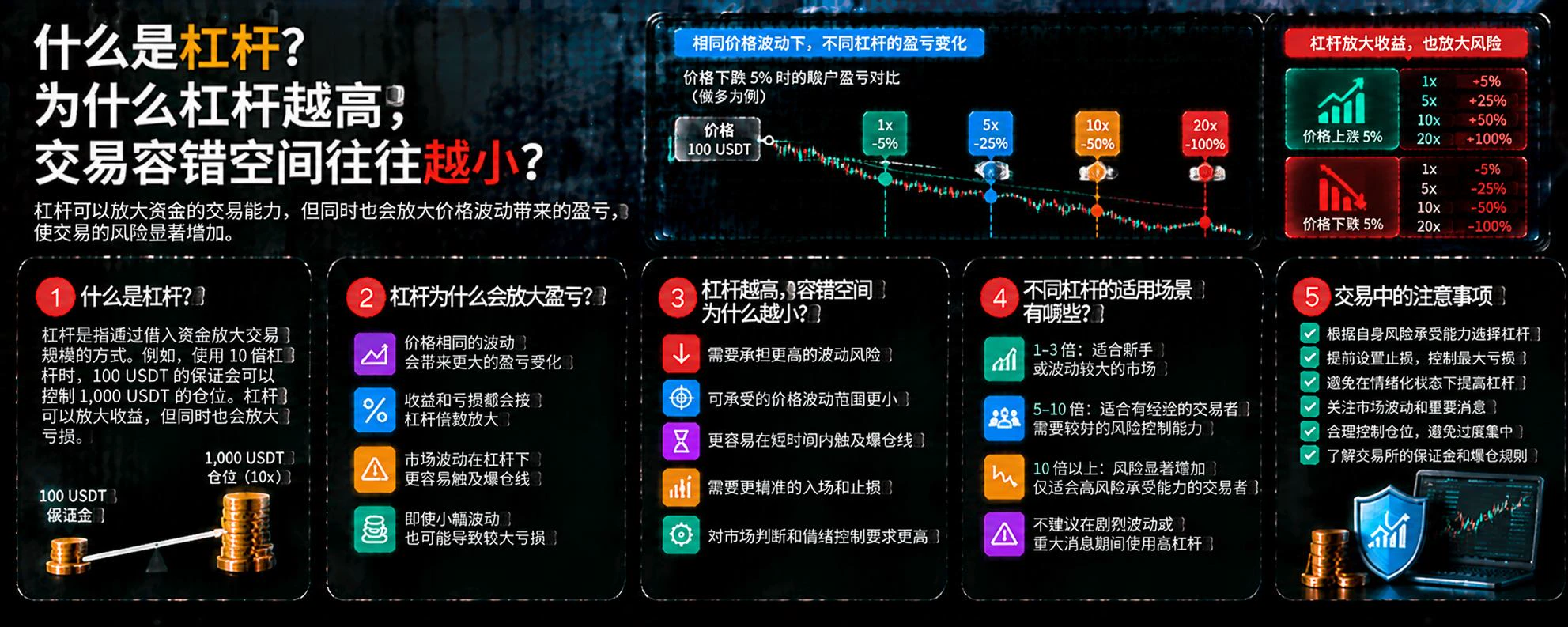
What Is Leverage? Why Doesn’t Lowering Leverage Mean Risk Is Necessarily Low?
In crypto futures trading, leverage allows traders to control a larger notional position with less margin. But the higher the leverage, the greater the impact that an adverse price move typically has on margin. What really matters is not just the leverage setting, but the relationship between the actual position size and the account equity.
First, what is a leverage ratio?
The leverage ratio usually represents the proportion between a position’s notional value and the corresponding margin. For example, 1,000 USDT in
What Is the Margin Ratio? How Can It Show How Close an Account Is to Forced Liquidation?
In crypto derivatives trading, many traders focus only on unrealized profit and loss while overlooking changes in the margin ratio. When the market suddenly moves against them, an account can quickly approach the liquidation threshold. Understanding the margin ratio can therefore help identify risk sooner.
First, what is the margin ratio?
The margin ratio is generally used to measure the relationship between an account’s margin or equity and the platform’s requirements, but definitions may vary across exch
post-image
What Is Maintenance Margin? Why Can Liquidation Be Triggered Even When Your Position Hasn’t Lost All Its Principal?
In crypto contract trading, some traders believe that as long as there is still margin in their account, their position will not be forcibly closed. In reality, platforms usually require an account to maintain a certain level of margin. This is called maintenance margin. Once the relevant requirements are no longer met, the position may enter the liquidation process.
First, what is maintenance margin?
Maintenance margin is the minimum margin required to keep an open contract posi
post-image
What Is the Difference Between Isolated and Cross Margin? Why Does Margin Mode Affect Account Risk?
In crypto contract trading, margin mode affects account risk just as leverage does. Isolated Margin and Cross Margin are two common modes. They differ in how the platform allocates margin and how much of your funds may be exposed to losses.
First, what is Isolated Margin?
Isolated Margin typically allocates a specified amount of margin to a position. If that position incurs losses, the risk is mainly limited to the margin allocated to it, although the exact rules depend on the platform. Traders
CROSS+2.15%
What Is Forced Liquidation? Why Might Leveraged Traders Be Forced Out Before a Price Rebound?
In crypto futures trading, some traders correctly predict the eventual direction yet still exit at a loss. This may happen because the price hits a risk threshold the account cannot withstand before reversing, causing the platform to forcibly close the position.
First, what is forced liquidation?
Forced liquidation occurs when a margin account no longer meets the platform’s maintenance margin requirements, and the trading platform closes some or all of the position according to its rules. The specific
What Are Long Squeezes and Short Squeezes? Why Can Concentrated Positions Amplify Price Volatility?
In the cryptocurrency market, prices can sometimes surge or plunge suddenly in a short period, with sharp volatility even when there is no obvious new development. One reason behind this is that when leveraged positions become concentrated, price movements can trigger a chain of position closures or forced liquidations.
First, what is a short squeeze?
When a large number of traders hold short positions, a sudden rise in price may force some of them to buy back their positions to close them. Leve
What Is the Long-Short Ratio? Why Can Prices Still Fall When There Are More Longs?
In crypto futures markets, many traders watch the Long-Short Ratio to gauge market sentiment. When data shows significantly more longs than shorts, some believe prices should rise. But that is not necessarily the case, because the Long-Short Ratio reflects position distribution under a specific set of metrics, not a definitive prediction of future price direction.
First, what is the Long-Short Ratio?
The Long-Short Ratio is typically used to compare the number of long and short accounts, the proportion of accoun
post-image
BLSH+2.72%
Why could falling prices and rising OI indicate stronger bearish pressure while also signaling a risk of a rebound?
In the crypto derivatives market, when prices continue to fall while open interest (OI) rises at the same time, many traders assume that short positions are increasing and the market may continue to weaken. But this is only one possible explanation; the market direction cannot be confirmed based on just two indicators.
First, what do falling prices and rising OI mean?
This means that open contract exposure is increasing as prices fall. New long and short positions may be opening,
post-image
  • 1
Price rises and OI increases: Does this mean capital is entering or risks are building up?
In crypto derivatives trading, when prices rise and open interest (OI) also increases at the same time, many people assume that longs are continuing to enter the market and that prices may keep rising. But this judgment is not always correct, because OI reflects outstanding contract exposure, not the market’s net long capital.
First, what do rising prices and rising OI indicate?
This usually means that outstanding contract exposure is also increasing as prices rise, and market participants are opening or
post-image
  • 1
What Is Open Interest (OI), and How Does It Help Us Track Changes in Market Leverage?
In crypto derivatives markets, rising prices do not necessarily mean market risk is declining, and falling prices do not necessarily mean all traders are exiting. In addition to price and trading volume, Open Interest (OI) is also an important metric for analyzing market structure.
First, what is OI?
OI refers to the number or notional value of contracts in the market that have not yet been closed out or settled at expiry. It reflects the contract exposure that remains open, but is not directly equivalent to
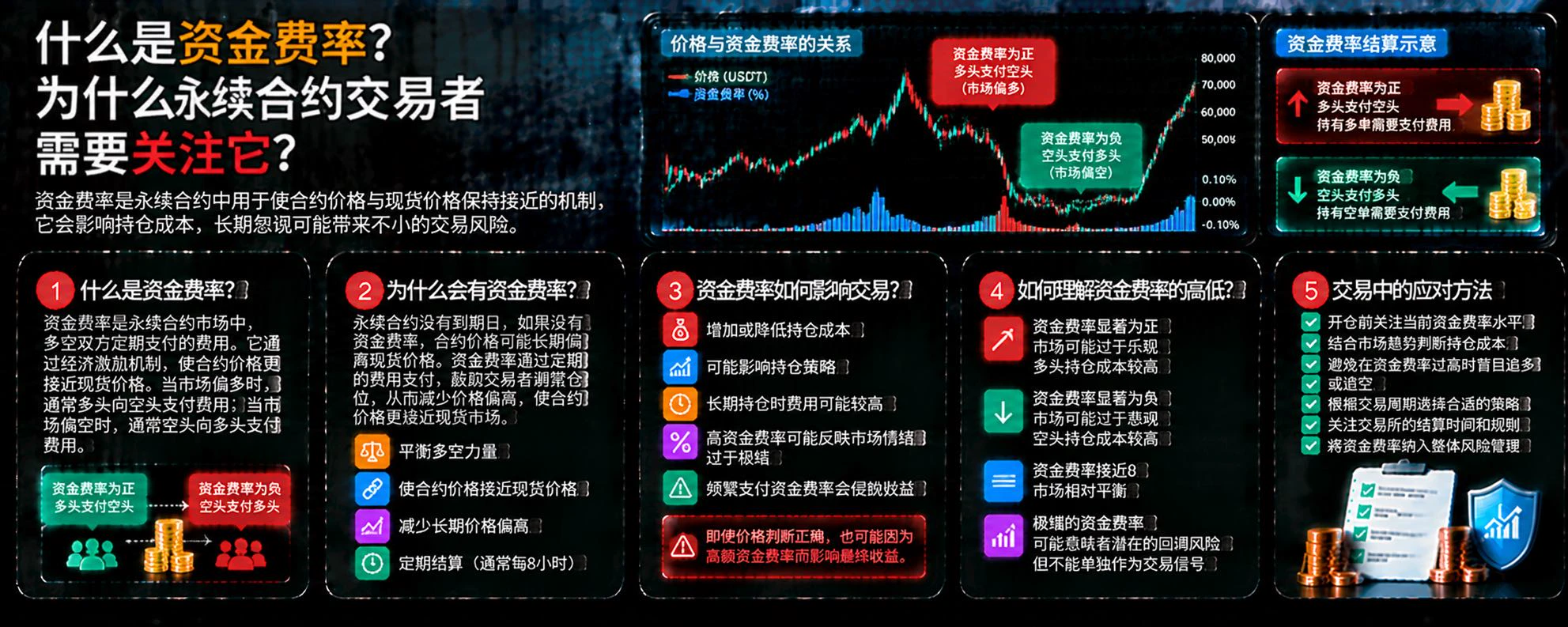
Do High Funding Rates Mean the Market Is About to Reverse?
In crypto perpetual futures markets, when funding rates remain high, many traders assume that longs are overcrowded and prices are about to fall. But high funding rates are not a reliable reversal signal. The key is to understand what they reflect and what other evidence is needed.
First, what do high funding rates indicate?
Under common perpetual futures mechanisms, persistently positive and elevated funding rates usually indicate strong demand for long positions or that futures are trading at a premium to spot. This may reflect optim
post-image
Load More