Square
Following
Hot
News
Profile

LunaCircuit

vip
Active for: 0.6y
Peak Tier 0
On-chain metrics enthusiast, enjoys tracking capital inflows and smart money movements. Doesn't post often, but every post comes with charts and logical analysis.
105
Following
12
Followers
3
Liked
Is 0.06 really coming? The selling pressure is making my scalp tingle.
BullishBanter01
$CAP STILL BEARISH — IS 0.060 NEXT?
$CAP dropped hard from 0.0888 and selling pressure is still strong.
Below 0.067–0.068 → 0.060 becomes the next key target.
Bulls need to reclaim 0.075 to weaken this bearish setup.
Holding the key level is a victory. The bulls have regained the initiative, and the next target can now be watched.
BullishBanter01
ALTCOINS RECOVERING AGAIN ... SUPPORTS ARE DOING THEIR JOB
#Altcoins are looking stronger again after the recent correction. The support zones we were watching are holding, and buyers are stepping back in.
$SOL : +0.77%
$AVAX : +13.02%
$LINK : +8.48%
$QNT : +6.75%
This is exactly what we wanted to see after the pullback ... support holds first, then momentum returns.
As long as these key support zones remain protected, the bullish recovery structure stays valid and higher levels can come back into focus.
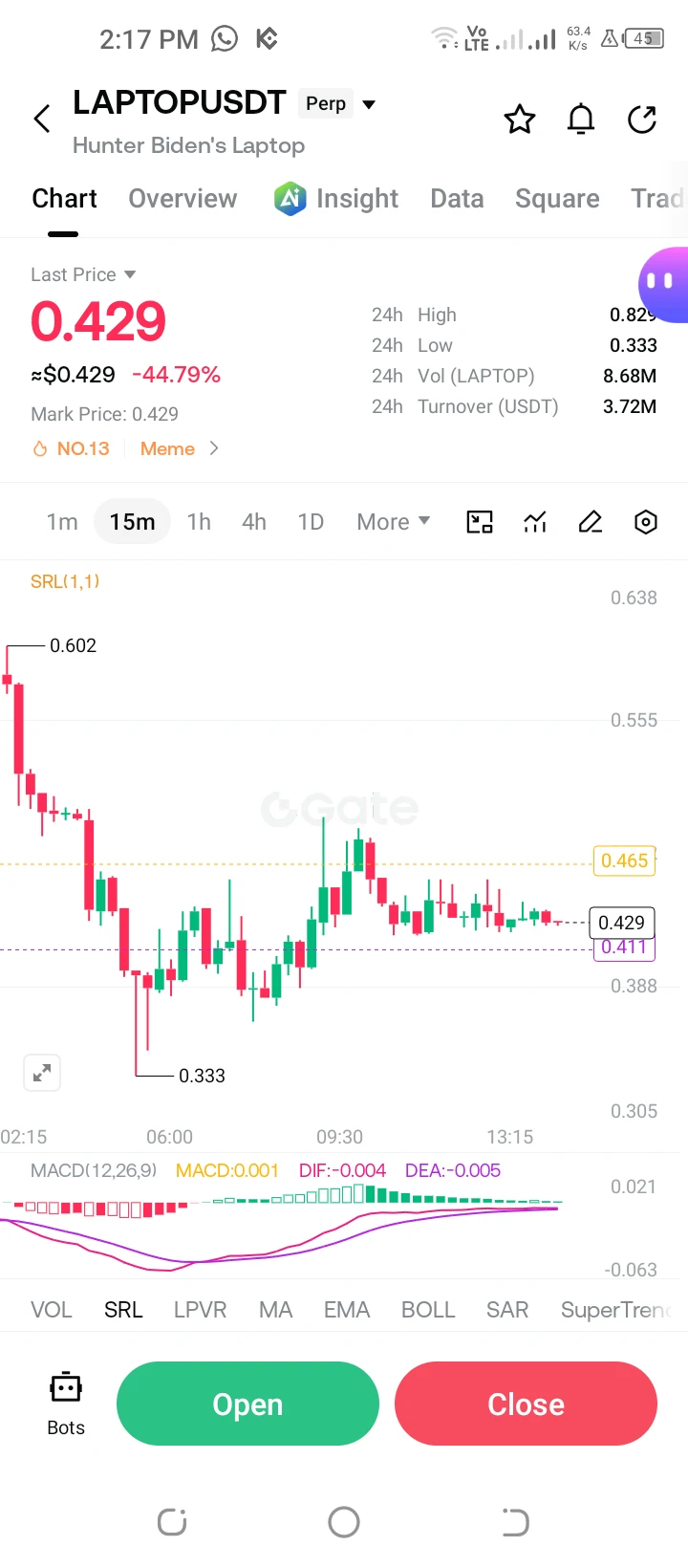
The risk-reward ratio on this LAPTOP short looks attractive: entered at 0.435, with dual targets at 0.411 and 0.380, and the stop-loss at 0.470. Clear structure. Waiting for the weak rebound after extreme panic to peter out, then following through.
Cryptoluter
$LAPTOP /USDT Perp – "Extreme Crash – Short"**
**Trading Plan Short $LAPTOP
Entry: 0.435
SL: 0.470
TP1: 0.411
TP2: 0.380
Explanation: Extreme capitulation from the 0.829 high. Shorting the current weak relief rally targets the purple support at 0.411, with an extension to 0.380.
#weeklyshare
repost-content-media
LAPTOP+5.04%
At first, I thought testnet points were just for practice—just running through the motions. But the more you do, the greedier you get, always thinking, “What if an airdrop is based on points someday?” That’s when you need to set a stop-loss limit for yourself—for example, spend no more than two hours a day on interactions, and stop once you go over. Put simply, once your expectations rise, your investment of time and effort can easily spiral out of control, so it’s better to set the rules in advance.
Recently, I saw people in a group comparing RWA with U.S. Treasury yields. To be honest, on-ch
RWA-3.40%
To be honest, when it comes to PFPs and memberships, I usually look at capital inflows first, then discussion heat. Short-term attention can drive prices up, but it cannot retain users; long-term value depends on whether people genuinely treat it as an “identity,” rather than using it as a profile picture to show off for two days before discarding it. On-chain data doesn’t lie, and smart money flows are more telling than shilling.
The same goes for modular blockchains: developers are talking about them enthusiastically, while users still open their wallets looking completely confused. No matte
I just went through a few DAO proposals and found them pretty interesting. On the surface, they’re all about governance optimization and community incentives, but if you follow the wallet addresses deeper, you often find that it’s actually controlled by multisigs or big whales. The reward structures hidden in the proposals amount to dangling carrots for voters—the real big share still sits in the hands of a circle of “loyal users.”
During the recent wave of new L1/L2 projects pulling in TVL, the comments were full of long-time users complaining about “digging and selling.” But if you look at i
I was just checking the fund flow of a certain protocol. The chart keeps spinning, and the Subgraph is stuck in a pending state. It’s especially annoying in moments like this—when you can clearly see a smart money route moving, but the data panel refuses to update. Between RPC rate limiting and everything, you’re just staring at it. The indexer can’t keep up, blocks have already been mined for a while, yet you’re still waiting for node responses.
Honestly, the re-staking “matryoshka doll” controversy these days is pretty interesting. People argue whether the returns are truly compounded or jus
Stablecoins are the real killer move that brings blockchain into real-world finance.
Venandi
#SummerCreationCamp
Stablecoins Might Be Crypto's Greatest Success Story
When most people think about crypto, they think about volatility.
Huge rallies.
Sharp corrections.
The constant search for the next big opportunity.
But the part of the industry that's quietly making the biggest impact isn't the most exciting.
It's stablecoins.
Unlike speculative assets, stablecoins aren't trying to outperform the market.
Their goal is much simpler: move value quickly, efficiently, and across borders.
That simplicity is exactly what makes them so powerful.
Over the past few years, stablecoins have become more than just a tool for traders.
They're being used for international payments, settlements, remittances, decentralized finance, and as a bridge between traditional finance and blockchain.
For millions of people, they're one of the first practical reasons to use crypto.
To me, that's what real adoption looks like.
Not just higher prices.
Not just more hype.
But technology solving everyday problems.
Of course, challenges remain.
Regulation is evolving.
Different stablecoins carry different levels of risk.
Transparency and reserve management continue to be important topics.
But despite those challenges, it's hard to ignore the role stablecoins now play in the digital asset ecosystem.
Sometimes the most valuable innovation isn't the one making headlines.
It's the one quietly becoming part of everyday financial infrastructure.
Years from now, people may not remember every meme coin or market narrative.
But they may remember that stablecoins helped bring blockchain technology into real-world finance.
What's your opinion? Do you think stablecoins are crypto's most practical innovation, or is another sector making a bigger impact?
I looked through on-chain data this morning, and the total stablecoin supply is quietly pushing upward again—both USDT and USDC are seeing activity. But to be honest, the net inflows from ETFs often don’t line up with this kind of rhythm. Last week there was a large subscription, yet stablecoins actually flowed out a bit. In any case, you can’t simply treat it as a chain like “ETF buying → stablecoin increases → the market is going up.” It’s true that the correlation is high, but it’s easy to mix up the causality.
This week, the perpetual funding rate has again run into extreme territory, and
USDC+0.04%
Whales are starting to relocate again—$52 million worth of activity. Are they preparing to dump, or are they switching positions?
Original content no longer visible
The U.S. military denies striking Halq Island. The news eased the pressure on oil prices, but with the Middle East’s powder keg, who can say for sure?
Original content no longer visible
A new twist in the petrodollar playbook: Fujairah becomes an alternative delivery point, Zakum’s upward differential rises by 0.8, Umm Lulu’s differential rises by 1, and Persian Gulf oil fields begin walking on two legs—maintaining traditional channels while also building in safety redundancy. The subtle shift in the Middle East energy landscape is worth keeping a close eye on.
Original content no longer visible
The short-term holders are still pushing up; the buyers haven’t backed down. The trend hasn’t reversed—keep watching the show 👀
Original content no longer visible
Silicon Valley VC godfather joins a Federal Reserve working group—will AI policy change dramatically?
Original content no longer visible
If your first order loses, you get coupons to recover. Invite friends to team up and you can share 5k USDC. Those who do leverage during the World Cup can go check it out.
Original content no longer visible
USDC-0.02%
Geopolitical conflicts have escalated again, and energy infrastructure has become the target—this war is getting ever more reckless, with no bottom line.
Original content no longer visible
What I fear most isn't slowness—it's chaos.
Scrolling through Twitter lately, one moment it's testnet points, the next it's mainnet token launch expectations. Before you even finish scanning smart money wallets, a new narrative pops up. I've got a bunch of data dashboards open, and the more I look, the more anxious I get—eventually, I end up doing nothing.
In plain terms, when narratives rotate, on-chain metrics actually become clearer—whether real capital is flowing in, whether smart money is positioning or just short-term trading—these things don't lie. My current approach: lock in one or tw
Within two weeks, return 16 million ADA. SecondFi's remedial action was timely enough; the victims can finally breathe a sigh of relief.
Original content no longer visible
ADA-2.62%
Hong Kong's stablecoin is finally getting serious—with bank backing and regulatory licenses, the compliance path is becoming clearer. Just waiting to see how it plays out in the second half of this year.
WuSaidBlockchainW
Wu Says learned that the Hong Kong government stated in a written reply to the Legislative Council that the Hong Kong Monetary Authority (HKMA) granted stablecoin issuer licenses to two institutions with banking backgrounds in April 2026.
According to the current business plans of the two institutions, Hong Kong's regulated stablecoins are expected to be launched between mid-year and the second half of this year.
The Hong Kong government said that the HKMA has sent letters to unregulated entities operating stablecoin issuance businesses in the market to explain legal requirements and will continue to follow up; if necessary, individual cases may be referred to the police or the Department of Justice for handling.
The government also stated that it will submit a bill to the Legislative Council this year to establish a regulatory framework for providers of virtual asset trading, custody, advisory, and management services.
New Hampshire's move is quite practical: a $2,000 limit plus a 48-hour cooling-off period. Finally, someone is addressing fraud prevention for the elderly.
WuSaidBlockchainW
According to New Hampshire Public Radio, a new law in the U.S. state of New Hampshire requires cryptocurrency ATMs to add anti-fraud protections, setting a daily transaction limit of $2,000 for crypto ATMs and establishing a 48-hour cancellation and refund window. If victims report the scam to law enforcement within two weeks of being defrauded, the crypto ATM operating company must provide a full refund. The report states that the regulation aims to address the issue of scammers luring victims, particularly the elderly, into transferring money through crypto ATMs.