Square
Following
Hot
News
Profile

YieldYuki

vip
Active for: 0.6y
Peak Tier 0
Yield farming isn’t about chasing the highest returns, it’s about sustainability. I love making comparison tables: sources of interest, risk points, exit liquidity—listing them one by one.
61
Following
11
Followers
5
Liked
78,888—this number looks familiar. Wait until the 18th comes back to slash you.
rtsky777
Recently, I’ve found these two Gate activities pretty interesting. They’re not the kind of pure tasks you look at once and immediately scroll past.
CNPY’s CandyDrop prize pool has reached 851,200 CNPY, and the tasks aren’t too much of a hassle. You can just complete them while you’re at it.
But I’m more interested in the BTC price prediction.
Predict BTC’s price at 20:00 on September 18 (UTC+8), and in the end, see who guessed the closest. The top 200 participants will also receive extra rewards.
I actually prefer this kind of activity.
There’s no need to guess how the project team will play it. Just guess how the market will play it.
My prediction:
78,888
It might seem outrageous right now, but I’ll come back on the 18th to check.
With something like the market, analyzing it a hundred times verbally is no better than leaving a number in advance.
Don’t miss it:
#GateBooster #CandyDrop #CNPY

repost-content-media
I just pulled the yield data for several restaking pools again, and the numbers gave me a headache. On the surface, the APYs stack beautifully—7%+9%+12%—making it look like a passive-income machine. But when you break them down one by one, they all rely on the same validator set underneath. It’s like buying three insurance policies, only to find that the same person would be paying you in case something goes wrong. Anyway, in my table, overlapping sources get marked in red: returns can stack, but risk can’t.
I’ve seen the community arguing about privacy coins and the boundaries of compliance,
This is the third time I’ve seen a fork involving AI and human interaction in the same contract. I still have to say: Agents are incredibly nimble at executing on-chain workflows, but when it comes to judging “whether they should act at this moment,” they’re really not there yet.
I’ve run several simulated stress tests on exiting liquidity. The data was comprehensive enough, but when it came time to assess changes in pool depth, sudden spikes in slippage, and those hard-to-define turning points in community sentiment, it would rationalize its way through the problem.
Put simply, AI excels
Before going to sleep, I checked my wallet and found that an old protocol I’d stopped using long ago was still showing an infinite-allowance approval. I got so scared that I sat up right away to revoke it, and I cleared a few other approvals while I was at it too. Honestly, this stuff is far more terrifying than I thought—once you approve a contract, if it gets hacked one day, or if the official side changes the logic on its own, it can directly transfer away all the balances in your account.
Recently, new L1/L2 incentive programs rolled out, and a bunch of people rushed in to “mine, withdraw
When I see an arbitrage opportunity, honestly my first reaction is: “Is this cutting someone else’s fees—or mine?” After you’ve been running on-chain for a while, you really do develop a bit of “awe.” To you it’s profit; to them it’s a gas fee cut. I used to pay attention to big-name influencers who talk about arbitrage strategies too—their content is definitely pretty detailed—but later I slowly unfollowed them. It wasn’t that what they said was wrong; it just felt like that “making quick money” mindset could steer me away from the habits I’m used to. I’m still more comfortable sticking to th
To be honest, I’ve been seeing a lot of heat around LSTs and restaking lately, so I couldn’t help but flip through my own comparison tables again. When it comes to returns, it’s basically a matter of node-operator rewards plus protocol incentives. As for sustainability, it depends on whether the protocol itself has real substance—for example, whether validator control is legitimate and how deep the liquidity pool is.
On the risk side, one issue is a mismatch with the underlying assets (such as delayed ETH redemptions), and the other is problems with smart-contract pegging. Recently, new L1/L
ETH-0.38%
A one-year prison sentence in exchange for $5 million in transaction volume—this ROI is more stimulating than DeFi mining, it’s just that the address is a bit of a hassle.
WuSaidBlockchainW
According to Procuratorial Daily, police in Xiangyang, Hubei, previously seized an Audi sedan at a highway service area. Inside the car, 5 book bundles contained 9 million yuan in cash. The investigation found that the relevant persons, acting on instructions from an upper-level contact, collected RMB cash within the country and used virtual currency as a cross-border intermediary, paying foreign currencies such as Hong Kong dollars overseas, using a “wash trading” approach to bypass foreign exchange supervision. From August 2023 to June 2025, the group’s illegal exchange of currency totaled more than 5 million yuan. In February this year, the court sentenced the principal offender to one year in prison for the crime of illegal business operations; the other 3 people were sentenced to between 8 and 10 months, and were each fined, and the judgment has taken effect.
EigenLayer 的 points airdrop just wrapped up, and in the group someone is already calculating how many layers of “re-staking matryoshka” you can stack for returns. I checked my table and found that the interest rate source for the top layer is written as “expected”—basically, it’s betting that other people will keep betting.
“Shared security” sounds like everyone is sharing the risk, but in reality you stake ETH with Protocol A, and Protocol A then stakes it with Protocol B. If any link in the chain has a liquidation delay or the oracle goes haywire, your exit liquidity gets frozen straight awa
EIGEN-2.60%
ETH-0.38%
If the bill is passed in the US, the global compliance narrative will have to change its script—wait for the details to see which tracks reap the benefits first.
Original content no longer visible
The pace of whale withdrawals is a bit steady—does that count as another kind of bearish signal?
Original content no longer visible
The open orders on the left side don't require watching the screen; mechanical execution truly saves effort. Once the stop-loss line is set, just leave it to the market.
CityLittleOverlord
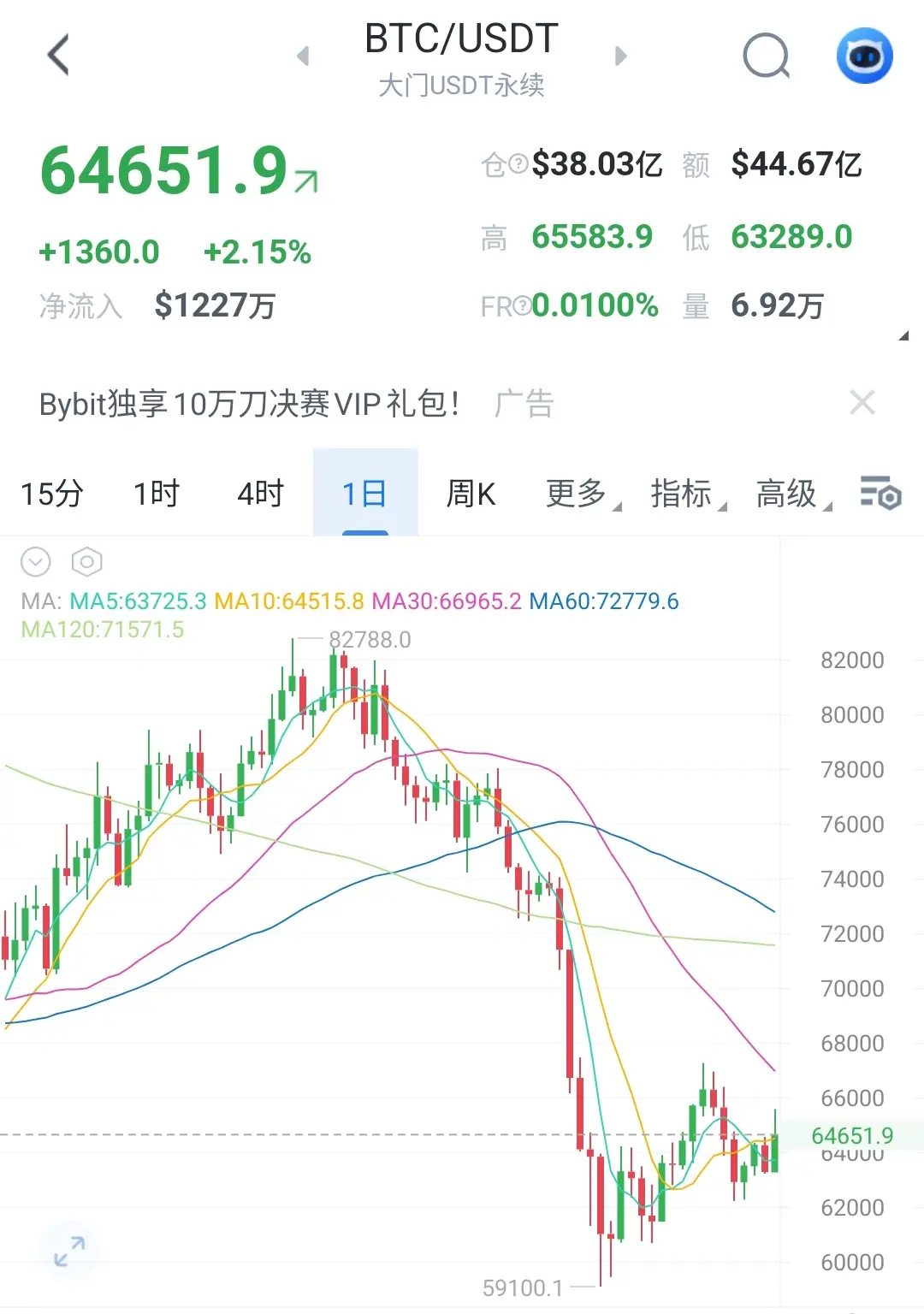
Right now, after a round of pullback and shakeout, the support beneath is gradually becoming apparent. The short-term corrective rally is ready and in place, so here is a precise limit-buy long position plan for everyone—beginner traders can refer to it directly and execute.
## 1. Limit price partial entry range: 62400 — 63188
Don’t chase the immediate upward push; instead, place limit orders to lie in wait for a low entry. Divide the plan into two stages to spread out volatility risk:
1. **Near 63188:** take a light position as the initial baseline; if the market retraces slightly, the order will be filled.
2. **Deep retracement to around 62400:** increase the position size here. This is the core support of this round of consolidation. Buy orders are densely stacked, so the downside room is extremely limited, and the risk-reward ratio is maximized.
Throughout the entire process, you “wait on the left side”—you don’t need to watch the chart to chase orders. Set your limit orders and wait for them to fill, avoiding the risk of getting trapped by chasing longs after a spike.
## 2. Three-stage, stepped take-profit—take profits in segments without missing out
This rebound will realize profits in three target tiers step by step. At each resistance level, reduce positions to balance capital preservation and fully capturing the move:
1. **First take-profit at 64400:** the first tranche of resistance pressure in the short term. When it is reached, sell half your position to lock in base profits and reduce psychological pressure on the holding.
2. **Second take-profit at 65900:** the dense trapped-order area in the medium term. Reduce the remaining core position by half again, leaving only a small portion to bet on even higher upside.
3. **Third take-profit at 67300:** the ultimate target of this rebound. If there is a breakout with increased volume above the first two resistance levels, fully close your position and exit—fully capturing the gains from the entire swing.
## 3. Hard defensive stop-loss: 61375
This lifeline must be executed strictly; it is the key dividing line for determining whether the long-side logic has failed.
If the price breaks below the 61375 support with effective downside volume, it means the bottom support from this round has completely collapsed. The short-term downside room will open further, the long-position idea becomes entirely invalid, and you must cut losses without conditions and exit—never hold on to a deep trap.
At this stage, the market mainly focuses on choppy repair. Back-and-forth needle moves are normal; frequently placing orders manually makes it easy to lose repeatedly.
By using limit orders for phased deployment and laddered take-profit execution, you can mechanically follow the trading plan and reduce interference from emotions.
Participate with light positions, strictly follow the stop-loss, set up long positions by “waiting on support,” and patiently wait for the rebound to realize the gains!
#我的Gate交易时刻 $BTC ‌
repost-content-media
67M position, average price 1735, liquidation price 2625, this safety margin is thick enough, +20 million profit is not luck
Original content no longer visible
A big player with a $70 million notional opened a $1.5 million long on XYZ100, and the liquidation price is $0—so is this an infinite margin mode? Followed along—let’s see if the on-chain crude oil trend indicator can take off this time.
Original content no longer visible
5.6M ETH holdings + 8.1 billion staked; institutional-level confidence is at its peak, but a 500 million cash reserve leaves a safety margin—still, it suggests they fear volatility.
Original content no longer visible
ETH-0.38%
Institutions say they haven't reached the bottom, but their actions are already heading toward AI. I've seen this script before.
Original content no longer visible
NATO jet fighters have all been deployed. What's the deal with this drone?
Original content no longer visible
Offshore prediction market trading volume is quickly catching up to compliant platforms, and regulatory arbitrage is a much bigger business than expected.
WuSaidBlockchainW
Consulting firm Crane Zeng released a report stating that the trading volume of offshore prediction market platforms accessed by U.S. users via VPNs and other methods has reached $11 billion to $34 billion, with Polymarket accounting for $11 billion to $27 billion. The report estimates that offshore platforms account for 12.5% to 31.5% of U.S. prediction market trading volume, with about 30% of Polymarket's trading volume coming from U.S. users. Data shows that the trading volume gap between regulated platforms and offshore platforms is narrowing. During the reporting period, CFTC-regulated platforms such as Kalshi and IBKR ForecastEx handled a total of approximately $74 billion in trading volume, while offshore platforms totaled about $85 billion. (The Block)
Mining company's earnings season, Canaan's holding structure is quite interesting, with a dual bet on BTC + ETH, driven by both proprietary and client sides, serving as a transformation example for veteran mining hardware companies.
WuSaidBlockchainW
Nasdaq-listed Bitcoin mining company Canaan Inc. released updated Bitcoin mining operation data for May 2026, revealing that self-mined output was 90 BTC, with an additional 24 BTC from customer payments. As of the end of May, the company's crypto asset reserves included 1,867 BTC and 3,952 ETH.
BTC-0.78%
ETH-0.38%
ARX and RE have been added to Coinbase's asset roadmap, but we still need to wait for technical conditions to be met. The specific launch time is to be determined. Stay tuned.
WuSaidBlockchainW
Coinbase announces the addition of Arcium (ARX) and Re (RE) to the asset roadmap. Coinbase states that the listing and trading of the two assets still require support from market makers and related technical infrastructure; once the conditions are met, the specific trading launch time will be announced separately.
Today I saw someone say that those “coincidental transfers” on-chain are too mystical… I usually don’t believe in coincidences, so let’s break down the path: Is the funds coming from the same entry point (the same CEX / same cross-chain bridge), is there a fixed “cleaning” point in the middle (commonly an aggregator / routing contract), and finally, are they ending up in the same LP pool or the same lending position to top up collateral? Many times it’s just the same script running on different addresses, and the timestamps being close together makes it look like collusion.
Recently, everyone