Square
Following
Hot
News
Notifications
Profile

DeltaSmile

vip
I don't trade large options positions, but I love analyzing volatility like reading an EKG. I enjoy explaining complex strategies in plain language.
Peak Tier VIP 00.6 Year(s)
75
Following
11
Followers
1
Liked
Stay true to your original intention. Mark this down
JsBigShark
In the trading markets, only a few people make money
As you turn your insight into profits, stay true to yourself
Keep striving, keep cultivating yourself
“Do you ever have those moments when your fingers get ahead of you?”

Yesterday I nearly entered my seed phrase into a “Claim Airdrop” pop-up. My finger was hovering over the confirm button when it suddenly hit me—what legitimate project would ever ask for your seed phrase? I broke out in a cold sweat.

Honestly, phishing sites are looking more and more real these days: domain names off by one letter, UI copied 1:1, even gas estimates laid out crystal clear. But there are only a few hard rules: your seed phrase is everything, never give it out; before signing an authorization, check whether it
RWA-0.39%
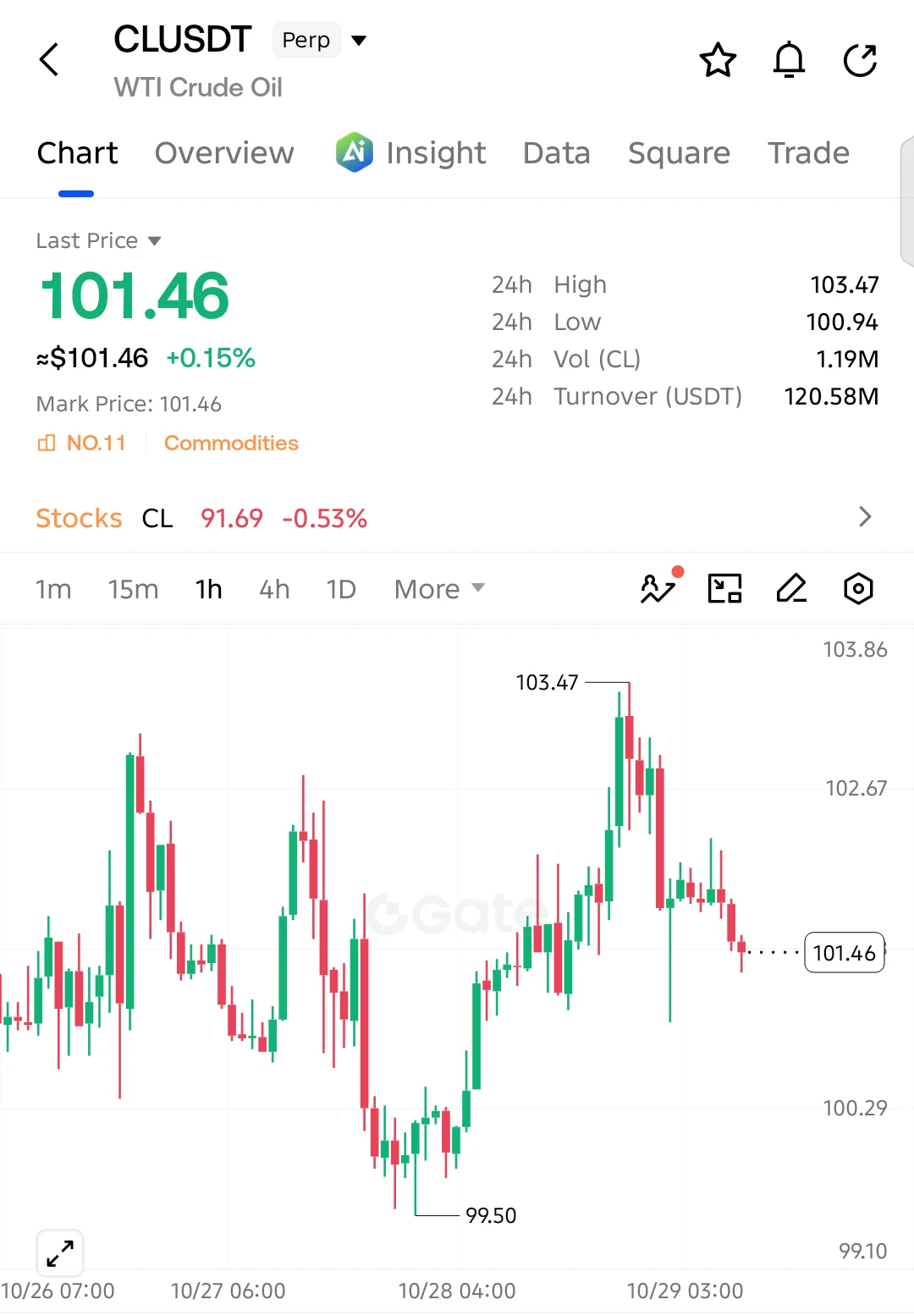
$CL This short looks pretty good. If 101.4 breaks, it’ll head straight for 100. Stop-loss set at 102.2, risk is under control
anasta_maverk
$CL SHORT SETUP — 100 NEXT?

$CL is showing bearish pressure on the 1H chart after a sharp rejection from 103.47. Sellers are forming lower highs, and price is now testing the 101.40 support area. A confirmed breakdown could open the door toward 100.

Entry: 101.40–101.60
SL: 102.20
TP1: 101.00
TP2: 100.50
TP3: 100.00
Extended Target: 99.50

As long as price stays below 102.20, the bearish setup remains valid. A sustained break above that level would weaken the short outlook.
repost-content-media
CL-1.83%
$BFC This sell-off is pretty brutal; 37% isn’t a signal to buy the dip. I’ll wait until it stabilizes above $0.027 before taking another look
Rock95
$BFC has plunged 37.42% to $0.024732.

This is extreme downside momentum, not an automatic bargain.

I'm watching whether price can establish a stable base. A recovery above $0.0270 would be an initial improvement, but downside risk remains elevated.
BFC-4.74%
A 30% gain is indeed eye-catching, but the key is still how much it can hold during a pullback—that’s the real test
CanDx
$Q at $0.070563, up 30.74%. One of the strongest movers in these screenshots. The gain is impressive, but how much of it survives a pullback will tell us more.

#USSeptemberPPIBeatsExpectations #GateWCTCS9GlobalTradingCompetition
SUI is deciding within the 1.03–1.19 range; unlocking-related selling pressure and insufficient volume are risks, so wait and see for now.
Anaya
SUI is testing channel support after a sharp rally that took it back toward the $1.10–$1.16 area. Analysts are watching $1.03–$1.19 as the next decision zone. A hold keeps the rebound intact; a break turns the move into a fade. Token unlocks and thin follow-through are the near-term risks. DYOR. #write2earn
#SUI #Sui $SUI ‌
SUI-1.05%
$ONDO 's 23% surge is indeed impressive, but chasing the top could leave you holding the bag; waiting for a pullback is safer.
Rock95
$ONDO is the strongest performer on this list, gaining over 23% to reach $0.5088. Momentum is powerful, but the sharp expansion also increases pullback risk.
My view: Bullish, but I would avoid chasing and wait for consolidation or a healthy retest.
#ONDO #OndoFinance #RWA
ONDO-0.29%
When I first got into crypto, I thought stablecoins were literally “stable”—$1 would always be $1, just like a bank deposit. Now I look at USDT’s monthly reports like medical checkup results: how much Treasuries and cash are in the reserves, whether there’s any commercial paper… It actually makes me even more nervous.

Put simply, a depeg doesn’t happen because the reserves are gone; it happens because everyone thinks “others are going to run,” so they all run for the exits together. A bank run moves even faster on-chain than at a bank—it’s a matter of one block.

MEV has been a hot topic late
The full version is ready—go get it now.
Original content no longer visible
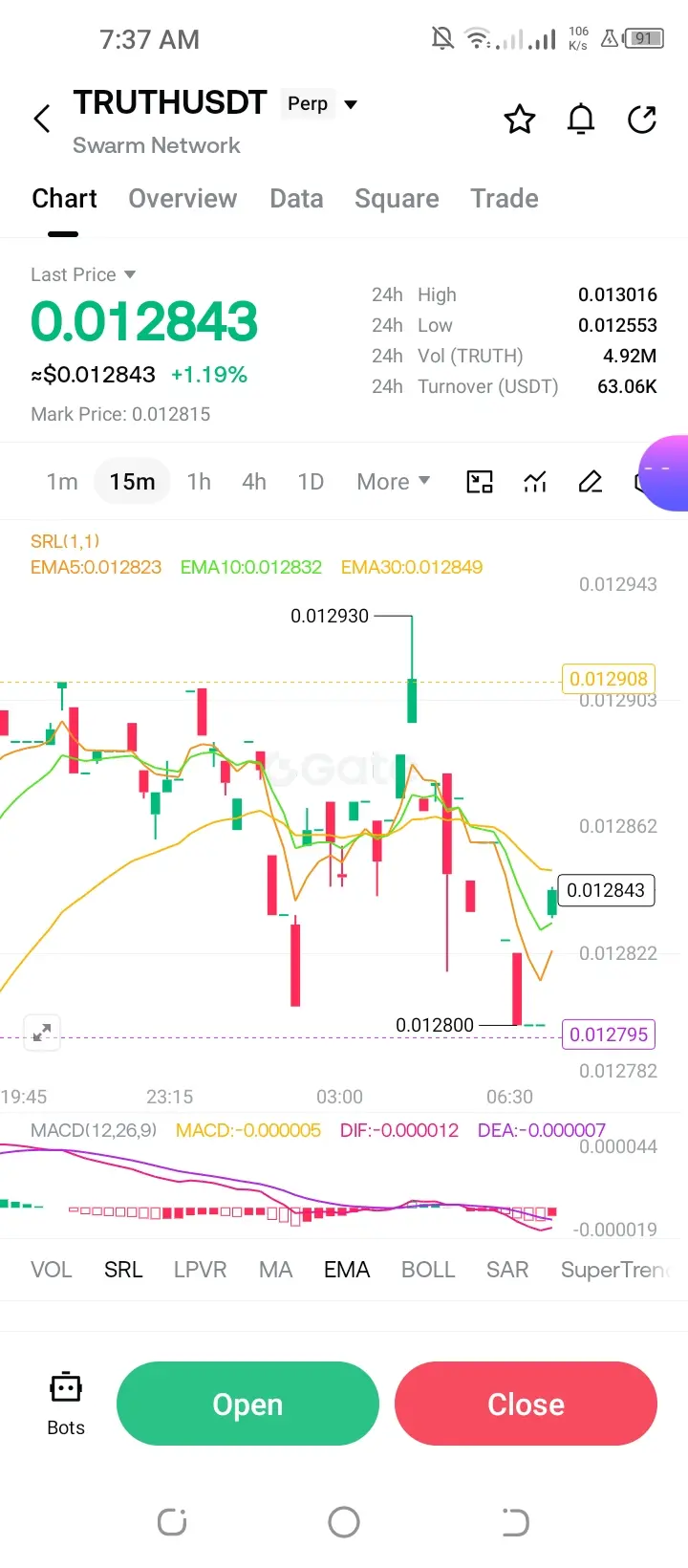
$TRUTH A short-term rebound to 0.0129 is a short entry point; place the stop-loss above 0.01300, with an initial target of 0.01275. Add to the position in the direction of the trend if 0.012800 breaks.
Cryptoluter
$TRUTH /USDT Perp – "Bearish Rejection – Short"**
**Trading Plan Short $TRUTH
Entry: 0.01286 – 0.01290
SL: 0.01300
TP1: 0.01275
TP2: 0.01265

TRUTH is down -1.19% at 0.012843, trading below the EMA5 (0.012823) and EMA30 (0.012849). MACD is bearish. The 0.012908 yellow line is the sell zone. TP targets the 0.012800 low. SL above 0.01300.
#GateStockInsightsChallenge
repost-content-media
TRUTH-4.46%
Lately, the assets in my wallets have been scattered like an ECG—some on one chain, some on another—so checking my balance every time feels like doing a jigsaw puzzle. To be honest, a multi-chain wallet isn't something you absolutely have to manage, but over time it really does get messy, especially with gas and cross-chain fees being deducted here and there. In the end, even I can't figure out how much is actually left.

My current method is pretty clumsy but effective: divide the assets into three categories based on their purpose—keep most of them on the main chains I use regularly, leave o
USIDX-0.47%
I’m just a retail trader who doesn’t trade options much and checks volatility more often than candlestick charts, but lately I’ve been thinking about cross-chain stuff.

Whether you call it IBC or some kind of message-passing bridge, when you strip it down, it’s just one chain telling another, “The ledger on my side has changed.” And that raises the question—who do you trust? Validator nodes are what make you trust the source, while the relayer is just the courier. But could the courier tamper with the package or deliberately fail to deliver it? Decoding the message format is another layer alt
The August window has closed, but the bill isn’t dead; the September procedural vote will be the real test.
Ai_Power
#CLARITYActVoteWindowClosing
CLARITY Act Vote Window Closing, What Happens Next for Crypto Regulation

The CLARITY Act has entered one of the most important stages of its journey through the United States Congress. The immediate August window for a full Senate vote has closed, but the legislation remains alive and attention is now shifting toward September. Recent Senate action has kept the bill moving procedurally, creating another important opportunity for lawmakers to debate and potentially advance comprehensive digital asset market structure legislation.

This development matters because the CLARITY Act is not simply another crypto-related proposal. It is designed to establish a broader regulatory framework for digital assets and clarify the roles of the Securities and Exchange Commission and the Commodity Futures Trading Commission.

1. What Is the CLARITY Act

The Digital Asset Market Clarity Act, known as the CLARITY Act, is a major U.S. market structure bill focused on establishing clearer rules for digital assets.

The House passed H.R. 3633 on July 17, 2025, by a bipartisan vote of 294 to 134. The legislation was subsequently received by the Senate and referred to the Senate Banking Committee.

At its core, the legislation attempts to answer one of the crypto industry's biggest questions, which regulator should have primary responsibility for different types of digital assets and market activities.

That question has remained important for exchanges, developers, investors, financial institutions and technology companies operating in the digital asset sector.

2. Why the Current Vote Window Matters

The August opportunity was significant because lawmakers had hoped to move the legislation before the Senate's summer recess.

However, the Senate did not complete a full floor vote before the recess. Instead, Senate leadership took a procedural step designed to keep the legislation alive and prepare the way for further consideration after lawmakers return.

This changes the timeline rather than ending the process.

The next major focus is September, when lawmakers are expected to return and continue negotiations and procedural work around the bill.

3. The September Stage Could Be Critical

Recent reporting indicates that Senate Majority Leader John Thune filed a motion to proceed, setting up a September confrontation over the legislation. Reports indicate a September 15 procedural vote is expected.

However, investors and market participants should understand the difference between a procedural vote and final passage.

A procedural vote does not automatically mean that the CLARITY Act becomes law.

There can still be debate, amendments, negotiations, voting requirements and additional legislative steps before a bill reaches the final stage.

Therefore, September should be viewed as an important decision point rather than a guaranteed approval date.

4. What the Bill Is Trying to Change

The broader objective of the CLARITY Act is to create clearer regulatory boundaries for digital assets.

The House version establishes provisions involving digital commodities, regulatory responsibilities, registration requirements and coordination between agencies. The legislation also contains provisions concerning implementation and financial compliance requirements.

The Senate's work has involved additional negotiations and revisions.

In May 2026, Senate Banking Committee leadership released market structure bill text intended to serve as the basis for committee consideration. The committee said the proposal reflected negotiations with lawmakers and input from regulators, financial institutions, innovators, law enforcement and consumer advocates.

This shows that the final legislation may not be identical to the original House-passed version.

5. Why Regulatory Clarity Matters

One of the biggest problems facing the digital asset industry has been uncertainty over regulatory classification and jurisdiction.

Clearer rules could potentially make it easier for legitimate businesses to understand their responsibilities.

For financial institutions, clearer requirements could improve the ability to evaluate digital asset-related activities.

For technology companies, predictable rules could potentially make long-term planning easier.

For market participants, greater regulatory clarity could reduce some of the uncertainty surrounding how different digital assets and platforms are treated.

However, clarity does not automatically mean that every crypto asset becomes safer or more valuable.

Regulation can establish rules, but market risk remains.

6. Potential Impact on Bitcoin and Ethereum

The CLARITY Act is primarily a regulatory development rather than a direct price catalyst.

Nevertheless, major regulatory developments can influence market sentiment.

If investors interpret progress as a sign that the United States is moving toward a clearer digital asset framework, sentiment around the broader crypto sector could improve.

Bitcoin could benefit indirectly through stronger institutional confidence in the digital asset ecosystem.

Ethereum could also attract attention because regulatory clarity surrounding blockchain networks, digital commodities and market infrastructure could influence how institutions approach blockchain-based assets.

But it would be incorrect to assume that passage of the bill automatically guarantees higher prices.

Crypto prices remain influenced by liquidity, interest rates, economic conditions, institutional flows, market positioning and investor sentiment.

7. Possible Bullish Scenario

A bullish scenario would involve several developments occurring together.

First, Senate negotiations could produce sufficient bipartisan support.

Second, procedural votes could successfully move the legislation toward full consideration.

Third, disagreements over remaining provisions could be resolved.

Fourth, the House and Senate could ultimately align on a final version.

Such progress could be interpreted by the market as a major step toward regulatory certainty.

In that environment, crypto-related companies and blockchain projects could potentially experience stronger investor confidence.

The key word is potentially.

The market may react positively to progress, but expectations can also become priced in before final approval.

8. Possible Delayed Scenario

Another possibility is continued negotiation.

If lawmakers disagree over important provisions, the process could take longer than expected.

This would not necessarily mean that the legislation is permanently finished.

Instead, the market could experience another period of uncertainty while participants wait for lawmakers to reach a compromise.

This is particularly important because the Senate requires significant bipartisan support for major legislation to advance.

Therefore, political negotiations remain one of the most important variables to watch.

9. Why the House Vote Is Important

The House already approved the CLARITY Act in 2025 with a substantial bipartisan majority.

The 294 to 134 vote demonstrated that the legislation could attract support from lawmakers across party lines.

However, Senate consideration introduces a different challenge.

The Senate must work through its own legislative process, and any substantial changes could create another stage of negotiations between the two chambers.

This means that even a successful Senate vote would not necessarily represent the final step.

10. What Investors Should Watch Next

The most important developments to monitor are procedural and legislative rather than short-term price movements.

The first is whether the September procedural process moves forward as expected.

The second is whether lawmakers can maintain bipartisan support.

The third is whether amendments significantly change the legislation.

The fourth is whether the Senate can eventually approve a version that can move through the remaining congressional process.

The fifth is how financial institutions and the broader digital asset industry respond to the evolving framework.

These factors will provide a clearer picture than simply watching headlines about a single vote.

11. Market Sentiment Could Become Volatile

Regulatory headlines can create short-term volatility because traders may react to expectations before an actual law exists.

Positive headlines could strengthen sentiment.

Negative headlines could produce temporary pressure.

A delay could also generate mixed reactions because some market participants may view it as uncertainty while others may see additional time for negotiations as constructive.

This is why headline-driven decisions can be risky.

The most important distinction is between proposed legislation, procedural progress, Senate passage, final congressional approval and legislation becoming law.

These are different stages.

12. The Bigger Picture for the Crypto Industry

The CLARITY Act represents a broader shift in how the United States approaches digital asset regulation.

For years, the crypto industry has argued that clearer rules are necessary for innovation and long-term investment.

At the same time, lawmakers and regulators have emphasized consumer protection, market integrity, financial stability and compliance.

A successful market structure framework would therefore need to balance both objectives.

Too much uncertainty can discourage legitimate innovation.

Too little oversight can create problems for consumers and financial markets.

The challenge is finding a workable middle ground.

13. Why September Could Be More Important Than August

The closing of the August vote window does not mean the story is over.

In fact, the procedural action taken before the recess suggests that lawmakers intend to keep the legislation active.

That makes September particularly important.

The next stage could reveal whether the Senate has enough support to move from procedural progress toward substantive consideration.

The market will likely pay close attention to every major development because regulatory clarity has become an increasingly important part of the digital asset investment narrative.

14. Final Analysis

The CLARITY Act remains one of the most significant pieces of U.S. crypto market structure legislation.

The August window closed without a full Senate vote, but the bill has not disappeared. Senate leadership has taken steps to preserve a path toward further consideration in September.

The biggest opportunity is clear regulatory guidance that could provide businesses and market participants with greater certainty.

The biggest challenge is equally clear, lawmakers still need to resolve political and policy disagreements and secure enough support for the legislation to move forward.

For the crypto market, the next major question is therefore not simply whether the CLARITY Act receives attention.

The real question is whether September can convert procedural momentum into meaningful legislative progress.

If that happens, the development could become an important milestone for the U.S. digital asset industry.

If negotiations stall again, uncertainty could remain a major theme.

For now, the most balanced conclusion is that the CLARITY Act is delayed, not dead.

September could be the next major test.

Ai_Power
repost-content-media
I almost forgot I still have another account, 😂. It hasn’t really been active lately—mostly I’ve been doing tax prep for the end of the year. I used to think that grabbing a screenshot of on-chain records on the spot would be enough. But last year, when I reconciled everything, it almost broke me—can you imagine putting together more than a hundred DeFi interactions, C2C, and farming/claiming airdrops one by one along the timeline, like assembling LEGO bricks? Anyway, now I’m being very old-school and carefully saving all on-chain records into Excel, with notes for fees, deposit/withdrawal ad
I just happened to check my wallet permissions—wow—there are a few failed, unfinished mining contracts still showing up with unlimited approvals. This feels like writing your bank card password on a sticky note and taping it to the outside of your front door: most people stare at the K-line charts every day to prevent a crash, but they forget that authorization loopholes are the real danger zone. Anyway, I’ve gotten into the habit of checking the approval list at least once a week—if something needs to be revoked, I revoke it, just as naturally as locking the door before bed.

Recently, I’ve n
I just saw a piece of data: an aggregator’s APY was labeled quite high. I looked into the underlying layer more carefully, and it turned out to be just routing funds into a leveraged loop strategy based on U.S. Treasuries. On the surface, the yield looks good, but liquidation logic in the contract and counterparty risk are basically never mentioned. In plain terms, it’s just an on-chain wrapper for RWA. But the U.S. Treasuries yield itself is only so-so—once you add leverage and contract interactions, if something goes off in the middle, your principal could be discounted directly.

Anyway,
RWA-0.39%
Gate DEX integrates with Robinhood Chain—this is absolutely not just a partnership announcement, but a sign that multi-chain infrastructure is moving toward maturity, with the real value in the underlying layer.
2In1
#SummerCreationCamp
The Crossroads of Innovation: Why This Summer Could Define the Next Crypto Cycle.

The crypto market is standing at a pivotal inflection point. After a brutal first half of 2026 that saw total market capitalization contract by nearly 47% from October 2025 peaks, we are now witnessing something rare: genuine structural evolution beneath the surface volatility.

Bitcoin has retreated to the low-$60,000 range, with Ethereum hovering near $1,750-$1,800 as of mid-July. While headlines focus on ETF outflows and macro headwinds, the real story is happening in infrastructure.

Bitcoin dominance is consolidating around 56%, while stablecoins now represent more than $300 billion of the total crypto market capitalization. This shift is fundamentally reshaping how capital flows through the digital asset ecosystem.

The most significant development this week is Gate DEX's full integration with Robinhood Chain, making it one of the first mainstream exchanges to support the ecosystem's on-chain capabilities.

This is far more than another partnership announcement. It reflects the continued maturation of the multi-chain ecosystem, allowing users to discover assets, manage wallets, execute cross-chain swaps, and monitor market opportunities through a unified Web3 gateway.

Cross-chain connectivity powered by Across and LayerZero is also expanding interoperability between Robinhood Chain, Ethereum, BNB Chain, and Base, reducing fragmentation across blockchain networks.

Analysis by 2in1:

This integration signals something much larger than a single product update. The exchanges that lead the next crypto cycle will not necessarily be those offering the largest number of trading pairs, but those delivering seamless infrastructure across multiple blockchain ecosystems.

Gate's strategy positions it as an on-chain gateway rather than simply a centralized exchange, aligning with the industry's long-term direction toward interoperability and decentralized infrastructure.

For traders, investors, and builders, the key takeaway is becoming increasingly clear: attention is gradually shifting toward infrastructure development instead of purely speculative narratives.

Whether the "Green July" thesis ultimately plays out in price action remains uncertain, but the underlying technology stack continues to improve at a rapid pace.

The next 30 to 60 days could determine whether current market conditions represent healthy consolidation before another expansion phase or the beginning of a deeper correction.

Those who spend this summer refining their strategies, understanding cross-chain ecosystems, and preparing for an increasingly interoperable blockchain landscape may be better positioned when market sentiment eventually turns positive again.

What infrastructure developments are you watching most closely as we head into the second half of 2026?

@Gate_Square
repost-content-media
HOOD-0.77%
Capex continues to ramp up, and the compute arms race is far from over—sit tight and hold steady.
Original content no longer visible
Oil-producing countries take the initiative to extend an olive branch; Japan’s oil strategy shifts from passive buying to actively building, adding +1 to its geopolitical chips.
Original content no longer visible
On-chain tracking exposed the attacker completely, from borrowing on marginfi to vote to depositing funds on the same exchange; DeFi's transparency truly becomes a double-edged sword at times like this.
Original content no longer visible
Load More