BTC_POWER_LA

vip
Age 2.4 Year
Peak Tier 0
No content yet
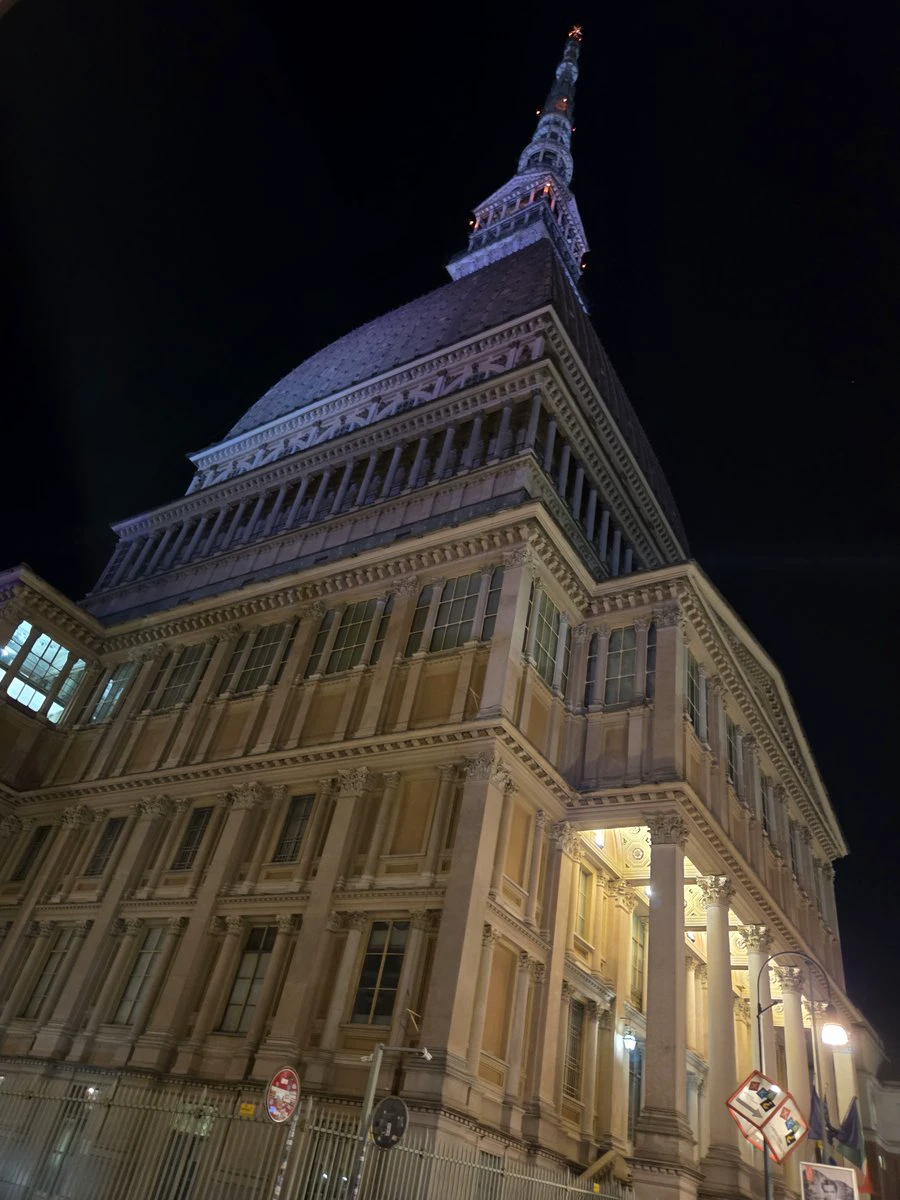
Sirmione Italy.
View Original
post-image
  • Reward
  • Comment
  • Repost
  • Share
  • Reward
  • Comment
  • Repost
  • Share
Lake of Garda Northen Italy.
post-image
  • Reward
  • Comment
  • Repost
  • Share
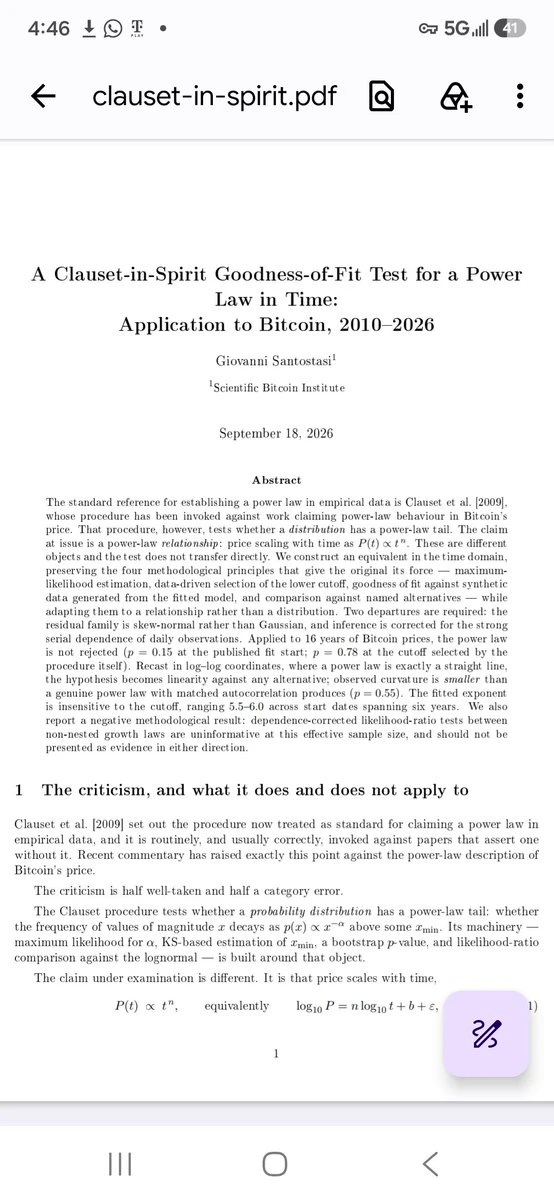
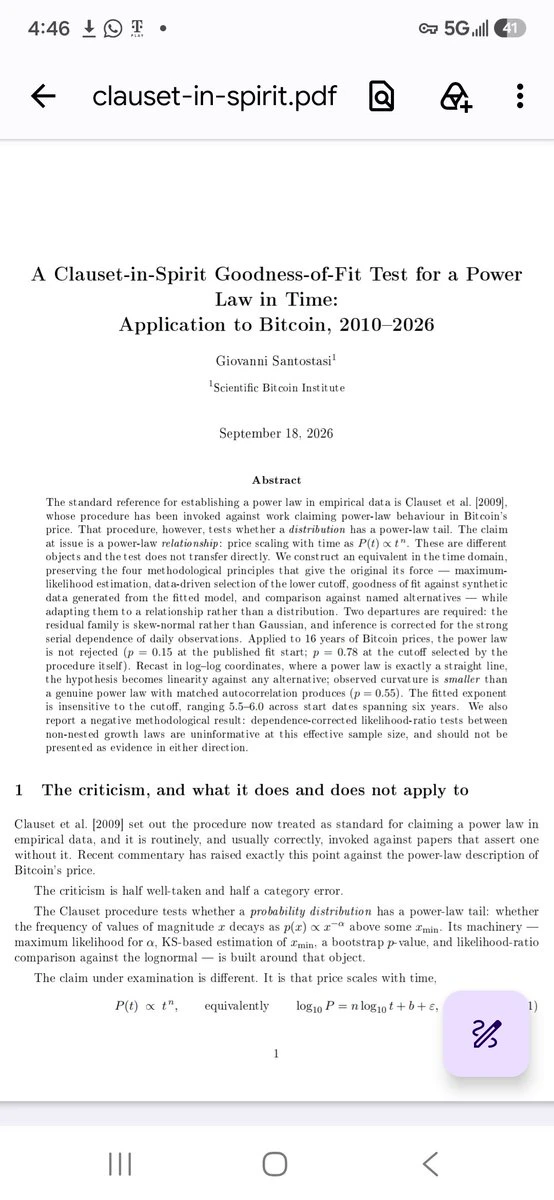
Achievement unlocked!
Power Law paper published.
Thank you for all your support and constuctive criticism along the way.
  • Reward
  • Comment
  • Repost
  • Share
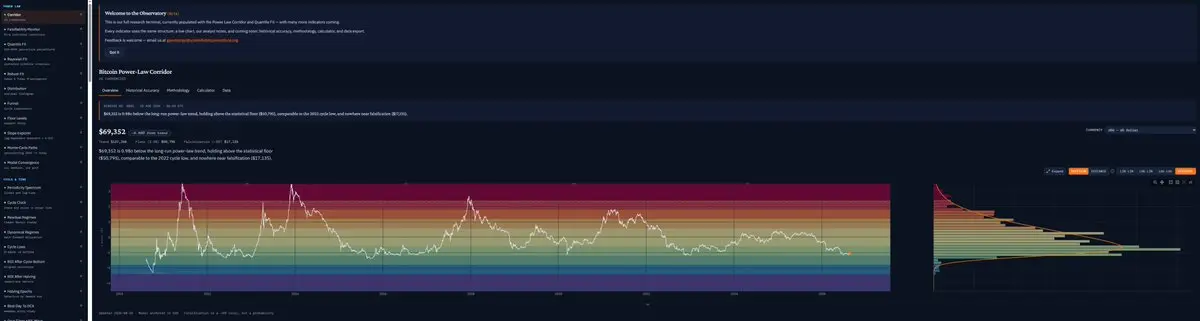
Instead of relying on third-party charts that are often incomplete, inconsistent, or not built with the correct methodology, the Scientific Bitcoin Institute is working on official Bitcoin power-law charts, indicators, and statistical tools.
Some of these resources will be available to everyone. Signing up for our free newsletter will be the minimum requirement to access them.
More advanced tools, deeper analysis, specialized indicators, and member-only dashboards will be available to those who support the Institute through membership, with reasonable donation tiers.
This is part of our broade
BTC1.81%
post-image
  • Reward
  • Comment
  • Repost
  • Share
  • Reward
  • Comment
  • Repost
  • Share
This table should give you an idea of historical deviations from the power law for the minima in terms of todays values.
The largest negative deviation would have brought us down to $27K .
Current deviations are similar to 2012 and 2015 bottoms.
  • Reward
  • Comment
  • Repost
  • Share
The distribution of Bitcoin's deviations from its long-run power-law trend — and where we sit in it today.
Fit the deviations (log-price minus the trend; n=5.65, R² 0.96, Aug 2010 → today). They are right-skewed: skewness +0.84. So price is not log-normal around the trend.
A normal fit fails on both tails — it overstates the floor and understates the bubble tail. A skew-normal fits cleanly (KS 0.047 vs 0.091; a large AIC gap), and the Q–Q confirms it: the normal bends away at both ends, the skew-normal hugs the line.
Two consequences:
— The floor is shallower and more bounded than symmetric ba
BTC1.81%
post-image
  • Reward
  • 1
  • Repost
  • Share
This is something many people still do not understand: Bitcoin is a scale phenomenon.
That means the relevant changes are not ordinary linear fluctuations, but changes in orders of magnitude. Bitcoin should not be understood primarily through daily noise, weekly corrections, or even 50% drawdowns. It has to be understood through logarithmic structure, multiplicative growth, and factors of 10.
This is why Bitcoin can fall 30%, 40%, or even 50%, and still remain perfectly consistent with its long-term structure. In most traditional assets, a 50% correction looks catastrophic. In Bitcoin, within
BTC1.81%
post-image
  • Reward
  • Comment
  • Repost
  • Share
If you really insist on defining a “floor” based on historical lows, then this is a more correct way to do it: use the observed asymmetric distribution of deviations and fit it properly.
But again, this is only an illustration of typical historical deviations. It is not an inviolable floor, and it should not be confused with the power law itself.
  • Reward
  • Comment
  • Repost
  • Share
It is actually strange and interesting that the downward deviations do not go beyond 2 sigmas and usually they are within 1.
Right now we are more like 1.3 sigma.
Well withing historical values.
Nothing is broken (so far).
post-image
  • Reward
  • Comment
  • Repost
  • Share
Here the real stats for the historical "floor".
Bitcoin near $58K, in power-law context — the data without the noise.
The long-run fit (price ∝ days^5.67, R² 0.96 on 2010–2026 daily data) puts the trend at ~$135K today. $58K is −1.22σ below trend — a factor of ~2.3 — and −54% off the $124.8K ATH.
That is ordinary cycle-low territory. Every major bottom has landed between −0.7σ and −1.4σ (mean −1.05σ):
2012: −1.25σ
2015: −1.38σ
2019: −0.75σ
2020: −0.72σ
2022: −1.17σ
$58K sits right among them — essentially the 2022 and 2012 lows.
On levels: the casually-cited −1σ floor is ÷2 ≈ $68K today. The m
BTC1.81%
post-image
  • Reward
  • Comment
  • Repost
  • Share
Where the minima are relative to the trend?
post-image
  • Reward
  • Comment
  • Repost
  • Share
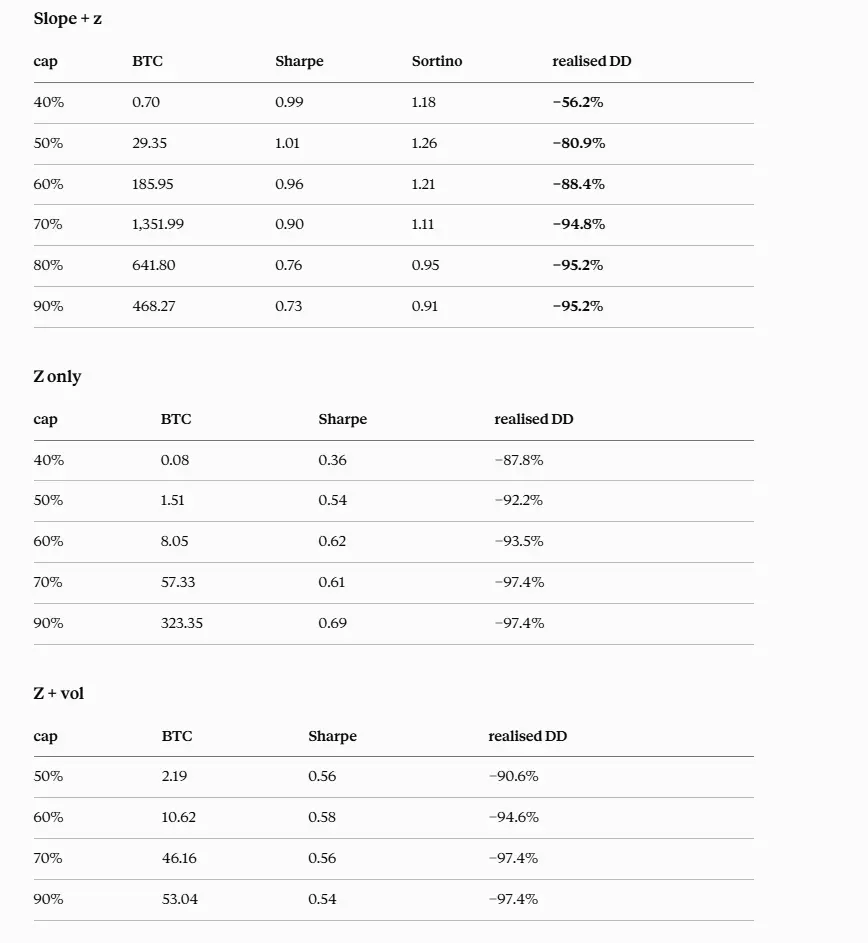
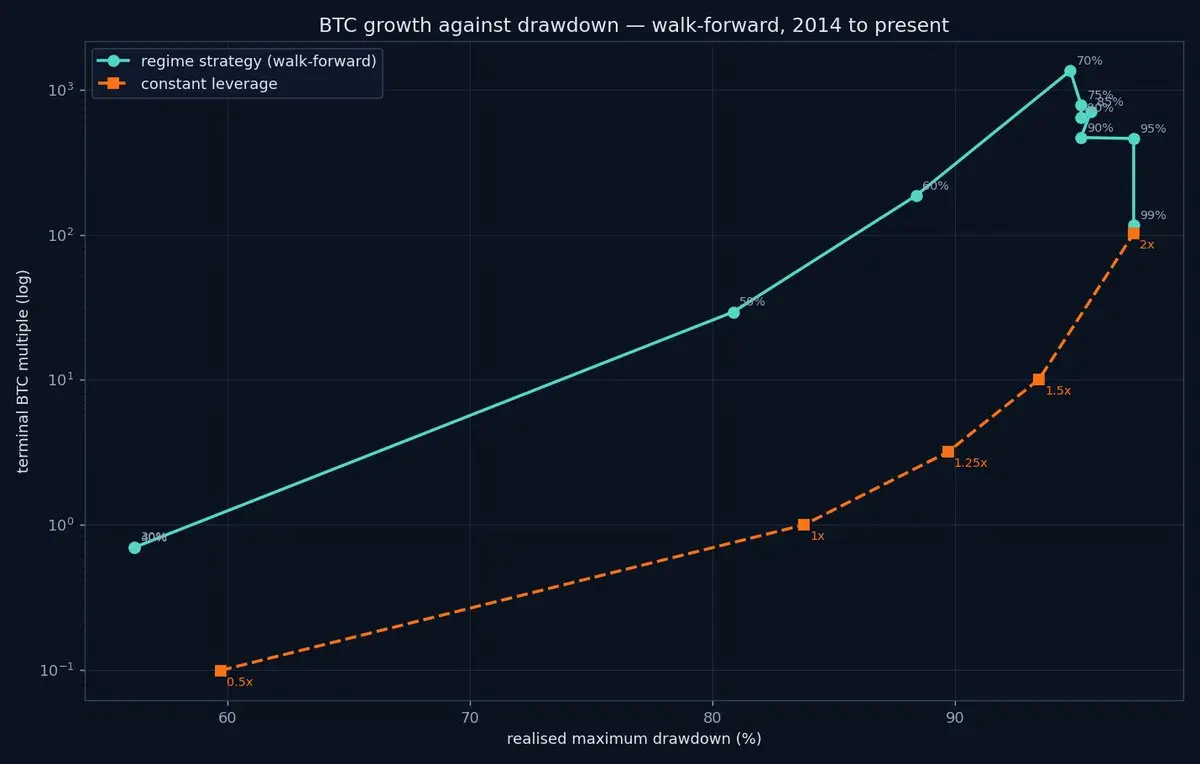
Leverage games, they never learn.
post-image
  • Reward
  • Comment
  • Repost
  • Share
In our article, we explicitly laid out the criteria that would falsify the Bitcoin power law, either in the past or in the future.
But falsification in the future would not mean that Bitcoin was never a power-law system. That is an important distinction.
At this point, given that the work has passed peer review, it is a scientific result that Bitcoin has displayed scale-invariant properties for 17 years. Scale invariance is the core property of a power law. The question is not whether Bitcoin has behaved this way historically. The question is whether it will continue to do so.
If Bitcoin stops
BTC1.81%
post-image
  • Reward
  • Comment
  • Repost
  • Share
Our power law paper has been accepted for publication.
  • Reward
  • Comment
  • Repost
  • Share
New paper about the stability of the power law.
post-image
  • Reward
  • Comment
  • Repost
  • Share
PlanB Summer School at Franklin University, Lugano, Switzerland.
post-image
  • Reward
  • Comment
  • Repost
  • Share
This book is the #1 Best Seller in Econometrics.
Support Bitcoin books in general (not necessarily this one, even if it is an amazing one).
Also, this helps the network.
BTC1.81%
  • Reward
  • Comment
  • Repost
  • Share
  • Pinned