Square
Following
Hot
News
Notifications
Profile

AiPeter

vip
No content yet
Peak Tier VIP 51.0 Year(s)
4
Following
3
Followers
36
Liked
Three declarations to quit, three precise calls delivered! Just how impressive is JS Big Shark’s foresight?

In the crypto and U.S. stock markets, plenty of people make calls, but how many are willing to put quitting the scene on the line?

This year, one person made a deep impression on the market with three public declarations that he would quit.

He is the KOL I’ve been following — JS Big Shark/JS Big Shark@JS大鲨鱼

Looking back at his three classic calls this year:

First: In May, with ETH around $2,100, he publicly bet his reputation against the major pla
ETH-1.26%
SNDK-15.99%
  • 1
NVIDIA short position hit its take-profit target as expected. Thanks, mentor Big Shark @JS大鲨鱼
Market conditions are very tough right now. Winter in the real world and the harsh winter in financial markets have arrived at the same time. What we need to do is protect our positions and persevere together until we get through this. Dawn is not far away
NVDA-0.35%
What’s the story with Hype today?
#Hype
HYPE+0.24%
2200 has been realized!!!
Time will prove it, Big Shark. No need to say more @JS大鲨鱼
Major update
JsBigShark
Money Laundering 1 | How does the money you were scammed out of start being laundered once it goes on-chain?
Once the money is stolen through a scam and goes on-chain, it is split up, converted into other coins, moved across chains, and sent through mixers to gradually erase its origins. In this episode, we break down every step based on real case files, then recap it in language even elementary school students can understand.
$BTC
Study
JsBigShark
Money Laundering 2 | The Last Mile of On-Chain Money Laundering: How Does the Money Enter the Real World, and How Is It Caught?
No matter how cleanly money is laundered on-chain, it ultimately has to be converted back into cash. Almost every route has to pass through several gates, with law enforcement waiting at the entrances. This episode examines how the money entered the real world in the Lichtenstein and Morgan case—and at which step the trail was exposed.
$BTC
High-Quality Series 3
JsBigShark
Money Laundering 3 | Why Did $700 Million Appear in a Prime Minister’s Account? (1MDB Scandal)
On the afternoon of September 30, 2009, a $700 million payment was sent out from Malaysia. According to the U.S. Department of Justice’s complaint, the money passed through a shell company, took a long, circuitous route, and ultimately flowed into the account of “Malaysian Official 1.” In this episode, we reconstruct the complete route alleged in the complaint and then review it once more in simple terms.
$BTC
The highly valuable second edition
JsBigShark
The previous episode of “Traditional Assets Changing Tracks” surpassed 30 million views across the entire internet
In that episode, we talked about capital changing tracks
This time, we’re talking about something more important
AI is moving from answering questions to doing people’s work
Muse is just a signal
What may truly be repriced is the entire way the world produces
“Traditional Assets Changing Tracks II,” to be continued
The ultimate high-value video has been updated again!!
JsBigShark
The previous episode of “Traditional Assets Changing Tracks” surpassed 30 million views across the entire internet
In that episode, we talked about capital changing tracks
This time, we’re talking about something more important
AI is moving from answering questions to doing people’s work
Muse is just a signal
What may truly be repriced is the entire way the world produces
“Traditional Assets Changing Tracks II,” to be continued
Reduce trading
JsBigShark
The bull market positioning is complete.
I’m taking a vacation.
See you in a few days.
Good luck, everyone.
I’ve done enough short-term trading lately.
Looking back and doing the math, I realized:
Watching the market every day, trading long and short, and تحملing the emotions and pressure.
In the end, it may not outperform simply buying spot at the bottom of a bear market.
Then quietly riding an entire trend could earn more.
Sometimes, trading more doesn’t mean earning more.
The really big money
often comes from daring to buy at the lows,
holding through the middle,
and being willing to exit at the highs.
From here, let the market run on its own.
I’ll wait until it truly reaches the highs.
I’ll be back to help everyone exit at the top.
repost-content-media
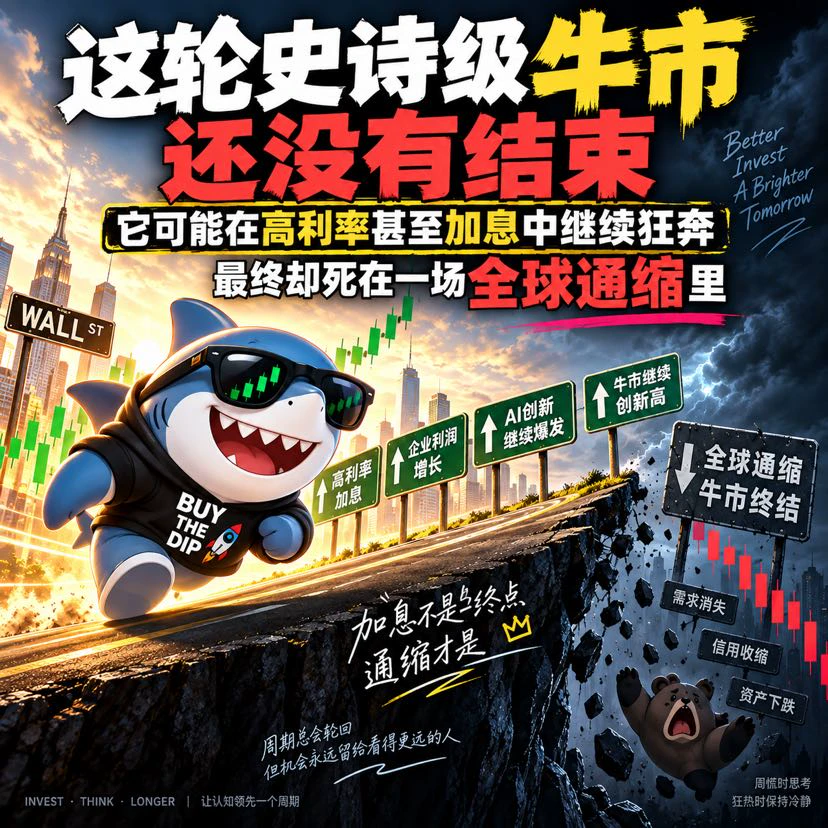
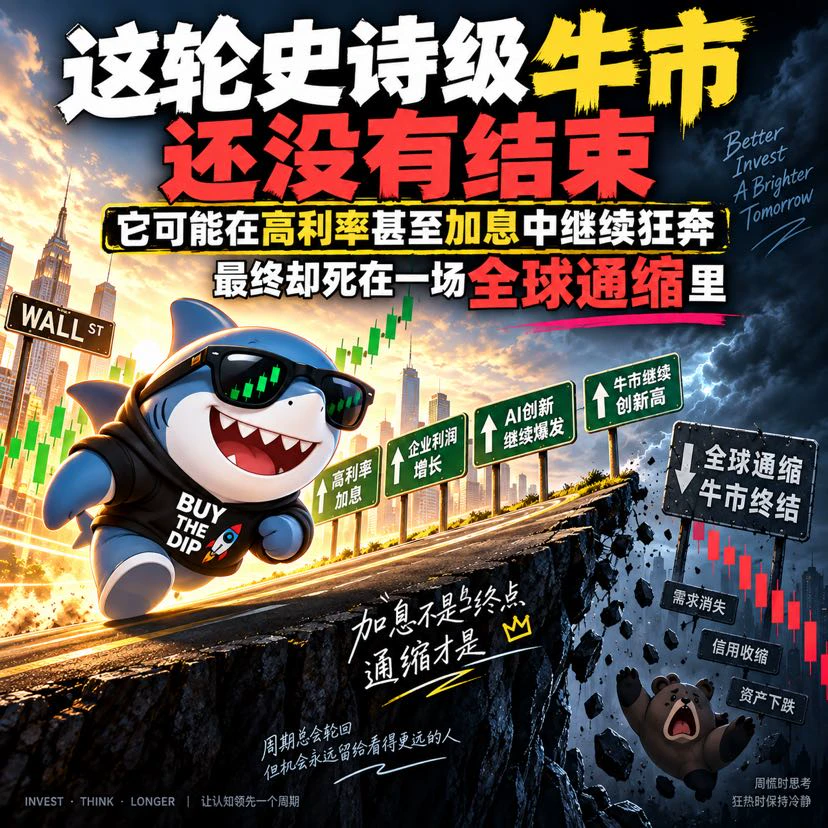
Rate hikes do not mean the bull market is over.
JsBigShark
【The Golden Pit Is Approaching】
History has proved this many times.
The Fed rapidly raised rates in 1994.
It raised rates 17 consecutive times from 2004 to 2006.
In 2022, it went through its fastest rate-hike cycle in decades.
But rate hikes themselves did not immediately end the bull market.
What truly kills a bull market has never been the words “rate hikes.”
It is when high interest rates eventually damage earnings, credit, and capital expenditure.
The Fed has now raised rates by 25 basis points.
There are only three things that truly matter next:
Whether AI capital expenditure turns lower across the board.
Whether corporate earnings begin to see significant downward revisions.
Whether cracks emerge in credit markets.
If none of these three deteriorate at the same time,
then the next deep washout could instead be the best starting point for the next major rally.
Prices fall first.
Leverage gets cleared first.
Sentiment panics first.
But the fundamentals remain intact.
This is the golden pit.
If this really happens,
the next cycle may be more than just a rebound.
Instead, AI, storage, power, robotics, and aerospace may all enter a new asset-revaluation cycle.
A true major bull market often does not begin when everyone feels most comfortable.
It starts from the most painful point. #MU #SNDK #FOMC $BTC ‌$ETH
repost-content-media
The risk persists.
JsBigShark
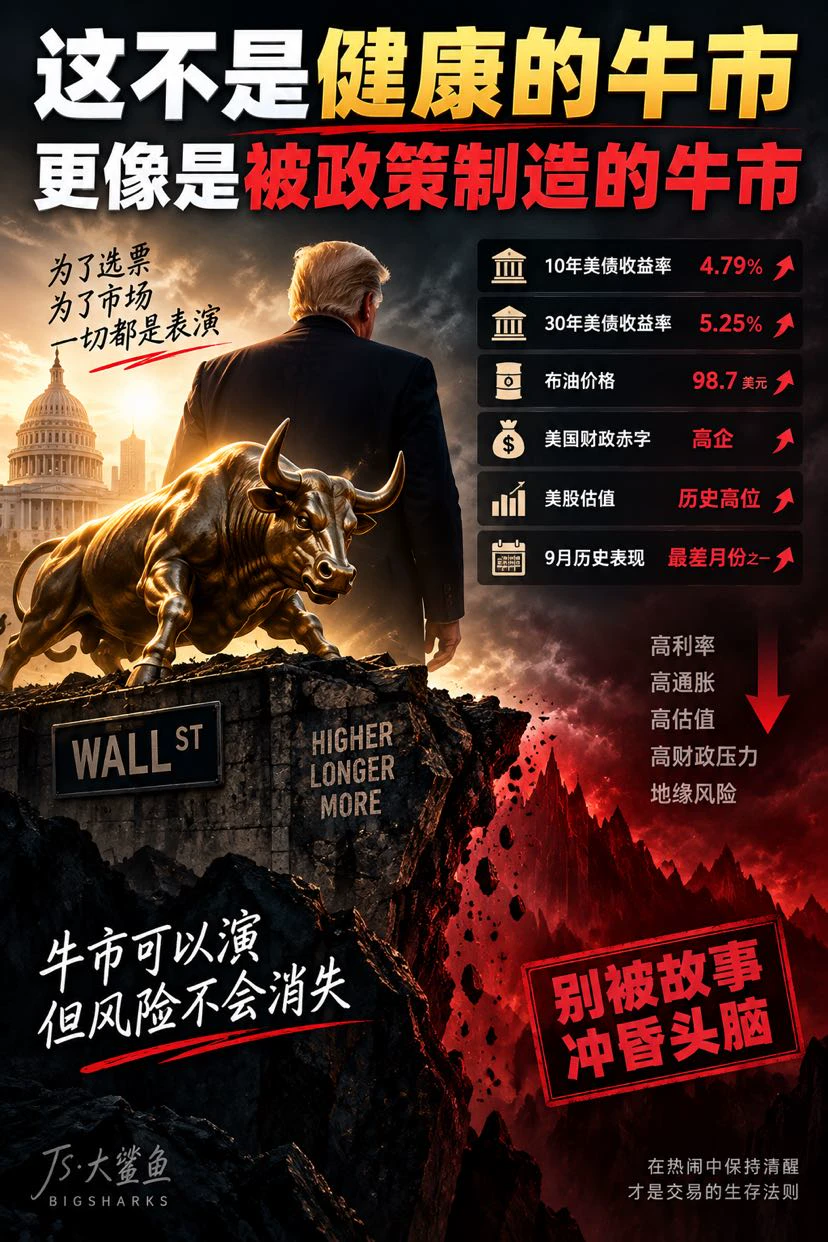
In this market, I increasingly feel that something is off.
Not that it is about to collapse.
But when you look at many macro indicators together, this does not look like an environment that should continue rising mindlessly.
10-year and 30-year U.S. Treasury yields are both elevated.
Global long-term interest rates are rising again.
Oil prices remain high.
U.S. fiscal deficits and debt issuance pressures are still increasing.
Stock valuations are already very expensive.
September is also historically a weak month.
Under normal circumstances, this combination is not friendly to high-valuation tech stocks.
Yet the indexes simply refuse to fall.
Why?
Because the market is no longer trading purely on macro fundamentals, but on expectations of policy support, AI earnings, and the U.S. continuing to maintain asset-price prosperity.
Especially with the U.S. midterm election cycle approaching.
What Trump obviously wants to see is:
A strong stock market.
Stable employment.
Rising retirement accounts.
Continued corporate investment.
U.S. assets continuing to attract global capital.
So this now looks more like a bull market continually extended by policy expectations.
Note that I said “policy expectations.”
That does not mean Trump can directly control the stock market, much less that someone can press a button and push the indexes higher.
What truly supports the market is still corporate earnings, AI capital expenditure, fiscal stimulus, capital flows, and risk appetite.
But that is precisely where the problem lies.
The current bull market is completely different from the most comfortable kind of macro bull market.
A comfortable bull market should look like this:
Inflation declines
↓
U.S. Treasury yields decline
↓
Financing costs decline
↓
Corporate earnings grow
↓
Valuations expand
But now it looks like this:
Long-term Treasury yields are high
+
Oil prices are high
+
Fiscal pressure is heavy
+
Valuations are high
+
AI capital expenditure is enormous
And stocks continue to hit new highs.
This divergence can persist for a long time.
It may even continue squeezing shorts and reach new highs.
But it requires increasingly stronger earnings and narratives to sustain it.
So I will not turn outright bearish simply because the macro environment is unfavorable.
On the contrary, the more a market “should not be rising but keeps rising,” the easier it is to force all the shorts out.
The truly dangerous moment is when the last short seller also starts believing in the bull market.
Going forward, I am watching only three signals:
Whether the 30-year Treasury yield can break above 5.3% or even 5.5%.
Whether oil prices and inflation will spiral out of control again.
Whether demand for AI capital expenditure, HBM, DRAM, and enterprise SSDs will slow down simultaneously for the first time.
Especially the last one.
NVDA is the brain of AI.
MU, SK Hynix, and SNDK are the most direct thermometers of AI demand.
As long as these companies’ orders, prices, and profits continue to grow, this market still has reason to keep extending the story.
But if one day we see:
Treasury yields continue rising
+
AI CapEx is cut
+
HBM/DRAM/SSD demand starts cooling
+
Credit spreads widen
Then it will not be an ordinary pullback.
The stock market did not collapse immediately in 2007 simply because interest rates rose.
The real problem was that after high rates remained in place for long enough, the most vulnerable point finally could not hold up.
Back then, real estate and subprime mortgages cracked first.
This time, I will be watching AI capital expenditure and the credit markets.
So do not rush to call the top.
This market could absolutely continue rising.
It may even produce one final, very beautiful acceleration to maintain bullish expectations.
But I will be riding the gains while keeping an eye on the door.
Because the current macro environment is not telling me “an immediate collapse.”
It is telling me:
The cost of taking this bull market higher is becoming increasingly expensive.
repost-content-media
xNext round of capital rotation
JsBigShark
For the next round of capital rotation, I’m focusing on Tesla, aerospace, and power.
There are also two old friends I’ll continue to watch:
SanDisk SNDK and Dell DELL.
They are about to enter the S&P 100.
This is very simple.
After entering the S&P 100, ETFs and passive funds tracking the index will need to adjust their holdings according to the new weightings.
Therefore, during the period from the announcement of the additions to their official inclusion, the market usually trades ahead of the expected passive-fund buying.
In other words:
Additions announced
↓
Active funds move in early
↓
Passive funds rebalance
↓
Trading volume increases around the effective date
So for SNDK and DELL, I believe there is still an “index inclusion trade” worth watching.
But what you really need to be careful about is what happens after the inclusion takes effect.
Because funds that positioned early may use the arrival of passive funds to take profits.
So my approach is not to chase them on the effective date.
Instead, I would capture the expectations early and pay closer attention to taking profits into any rally as the official effective date approaches.
Looking further ahead, I’m focusing on three areas for the next round of capital rotation.
First, power.
What AI is truly lacking now is not just GPUs, but electricity.
GEV, ETN, VST, CEG.
Second, aerospace.
SPCX, RKLB, ASTS, LUNR.
Satellite internet, commercial launches, defense, orbital communications, and even orbital computing in the future are all extending AI infrastructure further outward.
Third, Tesla.
TSLA can no longer be viewed solely as an automotive company.
Robotaxi, FSD, Optimus, and energy storage.
It represents the next phase of Physical AI.
So the flow of capital is becoming increasingly clear to me:
NVDA chips
↓
MU, SK Hynix, SNDK memory
↓
DELL servers
↓
Optical communications
↓
Power
↓
Aerospace
↓
TSLA Physical AI
SNDK and DELL entering the S&P 100 is itself a very interesting signal.
The money has not left AI.
It is simply moving along the entire industry chain in search of the next asset that has not yet been fully priced in.
In the short term, I’m watching SNDK and DELL’s index inclusion trade.
For the next round, I’m watching power, aerospace, and Tesla.
Capital never stops.
It simply flows from places that are already full to the next table.
repost-content-media
m U.S. Treasury bond sharing
JsBigShark
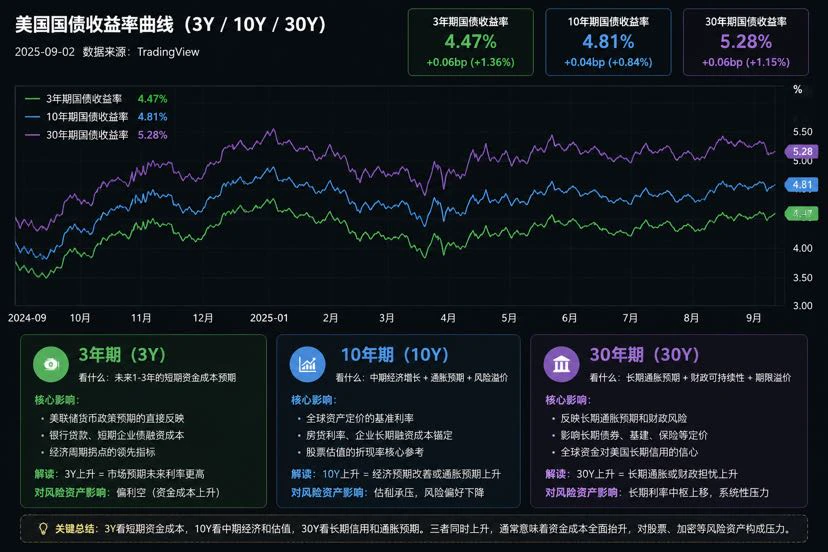
U.S. Treasuries are telling the market: money is getting more expensive.
What is really worth watching lately is not just the charts for U.S. stocks and crypto.
It is the yields on 5-year, 10-year, and 30-year U.S. Treasuries.
Many people know that rising Treasury yields suppress risk assets. But the three maturities represent completely different things.
5Y looks at corporate financing.
10Y looks at stock valuations.
30Y looks at long-term credit and fiscal conditions.
5Y is closest to the financing environment companies will face over the next few years.
U.S. companies rely heavily on corporate bonds, bank loans, and other forms of financing. When much of their debt matures, they need to borrow new money to repay the old.
Debt that was issued at 3% in the past may need to be refinanced at 5%, 6%, or even higher if the risk-free rate remains elevated.
High rates for a few days are not a major problem.
High rates for several months or even years are what really hurt.
More and more old debt enters the refinancing cycle → interest eats into profits → cash flow declines → buybacks and investment are reduced → layoffs and asset sales.
So when 5Y is high, it pressures companies’ future profits and cash flow.
10Y is the line I pay the most attention to when looking at U.S. stocks.
It is one of the most important valuation anchors for global risk assets.
When 10Y is only 2%, investors are willing to assign AI, semiconductor, and technology companies valuations of dozens of times earnings or even higher.
When 10Y approaches 5%, the market has to recalculate.
If buying Treasuries already offers a nominal yield close to 5%, why take on 20% or 30% volatility in stocks to buy companies trading at dozens of times P/E?
So AI demand can continue to grow, and earnings reports can remain strong, yet stocks can still fall.
The companies have not gotten worse.
Investors are simply no longer willing to pay such expensive prices.
So when 10Y is high, it is valuation that gets crushed.
What really makes me more cautious is 30Y.
30Y is no longer trading solely on whether the Federal Reserve will cut rates at its next meeting.
Behind it are America’s long-term fiscal deficits, Treasury supply, inflation, energy prices, and the price at which global investors are willing to continue lending money to the U.S.
If 30Y stays above 5% for an extended period or continues to hit new highs, it means the market is demanding higher long-term risk compensation.
This will ultimately be transmitted to long-term corporate financing, real estate, mortgages, infrastructure, and the entire financial system.
So when 30Y is high, it pressures long-term balance sheets and the credit system.
The truly dangerous combination is:
5Y↑ + 10Y↑ + 30Y↑
5Y tells you that corporate money is getting more expensive.
10Y tells you that stock valuations are becoming harder to sustain.
30Y tells you that long-term funding for the entire financial system is also getting more expensive.
If oil prices rise at the same time, the chain becomes even more complete.
Oil prices↑ → inflation pressure↑ → room for rate cuts↓ → Treasury yields↑ → stronger dollar → declining global liquidity.
It will ultimately reach the crypto market.
Because crypto runs on liquidity.
When money is cheap.
BTC → ETH → SOL → altcoins.
Capital spills over layer by layer into higher-risk areas.
When money starts getting more expensive, the process completely reverses.
Altcoins die first → ETH/SOL come under pressure → BTC proves relatively resilient → liquidity continues to deteriorate → BTC eventually catches down.
That is why sometimes BTC does not appear to have fallen much, while altcoins are already littered with corpses.
The story has not suddenly ended.
The water level has started to fall.
From now on, remembering a few things is enough when watching the markets.
5Y looks at financing.
10Y looks at valuation.
30Y looks at long-term credit.
The dollar looks at global liquidity.
BTC/ETH look at risk appetite.
Stocks can continue making new highs, and BTC can continue holding up.
But if 5Y, 10Y, and 30Y continue making new highs simultaneously,
I will become increasingly cautious.
Because Treasuries will not tell you what day the market will collapse.
They will only tell you in advance that money is getting more expensive.
Once refinancing starts coming due in concentrated waves and leverage begins to contract,
stocks will be hit on valuation.
Crypto will be hit on liquidity.
In the end, it is all the same pool of money that gets hit.
repost-content-media
I came across the two brilliant trades I once made alongside the big boss
Ethereum’s fierce declaration of leaving the crypto space at 1500; ZEC’s instant waterfall plunge from the mountaintop
Getting one major trend right is far more meaningful than opening trades frequently
And the big boss’s accuracy in judging trends needs no further explanation
Looking back now, the skepticism at the time seems so ironic
There are many KOLs in this space, and I’m fortunate to have followed the one I consider the most authoritative
As I always say, time will prove it: Big Shark [@JS大鲨鱼](gt://me
ZEC+1.16%
  • 1
ZEC's story
JsBigShark
《ZEC: A Big Shark That Has Manipulated ZEC Multiple Times Tells You What Stage It Has Reached》
In 2016, ZEC was born.
At that time, the market needed a new story.
BTC solved decentralization, but not privacy.
Then ZEC arrived.
A 21 million supply cap, zero-knowledge proofs, anonymous digital cash, a star cryptography team...
The story was almost flawless.
More importantly, when it first launched, the circulating supply was extremely small.
A sufficiently big story collided with a sufficiently small float.
The result was predictable.
The price was quickly pushed to an extremely outrageous level.
Many people encountered ZEC for the first time not because they had studied zero-knowledge proofs, but because:
It went crazy.
This is actually very important.
In financial markets, the best advertising has never been a white paper.
It is rising prices.
Once the price rises, people will naturally come along to explain why it is worth so much.
But as more and more ZEC was mined, the circulating supply expanded, and the initial scarcity began to disappear.
The price collapsed accordingly.
The first act ended.
But the story did not die.
The bull market arrived in 2017.
Privacy became a story again.
ZEC rose again.
The bull market ended, and it fell back down.
Then it happened again in 2020–2021.
BTC rose, market liquidity flooded in, and capital once again began looking for altcoin opportunities.
The story that had been told for many years was brought out again:
If all transactions can be tracked in the future, will humanity inevitably need a truly private asset?
ZEC came back to life.
The price once again rose from dozens of dollars to hundreds of dollars.
Then the bull market ended.
It was forgotten by the market once again.
What is truly interesting is not these rallies.
It is the silence of 2022–2024.
ZEC fell all the way down.
In 2024, it bottomed at only around $16.
Few people discussed it.
Few people believed in it.
Those who had chased it to several hundred dollars no longer had any interest in talking about a “privacy revolution.”
An asset reached its coldest moment.
But from another perspective:
This was precisely the best time for the chips to be reshuffled.
Because truly cheap chips never appear when everyone believes in the story.
They usually appear when:
No one is watching.
No one is talking.
No one is willing to buy.
Even those who criticize it cannot be bothered to do so.
Then 2025 began.
ZEC did not simply repeat the story from ten years ago.
It changed the way it told the story.
Previously, it was:
“Anonymous digital cash.”
Later, it became:
“In the AI era, privacy itself is a scarce asset.”
This statement clearly offered far greater room for imagination.
At the same time, Zashi, Shielded Pool, and privacy usage data began to become topics of market discussion.
For the first time, the story had some data that could be quantified.
Then the price began to move.
Once the price moved, all the market memories that had been dormant for years returned.
What came next was the truly exciting part of the entire story.
Capital began to enter.
Winklevoss Capital appeared.
Cypherpunk Technologies began building a ZEC Treasury.
It was not merely bullish talk.
It began buying ZEC with real money.
Then it publicly proposed a highly imaginative target:
Ultimately accumulating 5% of the ZEC supply.
After the market heard this, the story had completely changed.
Previously, people bought ZEC because:
“Privacy coins might rise.”
Now it became:
“Institutional investors are competing for a digital privacy asset with limited supply.”
Pay attention.
From this point onward, the relationship between price and the story reversed.
At the beginning:
The story drove the price.
Later:
The price began to validate the story.
At $50, no one cared about privacy.
At $100, some people began researching it.
At $300, the market began saying that the privacy sector was making a comeback.
At $500, people began discussing digital privacy gold.
The higher the price went, the easier it became to believe the story.
This is the most interesting thing about financial markets.
Many people think:
The price is rising because the fundamentals are getting better and better.
But often the real sequence is:
The price keeps rising, so more and more people begin looking for reasons why it should be even more expensive.
By 2026, the game had upgraded another level.
Capital was no longer satisfied with merely buying the coin.
It began entering the mining industry.
Cypherpunk began building ZEC mining capacity.
Capital's reach thus extended further upstream from the secondary market:
Buy coins.
Hoard coins.
Invest in the ecosystem.
Enter mining.
Influence new supply.
At this point, what the market saw was no longer an ordinary altcoin.
It was an increasingly complete story:
The supply is only 21 million.
Demand for privacy is returning.
Shielded Pool is growing.
Institutions are hoarding coins.
Capital is entering mining.
The AI era needs privacy.
The chips are becoming increasingly scarce.
Institutions are still buying.
When all these things are stacked together, the most powerful thing emerges:
Faith.
And once faith takes shape, it creates a very beautiful positive feedback loop.
Price rises
↓
More people believe institutions are competing for chips
↓
Holders become increasingly unwilling to sell
↓
The market's circulating supply decreases
↓
Less money can drive a larger increase
↓
The price continues rising
↓
Media and social platforms begin discussing it frantically
↓
New capital enters
↓
The price rises again
At this point, no one needs to actively tell the story anymore.
The market will tell it by itself.
Holders will tell it.
People making money will tell it.
KOLs will tell it.
The media will tell it.
Even those who enter later will actively seek out more evidence proving that their purchases were correct.
This is when an asset is at its strongest.
It is also when it is most deserving of caution.
Because there is one question that capital markets can never avoid:
If a large fund accumulated a massive amount of chips at low prices.
And ultimately wants to realize its profits.
Who will it sell to?
The answer is two words:
Liquidity.
And when is liquidity at its greatest?
Usually not when the market is at its most fearful.
Precisely when everyone believes in the story the most.
Therefore, large-scale distribution does not necessarily come with bad news.
Quite often, the opposite is true.
Good news keeps coming.
The media keeps reporting on it.
Price targets keep rising.
Trading volume keeps growing.
Everyone is discussing how much further it can rise.
Because only at this time does the market have enough people to absorb the chips that need to be realized.
So if we compress ZEC's ten-year story, there is really only one thread:
Create expectations
↓
Create scarcity
↓
Initiate the price
↓
The price attracts attention
↓
Attention brings capital
↓
Capital pushes up the price
↓
The price reinforces the narrative
↓
Institutional entry provides credibility
↓
The chips become further concentrated
↓
The circulating supply decreases further
↓
The price accelerates
↓
The market develops faith
↓
Everyone searches for reasons for a higher valuation
↓
Liquidity reaches a climax
↓
Only then might distribution take place
Pay attention.
I said “might.”
Because there is not yet enough evidence to prove that ZEC has entered the final distribution phase.
This is also what I am focusing on most in my current study of ZEC.
I no longer care much whether it rises 5% or falls 10% today.
What I want to examine are several other things:
Are institutions still buying continuously?
Is Shielded Pool still growing?
Are the chips continuing to become concentrated?
Is mining capital continuing to enter?
Has regulation begun cutting off institutional funding channels?
And most importantly:
When trading volume continues to grow, can the price continue making new highs?
If one day a very interesting phenomenon appears:
The news keeps getting better.
Discussion keeps heating up.
Trading volume keeps increasing.
Everyone begins believing in ZEC's future.
But the pace of institutional buying begins to decline.
Chip concentration stops.
The price can no longer be pushed higher despite massive trading volume.
That is when I would truly become cautious.
Because the most dangerous moment in the market has never been when no one believes in the story.
It is when everyone finally believes in the story.
In 2016, ZEC sold technological expectations.
In 2017, it sold the privacy revolution.
In 2021, it sold the revival of the bull market.
In 2025, it sold the repricing of privacy.
By 2026:
Institutional hoarding, concentrated capital, mining expansion, AI privacy, digital privacy gold...
The story has become increasingly complete.
At this point in the story, the ending is becoming increasingly clear.
ZEC's biggest problem has never been whether it has privacy value.
It is whether that privacy value can enter the mainstream financial system.
Over the past ten years, ZEC has been able to reprice itself again and again through narrative, scarcity, bull-market liquidity, and capital concentration.
But this time, it is facing something entirely different:
Regulators are beginning to block funding channels.
The EU anti-money-laundering framework has directly written anonymity-enhancing coins into its restricted scope.
The room for banks, financial institutions, and compliant crypto service providers to handle anonymity-enhancing assets is becoming increasingly narrow.
What does this mean?
It means ZEC can continue to be pushed higher.
It may even produce a short squeeze more extreme than that of ordinary altcoins because its chips are becoming increasingly concentrated.
But how high the price can be pushed and whether anyone will support it over the long term are two different things.
For an asset to maintain a valuation of tens of billions of dollars or more over the long term, it absolutely cannot rely only on retail investors.
It needs banks.
It needs funds.
It needs asset managers.
It needs ETFs.
It needs market makers.
It needs custodians.
It needs a continuous inflow of compliant capital.
If these funding channels are ultimately blocked one by one by regulators, who will be ZEC's largest remaining buyer?
Retail investors.
And the greatest characteristic of retail investors is that they can create sentiment, but cannot absorb massive capital exits over the long term.
Thus, the entire ten-year story ultimately forms a highly ironic closed loop:
2016
Create expectations.
↓
Create scarcity.
↓
Push up the price.
↓
The price creates sentiment.
↓
Bull markets repeatedly revive the narrative.
↓
Bear markets complete the transfer of chips.
↓
Capital becomes concentrated again.
↓
Institutional endorsement.
↓
Mining expansion.
↓
The circulating supply contracts.
↓
The price skyrockets.
↓
Faith reaches a climax.
↓
Regulators begin blocking institutional funding channels.
↓
In the end, only retail investors bear the liquidity burden.
This is my judgment of ZEC's ultimate fate:
It may not fall immediately.
Indeed, under conditions of highly concentrated holdings and an increasingly thin circulating supply, it may continue producing extremely outrageous rallies.
But the crazier this rise becomes, the more liquidity will ultimately be needed to support it.
And a privacy asset whose funding channels are gradually being restricted by the mainstream financial system cannot rely on retail investors forever to sustain an increasingly high valuation.
Without a continuous inflow of new capital, even the most beautiful narrative will eventually lose its pricing power.
Without institutional liquidity, even the highest price will ultimately be nothing more than paper wealth.
Therefore, ZEC's true risk has never been the sudden appearance of a large bearish candle one day.
It is that one day you will discover:
The price is still there.
The story is still there.
Faith is still there.
But the money can no longer get in.
Once the capital entrance is blocked, all that remains is existing capital taking turns supporting one another's positions.
And retail investors cannot support a high-valuation market abandoned by institutional capital.
So my long-term judgment has not changed:
ZEC can continue to be traded speculatively.
It can continue to be pushed higher.
It may even continue to go crazy.
But if privacy coins are ultimately isolated from the mainstream compliant financial system,
then this decade-long capital game will not end with the stars and the sea.
It will end with liquidity drying up.
Then valuation collapsing.
And finally, going to zero.
The bottom needs chips.
A rise needs a story.
A climax needs faith.
Distribution needs liquidity.
And going to zero,
only requires the last buyer to disappear.
repost-content-media
ZEC+1.16%
Better to miss out; discipline comes first.
JsBigShark
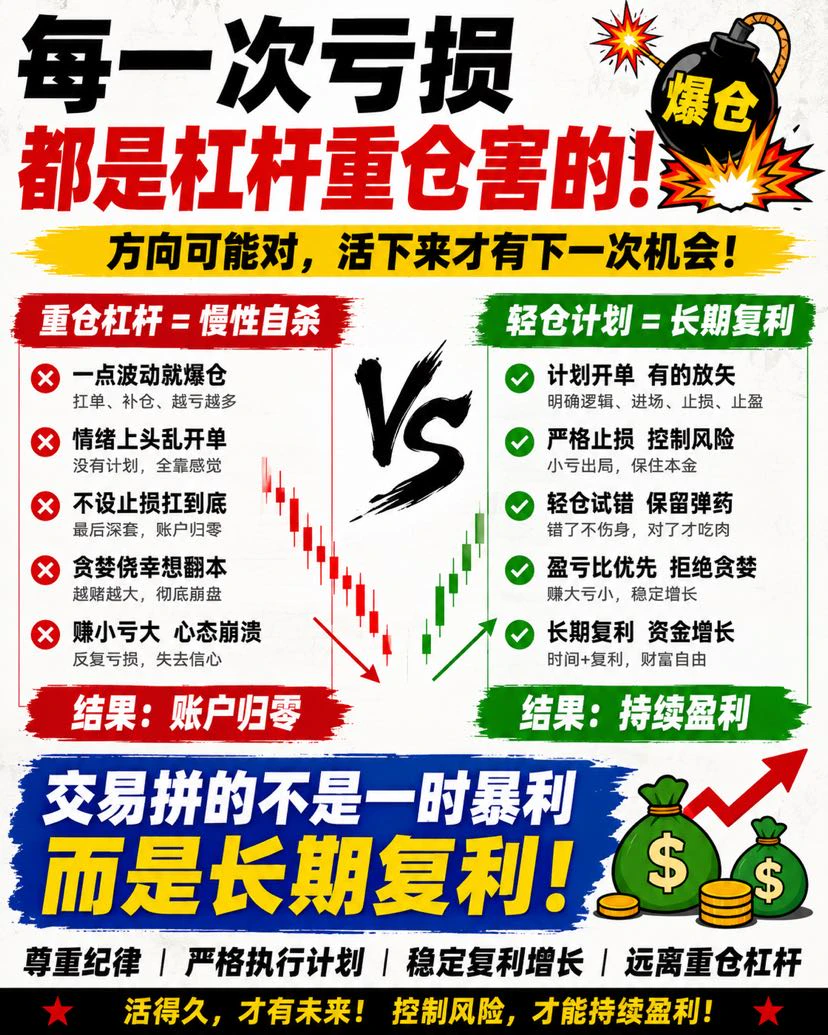
After trading for so long, when I look back at the times I suffered the heaviest losses, the reason was always essentially the same:
Too much leverage, and positions that were too large.
Many times, I wasn't even wrong about the direction.
I was bullish, and it ultimately did rise.
I was bearish, and it ultimately did fall.
But a normal fluctuation along the way began to distort everything because my position was too large.
Unwilling to stop loss, I started holding onto the losing trade.
When I could no longer bear it, I kept adding to the position.
The position grew larger and larger, while my mindset deteriorated.
In the end, the market only had to sweep a little liquidity for me to give back all the money I had worked so hard to earn.
So I've become increasingly certain of one thing:
The truly difficult part of trading has never been making a lot of money once, but keeping the profits.
To compound consistently, you must accept the constraints of discipline.
No plan, no trade.
No clear stop loss, no trade.
The risk-reward ratio isn't suitable, no trade.
The position exceeds the plan, no trade.
When emotions take over, especially no trade.
It's better to miss an opportunity than to gamble with a heavy position.
A small position allows you to make mistakes.
A heavy position only allows you to be right once.
In the end, trading is no longer about who is bolder.
It's about who can survive longer, who can keep every profit they make, and then continue compounding.
repost-content-media
Wash analysis
JsBigShark
Shorting needs a macro rationale
What Wosh said today was actually not that complicated.
The core points are just three.
Inflation has not returned to 2%, so don't expect much from rate cuts.
Employment has not deteriorated yet, so the Fed has no reason to rescue the market.
AI investment and corporate earnings remain strong, so he did not portray the economy as weak either.
That is the most troublesome part right now.
The economy is not weak.
AI is still expanding aggressively with heavy spending.
Inflation still cannot be brought down.
That means the Fed can continue keeping interest rates high and even retain room for further hikes.
So what really matters today is not how hawkish Wosh sounds, but how U.S. Treasuries perform.
If only the 2-year yield moves higher while the 10-year and 30-year yields remain stable, that is merely the market repricing short-term rates, and AI stocks may not collapse immediately.
If the 2-year, 10-year, and 30-year yields all surge higher, especially if the 10-year yield breaks above its previous high again, then it is an entirely different story.
Financing costs rise across the board, and high-valuation AI stocks take the first hit.
My current view is simple.
Wosh is hawkish, but this is not yet a systemic negative catalyst.
The real danger is when these three things appear together:
The Fed remains hawkish.
The 10-year Treasury yield breaks above its previous high.
AI earnings growth begins to slow.
Once these three collide, high-valuation AI stocks are not merely undergoing a correction—they are facing a valuation massacre.
repost-content-media
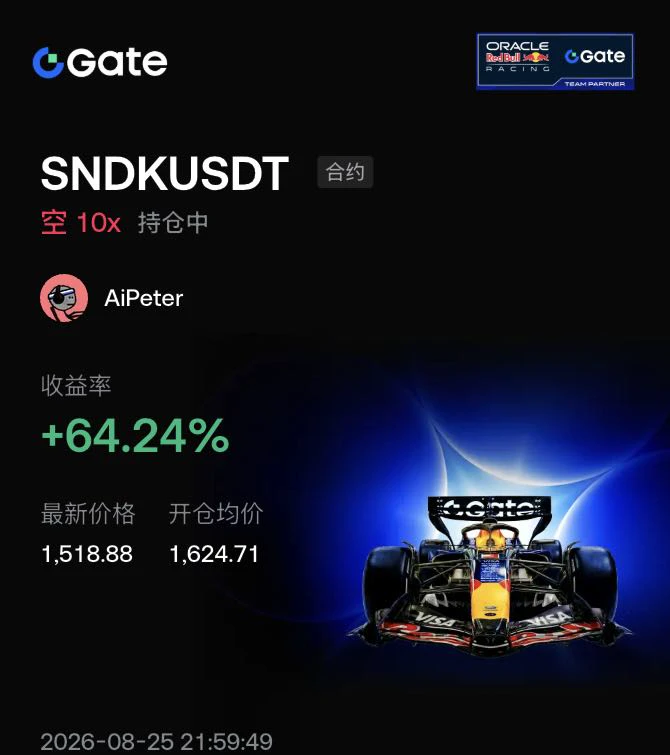
Shorts are in profit@JS大鲨鱼
post-image
  • 1
  • 1
ZEC short position closed.
JsBigShark
I am clearly bearish on ZEC’s medium- and long-term outlook—the countdown to zero has begun.
There is only one core reason:
The institutional capital it will need most in the future is being blocked by regulators.
The EU AMLR’s real impact is not on ordinary traders, but on the entire regulated financial system.
Banks.
Financial institutions.
Fund management companies.
Investment companies.
Insurance funds.
Asset management institutions.
Compliant CASPs.
Custodians and related financial intermediaries.
In the future, these institutions will face clear compliance restrictions when dealing with anonymized, transaction-obfuscated, and privacy-enhancing crypto assets.
This is ZEC’s biggest long-term problem.
Because an asset’s price can be pushed very high through market control.
But to sustain a valuation of tens of billions or hundreds of billions of dollars over the long term, institutional capital must ultimately continue to enter the market.
No banking system.
No large funds.
No insurance capital.
No mainstream asset managers.
No stable buying from compliant institutions.
What can support this market cap over the long term?
Market makers trading between their own accounts?
Short squeezes in perpetual contracts?
Retail investors chasing the rally?
All of these can create price action.
But they cannot create genuine long-term capital.
The biggest misconception ZEC currently creates is treating “a very high price” as meaning “very high market acceptance.”
In reality, if the tokens are highly concentrated, the genuine circulating supply is very small, and the price can be pushed to extremely high levels by a small amount of marginal capital.
$500 is possible.
$800 is possible.
$1,000 or even higher is possible.
Because market cap is simply:
The last traded price × the circulating supply.
It does not mean that an equivalent amount of capital has actually entered.
Therefore, ZEC’s enormous market cap today may simply be a nominal figure amplified by an extremely low circulating supply.
The real problem comes later.
When the core holders want to cash out, who will take the other side?
In the past, the market could still tell a story:
U.S. ETFs.
Institutional allocation.
Traditional finance entering the market.
But submitting an ETF application does not mean it will definitely be approved.
If the underlying asset itself has severely concentrated holdings, insufficient genuine liquidity, prices that can easily be influenced by a small number of accounts, and privacy characteristics, regulators will face several of the most difficult questions directly:
Is price discovery genuine?
Is the market vulnerable to manipulation?
Is the NAV reliable?
How can market makers hedge effectively?
Is there sufficient spot-market depth during large subscriptions and redemptions?
Can regulators truly see the structure of the underlying token holdings?
If these problems cannot be resolved, so-called “institutionalization” is merely a story.
What Europe is doing now is precisely further shrinking the space for ZEC to enter the formal financial system.
This creates an extremely dangerous structure:
The price keeps rising.
The market cap keeps growing.
But the financial institutions that can legally, compliantly, and at scale absorb it are becoming fewer and fewer.
This is the aspect that deserves the most caution.
ZEC can still continue to rise in the short term.
For a heavily controlled asset, the top has never been determined by valuation.
As long as the market maker does not release tokens, the free float remains sufficiently small, and shorts remain sufficiently numerous, it can continue pushing the price higher, triggering further short squeezes, and creating an even higher market cap.
But in the long term, it must return to the most basic capital logic:
Who provides the ultimate liquidity?
If European financial institutions gradually exit.
If the U.S. ETF and institutionalization processes are again hindered by concentration, liquidity, and market-manipulation concerns.
Then ZEC’s ultimate question will not be “can it continue to rise?”
It will be:
With such a large amount of tokens, who will ultimately buy them?
Market makers can control the price.
They can control the free float.
They can control short-term volatility.
They can even create a seemingly impressive $100 billion story.
But the one thing market makers cannot control is how much real money the outside world is willing to bring in to take the other side.
This is the core logic behind my medium- and long-term bearish view on ZEC.
Price can be manufactured.
Institutional purchasing power cannot.
When an asset’s price keeps rising while the amount of large-scale capital able to absorb it compliantly keeps shrinking, this divergence will ultimately be repriced by the market.
repost-content-media
ZEC+1.29%
Load More