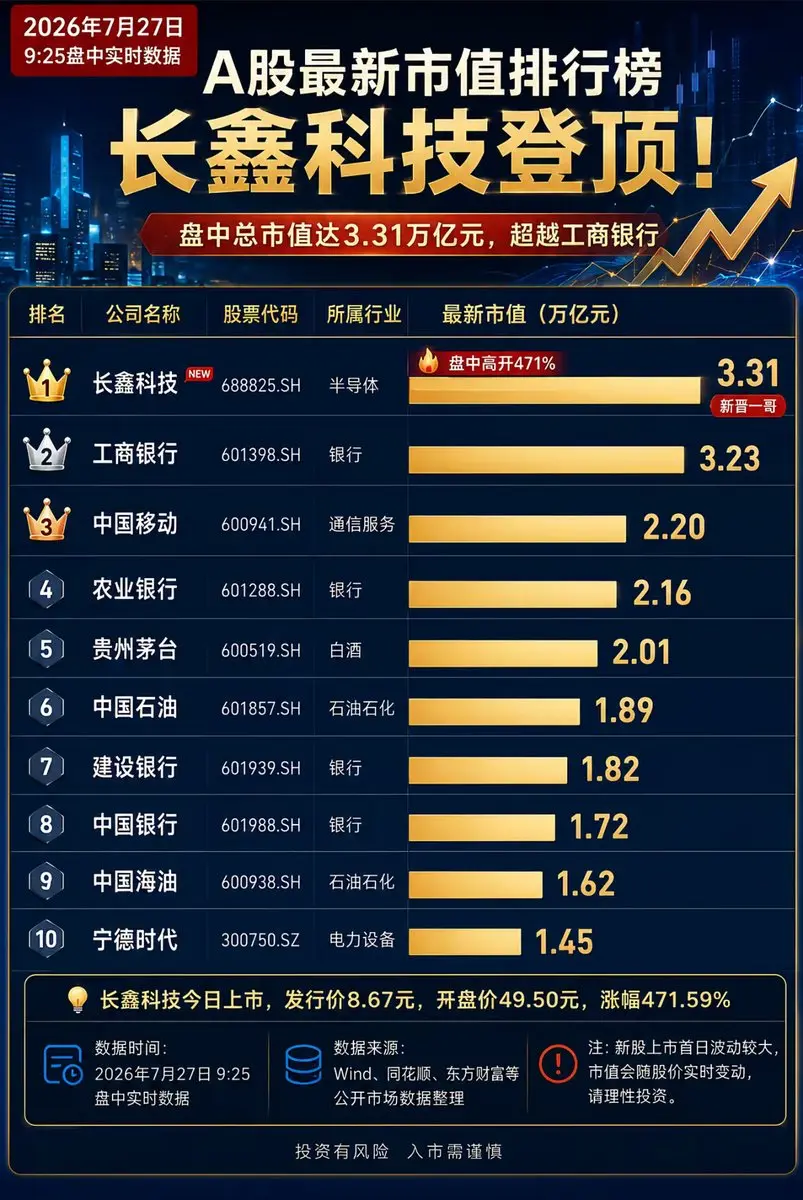
Changxin Technology goes public, and Hefei’s state-owned assets are rolling in it
Theoretically, it’s only around 10,000+ billion yuan 🤣
For Hefei, a third-tier city, its per-capita GDP this year is also set to exceed $20k.
From the issue price of 8.66 yuan, to an opening market cap of about $20k, to the first hour’s trading value breaking $100 billion—this doesn’t just refresh capital market records; it also helps the world re-recognize China’s strength in the storage industry.
The biggest winner isn’t only the investors who got the allocation,
but also the Hefei government that stuck with the bet for ten years.
From investing in Changxin back in 2016,
to today, estimated by the opening market cap: the value of shares held by Hefei’s state-owned asset system is about $1.3 trillion.
Compared with the early investment, it has delivered astonishing unrealized gains on paper. This once again proves: what truly changes the fate of a city isn’t real estate, but the technology industry.
More importantly, Changxin Technology’s IPO isn’t just the birth of a new giant.
It means China already has its own DRAM industry chain. From design and manufacturing to mass production—from DDR4, DDR5 to high-end storage for the AI era—China is filling in the last few critical pieces of the semiconductor puzzle.
In the past, China imported chips; today, China is beginning to export confidence.
In the global AI competition ahead, what matters isn’t only large models, but also GPUs, HBM, DRAM, advanced manufacturing, and a complete industrial chain.
Changxin Technology’s listing today might be just one IPO;
but seen over the long sweep of history, it’s very likely a new starting point for the rise of China’s storage industry.
Hefei is destined to be different now,
so you’d better speak to them more politely from now on.
Theoretically, it’s only around 10,000+ billion yuan 🤣
For Hefei, a third-tier city, its per-capita GDP this year is also set to exceed $20k.
From the issue price of 8.66 yuan, to an opening market cap of about $20k, to the first hour’s trading value breaking $100 billion—this doesn’t just refresh capital market records; it also helps the world re-recognize China’s strength in the storage industry.
The biggest winner isn’t only the investors who got the allocation,
but also the Hefei government that stuck with the bet for ten years.
From investing in Changxin back in 2016,
to today, estimated by the opening market cap: the value of shares held by Hefei’s state-owned asset system is about $1.3 trillion.
Compared with the early investment, it has delivered astonishing unrealized gains on paper. This once again proves: what truly changes the fate of a city isn’t real estate, but the technology industry.
More importantly, Changxin Technology’s IPO isn’t just the birth of a new giant.
It means China already has its own DRAM industry chain. From design and manufacturing to mass production—from DDR4, DDR5 to high-end storage for the AI era—China is filling in the last few critical pieces of the semiconductor puzzle.
In the past, China imported chips; today, China is beginning to export confidence.
In the global AI competition ahead, what matters isn’t only large models, but also GPUs, HBM, DRAM, advanced manufacturing, and a complete industrial chain.
Changxin Technology’s listing today might be just one IPO;
but seen over the long sweep of history, it’s very likely a new starting point for the rise of China’s storage industry.
Hefei is destined to be different now,
so you’d better speak to them more politely from now on.