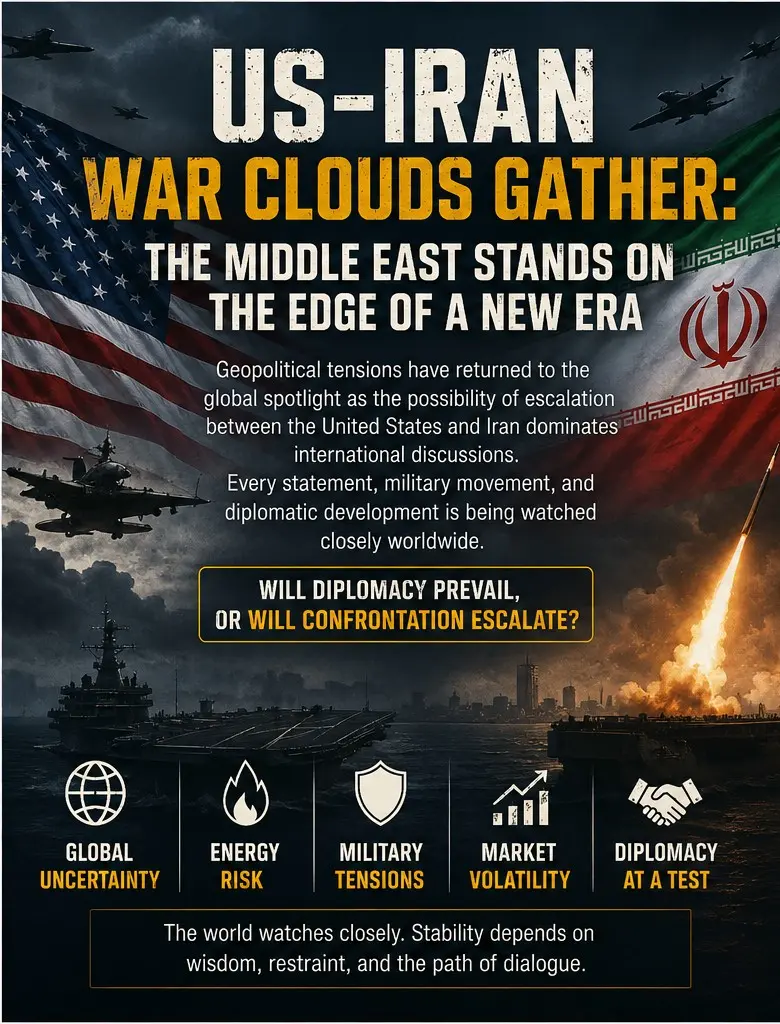
#USIranWarCloudsGather US–IRAN WAR CLOUDS GATHER: THE MIDDLE EAST STANDS ON THE EDGE OF A NEW ERA
Geopolitical tensions have once again become the center of global attention as concerns over a possible escalation between the United States and Iran continue to dominate international headlines.
While no one can predict the future with certainty, every statement from political leaders, every military deployment, and every diplomatic development is being closely monitored by governments, financial institutions, investors, and security analysts around the world.
The relationship between the United States and Iran has remained fragile for decades, shaped by sanctions, regional conflicts, nuclear negotiations, proxy groups, and competing strategic interests.
Whenever tensions rise between these two nations, the consequences are rarely confined to the Middle East.
Energy markets react immediately, global investors shift toward safe-haven assets, and financial markets become increasingly volatile.
Today, the world's attention is focused on a single question: Will diplomacy prevail, or will the region move toward a broader military confrontation?
Although there is no confirmed indication of a full-scale war at this moment, the possibility of further escalation keeps markets and policymakers on high alert.
1Why This Situation Matters
A conflict involving the United States and Iran would extend far beyond the battlefield.
It could affect global energy supplies, international trade routes, inflation, interest-rate expectations, shipping costs, and overall market confidence.
The Strait of Hormuz remains one of the world's most strategically important maritime routes, with a significant share of global oil exports passing through it.
Any disruption to this route could trigger sharp movements in crude oil prices and create ripple effects across the global economy.
Market Impact
Historically, geopolitical uncertainty has encouraged investors to seek relatively safer assets such as gold and, at times, the U.S. dollar.
Oil prices often become more volatile when there are concerns about supply disruptions, while equity markets may experience increased swings as traders reassess risk.
Cryptocurrency markets can also react to changing investor sentiment.
Some participants view digital assets as an alternative store of value during periods of uncertainty, while others reduce exposure to risk assets.
The exact market response depends on the broader economic environment and the specific developments as they unfold.
Key Factors to Watch
1. Official statements from Washington and Tehran.
2. Diplomatic negotiations and mediation efforts.
3. Military deployments or operational changes.
4. Developments affecting regional shipping lanes.
5. Oil production and export updates.
6. Global reactions from major powers.
7. Financial market volatility.
8. Gold and crude oil price movements.
9. Central bank responses if energy prices rise.
10. Whether tensions ease through diplomacy or intensify through further confrontation.
Conclusion
Periods of geopolitical uncertainty demand patience, careful analysis, and disciplined decision-making.
Headlines often create sharp short-term market reactions, but long-term outcomes depend on verified developments rather than speculation.
Investors, traders, and observers should rely on credible information, manage risk carefully, and avoid making decisions based solely on rumors.
As the situation evolves, diplomacy remains the most constructive path toward reducing tensions and maintaining regional and global stability.