Square
Following
Hot
News
Profile

0xLateComer

vip
Active for: 0.5y
Peak Tier 0
Always enter a step behind, but that also helps avoid many major pitfalls. Love watching on-chain capital flows and learning from smart money.
117
Following
11
Followers
3
Liked
The trading range is tightly locked in, and the risk management on this trade is meticulous. Let’s mark it first and check the order book depth.
CryptoOnline
83183.0 low to 85255.0 high. The current 84098.56 price tag proves the chop is real while down 0.855 percent on the day. Risk management dictates survival here. Consider this illustrative long setup: entry 84098.56, stop loss 81575.6, take profit 88303.49. Alternatively, test the other side with an illustrative short at entry 84098.56, stop loss 86621.52, take profit 79893.63. Watch order book depth closely before placing orders. This is not a prediction, Not financial advice, and DYOR. ⚡ $BTC #GateIdleEarnAutoYieldUpTo3% #GateLaunchesTrenchesWith0GasFee #ShareWeekly #WeekendMarketBullishOrBearish
repost-content-media
The three-step filtering method is indeed practical: narrative → activity → catalysts, much more reliable than blindly aping in.
SulaimanZerohunter
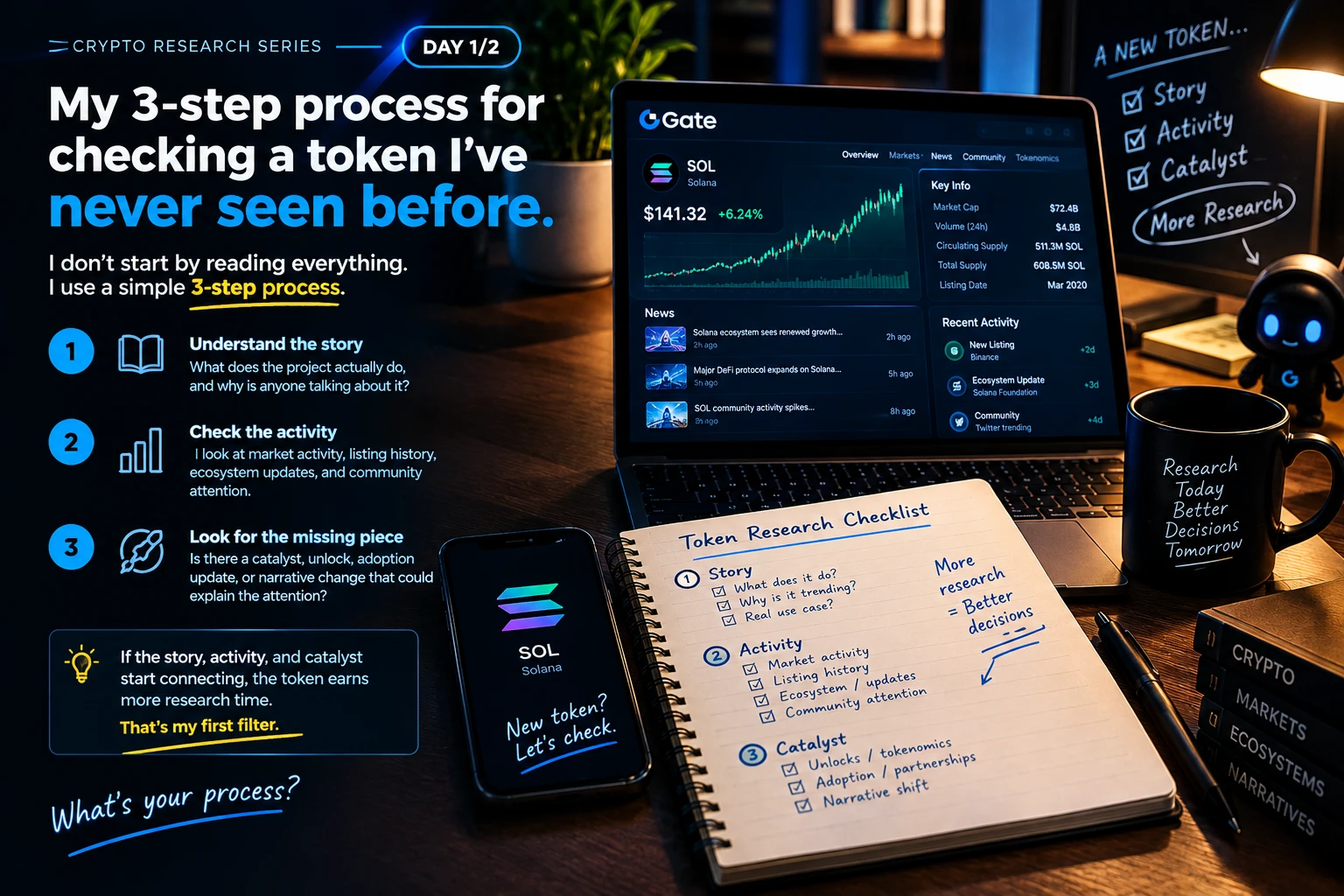
I found a token I’ve never seen before.
I don’t start by reading everything.
I use a simple 3-step process.
First, I understand the story.
What does the project actually do, and why is anyone talking about it?
Second, I check the activity.
I look at market activity, listing history, ecosystem updates, and community attention.
Third, I look for the missing piece.
Is there a catalyst, unlock, adoption update, or narrative change that could explain the attention?
If the story, activity, and catalyst start connecting, the token earns more research time.
That’s my first filter.
‍$BTC
‍$GT
$ETH
‍#CryptoResearch #TokenResearch #GateSquare
repost-content-media
Short-term short position; see you at 791.3.
Original content no longer visible
$SYN The volume squeeze is pretty intense; let's see if we can catch it around 0.175.
SulaimanZerohunter
$SYN
$SYN is moving aggressively, with the screenshot showing +12.77% in one hour. Recent analysis points to an extreme volume-driven squeeze, with $0.170 as support and $0.212 as the recent high.
Bullish setup — confirmation required
Entry: $0.175 - $0.185
TP1: $0.195
TP2: $0.205
TP3: $0.212
SL: $0.168
Invalidation: Losing $0.168 after entry would invalidate the continuation setup.
$SYN
SYN-7.32%
Every time I see an article discussing MEV, I feel pretty conflicted. Calling it queue-jumping isn’t wrong—some bots and deep pockets really can get ahead of you, and you end up eating the slippage. But if you say transactions shouldn’t be prioritized on-chain, when blocks are truly packed and gas spikes, smaller trades might not even go through… Anyway, after getting stuck a few times, I learned my lesson.
Looking at how new L1s/L2s launch incentives and chase TVL lately, old users are all complaining about “farm, withdraw, and sell.” The rewards look pretty juicy, but by the time you get in,
Recently, I’ve been seeing everyone in the group rushing into all kinds of new projects. Some people are almost trying to interact with ten projects a day—their wallets are so hot they feel burned. I’m always a half-beat late, so I’m actually a bit panicky, afraid of getting reverse-rugged. To put it bluntly: after watching so many “how to get an air drop” guides, I finally realize that even after you grind it all out, you still have to factor in the gas fees. One careless slip and you end up losing money.
But I don’t want to miss out completely, so I learned to be a bit smarter. I’m putting o
RWA-0.36%
A friend just asked me: with this market, and an asset size that’s neither too small nor too big, should I use a hardware wallet or a multisig? Honestly, I’m really torn.
To be honest, someone like me who joined a bit late is most afraid of “being safe just for the sake of being safe.” Not long ago, I saw a social recovery scheme and thought it would be a good fit for me—I’m too lazy to manage seed phrases, and I’m also afraid of losing my device. But on second thought: what if the “friend” I choose falls into a trap too one day? 😂
Recently, there have been steady rumors that tax enforcement
A twelve-year plan, selling for more than $400 million after spending over $40 million—this kind of patience and faith isn’t something everyone can have.
WuSaidBlockchainW
Wu Says learned that, according to Lookonchain monitoring, a Bitcoin OG has just sold off its last 1,000 BTC. The address accumulated 5,000 BTC at an average price of $332 per BTC about 12 years ago, and has been gradually selling since November 2024. All of its current holdings have now been fully sold out, with a total sell-off value of $435.75 million and cumulative profit of $434 million, yielding a return of up to 262 times.
Just looking into block builders and bundles—honestly, for retail investors, it’s enough to have a rough idea of how it works; there’s no need to dig too deeply.
Anyway, we’re not trying to抢 MEV; the key point is that transaction ordering isn’t strictly time-based anymore—it’s been “sorted” through a process, and that’s enough to understand.
It’s like a courier station: someone specializes in bundling large customers’ packages and handling expedited deliveries, while ordinary retail parcels just end up waiting.
Now they’re talking about modularity and a data availability layer, and devel
Every time I feel itchy and want to chase a breakout, my inner OS is really like: are you sure you’re seeing some “information,” or are you just being pushed by recent emotions? Over the past couple of days, there have been a lot of large on-chain transfers. And then a bunch of people start shouting that “smart money is coming in.” Looking at those wallet addresses, honestly, I don’t know how to tell whether the funds are being arranged by the main players or it’s simply an adjustment between internal hot and cold wallets within an exchange. Anyway, I’m always a bit late to the party. I wait u
I just saw a transfer and it stunned me for a second—an address first sent funds to a middle contract, and a few minutes later split them into several batches flowing to different DEXs. The timing was right on the eve of a certain NFT project’s announcement of a royalty reform. Honestly, I’ve seen “coincidences” like this a lot. It’s basically smart money splitting orders to lay liquidity traps and, at the same time, probing market sentiment. Lately there’s been a lot of noise over NFT royalties—creators think the secondary-market take is not enough, exchanges say the process is too cumbersome
Honestly, when I first started getting into options, I used to think the buyer was “staking a little for a big win.” And what’s time value, really, but the entry fee to place a bet? Later, the market corrected me a few times, and I slowly figured it out—time value, in practice, is more like the seller’s steady, reliable “paycheck.” When you buy an option, as the days tick by, its value decays, like air leaking out; when you sell an option, you’re basically waiting for other people to leak, and you just pick up the leftovers.
Recently, I’ve been watching the airdrop season and those points-base
Honestly, every time I get itchy to chase the rally, I just watch the big on-chain transfers and the movements of exchange cold wallets. These past couple of days, someone has been interpreting this as “smart money,” but really, who knows whether it’s institutions rebalancing or just driven by emotions? Anyway, I’m always a bit slow—I’ll look first and then decide. It’s not like we can’t afford to wait for half a day. What I don’t regret is that every time I wait for sentiment to cool down before making a decision, I’ve avoided a lot of traps.
Just took a look at the on-chain lending data. Some addresses are only three steps away from the liquidation line—and they’re still adding to their positions… People like me who are slow to catch up can’t help but feel anxious for them. Honestly, when you’re close to the red line, the most important thing isn’t gambling on which direction it’ll go—it’s doing the math: how far the liquidation price is from the current price, whether the volatility is enough for you to have room to run, and whether the collateral ratio can withstand a sudden needle-like spike. I’ve learned that the hard way twic
Ugh, while you’re farming testnet points, your mindset really changes fast. In the past, I just treated it as practice—click a few times and that’s it. Now the moment I see “points are redeemable,” I get all fired up, afraid of missing out on something. So what happened? The market suddenly went haywire, and the drawdown was faster than my principal.
Now I’ve got myself a strict rule: for any testnet that offers “expected returns,” think through your stop-loss first. Plainly put—if the points aren’t worth anything, treat it as practice; if they’re worth something, don’t go all in. Either way,
Ugh, I’ve been staring at the charts so long my eyes are sore and my neck is stiff. There isn’t really any big market action, but it’s become a habit to open and take a look. Just now I saw a new cross-chain bridge rolling out a testnet—points are getting farmed like crazy. Everyone’s guessing whether the mainnet will issue tokens. As for me, I’m always a bit late, so I’ll watch what the smart money does first.
Honestly, when it comes to cross-chain bridges, I’m starting to feel more and more that “waiting for confirmation” isn’t just wasted time. Some bridges with multi-sig controls are bette
I got itchy again and registered for a new project’s governance voting. When I clicked in, I saw that the delegated voting pool was ten times bigger than the tiny amount of tokens I have. 😂 LOL. I’m the kind of person who’s always half a beat behind—every time I try to show off as a “governance participant,” I find out that the real people deciding the direction are always the guys who delegate their votes to big institutions.
In plain terms, governance tokens are basically “whoever has more votes gets to have the say,” but in reality, once you keep playing delegated voting, it starts to look
I just set a stop-loss order, and my finger hovered over the confirm button for half a while without pressing it… My brain: “Wait a bit—maybe it’ll bounce.” My wallet: “Go ahead and keep holding—see how that works.” In the end, it slipped a few more points before I finally cut. The interest was, unfortunately, a whole extra chunk.
It suddenly occurred to me that stop-losses are just like breakups. Even though you know there’s no outcome in dragging it on, you still wait until the other side says everything is final before you’re willing to give up. Admitting the loss sooner is actually the bes
Recently I’ve been looking into the whole restaking thing. The returns look pretty enticing, but when you think about it carefully, where exactly do the risks come from? Put simply, the yield from LST mainly comes from node operations and protocol incentives, but restaking locks the liquidity in another layer. If the underlying protocol has a bug or we hit a liquidation wave, that could trigger a chain reaction. Anyway, for someone like me who’s a bit slow to react, I won’t get jealous just because other people are making money like crazy—I’ll observe it clearly first.
Coincidentally, these pa
Sigh, it’s me again—the slow-by-nature one who’s here just to vent. Lately, interest-rate expectations have been swinging between tightening and loosening, and it feels like the whole market’s sentiment is riding a roller coaster. Oddly enough, I actually think this kind of time is pretty good for observation—because even when rate-cut expectations come in, they won’t immediately rush into the crypto market; the transfer of capital always takes time. Meanwhile, those task platforms cracking down on anti-bot and anti–Sybil measures are making the “freebie-hunters” even more intense than going t