StableArbKing

vip
Active for: 0.5y
Peak Tier 0
Use CEX and DEX price differences for stable arbitrage, only doing USDT/USDC/DAI triangles. The discussion includes math; dislike one-way gambling.
This afternoon, I hit another “little freeze” while calling the API. After digging for ages, it wasn’t the chain—it was the Subgraph index falling behind plus RPC rate limiting. Third time I’ve fallen into this trap. Anyway, when the data looks half a beat slow, check Grafana’s request queue first instead of immediately suspecting the chain. That’s the daily grind of being the tool guy: after troubleshooting for ages, you discover you were hammering the free RPC yourself. A friend on the blockchain gaming side said the economy had collapsed—the inflation model wasn’t designed properly, and onc
I looked at several projects’ treasury proposals during the day and suddenly wanted to discuss something: How can you tell whether a project team is genuinely getting things done or just issuing announcements?
# I generally don’t look at those grand-vision roadmaps—they’re too abstract
Checking on-chain activity is the most straightforward. Is treasury spending transparent, with every transaction matching its stated purpose? Have milestones been delivered as usable products, rather than just celebrated in a tweet? Some projects have been active for a year, but when you dig in, all you find are
I’m actually pretty tempted to rant about this. Every time I see an especially attractive APY, my first reaction isn’t to jump in, but to wonder where the money is actually coming from. An aggregator layered on another aggregator, contracts stacked on contracts—how many layers are in between? Who is the counterparty for the underlying asset? All of that needs to be considered carefully.
When you talk about blockchain games collapsing... it’s actually the same logic. Tokens are issued without limits, studios farm them in bulk, but demand is only so large. When production exceeds consumption, a
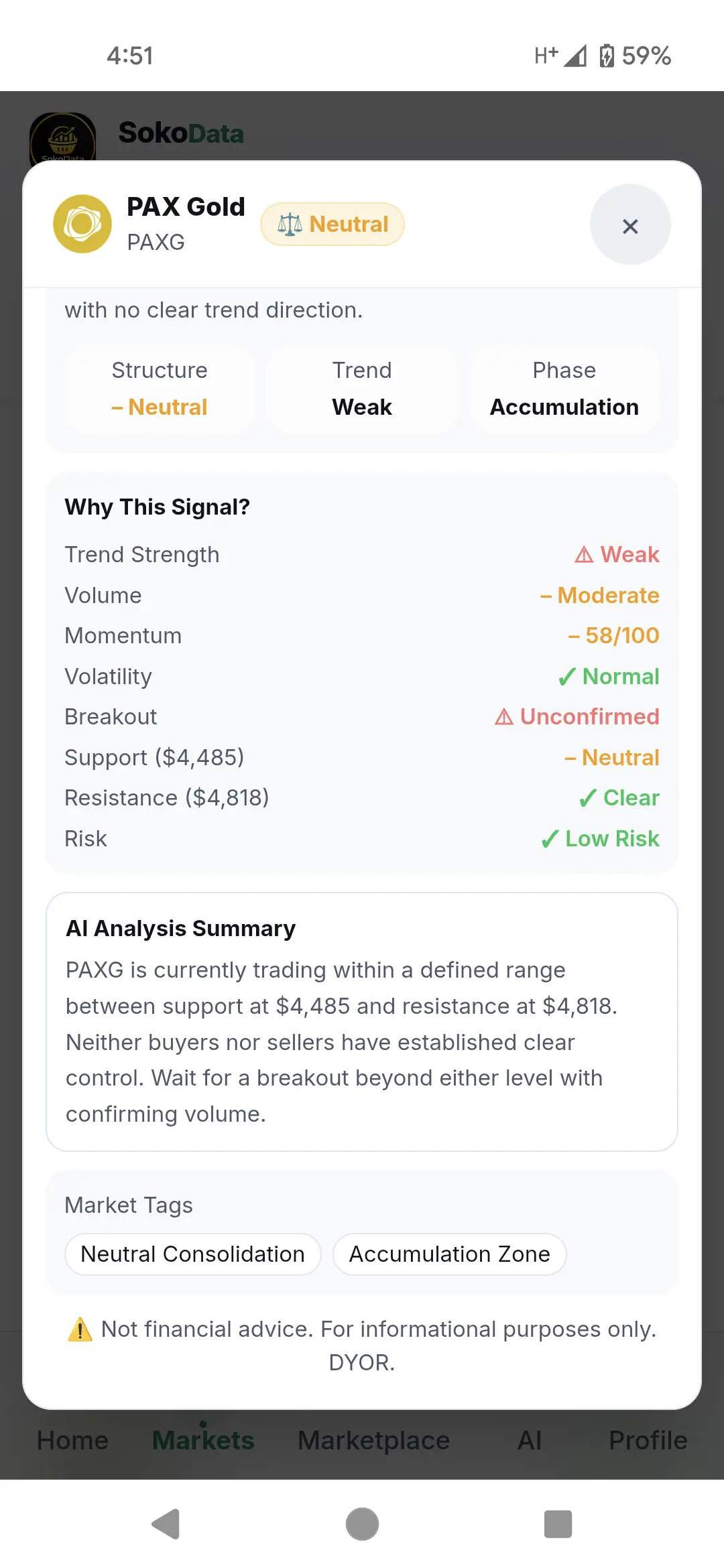
A sideways market isn’t dead water—it’s the last silence before the storm. $PAXG is grinding between 4485 and 4818, with unconvincing volume and momentum checked out—don’t guess the direction; wait for it to flip the table itself.
CryptoJourney1
$PAXG ‌— BORING, BUT BREAKOUT WILL COME
PAX Gold is stuck in a tight range — $4,485 support, $4,818 resistance. Momentum sits at 58/100, volume is moderate, and the trend is weak. This is a waiting game.
---
What I See:
· Support at $4,485 — strong.
· Resistance at $4,818 — strong.
· Momentum is indecisive.
· Volume is average — no conviction.
· Risk is low — this is a calm market.
---
The Play — WAIT FOR CONFIRMATION
If LONG:
· Entry: Above $4,818 with strong volume.
· Targets: $4,900, $5,000, $5,100.
· Stop-loss: $4,750.
If SHORT:
· Entry: Below $4,485 with strong volume.
· Targets: $4,400, $4,300, $4,200.
· Stop-loss: $4,550.
---
If You Are Watching:
· Stay patient. No active setup yet.
· Let the market confirm direction first.
---
Then vs. Now:
PAXG has been building a base between $4,485 and $4,818. This is a classic accumulation zone — the longer it stays here, the bigger the eventual move. The question is — which way?
---
Final Word:
This is a patience game. The range is tight, and the market is undecided. Let the breakout or breakdown happen — then act with confidence. Protect your capital and stay disciplined.#GateReservesRiseTo$8.2Billion
repost-content-media
PAXG-0.43%
I saw the Qixi Festival campaign go live, so I took a special look around Gate Square. It really does have quite a few more fun features now. Compared with simply watching the market, this feeling of having fun together with the community is much more enjoyable. Let’s go, brothers.
Nayeem003
Qixi on Gate Square
Qixi season has brought some fun community features to Gate Square. ❤️
I like seeing exchanges add more interactive elements instead of making everything about trading.
If you’re active on Gate Square, check out the Qixi activities, interact with the community and see what’s available during the campaign.
#Gateio #GateSquare #Qixi #CryptoCommunity #Gate
Didn’t expect another cross-chain bridge incident—the 1.65 million instantly turned into ETH; the hacker’s method was really smooth.
CoinNetwork
CoinJie(Wang) news: The Allbridge platform suffered a cross-chain attack, resulting in losses of about $1.65 million. The attacker moved the stolen funds from Solana cross-chain to Ethereum and exchanged them for ETH. This incident caused Allbridge’s total losses to reach $2 million.
ETH+0.27%
I just looked at a few on-chain addresses, and Whale’s move this round is pretty interesting. One address bought more than 3,000 ETH on Arb, and then immediately went elsewhere to open a short position to hedge. In plain terms, with large in-and-out flows like this, you have to first figure out whether it’s building a position to ride the main run-up, or hedging to lock in profits. Otherwise, if you follow blindly, they go short and you get trapped—you won’t even have time to cry.
Recently, hardware wallets have been out of stock. People say it’s because too many are hoarding them, but phishin
ETH+0.27%
Just finished a cup of coffee, glanced at a block explorer, and then saw a few old hands in a group chat yelling, “Don’t take the last baton”… honestly, this meme-rotation has me a little disoriented—one celebrity’s quote can clog the chain, gas fees shoot up, and then what? A bunch of people rush in, and then another batch gets trapped up on the mountaintop. Anyway, I really don’t get it. Maybe I’m just getting old.
But back to the point: lately, more people have been talking about modular blockchains. I’m actually pretty curious—what’s different for us regular users? Put simply, before, if y
MEME+3.06%
Haha, speaking of end-of-year tax filing, it gives me a headache. Last year I went through dozens of wallets, and the on-chain records were a total mess—I almost drove myself crazy. Now I’ve developed a strict habit: after every single operation, **immediately screenshot and save**—especially the confirmation pages for cross-chain bridges and Uniswap swaps. I just remember them like a meme; screenshots don’t take up much space anyway. Also, people have been criticizing on-chain tags nonstop—no matter what tool, it might “lag” or be “misleading.” Anyway, I don’t trust any of the auto-organizers
UNI+0.29%
So what—there’s been another wave of incentive campaigns for new L1/L2 projects lately, and the group chat is back to the familiar “mine-to-withdraw-to-sell” complaint tournament. Honestly, I don’t think you necessarily have to take sides—mainnet gas is expensive but reliable, while L2 is cheaper but sometimes it can lag.
My compromise is pretty basic but practical: for zero-earn projects, use a small wallet and go through L2—smaller limits, lower gas, and you can try without feeling bad. If you really need to move funds or do large transactions, then go back to the mainnet—it’s less hassle, l
I just looked at the chart again and felt a little itchy—I almost wanted to chase in. Luckily I stopped myself in time and asked: does this rally actually have real information driving it, or is it just emotion taking over?
It’s airdrop season—every kind of points and task is getting you to grind like you’re clocking in for work. Anti-sybil measures make everyone afraid of getting caught in the crossfire, and one careless move could mean you get wrongly targeted. Honestly, sometimes I really can’t tell whether I’m chasing information, or getting pushed along by my emotions.
Anyway, I asked mys
Honestly, RWA on-chain chatter has been quite hot recently, but when you actually look closely at those liquidity pools, it feels kind of flimsy. Basically, you tokenize U.S. Treasury bills or real estate, put them on-chain as “tradable assets.” Liquidity looks like it’s up, but when you flip the redemption terms—oh, it turns out there are still lock-up periods, minimum redemption amounts, and even requirements to wait for fund managers’ approval. This is not fundamentally different from the “same-day redemption” in traditional finance—it's just an extra layer of on-chain transparency.
Anyway,
RWA+0.72%
Recently I’ve been seeing a lot of people interpret ETF fund flows and the US stock market’s risk appetite together with crypto’s ups and downs—it does make sense, honestly. Anyway, I got so messed up that at night I’m constantly checking my phone to watch the charts. Going all in with the position I took—my heart really can’t handle it.
I’ve been running a few sets of grid trading and DCA on L2 lately, and I sleep much more soundly. Put simply, it’s trading time for space: spreading out your entry cost, leveling out your costs, and you don’t have to stare at the candlestick chart all day. Tha
Just saw someone else showing off the rewards from re-staking—stacked multiple layers—and it honestly looks pretty satisfying.
But really, don’t just get high on that “stacked” number. Every layer you add increases your risk and lock-up period.
During the current airdrop season, the anti-sybil task platforms are strict, and the point-based grind is as relentless as going to work. A lot of projects have you trapped the moment you enter—you can’t even get out.
Re-staking sounds really grand—shared security, right? But think about it: once the staked assets run into problems, the losses are s
Stop-loss, just do it—it's the same as breaking up after dating. If you keep holding without selling, you’re always thinking, “What if it can hold on a bit longer and I’ll break even?” The result is you lose more and more, and you burn up interest and time. Last time, I went into a testnet points campaign on a certain L2. I could clearly see the pool’s liquidity was running out fast, yet I still held on for two more days. In the end I cut my losses—only to find the fees were more than the profit. Now I’ve learned: set a stop-loss line, and when it hits, exit. The money I save is enough to buy
(Just finished making a latte and took a glance at the market.)
Interest rates are really like a roller coaster. The moment rate-cut expectations get blown out, small-cap coins bounce right along—then when it contracts again, everything just fully lies flat. I personally have a heavier bias toward the L2 ecosystem in my own positions. Anyway, this year, overall capital risk appetite is clearly more on the conservative side—everyone only dares to bet on things that feel certain.
Recently, testnets have been coming in thick and fast, stacking points and building up expectations, and then there a
Someone asked me whether sandwich attacks are something you can only dodge. When I was making latte art, I thought about it—really, the “opportunities” you see are just someone else’s pre-written fee schedule. After running a few simple arbitrage scripts on L2, I found that what makes real money isn’t your ability to read the K-line, but how fast you write the contract and how sensitive you are to gas. Ordinary users stare at price fluctuations and panic to death, while their robotic counterparts have already stacked the sandwich in the mempool. Anyway, my approach now is to let small orders g
TIA-2.90%
Hey, I can’t sleep no matter how I toss and turn. I might as well get up and make a cup of coffee to check the charts. To be honest, I’ve been thinking about something lately: how does macro actually end up in our positions? When rates rise, liquidity gets drained, and risk appetite visibly drops. A while back, I trimmed a bit of my L2 exposure—not because I don’t believe in it, but because I feel market sentiment is really “tight.” People always say crypto is decoupled from U.S. stocks, but in terms of psychological expectations, they’re actually fairly aligned. Just now I came across someone
Hey, a couple of days ago I demonstrated to a friend a privacy “send-money” tool on an L2. His first reaction was actually, “Won’t this get caught by regulators?” The truth is, when it comes to on-chain privacy, ordinary people really don’t need to overthink it—you’re not some huge whale, and nobody’s bored enough to dig into your everyday transfer history.
But on the flip side, those so-called “totally anonymous” wheels, when you run them, they do involve a bit of skating around the edge—so we should all have that in mind.
Recently, memes have gone absolutely wild. Celebrity endorsements
MEME+3.06%
Just saw a lending position in my wallet where the collateralization ratio dropped to 140%, and there’s only a few steps left before the liquidation warning line. Honestly, this kind of situation is pretty common—especially lately, with the staking unlocks and token unlock calendar rolling out, market sentiment tends to drift and people end up dumping a wave at the drop of a hat. My approach is: don’t panic first. Check the on-chain data to see the asset’s actual liquidity and the lending pool depth. If the pool is shallow, topping up the collateral might be more cost-effective; otherwise, rep