Square
Following
Hot
News
Notifications
Profile

WoChovy

vip
Rollup ecosystem enthusiast, focused on data availability and user experience. Doesn’t post long threads often, but tries to make every post clear and understandable.
Peak Tier VIP 00.7 Year(s)
82
Following
13
Followers
6
Liked
The biggest misconception I had after becoming an LP was thinking I could just leave my assets there and collect rent. Then one bout of ETH volatility last year wiped out half a month’s fees, and I finally understood what that curve was really calculating.

Put simply, AMM math is beautiful, but that doesn’t mean you’ll make money. When the price moves away, your position automatically shifts into the cheaper asset. By the time the price comes back, you realize you sold high and bought low like a sucker. A lot of people only look at the APY and never calculate how much impermanent loss can eat
ETH-1.26%
Lately, I keep seeing unlock calendars all over my feed. Honestly, those countdowns pinpointing selling pressure down to the exact day make me a little anxious… But then I think about it: with the amount I actually do on Layer 2, the money I save on gas might not even be worth as much as the energy I spend watching the unlock calendar.

Back to the point: I’m pretty casual about choosing chains these days—frequent small transactions go on L2, while larger amounts or anything I plan to hold for a while stays on mainnet. It’s not that I don’t trust Rollups; I just haven’t audited some of the con
What's 20%? In 2018, 23% was back in just four months
User_any
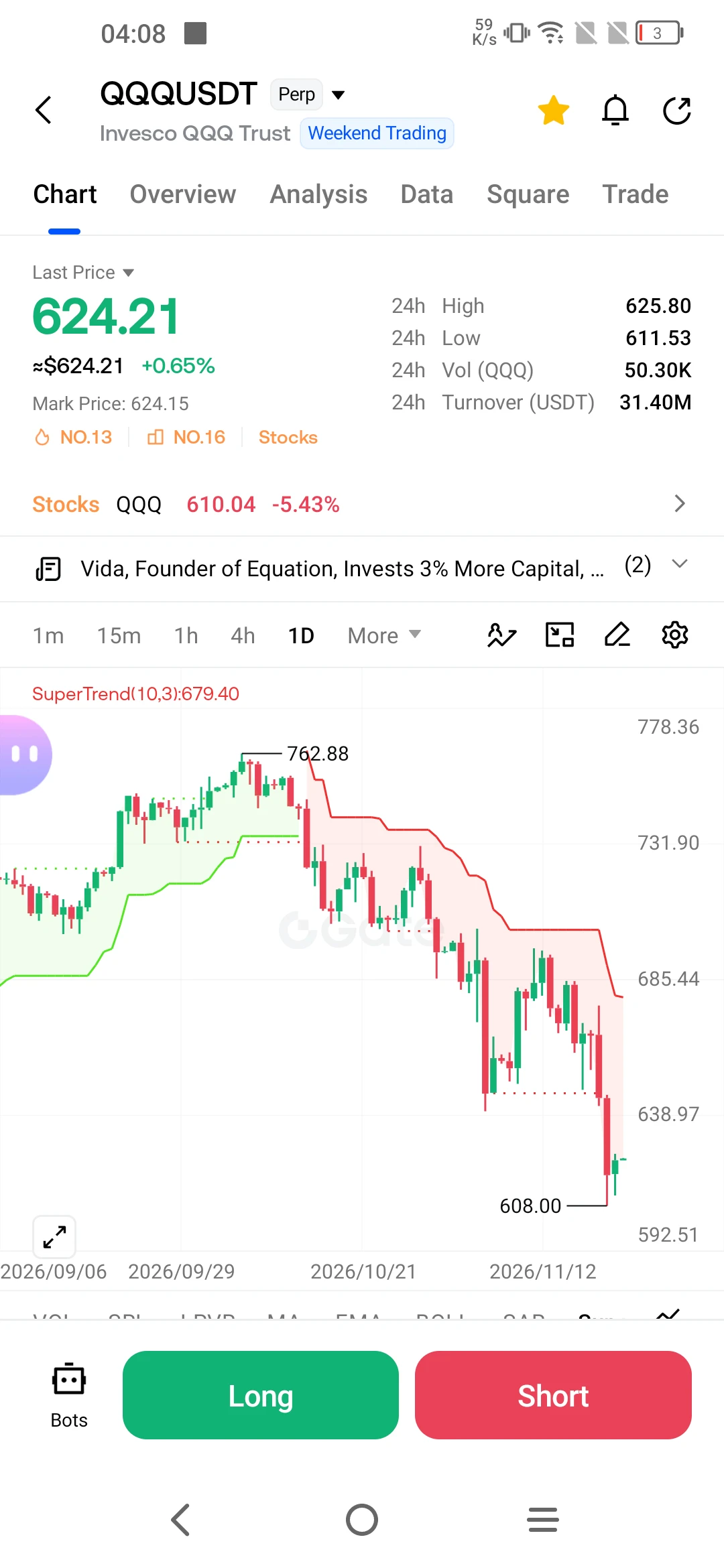
As we all stare at our screens, wondering, "How much further will this decline go?" the roughly 20% drop in the QQQ over the last six weeks is, understandably, alarming. Yet, history consistently whispers the same truth: sharp downturns are often followed by rapid and robust recoveries—provided that the long-term fundamentals remain sound.
Instead of panicking, let’s examine similar market crashes from the past alongside the realities of today.
Does History Repeat Itself?
Looking at the history of the QQQ, the recoveries that followed comparable sharp declines are striking. In 2018, the market experienced a 23% drop but managed to recover in about four months. During the COVID-driven crash of 2020, a 29% loss unfolded over 26 days, with a recovery that took less than three months. In 2025, the "DeepSeek shock" saw Nvidia shares fall 17% in a single day, yet AI-related stocks began to rebound the very next day. That same year, a 23% decline—triggered by tariffs—played out over 48 days, with a recovery again taking less than three months.
So, what is different today? The QQQ has retreated by approximately 20% from its peak in early October. The factors driving this decline are somewhat more complex than those seen in the past. Confidence in the artificial intelligence narrative has wavered; investors are no longer asking merely, "How fast is the growth?" but rather, "When will we see a return on these expenditures?" Compounding this, the news of a CEO change at Nvidia and an accounting review by the SEC has shaken trust in Nvidia—previously the strongest link in the chain. Add to this the Fed’s firm stance on interest rate hikes; a high-interest-rate environment naturally exerts pressure on technology stocks, whose valuations are often based on projected future earnings.
So, what should you do now?
At this juncture, rather than asking, "Is this the bottom?" it is more productive to ask, "What is my plan?" No one can ever know exactly where the bottom lies. However, history shows us that following such sharp declines, the market has generally tended to recover in the medium term—even if it moves sideways or faces further selling pressure for a while.
If you are a long-term investor and believe in the future of AI, these pullbacks may offer windows of opportunity for gradual accumulation. For short-term traders, however, this environment demands avoiding leverage and keeping a close watch on key price levels. With 3x leveraged products like SOXL, in particular, such intense volatility can be far more destructive.
Remember, the market always presents both fear and opportunity simultaneously. What matters is not which side you take, but rather how long you can stay the course.
Are you choosing to remain cautious and hold cash during this period, or are you betting on these historical recovery cycles by buying in gradually?
#QQQ #SOXL #Macro #StockMarket
#ShareWeekly
Not investment advice.
$QQQ ‌$QQQG ‌$SOXL ‌$NDAQ ‌$NAS100 ‌
repost-content-media
The name “Solo Conquers the World” is pretty interesting, but where did the ETH-1715 price level come from?
TheLittleDemonTheoryTrend
Subscribe to Walking Alone in the World, an accurate ETH short at 1715
repost-content-media
ETH-1.26%
How short a shelf life “restraint” has in political theater depends on how close the election is
BlockchainTuoge
Politicians talk about unity, but they’re the ones who are best at tearing people apart. Orengo isn’t wrong, but talk alone won’t do it. Once the election gets close, who remembers restraint? Ordinary people care about their livelihoods, not political theater. Let’s save this and see who fires the first shot at the next rally.
repost-content-media
Yesterday I saw someone post their trade again: they sold after spot was up 30%, only for it to double afterward. It was even worse on the futures side: fully loaded at 10x, they got wiped out by a single wick. Put simply, it’s the same problem: position size doesn’t match their mindset.

I have one simple rule of thumb now: before putting in any money, assume you’ll lose half of it. If you can still sleep at night, that’s the right position size. As for those on-chain labels, there’s been a lot of controversy lately; lagging is the norm, and if you take them at face value, you’ll end up as ex
Lately, I’ve gotten pretty numb from looking at unlock calendars.

I used to think, “This wave of selling pressure should be about done, right?” Then another batch pops up next month, and there’s more the month after that. The more diligently you track on-chain data, the more punctual your anxiety gets.

When you get down to it, this whole hot-topic rotation game is designed to make you feel like you’re always “missing out”—missing airdrops, missing narratives, missing the window to get out before an unlock. Then you chase, burn through gas, lose your cool, and finally realize you bought in at
Whether it can break back above the 0.03 hurdle depends on whether the structure can hold steady
JamSajid
$AKE is trading at $0.028722, down 5.17%. The $0.03 psychological level is above the displayed price. I’m watching whether buyers can reclaim it, but a stronger chart structure is needed to confirm improving momentum.
In the early stages of a bull market, avoid chasing pumps and selling dips; stand by your own judgment.
是大飞呀
Guys, to be honest, whether $BTC goes up or down, we’re still in the early stages of a bull market. Don’t rush to chase rallies or panic-sell; keep your mindset steady first.
Your holdings are your own. Don’t chase rallies or sell off just because of something someone else says—that’s completely meaningless.
The daily MACD has already turned positive, while the four-hour chart is showing declining volume. The larger timeframe drives the smaller one, and it will definitely break through 83000.
When the daily chart turns negative, just buy the pullback and go long again. Rhythm matters more than emotion, so don’t let short-term fluctuations throw you off.
Remember, your holdings are your own. Stick to your own judgment and don’t hand it over easily—that’s what matters most. #BTC突破81K #加密货币总市值重返2.8万亿美元 ‌
Recently, the more I look at a DAO vote, the more I feel that what appears on the surface to be a technical proposal is really all about competing interests underneath. Some votes seem to be merely adjusting a parameter, but in fact they are redistributing the power to shape decisions. No one really cares much about retail investors’ votes anyway; what matters is how a few whales and the project team line up. I’ve always thought the governance mechanism itself is more interesting than the outcome—how voting power is distributed, who gets to submit proposals, and how the voting window is set al
I just saw someone in the group share that screenshot of a stablecoin depeg again, with “Run” attached. The replies were all question marks and exclamation marks, and the reposts spread faster than I could check the on-chain data myself. Honestly, at times like this, I take my hand off the mouse and ask myself one question first: if I want to add to my position now, has the on-chain data actually changed, or has the mood in the group simply reached a boiling point?

I’ve probably lost money on too many positions where “the sentiment was just right.” I used to review my trades, but eventually I
Write a couple of simple sentences about LSTs and restaking.

When it comes to returns, to be honest, many people may be overcomplicating things. The foundation of LSTs is staking rewards, which are real, on-chain base yield; liquidization simply makes capital more efficient. Restaking is more like adding another layer on top—you use the same asset to secure other networks or services, and collect a security service fee in return. So essentially, it’s not printing money out of thin air; it’s just “making fuller use” of the assets you hold.

But the risks are hidden in that “fuller use.” The mo
When I was looking at on-chain data just now, it also lagged a bit—the indexer didn’t update for a long time. In fact, this kind of “sticking for a moment” is pretty common: basically the indexer can’t keep up, the Subgraph has to replay the block queue, or the RPC you’re calling got rate-limited. Anyway, once the data source stalls, the frontend will either show a blank screen or have random symbols floating around—it’s quite annoying. But then again, it’s somewhat similar to the discussions back when a certain blockchain was under maintenance, when everyone speculated whether the ecosystem m
Just saw someone discussing AMM curves. Honestly, when I first started providing liquidity (LP), I didn’t really take this seriously—I just thought, “It’s fine, on-chain automated market making will do it automatically; I’ll just post an order and earn fees while I sleep.”

Turns out I ran a route/LP position for half a year. The numbers went up and down, and in the end I checked: all those pools I tinkered with impulsively were used to fill the holes caused by impermanent loss.

To put it bluntly, this thing uses a constant product to force the price curve into place. While you provide li
ETH-1.26%
USDC+0.01%
$83 is indeed a tough hurdle; there’s no rush to chase it—wait until it’s stable first. Why be in such a hurry?
DanniéX
$SOL delivered an impressive rally over the past week, but the $83 resistance proved too strong for the bulls.
Here's how I'm approaching it:
A confirmed breakout and close above $83 would signal renewed strength and put $98 in play as the next major target.
If price gets rejected and retraces toward the $67 support zone, I'll be looking to accumulate in the spot market for a longer-term position.
For now, patience is key. Let the market confirm the next move before chasing price.
#WorldCupChampionPrediction
Miner shift to AI infrastructure is a bold move. Terawulf signs a 20-year lease, locking in $19 billion in revenue, and its stock price jumps 12.8% on the day. Compass Point raises target to $40. Wall Street clearly has strong confidence in this transformation.
Original content no longer visible
Once geopolitical games escalate, the negotiation table directly turns into a poker table.
Original content no longer visible
UNIfication has been burned into the v4 pool, and the proceeds are used to buy back UNI. The community cheers, but LPs complain. It begins taking allocations on the 7th—this time, the hook system is really about to cash out.
WuSaidBlockchainW
Uniswap proposes to extend the UNIfication burn program to v4 liquidity pools
Uniswap Labs proposes extending the UNIfication burn to v4 liquidity pools, allowing protocol fees to be charged on certain v4 pools and using part of the revenue to buy back and burn UNI. Voting period is 7/7–7/12, with on-chain voting in the week of 7/13. v4 introduces a hook system, allowing dynamic fee adjustments, and adds V4FeePolicy and V4FeeAdapter to manage fees and collection. The community response is positive, but some liquidity providers are concerned about liquidity loss.
UNI+3.05%
When Saylor sells and Tom buys, and the big shots trade insults with each other calling each other “SB,” my wallet is trembling.
CryptoZeno
SAYLOR SOLD - BUT TOM LEE BOUGHT.
repost-content-media
Historical data shows that long-term negative premium and pullback pressure are basically bound together. This 49-day period broke the record set earlier this year, and the signal of U.S. institutional funds exiting is becoming increasingly clear. In the short term, we need to fasten our seatbelts.
Original content no longer visible
Load More