
Futures
Access hundreds of perpetual contracts
CFD
Gold
One platform for global traditional assets
Event Contracts
New
Predict price moves and seize opportunities
Options
Hot
Trade European-style vanilla options
Unified Account
Maximize your capital efficiency
Demo Trading
Introduction to Futures Trading
Learn the basics of futures trading
Futures Events
Join events to earn rewards
Demo Trading
Use virtual funds to practice risk-free trading
CFD
Stock CFD derivatives
US Stocks
Access real US stocks and ETFs
HK Stocks
Trade quality Hong Kong-listed stocks
Korean Stocks
SK Hynix
Real Korean stocks and top assets
JP Stocks
Top Japanese stocks, all in one place
TW Stocks
Gate TW Stocks
Real Taiwan stocks and top assets
Stock Futures
High leverage, 24/7 trading
Stock Options
New
Popular stock options, flexible leverage
Stocks Activities
Trade popular stocks and unlock generous airdrops
Tokenized Stocks
Backed by real stock assets
IPO Access
Unlock full access to global stock IPOs
Launch
CandyDrop
Collect candies to earn airdrops
Launchpool
Quick staking, earn potential new tokens
HODLer Airdrop
Hold GT and get massive airdrops for free
Pre-IPOs
Unlock full access to global stock IPOs
Futures Points
Earn futures points and claim airdrop rewards


Promotions
Others
Help Center
Find FAQs and help guides
Partners
Grow with the champions
Proof of Reserves
Gate promises 100% proof of reserves
Proof of Security (PoSEC)
Full cold storage for user funds
Gate Guard
Account Protection Plan
Gate Vault
Keep your assets secure
Licenses
Regulatory licenses, registrations, and approvals

Pi Network ramps up investment in AI and its developer ecosystem, so why is the PI price still near its all-time low?
From November 17 to 19, 2026, Pi Network will hold its first Pi Ecosystem Summit. The official agenda shows that the second day (November 18) will focus squarely on AI and the ecosystem, with founders Fan Chengdiao and Nicolas Kokkalis appearing in a livestream. On the closing day, the Pi Next developer competition will launch with a prize pool of 200,000 USDT.
But the price has not kept pace. As of November 9, 2026, Gate market data shows that PI has a market cap of about $794 million, ranking 67th, and a circulating supply of about 11.36 billion tokens. It has fallen about 97.7% from its all-time high of $2.99 on February 26, 2025. Over the same period, the total crypto market cap was about $2.55 trillion, Bitcoin was trading near $75,000, the Fear and Greed Index was in the “Fear” zone at 28–30, and the Altcoin Season Index was between 39 and 44, reflecting a clear contraction in risk appetite.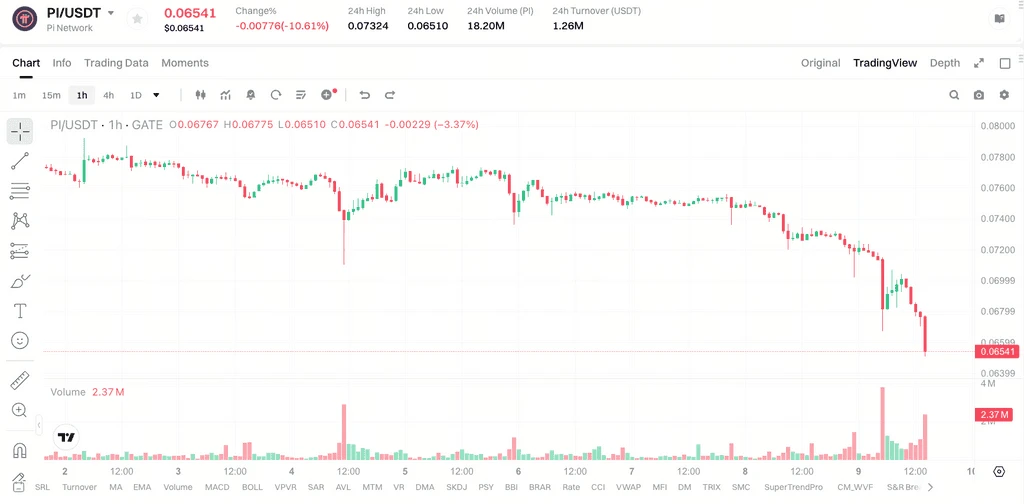 Source: Gate market data
A project making a flurry of developer-focused announcements while its token remains near its all-time low is not inherently contradictory. The real question to unpack is whether the summit and AI push are creating incremental demand for the token, or repeating the familiar pattern of “tools first, utility later.”
What the Summit and AI Push Actually Deliver: A Growing Toolchain, but No Defined Role for the Token
Looking at the public agenda and existing product line, Pi Network’s progress on the developer front over the past year has been more than empty PR. Pi App Studio lets users turn apps generated with external AI coding tools into apps within the Pi ecosystem; SoloHost allows developers to run and distribute self-hosted AI apps on Pi Desktop. As of August 2026, community developers had deployed 110 apps through SoloHost, and the node network had more than 420,000 nodes. On October 16, the Mainnet completed the Protocol 28 upgrade, improving how delayed transaction data is processed. Pi Desktop 0.6.4 simplified remote access to SoloHost apps, allowing users to access locally running AI agents from Pi Browser without adjusting their routers.
These updates all point in the same direction: lowering the technical barriers to building and distributing apps on Pi, with a “ready-made distribution network” as its main selling point to developers. The problem is that the token’s role in this narrative is unclear. Developers are drawn to build apps, and users can browse and use them, but the apps do not necessarily require users to spend or hold PI. If an AI tool can be accessed, distributed, and used within the Pi ecosystem while bypassing token payments or staking, increased developer activity will not automatically translate into buying pressure for PI.
Lessons from the Historical Product Line: Of Three Pi2Day Products, Only One Directly Stimulated Token Demand
This is not the first time Pi Network has faced scrutiny over a “disconnect between product launches and token utility.” The June 2026 Pi2Day event introduced three products, but a review showed that only one directly created demand for PI. The September SoloHost update improved Pi Desktop but added no features requiring users to spend or lock tokens. The four changes made ahead of the summit likewise focused on developer experience, remote-access convenience, and the network protocol layer, with no changes to tokenomics parameters.
In other words, without mechanisms that tie them to the token, the “new tools, new features, and new apps” showcased from November 17 to 19 are closer to an expansion of the ecosystem’s breadth than a direct injection of token demand. The test is therefore very specific: Will the apps showcased at the summit require PI to run? If not, the attention generated by the event will be difficult to convert into sustained buying demand.
Structural Pressure on the Supply Side: A Mismatch Between Daily Releases of 6,500,000 Tokens and Thin Liquidity
While demand has yet to be activated, supply-side pressure is ongoing and quantifiable. Data compiled by BSCN and several market sources show that about 1,210,000,000 PI are scheduled to unlock into circulation in 2026, averaging about 6,500,000 tokens released per day. At the current price, a rough estimate puts the potential daily sell pressure from unlocks alone at $400,000–$600,000. PI’s 24-hour trading volume is in the range of several million dollars, and liquidity is not deep enough to absorb supply at this pace without significant price impact.
A deeper issue is that balances belonging to Pioneers who have completed migration are transferable supply. When the price is near its all-time low, this supply naturally carries an incentive to sell. The summit itself will not change the existence of this structural selling pressure; it merely gives the market a point in time to focus on. Weak demand further amplifies the pressure from supply. Pi has a large base of registered users, but on-chain activity, merchant acceptance, and incentives to hold the token remain at an early stage. The transmission between social buzz and price is breaking down not because the community is too small, but because its attention has not yet translated into real economic activity that requires PI as a medium of pricing or settlement.
The Market Environment Is Not the Main Cause, but It Determines Whether the “Narrative Premium” Disappears
Macroeconomic and market conditions in early November 2026 do not support narrative-driven trading in small-cap tokens. Bitcoin was under pressure near $75,000, with about $1 billion in liquidations across the market in 24 hours. The Altcoin Season Index was at a relatively low level, and funds remained concentrated in Bitcoin. In this environment, a token with a market cap below $800 million and limited liquidity is unlikely to attract sustained capital on the strength of a “summit preview” alone.
More importantly, the market’s approach to valuing Pi Network is changing. In the early stages, user growth and Mainnet expectations could support the valuation narrative. As the project enters its ecosystem-building phase, the valuation anchor is gradually shifting toward verifiable token utility and the ability to absorb supply. After the summit agenda was announced, discussion volume doubled while the price stayed flat or even declined. This essentially shows that the market is no longer paying a premium simply because “there’s an event”; it is starting to ask where demand for the token will come from after the event ends.
Key Indicators Worth Tracking
Rather than predict price direction, it is better to define verifiable indicators. First, what proportion of the apps showcased at the summit require users to pay in PI, stake it, or lock it as a core feature? Second, can the Protocol 28 and SoloHost toolchain upgrades lead to an observable recovery in on-chain transaction counts and active addresses within 30 to 60 days after the summit? Third, will the annual unlock schedule see any marginal changes, such as an adjustment to the unlock rate, expanded lockup incentives, or proposals to burn tokens entering substantive discussion? Sustained improvement in any one of these three signals would constitute evidence that “ecosystem expansion” is translating into “token demand.” Until then, there is still a key missing link between growth in the number of developer tools and PI’s price performance.
Conclusion
Pi Network’s investment in AI and the developer ecosystem is real. The summit agenda, tool updates, and hackathon prize all point to a long-term push to lower barriers to building and expand the supply of apps. But the token price being near its all-time low is equally real. The disconnect between the two is not about whether “the project is doing anything,” but whether what it builds requires the market to buy and hold PI. Until the token is embedded in the core interactions of apps, annual unlocks are absorbed in tandem with demand, and thin liquidity improves, the ecosystem-building narrative may continue to gain traction, but it is unlikely to reprice the token on its own. For readers following PI, the value of the summit lies not in the headlines released from November 17 to 19, but in which apps make PI an indispensable component afterward.
FAQ
What is the main focus of Pi Network’s first Ecosystem Summit?
The summit will be held online from November 17 to 19, 2026, with the first two days streamed live on the official YouTube channel. The second day will focus on AI and the ecosystem, showcasing developer tools and technical demonstrations. The Pi Next hackathon will launch on the closing day with a prize pool of 200,000 USDT, and founders Fan Chengdiao and Nicolas Kokkalis will attend.
What AI tools has Pi Network already launched?
Pi App Studio lets users turn apps generated by external AI tools into apps within the Pi ecosystem; SoloHost allows developers to run and distribute self-hosted AI apps on Pi Desktop. As of August 2026, 110 community apps had been deployed through SoloHost, the node network had more than 420,000 nodes, and the Mainnet Protocol 28 upgrade had improved the efficiency of smart contract maintenance.
What are the main reasons PI’s price is near its all-time low?
The pace of supply is a key constraint. About 1,210,000,000 PI are scheduled to unlock in 2026, averaging about 6,500,000 tokens entering the circulating supply per day, while 24-hour trading volume is only in the range of several million dollars. Liquidity is not deep enough to absorb this supply neutrally. At the same time, AI and developer tools do not yet generally require users to spend or lock PI, so demand has not been activated in parallel.
What indicators should be monitored after the summit to determine whether the ecosystem is translating into token demand?
Three types of signals can be tracked: the proportion of showcased apps that require PI payments or staking; changes in active on-chain addresses and transaction counts in the 30 to 60 days after the summit; and marginal changes to the annual unlock schedule, such as adjustments to the release rate or expanded lockup incentives. Sustained improvement in any one of these variables would constitute evidence that the ecosystem narrative is translating into token demand.